
A new AI product category does not become real when a founder names it. It becomes real when the rest of the market is forced to respond.
That is why the OpenClaw moment matters.
In 2025, Lovable became one of the defining AI products of the year. It was copied everywhere because it captured a powerful user desire: describe what you want in plain language, and software appears. For many people, that felt like the future of computing. You did not need to know how to code in the traditional sense. You needed to know what you wanted.
Then OpenClaw changed the conversation.
Not because it was the first AI agent. Not because it was automatically the best. And not because every company suddenly started copying it. OpenClaw mattered because it forced the industry to reveal its assumptions about what an AI agent actually is.
That is the deeper story.
The real battle in AI is no longer just about who has the biggest model, the fastest benchmark, or the slickest demo. It is about where intelligence runs, how it is orchestrated, and how much trust users are willing to delegate to software acting on their behalf.
That is the question of 2026.
The shift from “build for me” to “act for me”
Lovable was a breakout product because it simplified creation.
You described an app, a site, or a workflow, and the system turned your intent into output. That made it one of the clearest examples of the “vibe coding” era: conversational software creation for people who care more about outcomes than syntax.
But markets do not stand still.
Once users experience an interface that can generate something useful, they quickly begin to ask a bigger question: why should it stop at generating? Why should it not also analyze, decide, execute, revise, and operate?
That is where the center of gravity moved.
The market is shifting from tools that build for you to systems that work for you.
This is why Lovable’s evolution matters. A product that began as an AI builder now has pressure to become a broader execution layer. It is no longer enough to create the first draft of software. Increasingly, the winning interface must also help run the business process around it.
That is not a feature expansion. It is a category compression.
A Lobster Changed Everything
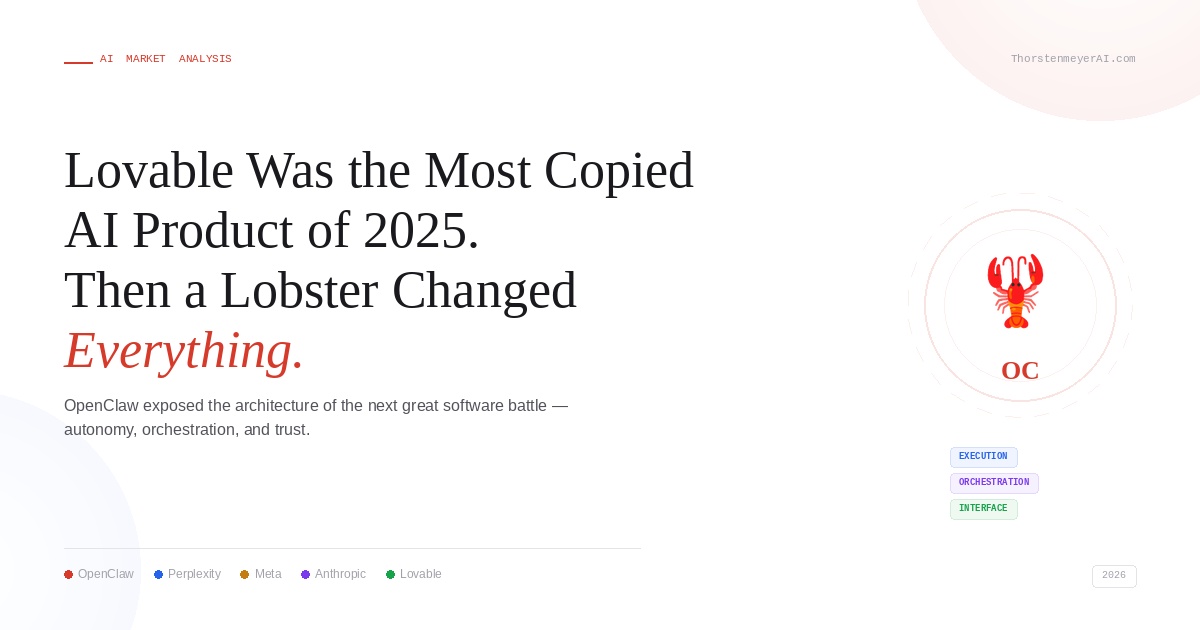
OpenClaw didn’t just launch. It exposed the architecture of the next great software battle — forcing every player to reveal their assumptions about what an AI agent actually is.
Artificial Intelligence for Workflow Automation: A Practical Guide to AI-Powered Automation
As an affiliate, we earn on qualifying purchases.
As an affiliate, we earn on qualifying purchases.
Three axes that define every AI agent
Practical Business Process Modeling and Analysis: Design and optimize business processes incrementally for AI transformation using BPMN
As an affiliate, we earn on qualifying purchases.
As an affiliate, we earn on qualifying purchases.
A map of trust decisions

Microsoft Conversational AI Platform for Developers: End-to-End Chatbot Development from Planning to Deployment
As an affiliate, we earn on qualifying purchases.
As an affiliate, we earn on qualifying purchases.
Why everything is converging

Autonomous Humanoid Robot Platform with Advanced AI Interaction, Multi-Task Execution Engine and Smart Ecosystem Compatibility for Next-Level Home Automation and Robotics Enthusiasts
With voice control capabilities, the humanoid robot can be controlled by voice commands. You can talk to the…
As an affiliate, we earn on qualifying purchases.
As an affiliate, we earn on qualifying purchases.
OpenClaw made the hidden strategic bets visible
The OpenClaw moment clarified something many people were missing: there is no single “AI agent” model. There are multiple conflicting visions of what an agent should be.
Once OpenClaw arrived, the market split into strategic camps.
Some products optimized for control.
Some optimized for convenience.
Some optimized for safety.
Some optimized for distribution.
Some optimized for becoming the default interface through which all work gets delegated.
This is why looking at agents as a simple horse race misses the point. Two products can both call themselves agents while making completely different assumptions about privacy, autonomy, workflow design, and human trust.
A better way to understand the market is to look at three underlying dimensions.
The three-axis framework for understanding AI agents
1. Execution environment
Where does the agent run?
This sounds technical, but it has enormous business consequences. An agent can run locally, in the cloud, or in some hybrid configuration. Each choice changes the trust model.
A more local setup suggests sovereignty, control, and potentially stronger privacy. It also introduces complexity, setup friction, and often more operational risk in the hands of non-technical users.
A cloud-based setup reduces friction and can feel simpler. It can also centralize trust in the vendor. The user gains convenience by giving up some control.
This is not a minor implementation detail. It determines who owns the experience and who bears the risk.
2. Intelligence orchestration
Who chooses the intelligence layer?
Is the system built around one model? Is it model-agnostic? Is it a multi-model harness that routes tasks dynamically?
This decision affects performance, cost, flexibility, and strategic power.
A tightly integrated system can be easier to manage and often more polished. A modular one may be more adaptable, more resilient, and better aligned with power users who want control over the stack.
The orchestration layer is where many future moats will live. The winners may not be the companies with one perfect model. They may be the companies with the best judgment about when to use which intelligence for which task.
3. Interface contract
How does the user interact with the agent?
This is the most underrated dimension.
An AI agent is not just a model with tools attached. It is also a contract with the human. Does the user operate it from a desktop app, a browser, a chat thread, a messaging app, an operating-system-like shell, or a workflow dashboard?
Each interface implies a different kind of relationship.
Some interfaces assume the user is a builder who wants visibility and control. Others assume the user is a delegator who wants to hand off work and receive outcomes. Others assume the user wants lightweight, low-friction access in a familiar environment.
The interface is not the packaging. The interface is the product philosophy made visible.
The market is becoming a map of trust decisions
Once you apply that three-axis framework, the current AI landscape becomes easier to read.
OpenClaw represents the sovereignty end of the spectrum. It appeals to users who want control, modularity, and local power. It is compelling because it gives advanced users leverage. It is difficult because that leverage comes with complexity and security exposure.
Perplexity’s approach looks more like a delegation play. It says, in effect: let us handle the infrastructure and execution layer so you can focus on the result. That is attractive for users and teams who value ease of use over deep system control.
Meta’s likely advantage is distribution. Even if its implementation is not the purest or most elegant, Meta understands how to push a new interface pattern into mass adoption at enormous scale.
Anthropic appears to be leaning into safety and constrained simplicity. That is a different kind of trust strategy. Instead of maximizing power, it reduces ambiguity and narrows the human-agent interaction to something more legible and defensible.
Lovable stands out because it illustrates what happens when a winner in one AI interface category realizes the category itself is being absorbed into something bigger.
That is why the story is not really “OpenClaw versus Lovable.”
The real story is that OpenClaw made it impossible for every other serious player to avoid answering the same question:
What kind of agent do you believe users actually want?
Why this matters beyond the AI industry
This is not only a product story. It is a business infrastructure story.
Most companies are still thinking in terms of applications, websites, and workflows designed for direct human interaction. But agentic systems change the layer at which value is discovered and action is executed.
If agents become the primary way users research, compare, decide, and act, then businesses will no longer compete only for human attention. They will also compete for agent legibility, agent compatibility, and agent trust.
That means the interface layer gets compressed.
Instead of opening five tools, a user may increasingly open one conversational environment and delegate five jobs.
Instead of navigating a dozen dashboards, they may issue one instruction and expect the agent to route the work.
Instead of manually moving between systems, the agent becomes the operating layer that spans them.
This is why vertical tools should be nervous. The more capable general-purpose agents become, the more pressure there is on every narrow interface that exists primarily to coordinate tasks rather than provide unique underlying capability.
The risk is not just disruption. The risk is invisibility.
Lovable’s lesson for founders
Lovable is the case study founders should pay attention to.
A company can build a breakout product, define a category, achieve enormous mindshare, and still be pulled into a wider platform war it did not originally set out to fight.
That is not failure. It is the reality of fast-moving interface markets.
If your product becomes successful, your users will not keep their expectations narrowly contained. They will immediately begin projecting adjacent jobs onto the same interface. They will want the app builder to become the data analyst, the file handler, the workflow coordinator, the research assistant, and the execution engine.
In AI, success expands the surface area of expectation.
This is why so many products are converging. Not because founders lack imagination, but because users keep asking the same thing in different words:
Why can’t this just do the whole job?
The real question of 2026: how do we delegate agentic trust?
That is the heart of it.
The biggest question in AI for 2026 is not simply which model is smartest. It is not even which product has the best benchmark or the most viral launch.
It is this:
How do humans decide to delegate trust to systems that can act?
Do they want control or convenience?
Transparency or abstraction?
Local sovereignty or managed safety?
One powerful assistant or many specialized tools behind a single conversational layer?
Every product in this market is answering that question differently.
And every business building digital systems should be paying attention, because this choice will shape not only consumer software, but also how companies design workflows, interfaces, data systems, and competitive moats.
The companies that understand this early will not just build better AI products.
They will build for the world that comes after apps.
Final thought
OpenClaw did not merely create excitement. It exposed the architecture of the next fight.
Lovable showed how powerful a simplified AI interface could become. OpenClaw showed that simplification alone is not the end state. The market is now moving toward a deeper contest over autonomy, orchestration, and trust.
That is why this moment matters.
The winners of the next phase of AI will not be defined only by raw intelligence. They will be defined by where they place control, how they structure delegation, and whether users are willing to let them act.
In other words, the next great software battle is not just about what AI can do.
It is about who we allow it to become on our behalf.