For years, businesses optimized for humans.
They designed websites for clicks, ads for attention, funnels for conversions, and content for search engines. The web rewarded whoever could capture a person’s gaze, hold it long enough, and push them toward a decision.
That model is starting to break.
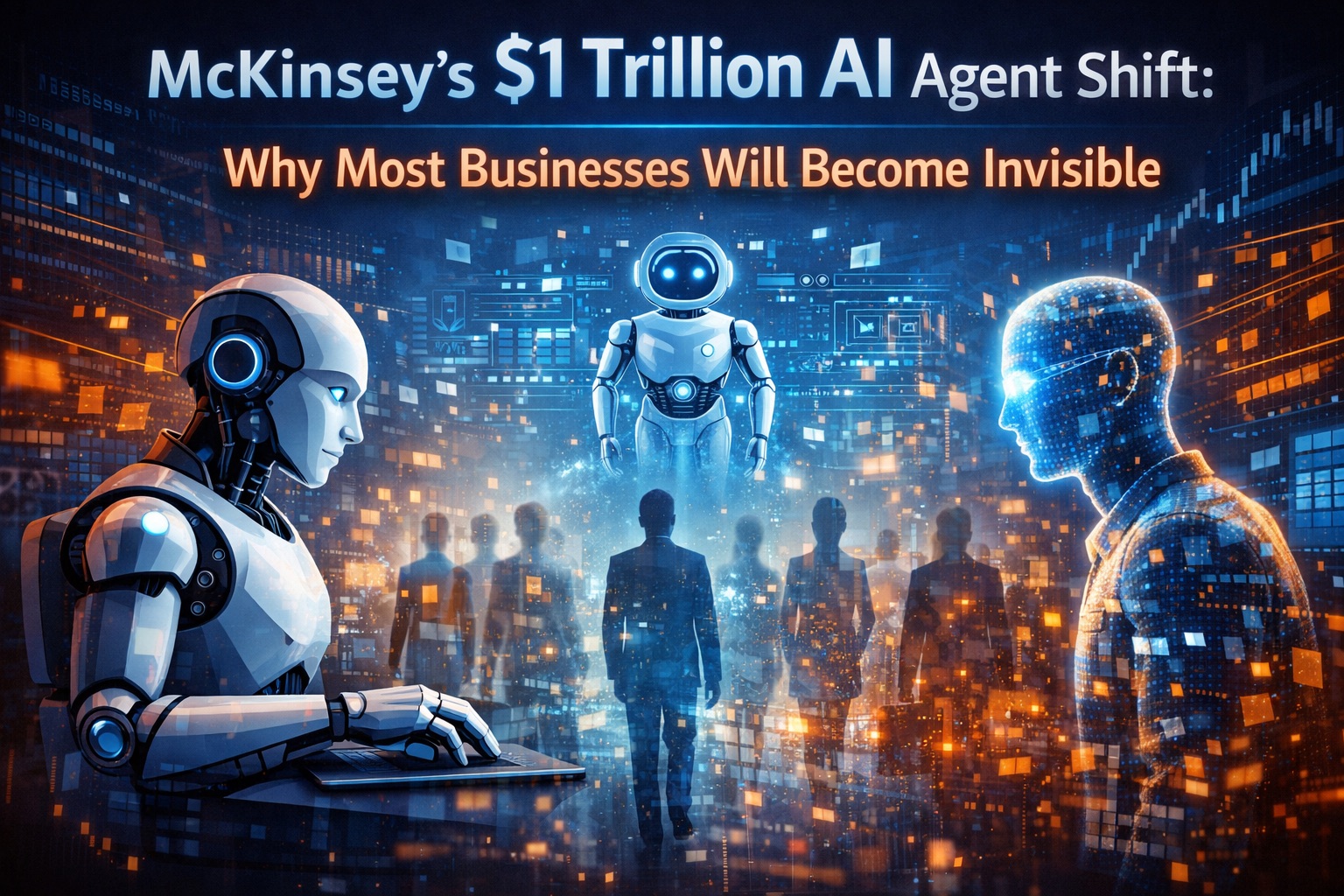
A new layer is emerging between businesses and buyers: AI agents. According to McKinsey, by 2030, $1 trillion in sales could flow through AI agents. That projection is striking, but the real signal is even bigger than the number. It points to a structural shift in how products, services, and brands will be discovered, evaluated, and chosen.
In the next phase of the internet, many decisions will no longer be made by a human comparing ten tabs in a browser. They will be shaped by AI systems acting on behalf of that human.
And that creates a brutal new reality:
Most businesses are invisible to AI.
The old web was built to keep bots out
For the past 15 to 20 years, digital infrastructure has largely been built around an anti-bot mindset.
That made sense. Bots scraped sites, abused forms, clogged systems, and created security risks. So businesses responded with CAPTCHAs, locked-down APIs, JavaScript-heavy pages, rate limits, fragmented user flows, and enterprise systems that were never meant to be read or used by outside automation.
The result was a web optimized for human browsing and hostile to machines.
Now the environment has changed.
The same systems that once kept bad bots away are also preventing useful AI agents from understanding products, checking constraints, comparing offers, and completing tasks on behalf of real customers.
The anti-bot web is becoming a liability in a pro-agent economy.

Mastering n8n Workflows: Building Self-Hosted Automations, Custom API Integrations, and Low-Code Data Pipelines
As an affiliate, we earn on qualifying purchases.
As an affiliate, we earn on qualifying purchases.
The real issue is not AI hype. It is machine legibility.
A lot of executives will look at this shift and assume the answer is simple. Add an API. Launch a chatbot. Put a thin AI layer on top of the existing stack. Maybe expose a few endpoints and call it progress.
That is not the real work.
The problem is deeper. This is not primarily a model problem. It is a data architecture problem.
For AI agents to function well, businesses need systems that are:
- structured
- consistent
- queryable
- trustworthy
- readable by machines
- writable where appropriate
- low-friction to access
- rich enough to support real decisions
An agent trying to help a customer does not just need a product title and a price. It may need to know:
- shipping costs
- delivery times
- return policies
- compatibility constraints
- feature-specific tradeoffs
- availability
- warranty conditions
- regional limitations
- configuration logic
- support boundaries
- business rules that influence the purchase
If that information is scattered, inconsistent, trapped in internal systems, hidden behind user flows, buried in prose, or absent entirely, the agent cannot act with confidence.
And if it cannot act with confidence, it will move on.
That is the core strategic risk: not poor branding, not weak ads, not lower rankings — but complete omission from the machine-mediated decision path.
AI Sales Agents: What Works, What Doesn’t, and the 90-Day Path to a Production-Ready Outreach System
As an affiliate, we earn on qualifying purchases.
As an affiliate, we earn on qualifying purchases.
The next competitive battleground is not just traffic. It is agent visibility.
In a traditional web journey, a human might still forgive messy information. They may click around, read FAQs, compare screenshots, scan bullet points, or even email support.
AI agents do not work like distracted but persistent humans.
They do not get emotionally attached to a brand’s color palette. They do not browse for fun. They do not absorb vague marketing language and give the company the benefit of the doubt.
They evaluate based on goals, constraints, and confidence.
If the product data is clean, the policies are explicit, the structure is readable, and the workflow is clear, the business stays in the set.
If not, it drops out.
That means the future winners may not be the businesses with the flashiest pages or the biggest media budgets. They may be the businesses whose information is easiest for machines to understand, compare, and trust.

Fundamentals of Data Engineering: Plan and Build Robust Data Systems
As an affiliate, we earn on qualifying purchases.
As an affiliate, we earn on qualifying purchases.
Why this is bigger than SEO
A common mistake is to think that AI agent optimization will look like search engine optimization.
It will not.
Search still centered on humans. Humans saw headlines, rankings, descriptions, images, reputation signals, and ad placements. They could be nudged by copywriting, layout, design, familiarity, and sheer repetition.
Agents evaluate differently.
They care about whether a product or service satisfies the user’s constraints. They care whether important data is available and coherent. They care whether a workflow can be completed without ambiguity.
That changes the game.
The new winners are less likely to be chosen because they dominate attention. They are more likely to be chosen because they expose high-quality, machine-usable information.
This is not classic SEO. It is closer to operational clarity as a competitive advantage.

Inside the Machine: An Illustrated Introduction to Microprocessors and Computer Architecture
As an affiliate, we earn on qualifying purchases.
As an affiliate, we earn on qualifying purchases.
Complex businesses have more to gain, not less
Another bad assumption is that structured data only matters for simple products.
The opposite is true.
Simple products are easy enough for humans to compare on their own. Complexity is where AI becomes most valuable.
The more variables there are, the more friction humans experience. They get overwhelmed. They simplify. They settle for “good enough.” They fall back on brand trust or random heuristics.
Agents do not get tired in the same way. They can hold more variables in view. They can compare edge cases. They can weigh tradeoffs against a specific user profile.
That means complex categories stand to gain the most from becoming agent-readable:
- configurable hardware
- high-ticket consumer products
- specialist tools
- technical services
- B2B workflows
- compatibility-sensitive products
- luxury or expertise-driven categories
The more complexity matters, the more structure matters.
Most valuable product knowledge is still trapped in human language
Basic metadata is easy to structure:
- size
- color
- dimensions
- weight
- price
But that is only the outer shell of understanding.
The hard part is everything that makes a product or service meaningful in practice. This includes the knowledge that often lives in marketing copy, support conversations, internal notes, sales experience, product manager intuition, and brand storytelling.
This is the information that answers questions like:
- Why is this a better fit for a particular use case?
- Which hidden tradeoff matters most?
- What subtle distinction would an expert notice?
- What does this product signal to a buyer?
- What is the real-world difference between similar options?
- What matters that is never stated clearly in the official specs?
Right now, much of that knowledge exists in unstructured language.
Humans can sometimes interpret it. Machines struggle unless it is translated into durable attributes, normalized definitions, and usable relationships.
This is one of the most important strategic tasks in the AI era: converting fuzzy institutional knowledge into machine-usable information assets.
Marketing can no longer paper over weak data
For a long time, companies got away with messy information.
They compensated with better ads, stronger copy, more polished design, more aggressive retargeting, and persuasive storytelling. A site could still convert even if the underlying data was incomplete or poorly structured because the human buyer filled in the gaps.
That becomes much harder when an AI agent sits between the buyer and the business.
Agents do not reward ambiguity the way humans often do. They do not infer confidence from brand polish alone. They do not tolerate missing details as easily when comparing across many options.
The implication is uncomfortable but clear:
Good marketing will matter less if the underlying data cannot support agent decisions.
In the next wave of commerce, marketing may still attract interest, but structured truth will decide visibility.
Why incumbents are slow to adapt
Large organizations often understand this problem later than smaller, more agile businesses.
Part of the reason is technical debt. Enterprise systems were often designed to keep data inside the company, not expose it in usable ways. Different functions operate in silos. Product data, logistics data, support data, and customer policy data may sit in separate systems that do not cleanly connect.
Part of the reason is strategic fear. If AI agents become the primary interface for customer decisions, businesses lose some control over the traditional buying journey. They cannot rely as heavily on shelf placement, interface design, or ad dominance if the agent is doing most of the evaluation.
That fear is rational.
But resisting the shift does not stop it. It only delays adaptation while the market reorganizes.
What this means for publishers, affiliate sites, and AI-native businesses
This shift is not limited to retailers or big SaaS platforms. It matters for anyone whose business depends on being discovered, trusted, and chosen online.
For publishers and affiliate content sites, the old model assumed a human would search, click, read, compare, and decide. In an agent-mediated world, content has to do more than rank. It has to become machine-legible, well-structured, and easy to extract meaning from.
For e-commerce operators, product pages are no longer enough. The business needs agent-facing clarity across specs, policies, support, logistics, and edge-case conditions.
For SaaS and enterprise tools, the question becomes whether the data locked inside the platform can actually be used by agents without heroic effort. If not, the software may remain operationally useful while becoming strategically obsolete.
For AI-native builders, this opens a powerful new category of opportunity: tools that help businesses audit, improve, and monitor their agent readiness.
The simplest test every business should run
There is a practical way to see this problem in real terms.
Take a real product or workflow and ask ChatGPT or Claude to evaluate your company and your top competitors.
Then watch what happens.
Can the model clearly extract product details? Can it understand the differences between options? Can it identify shipping, return, compatibility, and policy constraints? Can it make a confident recommendation? Can it explain why one brand is the better fit?
Where it gets stuck, your business likely has an agent-legibility problem.
This is not a perfect audit, but it is a revealing one. It quickly exposes whether your information is actually usable by the machine layer that is beginning to mediate decisions.
The businesses that win will be machine-understandable
The next phase of the web is not just about AI chat interfaces or generated content. It is about AI-mediated decision infrastructure.
That means a growing share of commercial outcomes will depend on whether machines can understand what a business offers, how it works, what constraints apply, and why it should be chosen.
The winners in that environment will not just be the loudest brands.
They will be the clearest systems.
They will be the businesses that turn operations, policies, knowledge, and offerings into information that machines can trust and act on.
Because in the agent economy, invisibility will not come from lack of traffic.
It will come from lack of machine legibility.
Final thought
If your business cannot be understood by an agent, it cannot compete at agent speed.
And if McKinsey is even directionally right about the scale of this shift, the question is no longer whether AI agents will matter.
The question is whether your business will still be visible when they do.