
By Thorsten Meyer | November 17, 2026 | ThorstenMeyerAI.com

Get business pricing on tech for your team
- Business-only prices and quantity discounts
- Tax-exempt purchasing
- Multiple users, one account, clear invoices
Most GPU headlines of recent years have been about training and running AI models. Nvidia’s newest announcement points somewhere else: at the simulations that scientists and engineers run to test an idea before they spend money on an experiment or a prototype. At the SC26 supercomputing conference in Chicago, Nvidia unveiled Rubin HPC, a GPU that it says is “designed to accelerate simulation and data processing for science, engineering and analytics workflows.” Its headline number is what Nvidia calls “a record number of CUDA cores — more than 50,000 on a single GPU.” It is expected in 2028. The most useful part of the announcement for anyone planning a computing budget, though, is what it does not say yet.
Key takeaways
- What Nvidia announced: Rubin HPC is “a new GPU in the NVIDIA Vera Rubin platform” for simulation and data processing in science, engineering and analytics, announced on November 16, 2026, at SC26.
- The headline spec: more than 50,000 CUDA cores on a single GPU, which Nvidia calls a record. By our arithmetic, that is at least 1.7 times the 28,672 CUDA cores of today’s Rubin GPU (figure as reported by Tom’s Hardware) and at least 2.3 times the 21,760 of the GeForce RTX 5090 (Nvidia’s spec page).
- The design idea: a “balanced design” that scales “data movement and compute together rather than increasing compute alone”, with “a sparse data acceleration capability” and seventh-generation NVLink between GPUs.
- The agent angle: Nvidia pitches the chip at AI agents that propose materials, molecules or designs, which then have to be tested in simulation. Faster simulation, Nvidia argues, shortens “the loop of hypothesis, simulation and refinement.”
- Timing: “Rubin HPC is expected to be available in 2028.”
- What is missing: no FP64 figures, no memory size or bandwidth, no power, no price, no named systems and no independent benchmarks.
Nvidia Rubin HPC · SC26 · Nov 16, 2026
Where a science GPU sits in the AI research loop
An agent suggests ideas, a simulation tests them, the result guides the next step. Nvidia’s pitch: speed up the test.
The loop and one simulation (schematic)
Six steps, as Nvidia describes them
- Agent ideaAn AI agent proposes candidate materials, molecules or designsNvidia
- TestEach idea is checked in a simulation before lab work or a prototypeNvidia
- GatherThe code reaches into an immense dataset for a handful of scattered valuesNvidia
- ComputeIt calculates a result and repeats this on an enormous scaleNvidia
- Feed the coresRubin HPC: sparse data acceleration is meant to keep more than 50,000 CUDA cores supplied with dataNvidia’s claim, not yet measured
- RefineFaster results shorten the loop of hypothesis, simulation and refinementNvidia
Source: Nvidia Blog, “NVIDIA Announces Rubin HPC — A New GPU to Accelerate Agents for Science, Engineering and Analytics”, Nov 16, 2026. Schematic, not the real chip or software.
Graphic: Powered by Thorsten Meyer AI
Products Worth Considering

Sony WH-1000XM6 Wireless Noise-Cancelling Headphones (Black)

Samsung Galaxy Tab A11+ Tablet (6GB RAM, 128GB Storage, Gray)

Logitech MX Keys S Combo Wireless Keyboard and Mouse, Graphite
As an affiliate, we earn on qualifying purchases.
What Nvidia actually announced
The announcement is a short post on Nvidia’s blog by Dan Ernst, senior director of supercomputing products, published on November 16, 2026. It is one of several Nvidia posts for SC26, which runs in Chicago from November 15 to 20. We found no separate press release for the chip in Nvidia’s newsroom.
The post makes four concrete technical claims:
- Cores: “a record number of CUDA cores — more than 50,000 on a single GPU”. Nvidia gives no exact count.
- Data feed: “a sparse data acceleration capability that keeps those cores fed with data”. Nvidia does not explain how it works.
- Connections: GPU-to-GPU links with “seventh-generation NVIDIA NVLink interconnect technology”. Today’s Rubin platform uses the sixth generation, according to Nvidia’s Vera Rubin NVL72 product page.
- Platform and date: Rubin HPC is part of the Vera Rubin platform and “is expected to be available in 2028.”
Ian Buck, Nvidia’s vice president of hyperscale and high-performance computing, summed up the pitch: “For agents tackling science and engineering, faster simulation means faster discovery.”
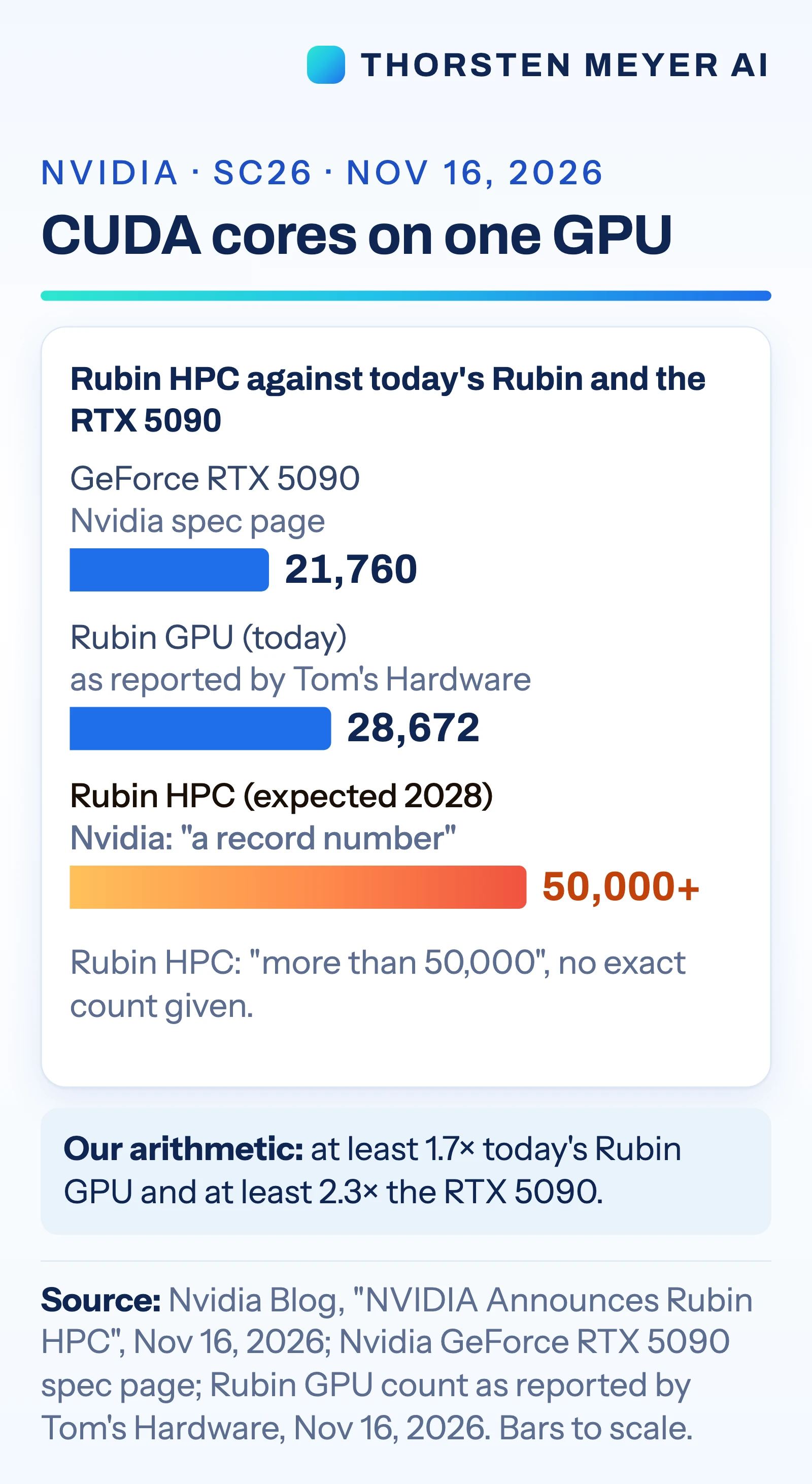
How big is “more than 50,000”? Nvidia does not compare it with its other chips. Tom’s Hardware reports that “Today’s Rubin GPU has 224 SMs and 28,672 CUDA cores”; Nvidia’s own technical blog confirms the 224 SMs. On that basis, Rubin HPC has at least 1.7 times the cores. Against the consumer GeForce RTX 5090, which Nvidia lists with 21,760 CUDA cores, it is at least 2.3 times. Notebookcheck’s headline says “nearly 2.5×”; from the floor that Nvidia gives, our arithmetic comes to 2.3, and more only if the real count is well above 50,000.
How does it fit that many cores? Tom’s Hardware says the count “might imply that this chip uses a configuration similar to the four-die Rubin Ultra GPU”. That is the outlet’s inference. “Nvidia didn’t reveal more details of the chip’s physical layout,” it adds.
Why a separate GPU for science matters
Nvidia describes the workload it is aiming at in one sentence. Across climate models, engineering simulations, genomic analysis and financial risk, “an application reaches into an immense dataset, gathers a handful of scattered values, calculates a result and repeats this on an enormous scale.” In that kind of work, the cores often sit idle while they wait for data. Nvidia’s answer is “a balanced design”, which keeps the cores “supplied with data, so they spend their time computing rather than waiting.” It names the patterns it wants to speed up: “from sparse matrix operations to stencil computations to sorting and reductions.”
That is a different job from the one the standard Rubin GPU was built for. Nvidia’s own technical blog on the Vera Rubin platform, published in January and last updated in August, shows the trade-off in a table. Native FP64 vector performance, the double-precision math that much classic simulation code relies on, is 34 TFLOPS on Hopper, 40 TFLOPS on Blackwell and 33 TFLOPS on Rubin. FP64 matrix performance rises from 67 to 150 and 200 TFLOPS, but for Blackwell and Rubin the table marks those as “Peak performance using Tensor Core-based emulation algorithms.” In Nvidia’s words, the newer chips reach high FP64 matrix throughput “via multiple passes over lower-precision tensor cores”.

The same Nvidia blog makes the case for why that is not the whole story: “dedicated FP64 vector performance remains critical for scientific applications that are not dominated by matrix kernels.” For those codes, it says, “performance is constrained by data movement through registers, caches, and high-bandwidth memory (HBM) rather than raw compute.” That reads like the problem Rubin HPC is meant to solve. Our reading: Rubin HPC looks like Nvidia’s answer for the part of science that AI-tuned chips serve less well. Whether it actually adds native FP64 power is the open question.
Tom’s Hardware puts it plainly. Nvidia “also didn’t share whether this part includes a rebalancing of compute resources towards native FP64, as AMD and Intel are touting at the conference with their own GPUs this week.” We have not checked AMD’s or Intel’s SC26 announcements ourselves.
What “agentic HPC” means here
The new part of the pitch is the role of AI agents. “As agents help scientists and engineers explore more candidate materials, molecules and designs, they rely on simulations to test those ideas and guide their next steps,” Nvidia writes. The more ideas an agent can generate, the more simulations someone has to run. Nvidia’s argument: faster simulations mean faster feedback, so researchers “can choose next steps sooner and point lab work at the most promising candidates.”
Nvidia pairs the chip with its CUDA-X libraries, which “offer a growing set of optimized implementations of complex algorithms for agents to use”. A separate Nvidia post at SC26 gives examples of the library work, such as cuPotential, which Nvidia says “accelerates existing simulation software by up to 3x”. Those are claims for the software on today’s hardware, not measurements of Rubin HPC.
Our reading: the bottleneck in AI-assisted research is moving from producing ideas to checking them. A chip built for the checking step is a logical product. But it is still a plan for 2028, described by the company that sells it.
What it means for research labs and supercomputing centres
- Planning cycles: large systems are usually planned years ahead. A GPU “expected to be available in 2028” gives centres a name to put in their roadmaps, but no specification to put in a tender.
- Know your code: the key question is which kind of FP64 work dominates your applications. Matrix-heavy codes may profit from emulated FP64 on today’s chips, by Nvidia’s own account. For codes that are not dominated by matrix kernels, Nvidia says “dedicated FP64 vector performance remains critical”. Those are the workloads to ask Nvidia about for Rubin HPC.
- Accuracy checks: Nvidia itself notes that “classical simulation remains essential for establishing ground truth and final validation.” If you test emulated FP64 on current hardware, compare the results with a reference run before you trust them.
- Smaller labs: at SC26 Nvidia also introduced the DGX Spark HPC Developer Kit, “a four-node cluster of NVIDIA DGX Spark systems”, so researchers can run multi-node jobs at their desk instead of waiting for time on a shared cluster. That is today’s hardware, not Rubin HPC.
What it means for businesses that run simulations
- Engineering, materials, pharma and finance: Nvidia names climate, engineering simulation, genomic analysis and financial risk as target areas. If simulation sits on your critical path, for example in product design or risk models, Rubin HPC is a signal that Nvidia wants to compete for that work, not only for AI training.
- Agents need compute behind them: if you plan to let AI agents propose designs or molecules, budget for the simulations that have to check those proposals. The agent is the cheap part; the verification is not, by Nvidia’s own logic.
- Do not wait on a 2028 product for a 2026 need: with no price, no performance figures and no systems announced, nothing in this announcement can be compared with what is on the market today. Our reading, not purchasing advice.
- For users: you will not buy this chip. If it delivers, the effect will be indirect: faster turnaround on weather and climate models, materials and drug candidates tested sooner, and engineering checks that run more often.

What is not known
- FP64 performance: Nvidia gave no FP64 figures and did not say whether Rubin HPC rebalances the chip towards native FP64, as Tom’s Hardware notes.
- Memory, bandwidth and power: “Nvidia has yet to disclose the GPU’s full specifications, including its memory capacity, bandwidth, power consumption and detailed compute performance,” Notebookcheck writes.
- The exact core count and layout: “more than 50,000” is a floor. The four-die layout is Tom’s Hardware’s inference, not Nvidia’s statement.
- How “sparse data acceleration” works: Nvidia names the capability but does not describe it.
- Price, systems and customers: “The company has also provided no details about pricing or the systems that will use the GPU,” according to Notebookcheck. Nvidia’s post names no supercomputer centre or cloud provider as a buyer.
- A date within 2028: only the year is given.
- Independent benchmarks: there are none. Every performance claim so far comes from Nvidia.
The announcement also comes during a change at the top of Nvidia, which we covered separately in Who Will Run Nvidia?; it does not change the facts above.
The bottom line
Rubin HPC is a clear signal that, at Nvidia, the chip for AI and the chip for science are drifting apart. Nvidia’s own numbers show that native FP64 vector performance has barely moved across three GPU generations while the company relied on emulation for matrix work. A GPU with more than 50,000 CUDA cores and a design built around data movement is meant to close that gap for simulation, at a time when AI agents can generate more ideas than labs can check. Whether it does depends on the numbers Nvidia has not published yet: FP64, memory, power and price. Until then, Rubin HPC is a promise for 2028, not a product you can plan around in detail.
I’m Thorsten Meyer. The full sources are below, and more reality checks are at thorstenmeyerai.com.
Sources
- Nvidia Blog (Dan Ernst): “NVIDIA Announces Rubin HPC — A New GPU to Accelerate Agents for Science, Engineering and Analytics”, November 16, 2026
- Nvidia Blog: “At SC26, NVIDIA Unveils the Latest Advancements in Scientific Computing” (SC26 news page, retrieved November 17, 2026)
- Nvidia Blog: “NVIDIA CUDA-X Libraries Give Agents the Tools to Accelerate Scientific Discovery”, November 16, 2026
- Nvidia Blog: “NVIDIA DGX Spark Developer Kit Turns a Desk Into a Supercomputing Lab”, November 16, 2026
- Nvidia Technical Blog: “Inside the NVIDIA Vera Rubin Platform: Six New Chips, One AI Supercomputer”, January 5, 2026, updated August 21, 2026 (Table 3, FP32 and FP64 compute)
- Nvidia: Vera Rubin NVL72 product page with specifications (retrieved November 17, 2026)
- Nvidia: GeForce RTX 5090 product page with specifications (retrieved November 17, 2026)
- Tom’s Hardware: “Nvidia announces Rubin HPC GPU with ‘record number of CUDA cores’ at Supercomputing 2026”, November 16, 2026
- Notebookcheck: “Nvidia unveils Rubin HPC GPU with nearly 2.5× RTX 5090’s CUDA cores, coming in 2028”, November 16, 2026
Researched and drafted with AI assistance, including Anthropic’s Claude. No company or person named here reviewed or sponsored this article. Our own text and graphics contain no affiliate links; offer and product boxes added by the site may contain Amazon affiliate links. This article is for information only. It is not purchasing or investment advice. Statements as published by Nvidia and as reported by the outlets above, as of 05:30 UTC on November 17, 2026. Images: AI-generated illustration (Runware) and graphics by Thorsten Meyer AI; our own images show no real people or logos. Boxes added by the site may show product photos or people.