

By Thorsten Meyer | November 17, 2026 | ThorstenMeyerAI.com

Get business pricing on tech for your team
- Business-only prices and quantity discounts
- Tax-exempt purchasing
- Multiple users, one account, clear invoices
None of these websites had to be hacked themselves. On November 16, visitors to sites run by Zoom, the BBC, CNN, HSBC, Salesforce, IKEA and many others received malicious code through a script those sites had invited in on purpose: the snippet of Optimizely, a platform that companies use to test versions of their web pages. According to security researcher Scott Helme of Report URI, who found it, the code tried to swap crypto wallet addresses, skim card numbers, steal cookies and screenshots, and push exploit kits to older iPhones. Optimizely has confirmed that an unauthorized party used a vulnerability to add the code to customer projects. This is a supply chain attack in its plainest form: one trusted supplier, hundreds of brands, and visitors who could not see the difference.
Key takeaways
- What happened: according to Report URI, “On 16 November 2026, malicious JavaScript was served to visitors of 178 organisations through the Optimizely Web experimentation platform.” Report URI checked 1,611 Optimizely snippets and found the code in 188 of them. It says “The real number is likely higher”.
- What Optimizely confirms: on its status page, the company says “an unauthorized party exploited a vulnerability in Experimentation and used it to add malicious JavaScript to some customer projects.” It told BleepingComputer the hole was in “the Experimentation account signup flow” and that it has “notified all affected customers.”
- What the code tried to do: swap crypto addresses on the page and in the clipboard, capture card numbers typed into a site’s own forms, take cookies and screenshots, and send iPhones and iPads to the Coruna and DarkSword exploit kits.
- How long: the first Optimizely injection Report URI saw was at 04:21 UTC on November 16. By 23:11 UTC, all infected Optimizely files had been cleaned, Report URI says. That is about 19 hours.
- iPhone users: Report URI advises updating to iOS 18.7.3 or later, or iOS 26.3 or later. Both versions came out months ago, according to Apple. Hudson Rock, which analyzed the iPhone stage, stresses that its findings are “delivery observations, not demonstrated iPhone compromises.”
- For businesses: Report URI checked the security policies on affected organisations’ own sites. Only 24 of 159 organisations blocked the code; 68 had no policy at all.
Optimizely script attack · Nov 13 – Nov 17, 2026
How one trusted script carried malware to 178 websites
The sites were not hacked themselves. The code arrived inside a file they loaded on purpose.
The route (schematic)
Whether any iPhone was compromised has not been shown.
Timeline (UTC)
- Nov 13Earlier wave through three other providers’ scriptsKissmetrics, StorifyMe, Minute Media
- Nov 16 04:21First Optimizely injection seen
- 08:28Address-swapping payload first seen on a site
- 13:43Card skimmer added
- 17:13iPhone exploit delivery widened
- 19:24Report URI sweep: 186 of 1,611 snippets infected
- 21:52Only 1 of 188 infected snippets left
- 23:11All infected Optimizely files cleaned
- Nov 17 01:02Optimizely confirms the incident on its status page
Sources: Report URI (Scott Helme), Nov 16, 2026, timeline and update of Nov 17; Optimizely status page, Nov 17, 2026; Hudson Rock (Infostealers.com), Nov 16–17, 2026. The route is a schematic.
Graphic: Powered by Thorsten Meyer AI
Products Worth Considering

DJI Mini 4K Drone Combo with 4K Camera, 3-Axis Gimbal, and Two Batteries

Logitech MX Creative Console with 9 Customizable Keys, Graphite

LG 27GS60QC-B Ultragear 27-inch Curved Gaming Monitor (QHD, 180Hz, 1ms, 1000R)
As an affiliate, we earn on qualifying purchases.
How the code got onto the sites
Optimizely Web works through a small JavaScript file. Each customer site loads its own “snippet” from Optimizely, and that file carries the customer’s experiments plus an optional field called Project JavaScript: custom code the customer writes, which runs on every page.
According to Report URI, “The attacker wrote their own code into the Project JavaScript of customer projects, and the rest of each snippet was untouched.” The file was still delivered by Optimizely, from an address every affected site already trusted. Report URI also rules out one explanation: “this was not a CDN cache-poisoning attack.” Optimizely’s own websites carried the code too.
Optimizely’s account of the cause is short. The status page entry of November 17, posted at 01:02 UTC, says the company has “fixed the vulnerability and removed the injected code from affected projects.” To BleepingComputer, Optimizely added that it has “ended active sessions, revoked tokens, and reset access for affected user accounts.”
What neither statement explains is how a flaw in a signup flow could give someone write access to many unrelated customers’ projects. Report URI says: “We don’t know how the attacker got write access to so many unrelated customer projects”. Hudson Rock, which ran its own investigation, notes that Optimizely’s disclosure “does not explain the bug’s code-level mechanics.”

Which sites
Report URI published a list of all 178 organisations, sorted by sector. Banking and finance leads with 32, followed by technology and software with 23 and retail with 20. The list includes Zoom, the BBC, CNN, Fox News, HSBC sites in several countries, Equifax, Salesforce, GitLab, IKEA, Ledger, Peacock, Air France-KLM and UNICEF USA. BleepingComputer says it independently confirmed with urlscan.io scans that the script loaded, or tried to load, on sites including Zoom, KLM, GitLab, the BBC, CNN and Salesforce.
A listed name does not mean every page of that company was affected. Many entries are single subdomains, such as an IKEA home design tool. Hudson Rock warns: “An affected subdomain does not establish exposure across an organization’s entire website, product, customer base or checkout system.”
There was also an earlier wave. According to Report URI, from November 13 the same actor’s injector appeared in scripts from three other providers, Kissmetrics, StorifyMe and Minute Media, on sites that are not in the list of 178. Hudson Rock found the same pattern and says that how the code got into those three services is still “unresolved.”
What the code did
Report URI analyzed the payload, which “was rebuilt 26 times during the day.” Every visitor received the same script. What it did depended on the device and on what the visitor did on the page:
- Crypto address swapping: the script looked for valid wallet addresses and replaced them with the attacker’s, in page text, form fields and the clipboard. Report URI warns: “Copy an address from any affected page, or from anywhere else while that tab is open, and you may paste the attacker’s.”
- Card skimming: added in the afternoon (UTC). It watched for card number, expiry date and security code. Report URI: “Cards entered in hosted payment iframes (Stripe, Adyen and similar) were out of its reach. Cards typed into a site’s own form fields were not.”
- Cookies and screenshots: next to wallet or payment wording, the script sent the page address, readable cookies and a screenshot to the attacker. Cookies marked HttpOnly were out of reach.
- iPhone and iPad exploit kits: on Apple mobile devices, the script loaded the Coruna and DarkSword exploit kits, chosen by iOS version.
Report URI says “Crypto has already been stolen, with verified transactions to the attackers.” We do not report the amounts here. Report URI itself notes that it has “no way to see how many credit cards were skimmed, how many cookies or screenshots were stolen, or how many iOS devices were infected before the attack was stopped.”
What it means for iPhone users
The iPhone part sounds the most alarming, so precision matters. Report URI writes that the kit’s own comments say “iOS 18.7.3 and later, and 26.3 and later, are patched.” According to Apple’s list of security releases, iOS 18.7.3 came out on December 12, 2025, and iOS 26.3 on February 11, 2026. Apple lists 27.2.1 as the latest version of iOS. A phone that has received updates this year should be well past both versions.
Hudson Rock adds an important limit: “The current evidence does not establish a zero-day, successful device exploitation, or collection of specific device data by unseen downstream stages.” In other words: the exploit kits were served, but nobody has shown so far that an iPhone was actually taken over. Apple did not immediately respond to Reuters’ request for comment.
What visitors should check
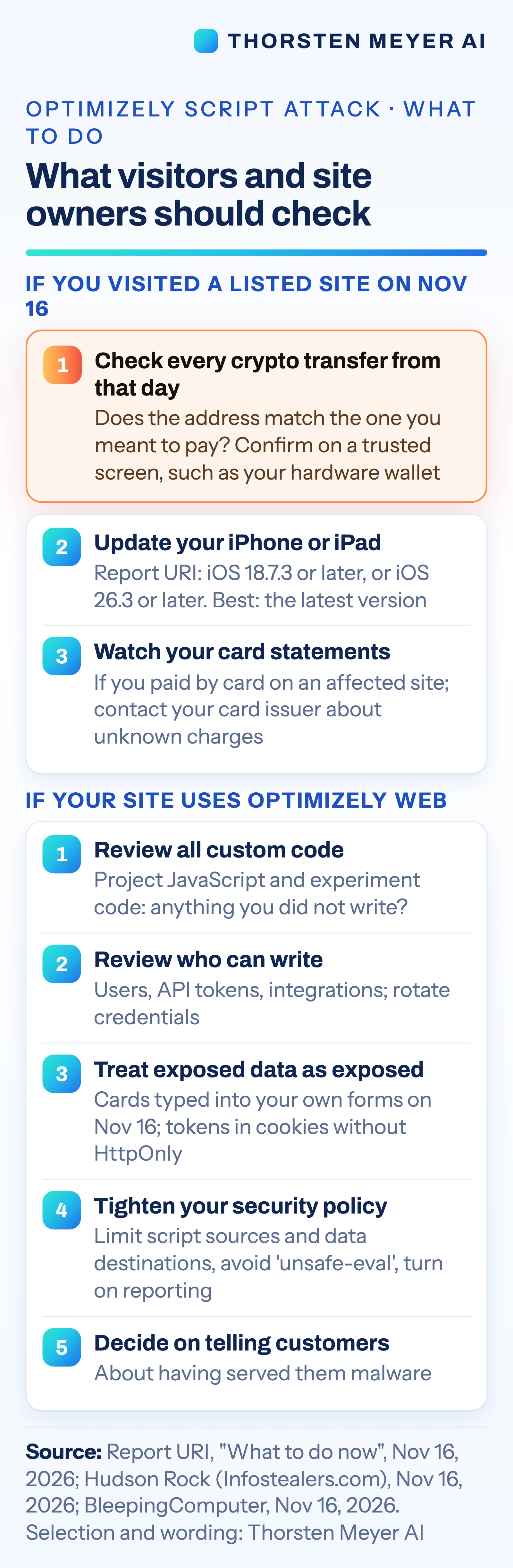
If you visited one of the listed sites on November 16, Report URI recommends three steps:
- Update your iPhone or iPad to iOS 18.7.3 or later, or iOS 26.3 or later. Our advice: install the latest version Apple offers for your device.
- Check any crypto transfer you made that day. If the address you pasted does not match the one you meant to pay, it may have been swapped. Hudson Rock adds that payment addresses “should be checked through an independent trusted view.” Our reading: with a hardware wallet, that means the address shown on the device’s own screen.
- Watch your card statements if you paid by card on an affected site. BleepingComputer adds that anyone who sees suspicious charges should contact their card issuer, and that users should watch for unusual account activity, particularly if they were logged in to sensitive services at the time.
Hudson Rock also cautions against panic: “membership in a large customer population alone does not establish compromise.” Information about your own exposure should come from the company whose site you used.
What it means for businesses that embed third-party scripts
This is not security-consulting advice. The core lesson comes from Report URI itself: “A website can be compromised through a third-party dependency without its own code or infrastructure ever being breached.” Report URI sells tools that monitor scripts, so it has a commercial interest in that lesson. Its data is still the most detailed we have.
Content Security Policy helped only where it was strict. Report URI crawled 256 hosts belonging to affected organisations and evaluated their policies against what the payload needed. The results, counted by organisation:
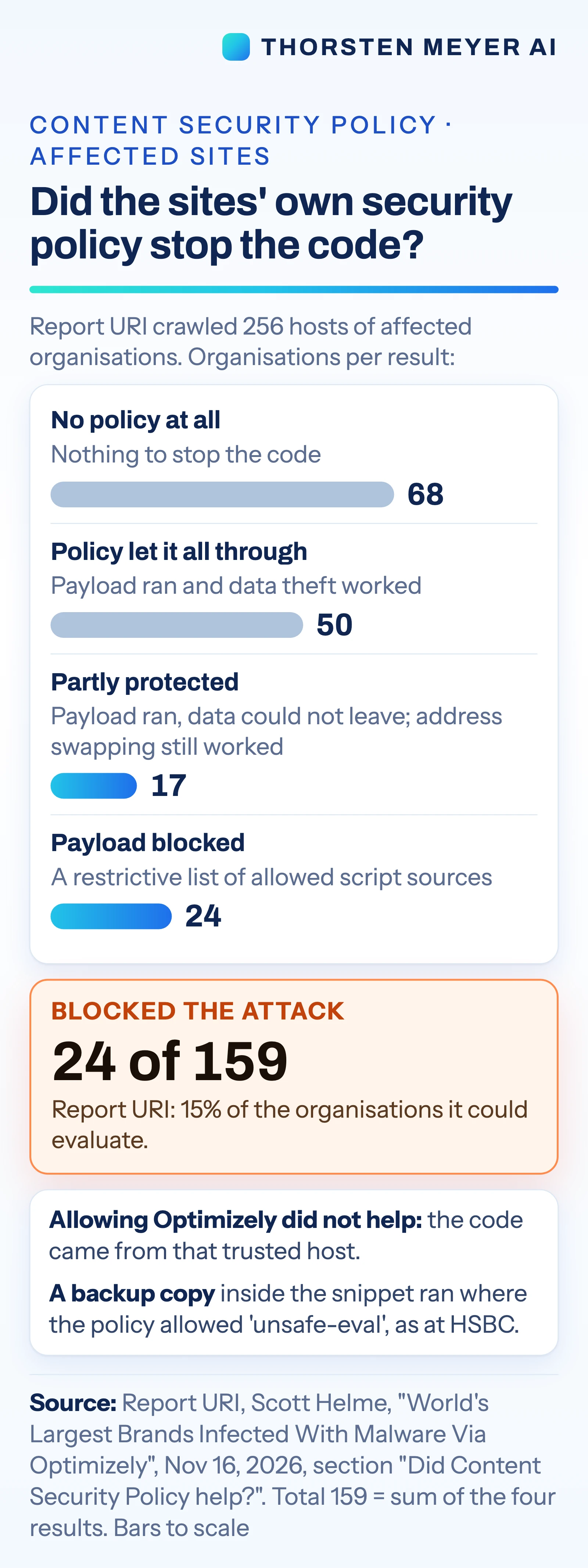
- 68 organisations had no Content Security Policy at all.
- For 50, the policy allowed the payload and the data theft.
- For 17, the payload ran, but the policy stopped the data from leaving. Address swapping still worked.
- 24 blocked the payload. Report URI: “What separated the 24 protected sites from the rest was a restrictive script-src.”
Allowing Optimizely’s own address in the policy did not help, because the code arrived from that trusted host. And a setting that Optimizely’s documentation tells customers to allow, according to Report URI, let a hidden backup copy of the payload run. “That is what happened at HSBC,” Report URI writes: its policy blocked the main script and the data theft, but the inline copy still ran.
Subresource integrity has a limit here. MDN describes subresource integrity as a way to give the browser “a cryptographic hash that a fetched resource must match.” That works well for a fixed library file. Our reading: an experimentation snippet changes whenever a team edits an experiment, so a pinned hash would break on every legitimate change. For files like this, monitoring what changed, and when, is the more realistic control.
Report URI’s checklist for Optimizely Web customers, in short:
- Review custom code. Check every project’s Project JavaScript and every experiment’s custom code for anything you did not write.
- Review vendor access. Check who and what can write to your Optimizely account, including users, API tokens and integrations, and rotate credentials.
- Treat card data as exposed if card fields sit in your own forms: cards entered on November 16 “as potentially exposed.”
- Rotate session tokens stored in cookies that are not HttpOnly.
- Tighten the policy. Restrict where pages may send data, avoid ‘unsafe-eval’ where you can, and turn on reporting.
- Decide on customer communication about having served malware.
Our reading on top: every third-party script on a page runs with the page’s full trust. Two design choices limited the damage this time: card fields inside a payment provider’s frame, and session cookies marked HttpOnly. The same vendor-risk logic applies far beyond web scripts. We saw it today in TSMC’s employee data leak tied to a cloud provider.
How companies responded
According to Reuters, Salesforce said it was investigating unauthorized Optimizely script changes and had disabled them as a precaution. Salesforce told BleepingComputer that it “will notify affected customers without undue delay if we identify unauthorized access to their data.” Equifax stopped using Optimizely and found no evidence that its systems were compromised, Reuters reports. IKEA was seeking to determine whether there was any potential impact on its digital services and customers. Reuters could not immediately ascertain whether the code was successfully used in each case.
What is not known
- The exact flaw. Optimizely names the signup flow but has not published how it led to write access across customer projects.
- How many people were affected. Hudson Rock: “No verified total of compromised visitors is established by this investigation.” Nobody has said how many cards, cookies or screenshots were taken.
- Whether any iPhone was compromised. The kits were delivered; successful exploitation has not been shown.
- The other three services. How the code got into the Kissmetrics, StorifyMe and Minute Media scripts is not explained.
- The full list. Report URI could only check the snippets it found in time, and Optimizely has not said how many customers it notified.
- Who is behind it. Report URI links the attacker’s wallets to earlier activity in March 2026 and on November 3, 2026, but names no one.
The bottom line
Nothing was wrong with the code these companies wrote. The attack came through a file they trusted, from an address they trusted, and it ran for about 19 hours on some of the most visited sites in the world. For visitors, the to-do list is short: update the iPhone, check any crypto transfer from November 16, watch card statements. For companies, the harder question is how much they let each third-party script do, and whether they would notice when it suddenly does something else.
I’m Thorsten Meyer. The full sources are below, and more reality checks are at thorstenmeyerai.com.
Sources
- Optimizely status page: “Web Experimentation Security Incident”, update of November 17, 2026, 01:02 UTC (retrieved November 17, 2026)
- Report URI, Scott Helme: “World’s Largest Brands Infected With Malware Via Optimizely”, November 16, 2026, with update of November 17, 2026, 09:17 UTC
- Hudson Rock (Infostealers.com): “Poisoned Scripts on BBC, Zoom and Other Major Websites Linked to iPhone Exploit Loaders”, November 16, 2026, updated
- Hudson Rock (Infostealers.com): “Beyond Optimizely: Malicious Scripts Traced Across Four Web Services”, November 17, 2026
- BleepingComputer, Lawrence Abrams: “Optimizely hack infected CNN, Fox News, BBC, Salesforce sites with malware”, November 16, 2026
- Reuters: “Popular websites subverted in bid to steal crypto, target iPhone users”, November 16, 2026, as published by CNA and The Straits Times (the Reuters site itself was not accessible to us)
- Apple: “Apple security releases” (retrieved November 17, 2026)
- MDN Web Docs: “Subresource Integrity” (retrieved November 17, 2026)
Researched and drafted with AI assistance, including Anthropic’s Claude. No company named here reviewed or sponsored this article. Our own text and graphics contain no affiliate links; offer and product boxes added by the site may contain Amazon affiliate links. This article is for information only. It is not security-consulting advice. It deliberately leaves out attacker domains, wallet addresses and other technical indicators; site owners can find them in Report URI’s report. Statements as published by Optimizely, Report URI and Hudson Rock and as reported by the outlets above, as of 12:00 UTC on November 17, 2026. Images: AI-generated illustration (Runware) and graphics by Thorsten Meyer AI; no real people or logos are shown in our images. Boxes added by the site may show product photos or people.