
Eight days ago I wrote that the AI frontier had stopped being a leaderboard and become a price curve. Since then, two new models have landed on that curve: Google’s Gemini 4 Argon on 30 September and Mistral Large 4 yesterday.

Get business pricing on tech for your team
- Business-only prices and quantity discounts
- Tax-exempt purchasing
- Multiple users, one account, clear invoices
My stack doesn’t change:
- Opus 5.5 at high or xhigh builds.
- GPT-6.1 Sol digs into details and reviews every change.
- Jev takes the high-volume yes/no and routing calls.
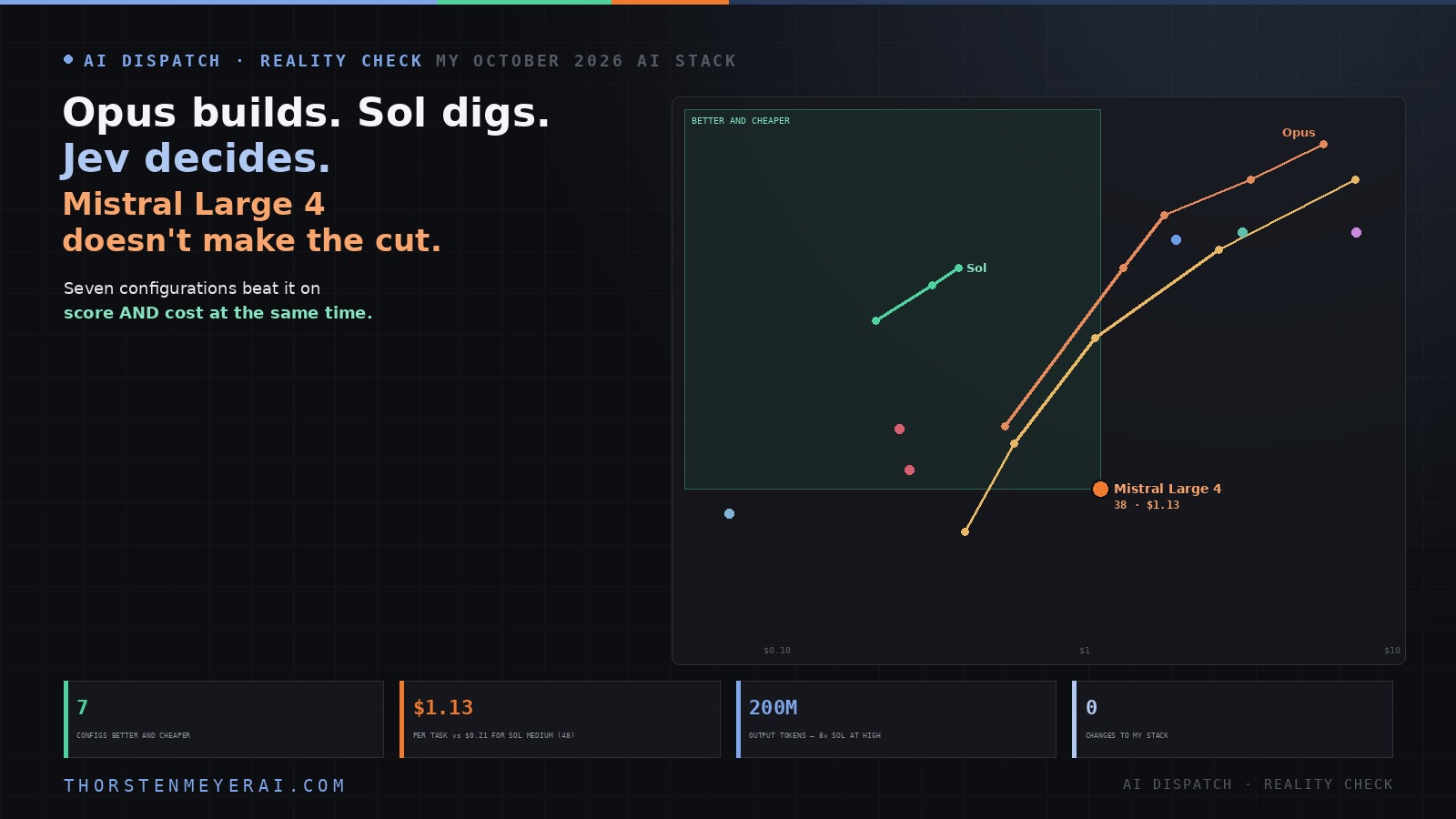
What changed is the evidence for why. Mistral Large 4 is the clearest test yet of the question that matters: does a model clear my quality bar at a lower cost per task than what I already run? I put it on the same ruler as everything else, and the answer is no. Not marginally — at least seven model configurations beat it on score and on cost at the same time.
All scores below come from the Artificial Analysis Intelligence Index v4.3.x unless noted. That index is a map of general capability, not a verdict on your workload. Shadow-test before you switch anything.
Opus builds, Sol digs, Jev decides — and Mistral Large 4 doesn’t make the cut
Two models landed on the price curve in eight days. My stack doesn’t change. The test is the same as in September: does it clear my bar at a lower cost per task than what I already run? For Mistral Large 4, no — seven configurations beat it on score and cost at once.
Cheaper per token ($4.18 vs Sol’s $10 output) — but ~8× the output of Sol for a lower score. Budget cost per task, not per token.
Speed: 116 tok/s, 1.46 s to first token — far faster than Sol at high/xhigh (57–69 s).
Cyber: AA Cyber Index 50, CyberGym-E2E 82%.
Jurisdiction: French parent, weights at the end of October.
For legally bound buyers, the best European option by a wide margin. For my stack, none of it clears the bar.
Being behind the frontier is normal for a challenger. Being beaten on both axes by models you can already buy is a pricing problem, not a capability one. Argon is the more interesting arrival — level with Astra and Fable at a third of Fable’s cost — but access is still restricted, and a model I can’t put into production isn’t part of my stack. Run the dominance test on every new model before you read its benchmark table. Most new models don’t change anything — the ruler tells you which ones do.
One price tape, ten models
Here is the September tape with the October arrivals added, plus two Chinese open-weights models as reference points, since that’s the field Mistral says it competes with.
| Model | Lab · origin | Index (top setting) | Cost per task | Tasks per $100 |
|---|---|---|---|---|
| Claude Opus 5.5 | Anthropic · US | 58 | $5.98 | 17 |
| Claude Sonnet 5.5 | Anthropic · US | 56 | $7.60 | 13 |
| Claude Fable 5.1 | Anthropic · US | 53 | $7.63 | 13 |
| GPT-6 Astra | OpenAI · US | 53 | $3.26 | 31 |
| Gemini 4 Argon (new, restricted access) | Google · US | 53 | ~$1.99 | ~50 |
| GPT-6.1 Sol (xhigh) | OpenAI · US | 51 | $0.39 | 256 |
| GLM-5.3-Flash (open weights) | Z.ai · China | 42 | $0.25 | 400 |
| DeepSeek V4.1 Flash (open weights) | DeepSeek · China | 39 | $0.27 | 370 |
| Mistral Large 4 (new, preview) | Mistral · France | 38 | $1.13 | 88 |
| GPT-6 Luna | OpenAI · US | 37 | $0.07 | 1,429 |
Read the bottom of that table carefully. Mistral Large 4 sits between OpenAI’s small model and two Chinese open-weights models — and costs four to sixteen times as much as each of them per task.
Products Worth Considering

Bose QuietComfort Wireless Bluetooth Noise-Cancelling Headphones, Ice Blue

Sony WH-1000XM4 Wireless Noise Cancelling Headphones (Silver)
DJI Mic 3 Wireless Microphone (2 Transmitters, 1 Receiver, Charging Case)
As an affiliate, we earn on qualifying purchases.
The dominance test
The fastest way to judge a new model on a price curve is to ask: is anything both better and cheaper? If so, the new model is dominated, and there’s no workload where it’s the rational pick on capability and cost alone.

For Mistral Large 4 ($1.13 per task, index 38), the answer is yes, seven times over:
| Configuration | Index | Cost per task | vs Mistral Large 4 |
|---|---|---|---|
| GPT-6.1 Sol · medium | 48 | $0.21 | +10 points, 5.4× cheaper |
| GPT-6.1 Sol · high | 50 | $0.32 | +12 points, 3.5× cheaper |
| GPT-6.1 Sol · xhigh | 51 | $0.39 | +13 points, 2.9× cheaper |
| GLM-5.3-Flash | 42 | $0.25 | +4 points, 4.5× cheaper |
| DeepSeek V4.1 Flash | 39 | $0.27 | +1 point, 4.2× cheaper |
| Claude Opus 5.5 · low | 42 | $0.55 | +4 points, 2.1× cheaper |
| Claude Sonnet 5.5 · medium | 41 | $0.59 | +3 points, 1.9× cheaper |
Even at Mistral’s two-week launch discount ($0.57 per task), six of those seven still dominate it. The only one that drops out is Sonnet 5.5 at medium.
That’s the finding that matters more than “it’s 19 points behind Opus.” Being behind the frontier is normal for a challenger. Being beaten on both axes by models you can already buy is a pricing problem, not a capability one.
Why it costs so much: verbosity
Mistral’s per-token prices look competitive: $1.36 in and $4.18 out per million tokens, cheaper on output than Sol’s $10. The problem is volume. Mistral Large 4 generated 200 million output tokens to complete the Index, against a median of 81 million for comparable models.
Compare GPT-6.1 Sol at high: 25 million output tokens. Mistral writes roughly eight times as much to reach a lower score. Cheap tokens multiplied by eight times as many tokens is not a cheap model.
This is the same lesson as the effort dial in September: budget cost per task, not cost per token.
Why I won’t use it for agentic or long-running work
Three reasons, the same three that apply to any model on this curve:
The capability gap compounds over steps. The v4.3 Index is dominated by agentic work — AA-Briefcase, GDPval-AA, AutomationBench and Terminal-Bench 4.0. A model 19 points behind on that index loses more ground with every step of a long task.
Verbosity is a cost on every step. On a multi-step agent, 2.5× the median output is paid again and again.
I saw confident hallucinations in my own testing. That’s my observation, not an Artificial Analysis figure, but it’s a failure mode the US frontier has largely moved past (Gemini 4 Argon posts a 15% AA-Omniscience hallucination rate). In an agent, a confident fabrication is a wrong premise every later step builds on.
In fairness, Mistral Large 4 has real strengths. It scores 50 on the AA Cyber Index and 82% on CyberGym-E2E. It’s fast: 116 tokens per second, 1.46 seconds to first token, which beats Sol at high and xhigh (57–69 seconds before the first token). Its weights are due at the end of October under EU jurisdiction. If you’re legally bound to a European model, it’s now your best option by a wide margin. For my stack, none of that clears the bar.
What about Gemini 4 Argon?
Argon is the more interesting arrival. It scores 53, level with Astra and Fable, at roughly $1.99 per task on introductory pricing, with the lowest hallucination rate of any model above 45 on the Index. On paper it slots into the “second opinion” seat at a third of Fable’s cost.
But access is still restricted. Coverage describes it as limited to selected users, with general availability pending. A model I can’t put into production isn’t part of my stack, however good its numbers. I’ll test it when it’s public.
My October stack
| Role | Model and setting | Why | Changed? |
|---|---|---|---|
| Main builder | Opus 5.5, high | 54 points for $1.82 per task | No |
| Hard problems | Opus 5.5, xhigh | 56 points for $3.46 | No |
| Details and review | GPT-6.1 Sol, high or xhigh | Different model family, $0.32–$0.39 per task | No |
| Second opinion | Astra or Fable | 8–20× Sol’s cost; only when Sol and Opus disagree | Argon is a candidate once public |
| Side work | Sonnet 5.5 (high), Luna | Scoped subtasks, bulk checks, routing | No |
| High-volume decisions | Jev | Typed yes/no and routing calls, ~$2.50 per 100,000 decisions | No |
| Evaluated, not adopted | Mistral Large 4 | Dominated on score and cost by seven configurations | New |
The rules from September still hold: effort isn’t capability, more effort can’t supply a missing requirement, a second model reading the same flawed spec isn’t independent review, and green tests aren’t approval.
Five warnings before you quote any of this
- The index moves. Compare within one version only, and treat a one-point gap as noise.
- Mistral Large 4 is a preview. Mistral says reinforcement learning is still running, so its score may rise. If it does, it should go back on the tape — but it would have to gain more than ten points, or cut its verbosity sharply, to stop being dominated.
- Argon’s price is introductory. It may not hold at general availability.
- Anthropic scores include safety fallback on flagged cyber and biology tasks.
- Max is not production. Real deployments run medium or high, where gaps narrow and costs fall.
What to do this week
- Run the dominance test on every new model. Before you read the benchmark table, ask whether anything you already run is both better and cheaper.
- Budget cost per task, not per token. Mistral’s per-token pricing looks cheap until you count its output.
- If you’re legally bound to a European model, wait for Mistral Large 4’s weights at the end of October, check the licence, and pilot it on cyber and document work, where it’s strongest.
- If you’re not bound, don’t migrate agentic or long-running work to it.
- Put Argon on your shadow-test list for the day it becomes generally available.
The curve moved twice in eight days. My stack didn’t, because neither arrival cleared the bar at a lower cost than what I already run. That’s the point of measuring on one ruler: most new models don’t change anything, and the ruler tells you which ones do.
Sources: Artificial Analysis Intelligence Index v4.3.x — Mistral Large 4 Preview article and model page (6 October 2026: index 38, $1.13 per task, $0.57 at launch discount, $1.36/$4.18 per 1M tokens, 200M vs 81M median output tokens, 116 tokens/s, 1.46 s TTFT, Cyber Index 50, CyberGym-E2E 82%, preview with weights at end of October); GLM-5.3-Flash (41.8, $0.25) and DeepSeek V4.1 Flash (39.5, $0.27) per the same article and Artificial Analysis comparison pages; Gemini 4 Argon (52.6, ~$1.99 per task introductory, 15% hallucination rate, restricted availability) via Artificial Analysis-derived reporting from OfficeChai, FelloAI and MarkTechPost; Opus 5.5, Sonnet 5.5, Fable 5.1, GPT-6 Astra, GPT-6.1 Sol and GPT-6 Luna scores, effort-level costs and output-token counts as published in “Opus Builds, Sol Digs, Jev Decides: My September 2026 AI Stack” (29 September 2026), sourced there from Artificial Analysis. Tasks-per-$100 and dominance ratios are the author’s arithmetic. The hallucination observation on Mistral Large 4 is the author’s own testing, not an Artificial Analysis measurement. Jev figures are the author’s production measurements from September 2026. Not investment advice.