
By Thorsten Meyer
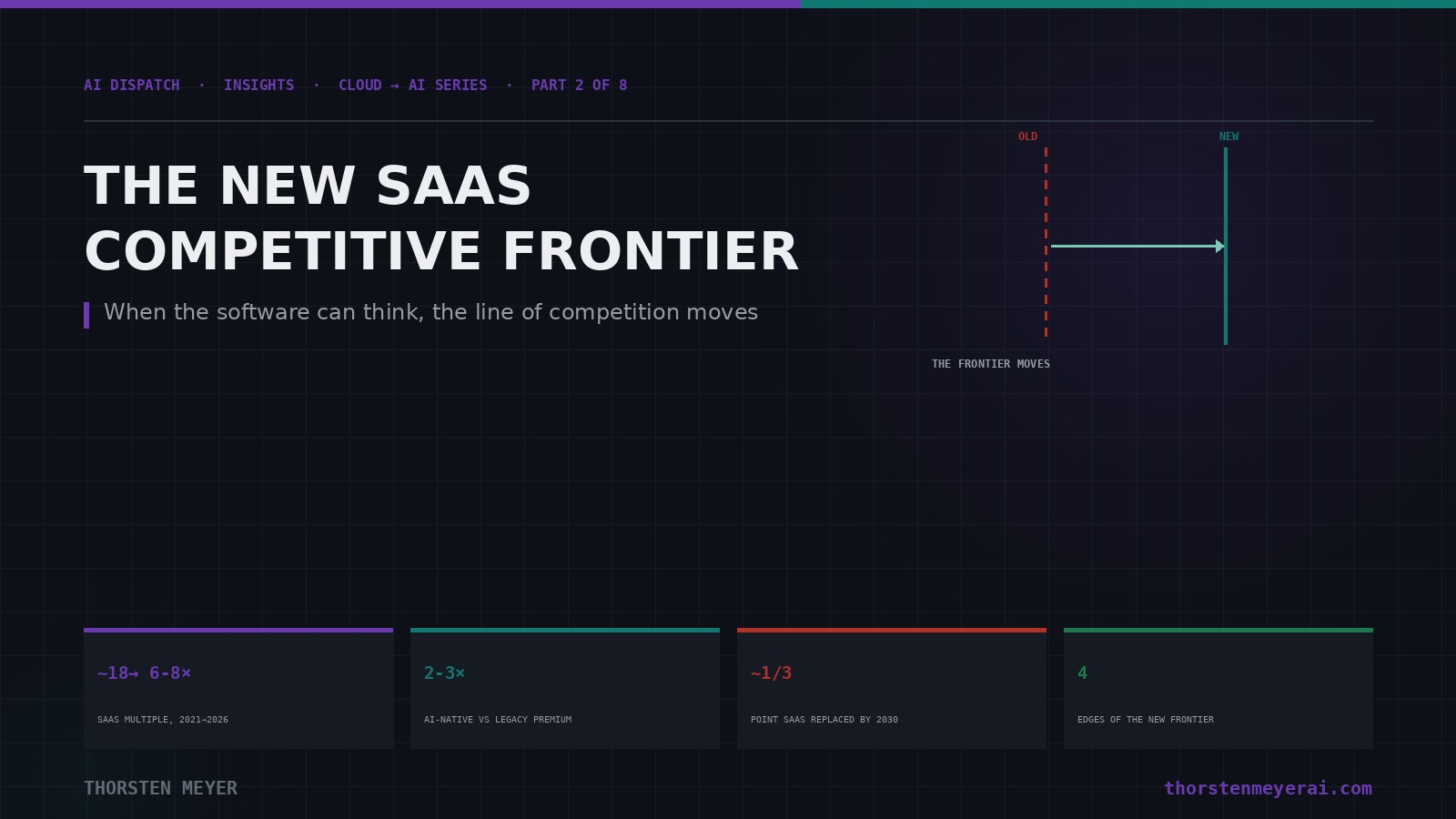
Every software category has a competitive frontier — the specific set of things that actually decide who wins and who loses. For twenty years, SaaS had a stable one: own the system of record, make switching painful, compound at 85% gross margins, and let the sheer agony of migration keep customers locked in. That frontier didn’t erode. It moved. And the companies that are struggling right now are, almost without exception, still defending the old line while the fight has relocated somewhere else entirely.
This is the second piece in my cloud-to-AI series, and where the first was about market structure, this one is about the thing underneath it: what happens to the software business model when the software can think, and where the new line of competition actually runs.
The frontier that used to work
Consider the database business, because it’s the cleanest example of the old frontier and its collapse. Databases were phenomenal software businesses — Oracle, SQL Server, a long tail of specialists — for one structural reason: migration was hell. A developer built against a specific database’s interface, accumulated years of data and application logic against it, and moving to a competitor was a giant, risky, expensive project nobody wanted to run. That difficulty was the moat. High switching costs plus data gravity equalled durable margins.
SaaS’s competitive frontier — the things that actually decide winners — relocated. Companies struggling now are defending the old line while the fight moved elsewhere.
- Own the system of record
- Make switching painful
- Migration as the moat
- Compound at 85% margins
- Lock-in = durability
- Fluency with the jagged edge
- Outcome pricing, not per-seat
- Cost & clean zero-to-infinity scaling
- Proprietary workflow data
- Value of staying, not cost of leaving
Now watch what AI does to that. The developer building against the interface is increasingly not a human — it's an agent. Database interfaces are extremely well-specified, and agents are exceptionally good at well-specified translation tasks, tirelessly, without the boredom that made migration a project humans avoided. The thing that used to be the number-one task you would never take on — migrating from one database to another — becomes, roughly, a line item. Put some money against it and move.
Here's the crucial part, and it's the whole thesis: this does not mean databases stop mattering. Nobody's going to vibe-code their own database. What it means is the criteria changed. When starting and migrating are cheap, the things that win shift — to cost, to scaling cleanly from zero usage to enormous, to spinning up and tearing down fast, to iteration speed. The category survives. The frontier moved. And a company optimizing brilliantly for the old criteria — maximum lock-in, maximum switching pain — is now optimizing for a moat that's evaporating.

Database Migration Specialist T-Shirt
- Targeted for Database Migration Specialists: Ideal gift for migration experts
- Humorous Design: Features a funny migration quote
- Comfortable Fit: Lightweight, classic fit with durable stitching
As an affiliate, we earn on qualifying purchases.
As an affiliate, we earn on qualifying purchases.
Stickiness was never one thing
The single most useful distinction I can offer here is that "stickiness" was always two different things wearing the same coat, and AI is pulling them apart.
Real switching costs and customer inertia looked identical on a revenue report — both produced low churn. AI pulls them apart ruthlessly.
- Data gravity & deep workflow integration
- Compliance lineage, regulatory approval
- Permissioned access to workflow data
- "We've always used this"
- Friction of change & habit
- Nobody wanted to do the migration
Public SaaS median: ~18x forward revenue (2021) → ~6–8x (2026) — a ~55% permanent reset. The recovery split by which side of the frontier you're on.
There is stickiness that comes from real switching costs — data gravity, deep workflow integration, compliance lineage, regulatory approval. And there is stickiness that comes from customer inertia — the friction of change, the habit, the "we've always used this," the fact that no human wanted to do the migration. For twenty years these looked identical from the vendor's side, because both produced the same low churn. You couldn't tell them apart on a revenue report.
AI separates them ruthlessly. Inertia-based stickiness is evaporating fast, because the friction that sustained it — humans not wanting to do tedious migration and integration work — is exactly what agents erase. Real-switching-cost stickiness is holding, and in some cases strengthening. If your retention was quietly resting on inertia and you assumed it was a moat, you're about to find out the hard way. The diligence question of 2026, the one acquirers are now asking explicitly, is: is this company's low churn earned by genuine switching costs, or is it inertia that an agent can dissolve in a weekend?

Workflow Automation with Microsoft Power Automate: Design and scale AI-powered cloud and desktop workflows using low-code automation
As an affiliate, we earn on qualifying purchases.
As an affiliate, we earn on qualifying purchases.
The frontier has visibly moved — the numbers say so
This isn't theory; the market has already repriced it. In 2021, public SaaS traded at a median around 18x forward revenue; some names went far higher. Today the median sits near 6–8x — roughly a 55% permanent compression, a reset back to where multiples were in 2015–2016. That's not a temporary dip waiting to recover. As one analyst put it, the market stopped paying for the category and went back to paying for the company.
And the recovery is sharply bifurcated, which is the frontier showing up directly in the numbers. AI-native SaaS trades at roughly two to three times the multiple of legacy SaaS; high-growth AI-native names command 15–40x while slow-growth legacy software sits at 2–4x. Same "SaaS" label, completely different frontier. The market is pricing not whether you're software, but which side of the line you're on.
The disruption underneath those multiples is real and measurable. Vertical AI agents are taking workflows one at a time — not replacing whole platforms in one move, but peeling off the layer above the system of record. Abridge in clinical documentation, Sierra in customer support (reportedly $100M ARR about seven quarters after launch, a ~$15.8B valuation), Legora hitting $100M ARR in 18 months. Gartner's estimate that roughly a third of point-product SaaS tools get replaced by AI agents by 2030 is worth reading carefully in both directions: a third is enormous disruption, and the other two-thirds survive — the deeply embedded, compliance-bound, workflow-critical software that has real switching costs rather than inertia.
outcome-based SaaS pricing solutions
As an affiliate, we earn on qualifying purchases.
As an affiliate, we earn on qualifying purchases.
Where the new frontier actually runs
So if lock-in and migration-pain are no longer the line, where is it? From what I can see, the new competitive frontier for software has four edges, and they're different from the old ones.
If lock-in and migration pain are no longer the line, where is it? The new competitive frontier for software has four edges — and one honest limit.
Understanding the jagged edge of AI capability. This is the big one. Model capability is not a smooth arc; it's jagged — brilliant at some things, surprisingly poor at adjacent ones, and the edge moves every few weeks. The winning software companies are the ones that understand that jagged frontier intimately and build products that ride it — filling the valleys, exploiting the peaks, and re-architecting as the edge shifts. The old product-management model, where a PM understood the customer and handed requirements to engineers, is broken here. You now need people who understand the customer problem and the jagged capability and can bridge them. Taste, customer understanding, and curiosity about the jagged edge — those are the three scarce skills, and it no longer matters much whether the person holding them is called an engineer, a designer, or a PM.
Pricing that survives agents as users. Per-seat pricing is under real structural pressure, because when an AI agent is the "user," seats stop mapping to value. The market is moving toward usage-, token-, and outcome-based pricing — charging per resolved ticket, per completed workflow, per outcome delivered. This is genuine business-model innovation, the same kind that made subscription SaaS more than just "software delivered differently." Whoever gets outcome-aligned pricing right captures the value that per-seat pricing is about to leak.
Cost and clean scaling as first-order features. When it's cheap to start and cheap to experiment, far more applications get born, most small, some exploding. That makes zero-to-infinity scaling, low cost, and fast teardown into competitive features rather than back-office concerns. The old world procured a license and ran it on fixed hardware; the new world needs software that costs almost nothing at zero usage and scales cleanly if it works.
Proprietary workflow data as the real moat. The durable defensibility in the agent era isn't the interface anymore — it's permissioned access to the data exhaust of a specific workflow. A vertical agent that lives inside a hospital's clinical notes, a law firm's case archive, an insurer's claims history has something a foundation model structurally cannot get. That's the moat that AI strengthens rather than erodes, and it's why the winning pattern so far is "agent over SaaS, sitting inside the workflow," not "generic chatbot bolted onto a homepage."
As an affiliate, we earn on qualifying purchases.
The honest bear case
I don't want to oversell the disruption, because the reflexive "AI eats all of SaaS" take is as wrong as the old "AWS eats everything" was.
Most SaaS survives. Two-thirds of point products persisting, by Gartner's own math, is the base case, not the exception. The system of record — the database, the ERP, the compliance-bound platform of record — has data gravity and regulatory lineage that agents don't dissolve. Much of the "disruption" is agents layering on top of incumbent SaaS, not ripping it out. The incumbents that move fast keep their floor.
New switching costs are already accreting. The lock-in story isn't ending; it's relocating. Enterprises are accumulating fresh switching costs across Copilot, Agentforce, and vertical agents — custom agents, workflow automations, institutional knowledge encoded in AI outputs. The new frontier grows its own moats; they're just made of different material.
And "vibe-coded replacements" are mostly a myth. The threat to SaaS was never that every customer builds their own software. It's subtler and more real: the criteria by which customers choose changed, and companies optimized for the old criteria lose to companies optimized for the new ones. That's a competition story, not an extinction story.
Where I land
The mistake that's killing SaaS companies right now isn't that they failed to add AI features. It's that they're defending a frontier that has already moved — pouring energy into lock-in and switching-cost moats that AI is quietly dissolving, while the real fight relocated to jagged-edge fluency, outcome pricing, clean scaling, and proprietary workflow data.
The reframe I'd offer any software builder is the one the best operators have already internalized: stop asking how to make customers unable to leave, and start asking how to be the thing they'd never want to. The old frontier was built on the cost of leaving. The new one is built on the value of staying — value that has to be re-earned every few weeks as the jagged edge moves. That's a harder game, and a better one, and it's where the next decade of software gets won. Next in the series: the constraint underneath all of this — the energy bottleneck that decides how much intelligence there is to build on in the first place.
Analysis and opinion from a builder, founder, and post-labor economist running a local-first inference operation. Figures verified at time of writing against multiple 2026 market sources (SaaS Capital Index, Aventis Advisors, SEG, Gartner) for multiple compression (~18x 2021 peak to ~6–8x median 2026), the AI-native vs. legacy valuation bifurcation, and cited vertical-AI companies; named valuations and ARR figures are as reported and may change. Framework and interpretation are the author's own, informed by the "competitive frontier" and "sandcastles" framing discussed publicly by investor Eric Vishria. This is analysis, not investment advice. Part 2 of an 8-part series. Point-in-time as of 12 August 2026.