By Thorsten Meyer
Overnight on Tuesday, an employee at Leipzig/Halle airport spotted a small drone carrying explosives near the south runway, in the cargo zone of one of Europe’s largest freight hubs — a Nato and German military logistics node, and the European base of Ukraine’s Antonov fleet. Police sent in a bomb-disposal robot, defused it, destroyed it. In the same window, a DHL cargo aircraft climbing away from the airport struck an unknown object in mid-air and diverted to Hanover. Germany opened a counterterrorism investigation. The interior minister, Alexander Dobrindt, called it what it plainly was: not amateurish, a professional hybrid threat scenario, and “a new level of danger.”
No one has officially named Russia, and I will not pretend the attribution is settled. But the target selection — a military and Ukraine-linked logistics hub — and the pattern of the last two years point where everyone’s suspicion already points. This is what hybrid war looks like: below the threshold of open conflict, deniable, aimed at the infrastructure a modern economy and a modern military both run on.
I want to use this moment to say something uncomfortable about how Europe is responding to the era it has entered, because the drone and the thing I actually work on are more connected than they look.
An explosive drone on a military cargo hub’s runway. A “professional hybrid threat,” said the interior minister — “a new level of danger.” It’s a moment to say something uncomfortable about how Europe is meeting the era it has entered.
▲ Opinion · strategic argument is the author’s ownEurope’s reflex to a new technology is to regulate it — and it’s genuinely good at it. The AI Act is the most comprehensive AI law on Earth. The discomfort is what sits underneath.
The sloppy version of this argument is wrong, and I won’t make it. The real connection runs one level deeper — through the word “hybrid.”
The rebuttal: just use American AI. For many things, today, Europe can. But defense is the specific case where you can’t.
The strongest version of the other side, because parts of it are right and it deserves to be heard.
- Regulation and capability aren’t zero-sum — Europe is investing (InvestAI, gigawatt data centers)
- Drone defense is mostly physical security and intelligence, not frontier LLMs — I overweight my own field
- Sovereign defense AI may need a smaller controllable model, not a leaderboard chase
- Setting global norms has real value, capability or not
Only capability does that — and it’s the thing we’ve been legislating around instead of building.
The reflex we reach for
Europe's characteristic response to a new technology is to regulate it. It is genuinely good at this — the AI Act is the most comprehensive artificial-intelligence regulation on Earth, a serious, detailed, globally influential piece of law. When the history of AI governance is written, Brussels will be in it.
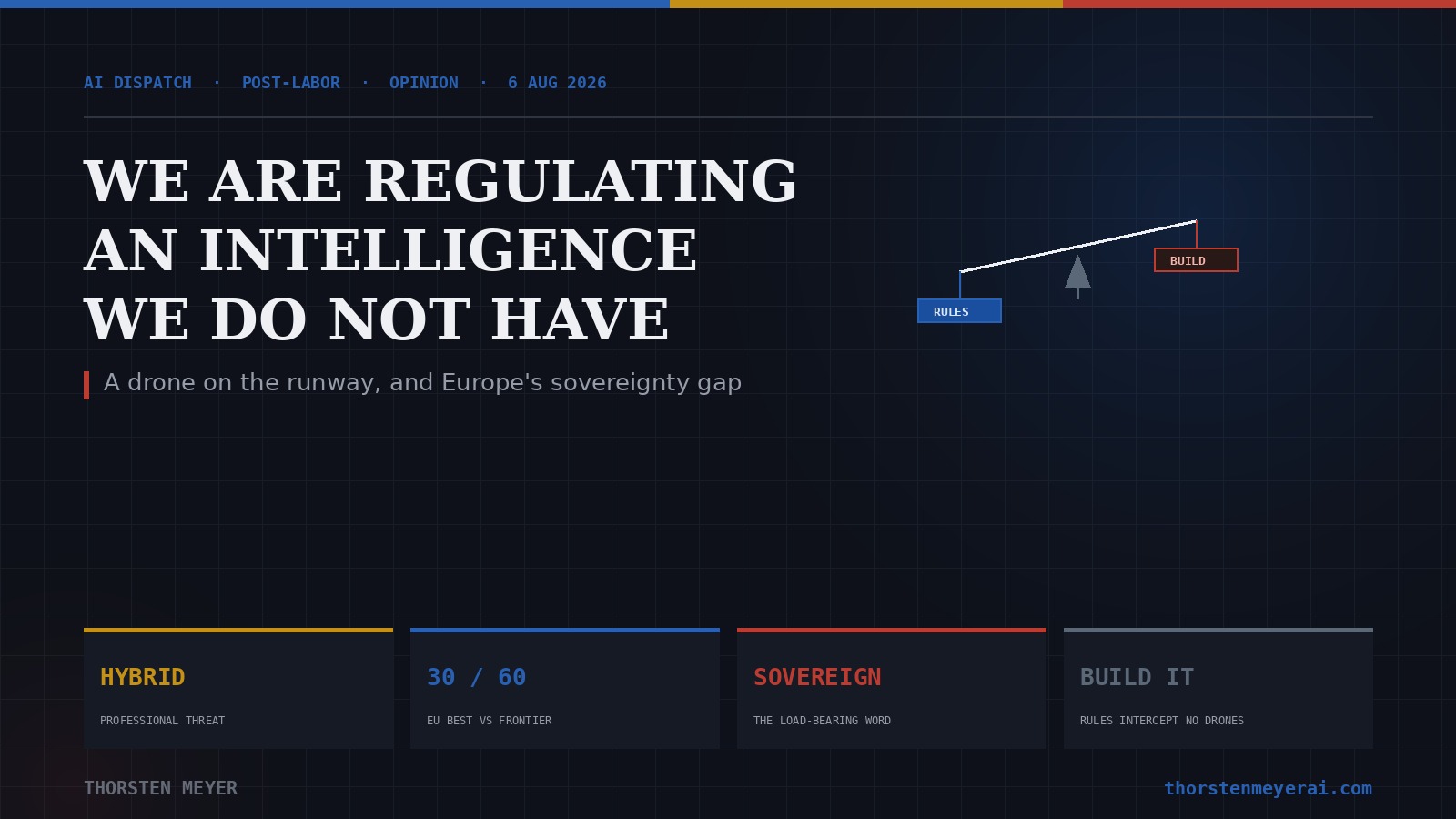
Here is the discomfort. We have written the world's leading rulebook for a technology we do not lead in building. I documented this in detail only days ago: on the independent Artificial Analysis Intelligence Index, Europe's flagship model — Mistral's best — scores 30 out of a frontier that now runs to 56–61. Half. Tied with a US competitor's cheapest model. And the trajectory is the flattest of any major lab, meaning the gap widens with each generation rather than closing. That is the honest state of European frontier AI in August 2026: a continent that regulates the technology magnificently and builds it at roughly last year's frontier, falling further behind the American and Chinese labs every quarter.
I am not against the AI Act. Rules for a powerful technology are legitimate, and some of what it does is wise. My objection is to the balance of our energy. We have poured extraordinary political will into governing AI and comparatively little into possessing it — and possession is the part that determines whether, when the hybrid war escalates, we can actually defend ourselves. You cannot regulate your way to a capability you have chosen not to build.

Military Weapon Set Camouflage Army Men Accessories Building Blocks Toy
- Piece Count: 233-piece military weapon set
- Color Variations: Includes four camouflage and solid colors
- Accessories Included: Robotic dog, drones, helmets, suits, shields
As an affiliate, we earn on qualifying purchases.
As an affiliate, we earn on qualifying purchases.
Where the drone and the model actually meet
Let me be careful here, because the sloppy version of this argument is wrong and I do not want to make it. A better large language model would not have stopped Tuesday's drone. Physical airfield security, counter-drone systems, radar, jammers, human vigilance — that is what stops a drone, and conflating "Europe lacks a frontier LLM" with "a drone got through" would be exactly the kind of unearned leap I criticise in others. The airport employee who spotted it is the hero of this story, not any algorithm.
The connection is real but it runs one level deeper, through the word Dobrindt used: hybrid. Hybrid war is not one drone. It is a sustained, multi-domain campaign — sabotage, cyber intrusion, disinformation, infrastructure probing, all at once, all deniable, all designed to operate faster and at greater volume than human analysts can track. And the tools that increasingly run both sides of that campaign — the systems that detect the anomaly in the network traffic, correlate the drone sighting with the freight manifest with the cyber probe, sift a firehose of signals for the pattern that means attack, and do it at machine speed because the attack moves at machine speed — those tools are built on exactly the frontier AI that Europe has chosen to regulate rather than to own.
That is the connection. Not "an LLM stops the drone." Rather: the defensive nervous system of a state under hybrid attack now runs on advanced AI, and the more capable that AI, the faster and better the defense. A cyber-defense stack, a threat-fusion centre, an autonomous counter-drone system — each of these is increasingly an AI system, and its ceiling is set by the models and the compute underneath it. If Europe's sovereign AI is at 30 while the threat operates with tools at 55, that is not a metaphor. It is a capability deficit in the one domain where you most need not to have one.

Police Drone & Pilot Detection Kit– Handheld Drone Detection & Tracking Tool | Real-Time Alerts for Law Enforcement, Event Security & Emergency Response | Portable Airspace Awareness Device
- Real-Time Drone Detection: Detects drones via remote ID signals instantly
- Portable & Compact Design: Handheld, lightweight, and easy to carry
- Immediate Threat Alerts: Provides instant notifications for quick response
As an affiliate, we earn on qualifying purchases.
As an affiliate, we earn on qualifying purchases.
Why "sovereign" is the load-bearing word
The obvious rebuttal: Europe can just use American AI for defense. And for many things, today, it can, and does. But sovereignty is not a luxury preference here; it is the specific requirement.
You cannot build your national cyber-defense, your military threat-fusion, your counter-hybrid centre on models you neither control nor can run inside your own jurisdiction, operated by companies subject to another government's law and another government's export switches. The whole point of a sovereign defensive capability is that it keeps working when relations are strained, when the provider's home government has other priorities, when the API you depend on becomes a lever someone else holds. A defense you rent from a foreign power is not a defense; it is a dependency you have not yet been punished for. Dobrindt opened a Joint Centre for Countering Hybrid Threats in June. A centre like that, to do its job in five years, will need frontier AI it can trust absolutely — which means AI Europe controls. Right now, that AI is at 30, and Mistral's flat trajectory says it is not on track to be at the frontier when the centre needs it.
This is where my loyalty being to the goal and not to any company matters. I do not need Mistral specifically to win. I need Europe to possess sovereign, frontier-grade AI capability — from Mistral, from a consortium, from a state-backed effort, from whatever combination bends the curve — because that capability is now part of the defensive infrastructure of the continent, as surely as radar and runways. And on the current numbers, we do not have it, and we are not on track to have it, and we are spending our institutional energy writing rules for it instead.

Luminda C128 Scout Drone with 1080P Camera, Military Remote Control Helicopter, 2.4G Aerial Vehicle Reconnaissance, Take Off/Landing, 6-Axis Gyro
As an affiliate, we earn on qualifying purchases.
As an affiliate, we earn on qualifying purchases.
The honest counter-argument
Let me put the strongest version of the other side, because it deserves to be heard and parts of it are right.
Regulation and capability are not a zero-sum trade, the argument goes: the AI Act and industrial investment can proceed in parallel, and Europe is investing — InvestAI, the gigawatt data-center plans, real money. Defense against drones and sabotage is overwhelmingly a matter of physical security, intelligence, and hardened infrastructure, not frontier LLMs, so framing it as an AI-sovereignty problem overweights my own field. Sovereign AI may not require a frontier general model at all — a smaller, controllable, open model fine-tuned for defensive tasks might serve better than chasing the leaderboard. And there is real value in Europe setting global norms it can then ask others to meet, capability or no. Each of these has force. The regulation-versus-capability framing is a simplification, and I am sharpening it deliberately to make a point.
But here is why I hold the line anyway. Every one of those rebuttals is a reason to invest more in sovereign capability, not less, and none of them changes the measured facts: our best model is at 30, the frontier is at 60, the gap is widening, and the threat environment is escalating on exactly the timeline our capability is not. You can grant the whole counter-argument and still be left with a continent whose defensive AI ceiling is set by a lab that ties a competitor's budget model. The norms are worth setting. They are not a substitute for the capability, and a drone with explosives on a military runway is a poor moment to mistake the one for the other.

ZOSI 8Channel Surveillance Video Recorders with Human Vehicle Detection,H.265+ Hybrid 1080P 4-in-1 HD-TVI Standalone CCTV DVR System for 720P,1080P Security Cameras,Easy Remote Access(NO Hard Drive)
- Channel Support: Supports 8 wired cameras up to 1080p
- Camera Compatibility: Compatible with HD-TVI, CVI, CVBS, AHD
- Remote Access: Easy remote viewing via ZOSI Smart App
As an affiliate, we earn on qualifying purchases.
As an affiliate, we earn on qualifying purchases.
What Tuesday should change
The drone at Leipzig will be investigated, attributed or not, and folded into the long list of incidents that define this period. My worry is that we will respond to it the way we respond to everything — with a hearing, a directive, a new rule — and leave the underlying deficit exactly where it sits.
The era we have entered rewards those who can convert advanced AI into defensive capability at machine speed, on infrastructure they control. Europe has chosen, so far, to be the continent that governs that technology rather than the one that fields it. That was a defensible choice in peacetime. Tuesday is a reminder that we are not, in the relevant sense, at peace — and that a rulebook, however excellent, intercepts no drones, defends no network, and fuses no threats. Only capability does that, and capability is the thing we have been legislating around instead of building. We should build it. The regulation can wait for the intelligence to exist; the hybrid war will not wait for the regulation.
Opinion from a builder, founder, and post-labor economist running a local-first inference operation, who wants European AI sovereignty to succeed through whichever lab or effort delivers it. Factual basis: reporting by Reuters, AFP, AP and others (5–6 August 2026) on the explosive drone found at Leipzig/Halle airport, the DHL cargo-plane collision, and Interior Minister Dobrindt's "new level of danger" and "professional hybrid threat" remarks; no official attribution had been made at the time of writing. Model-capability figures from Artificial Analysis's independent Intelligence Index (v4.1). The strategic argument, and the opinions throughout, are the author's own. Not defense-procurement or investment advice. Point-in-time as of 6 August 2026.