

By Thorsten Meyer | November 18, 2026 | ThorstenMeyerAI.com

Get business pricing on tech for your team
- Business-only prices and quantity discounts
- Tax-exempt purchasing
- Multiple users, one account, clear invoices
Almost one million young people in the UK are not in education, employment or training. On Tuesday, the man the government asked to fix that delivered his answer. Alan Milburn’s final review, published by the Department for Work and Pensions on November 17, runs to 278 pages and has a blunt title: “From a Welfare State to a Working State”. Its core idea fits on a sticky note: “Investment first, payback later.”
Earlier this month I looked at the numbers behind the UK’s youth unemployment rate and the AI skills question. On the morning the review came out, we looked at the graduate job squeeze. This piece is about the policy answer: what the review finds, what it would cost and save by its own numbers, where AI shows up in it, and what the government has said so far. I read the report itself, not just the coverage.
Key takeaways
- The problem is detachment, not just unemployment. 981,000 young people aged 16 to 24 were NEET in April to June 2026, 13.0% of the age group (ONS). Most of them are not looking for work, and the review says “Six in ten have never had a job.”
- The plan is a legal guarantee. Every young person who is NEET would get a statutory route into work, education or training, a named adviser within 14 days, a plan within four weeks and, after 12 months, a paid six-month job where work is possible.
- The money is front-loaded. £500 million in 2027/28, rising to about £5.8 billion a year by 2036/37. The review expects £3.6 billion in welfare savings and £2.4 billion in extra tax and lower benefit spending in that year, a net saving of “around £200 million”.
- The hard part is benefits. Under-25s would get a new Youth Allowance instead of the Universal Credit health top-up, and a new Additional Cost Allowance would replace PIP. The review admits the changes will not be “pain-free”. Charities, Plaid Cymru and some Labour MPs object.
- AI is in the report, but not as the culprit. It would be “wrong to blame AI for the recent rise in youth detachment”, Milburn writes. He proposes AI skills training for every young person and a small “AI Youth Observatory” to track shrinking entry routes.
- The government has given a first answer, not the full one. On publication day it said it “agrees with the core principles in the report”, announced locally led youth services from next year, an Opportunity and Support Guarantee and a Youth Opportunities Unit reporting to the Prime Minister, and promised a White Paper next year. The benefit changes are still undecided.
Milburn review · explainer
The proposed guarantee, step by step
What the review wants the state to owe every young person who is not earning or learning, and what it would ask in return.
From first contact to a guaranteed job
- Day oneThe young person contacts the Youth Opportunity Serviceonline, in person or through a group they trust
- 14 daysMeets a named adviser: a participation conversation, not an incapacity assessment
- 4 weeksOne Participation Plan: what the young person and the state will do, and by when
- 4 monthsThe statutory outer limit: a course, apprenticeship, work experience or job under way
- 6 monthsEmployers who hire them can get hiring incentives
- 12 monthsStill NEET despite engaging? The state guarantees a paid six-month jobwhere paid work is realistically possible
What the young person owes
- Be available for an agreed form of participation, where able
- Make and pursue a Participation Plan
- Do not refuse reasonable offers without good cause
Persistent refusal could, as a last step, cost the new Youth Allowance.
Source: DWP / Alan Milburn, From a Welfare State to a Working State, full report (PDF pp. 181–182) and executive summary (PDF p. 21), Nov 17, 2026. A proposal, not law: the government supports the guarantee in principle (GOV.UK, Nov 17, 2026); full plans follow in a White Paper next year.
Graphic: Powered by Thorsten Meyer AI
Products Worth Considering

Apple Watch SE 3 GPS 40mm Smartwatch

Bose QuietComfort Headphones (2nd Gen), Wireless Noise-Cancelling Over-Ear Headphones, White Smoke

Logitech MX Master 4 Ergonomic Wireless Mouse with Haptics – Graphite
As an affiliate, we earn on qualifying purchases.
What the review finds
Milburn was commissioned by the Work and Pensions Secretary. His interim report in May made the case for change; the final report is the plan. Its diagnosis is that the UK no longer has an old-style youth unemployment cycle but something more stubborn. In his words: “Today’s NEET crisis is no longer the old story of a temporary cycle of youth unemployment. It is a new phenomenon of youth detachment.”
The figures in the report back that up. The NEET rate “has barely been below 10 per cent in 25 years”, and “Across Europe, only Romania has higher NEET rates than the UK.” Around 60% of NEET young people are economically inactive rather than unemployed. Failure to address high NEET rates is “costing the country around £125 billion a year”, the report says, spread across lost output, scarring, foregone tax, benefits and health. Without a change in policy, forecasting for the review suggests the NEET rate “could reach 16.3 per cent, around 1.27 million young people by 2031”.
The review blames five failures at once: a labour market that has “moved against young people”, schools built for a more predictable economy, a health system that waits for a diagnosis, a welfare system that “asks the wrong question” and services that do not join up. One figure sums up the imbalance: “In 2024/25 for every £25 we spent on benefits we only spent £1 on support to help them into education or employment.”
The labour market it lands in
The review was published on the same day as the Office for National Statistics’ November labour market figures. They show a market that is cooling, not one that will absorb young people by itself.
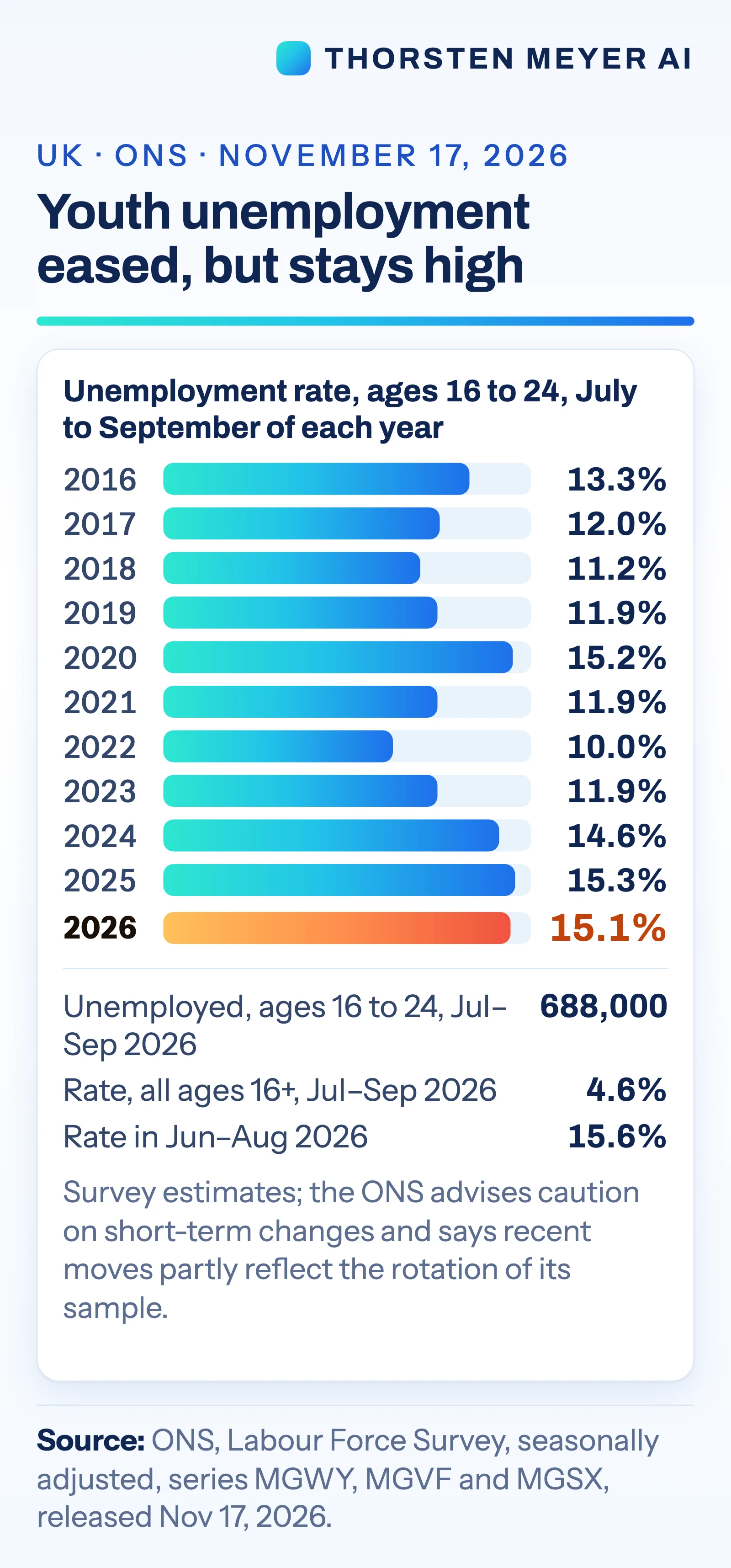
The unemployment rate for 16- to 24-year-olds was 15.1% in July to September 2026 (ONS series MGWY). That is down from 15.6% in June to August, the figure in our earlier piece, and from 15.3% a year earlier. In people, 688,000 young people were unemployed (MGVF). Among those not in full-time education, the rate was 13.0% (AIXT). The rate for all ages was 4.6%.
Do not read too much into the drop. The ONS says the latest quarterly movements “partly reflect the rotation of the Labour Force Survey (LFS) sample” and advises users to “focus on long term movements in the data”. Over the longer run, the youth rate for July to September is well above the 10.0% of 2022.
Demand is weak. Vacancies fell by 22,000 to 690,000 in August to October 2026. The largest quarterly decrease was in businesses with 1 to 9 employees, “down by 22,000 to 73,000 vacancies”, and the ONS says “smaller firms may not be recruiting because of labour costs and other economic conditions”. Payrolled employees fell by 90,000 over the year to July to September. The next NEET release is due on November 26.
What Milburn recommends
The heart of the plan is a deal with obligations on both sides. The state would owe every 18- to 24-year-old who is NEET two new legal entitlements: an Opportunity Guarantee (“a statutory entitlement to a route into education, training or work”) and a Support Guarantee for health, employment and practical help. A new Youth Opportunity Service in every part of England would deliver both, built mainly from existing teams such as Jobcentre Plus youth staff, council participation teams and Youth Hubs.
The timetable is specific. A young person meets a named adviser within 14 days. Within four weeks they have one Participation Plan. Within four months, “The statutory outer limit”, something substantive should be under way. If they are still NEET at 12 months despite engaging, “the State guarantees a paid six-month job”. In return, young people must engage, and one “who persistently refuses to engage” should “ultimately lose their Youth Allowance benefit”.
On skills, Milburn wants apprenticeships to be the biggest priority: a path towards 270,000 under-25 apprenticeship starts a year by 2036, an initial 25,000 pre-apprenticeship places and an extra 150,000 18- to 24-year-olds in further education each year. On health, he wants faster, needs-led mental health support without waiting for a diagnosis.
The most contested part is welfare. Young people would move to “A new single Youth Allowance”, set at the standard Universal Credit rate for under-25s, with the Universal Credit health top-up and the Work Capability Assessment removed. “A new Additional Cost Allowance” would replace the Personal Independence Payment (PIP), and a more generous “Severe and Complex Needs Insurance” would cover those who will likely never be able to work. Milburn does not hide the cost to some claimants: “Nor will they be pain-free. They could mean some people get less financial support at the beginning of their benefit claim than under the current system.”
What it would cost, and what it would save

The review asks for £500 million in 2027/28, found “by reprioritising existing spending”, and says the 2027 Spending Review should make the programme a priority. By 2036/37, annual investment would reach about £5.8 billion: £2.1 billion for education, £1.9 billion for the two guarantees, £1.1 billion for hiring incentives and £700 million for health, according to the accompanying data tables.
Against that, it counts £3.6 billion in welfare savings and £2.4 billion in “increased tax revenues and reduced benefit payments from growing employment”. The result, in the report’s words: “£5.8 billion of investment is matched by around £6.0 billion in welfare savings and wider fiscal offsets, resulting in a net annual saving of around £200 million.” Welfare savings would start in 2029/30 and reach £13.7 billion cumulatively by 2036/37.

What would that buy? The review’s modelling has the reforms bringing the NEET rate down to 6.8% by 2036/37, against a baseline of 13.4% without them. Milburn’s target is lower still, about 5%, and he counts on “potentially higher levels of economic growth” to close the gap. The modelling expects the reforms to help around 440,000 young people into sustained work by 2036 and to add about 0.4% of GDP a year if the package is delivered in full.
Two caveats matter. The data tables say the analysis “should not be regarded as official government analysis or as representing agreed government policy”. And the review itself warns that some reforms “may not deliver as expected and need further development and refinement”. The savings also depend on the benefit changes that are the hardest to pass.
Where AI fits in
The review mentions artificial intelligence often, but it does not use it as an explanation for the crisis. Its framing is about uncertainty. Young people “face a future of uncertainty as artificial intelligence and automation reshape the world of work faster than at any point in history”, the summary says, and, in its closing pages, “Now they face the risk of an AI-led employment meltdown.”
On cause, it is careful: “It would be wrong to blame AI for the recent rise in youth detachment, or to pretend that anybody can know precisely what its impact will be over the next decade.” The worry is about the bottom rung: “there is a real risk that young people bear a disproportionate share if the entry-level tasks through which previous generations learned how to work disappear faster than new routes are created.” The report also cites research that “Entry-level vacancies have fallen by 49 per cent over the past decade” and that entry-level recruitment has become “more formal, more remote and increasingly automated”.
Young people are not avoiding the technology. In the Youth Voice Census quoted by the review, “69 per cent of young people in the Youth Voice Census had used AI or machine-learning tools, but 55 per cent said technological change made them uncertain about the future and only 19 per cent believed it would create more opportunities.”
The concrete AI proposals are modest:
- AI skills for everyone. “the Government should ensure that training in AI Skills is available to every young person”, building on the existing AI Skills Hub and targeting places “at greatest risk of disruption”.
- An AI Youth Observatory. A small unit to “track changes in youth recruitment, entry-level tasks and occupations by sector and place” and publish an annual assessment of where entry routes are shrinking.
- A condition for subsidised firms. “An employer should not be able to use taxpayer support to remove large parts of its entry pipeline without explaining what will replace them.”
- Fairer automated hiring. Employers should “test automated recruitment for barriers unrelated to the job”.
What the government has said so far
The government gave a first response on publication day. It backs the direction, not yet every recommendation. In a short response note on GOV.UK it says it “agrees with the core principles in the report” and that “A White Paper setting out the full plans in detail will be published next year, with legislation to follow.” Its press release backs Milburn’s call for “whole-system reform”, but adds: “Wider recommendations to be considered alongside the Timms Review”, with next steps on welfare reform “in the coming weeks before a White Paper in the new year”. Until then, “Young people will continue to receive the benefits and support they are currently eligible for while the government considers the report.”
The immediate steps are about services. New locally led youth services will bring together employment, health, skills and wider youth support “in one place starting from next year”, shaped by mayors and local leaders. A new Opportunity and Support Guarantee is meant to give every young person “a real opportunity to gain a college place, training, an apprenticeship, high-quality work experience or a job”. A new Youth Opportunities Unit will report directly to the Prime Minister. On money, the government says “Further detail on local delivery arrangements, funding and implementation, including through legislation, will be set out in due course.”
Before the report landed, Prime Minister Andy Burnham declined to promise full implementation. “There’s lots of detailed recommendations, so I can’t give you that blanket assurance here tonight,” he said, as reported by The Telegraph on November 13. On publication day he struck the same note: “We will carefully consider all the recommendations and come back with the Government’s full response in the coming weeks, but our direction is already clear: a fundamental overhaul of how we support young people.”
The government has moved on one piece already. On November 14 the DWP said every eligible 18- to 24-year-old on Universal Credit and looking for work will be “guaranteed a fully-funded, six-month job matched to their skills from the end of November”, and that from April they will get it “after 12 months rather than 18”. That is the same 12-month backstop Milburn asks for, though only for young people on Universal Credit who are looking for work. The DWP expects the scheme to “help more than 90,000 young people into work by March 2029”.
In his statement to the Commons, published on GOV.UK, Work and Pensions Secretary Pat McFadden said the Prime Minister and the whole Cabinet had “endorsed the need for a whole new system for young people”. He said the government supports the Opportunity and Support Guarantee and “also accepts” the review’s call for a more personalised, locally delivered system. On the 12-month trigger for the Jobs Guarantee, he said: “I agree, and we will do that.” On the Youth Allowance and help with disability costs, he set out what the report recommends without saying whether the government will adopt them. On benefits, McFadden told the BBC that “there will be people in the future who will not get what they will get today”, as reported by Big Issue.
The criticism is already loud. Ruth Curtice, chief executive of the Resolution Foundation, said turning this around “will require significant investment, through new legislation and a young people centred spending review next year”, as quoted by Big Issue. Plaid Cymru’s Ann Davies said the answer lies in good jobs, “not blunt cuts to disability support”. Before publication, Labour MP Neil Duncan-Jordan warned that “Young people will not cease to be disabled if the support they rely on is cut – they will simply be poorer”, as reported by The Telegraph.
What it means for employers
- A cheaper first hire, if adopted. Employers who take on a young person who has been NEET for six months would get £3,000, plus £2,000 more for someone facing bigger barriers and another £2,000 for firms with fewer than 50 staff. The apprenticeship payment would rise to £2,500. The review prices the package at “around £1.1 billion a year”.
- No blanket National Insurance cut. Instead, when budgets allow, the point at which employer National Insurance starts for 21- to 24-year-olds in retail and hospitality would double “from the current £5,000 threshold to £10,000”. Those two sectors provide 37% of jobs for 16- to 24-year-olds.
- A new ask on hiring practice. The voluntary “First Chance” movement asks large firms to aim for 10% of entry-level vacancies going to young people who are NEET or at risk, to drop unnecessary experience requirements and to answer rejected applicants. The report lists Marks & Spencer, Octopus Energy and Lloyds Banking Group among the first supporters.
- AI choices may come with strings. Our reading: if the condition on taxpayer-supported firms is adopted, companies that automate entry-level tasks may have to show how they will still train the next generation.
What it means for young workers
- Nothing changes yet for benefits. The government says young people “will continue to receive the benefits and support they are currently eligible for while the government considers the report”. A new system needs a White Paper and then new law; Milburn wants it in place by 2029.
- One concrete change is coming. If you are 18 to 24, on Universal Credit and looking for work, the Jobs Guarantee rolls out across Great Britain from the end of November, with the trigger moving from 18 to 12 months from April.
- The deal cuts both ways. More guaranteed help would come with a duty to engage. Under the proposal, refusing reasonable offers without good cause could ultimately cost the Youth Allowance.
- AI skills help, but they are not the whole answer. The review treats AI training as one tool among many. Experience, apprenticeships and a first job matter more in its plan than any single skill.
What is not known
- What the government will adopt in detail. It agrees with the core principles and backs the Opportunity and Support Guarantee and local delivery, but the full plans come in a White Paper next year, considered alongside the Timms Review. Which benefit changes survive, and what the new services will cost, is open.
- The money. The £5.8 billion and the savings are the review’s own modelling, not official forecasts, and the multi-billion investment beyond 2027/28 depends on future Spending Reviews.
- Who would get less. The review says some people may get less support at the start of a claim. We found no count in the report or its annex of how many, or by how much. Its poverty modelling, which includes the expected job gains, shows relative poverty after housing costs falling by 50,000 people.
- AI’s real effect. The review itself says nobody can know AI’s impact over the next decade. No UK study we have seen yet measures how much of the rise in youth detachment AI explains.
- The newest NEET figure. The 981,000 figure covers April to June 2026. The ONS publishes the next NEET estimate on November 26, and the youth unemployment rate moves a lot from quarter to quarter.
The bottom line
Milburn’s review is the most detailed plan the UK has had for young people out of work, and its sums are unusually clear: pay about £5.8 billion a year by the mid-2030s and get most of it back through lower benefit bills and higher taxes. Whether that holds depends on the benefit changes that are hardest to pass and on investment that later governments must keep up. On AI, the review is more sober than many headlines: it does not blame the technology for today’s crisis, but it wants the state to watch the entry level closely, so the first rung of the ladder does not quietly disappear. For employers, the message is that the first job is now a policy priority. For young people, it is a promise that is not yet law.
I’m Thorsten Meyer. The full sources are below, and more reality checks are at thorstenmeyerai.com.
Sources
- Department for Work and Pensions / Alan Milburn: “From a Welfare State to a Working State: a new settlement for the next generation”, independent report, published November 17, 2026 (full report PDF, 278 pages; executive summary PDF; analytical annex; accompanying data tables). Page numbers in our notes refer to the PDF pages.
- Office for National Statistics: “Labour market overview, UK: November 2026”, November 17, 2026; time series MGWY, MGVF, AIXT and MGSX (Labour Force Survey, July to September 2026)
- Office for National Statistics: “Young people not in education, employment or training (NEET), UK: August 2026”, August 27, 2026
- Department for Work and Pensions, GOV.UK press release: “90,000 young people furthest from work to be given guaranteed job, no matter where they live”, published November 14, 2026, updated November 16, 2026
- GOV.UK, government response: “The independent Young People and Work Review: what it means for young people”, November 17, 2026
- GOV.UK press release: “Government commits to new settlement for young people and to invest in success rather than pay for failure”, November 17, 2026
- GOV.UK oral statement: “Work and Pensions Secretary statement on the Milburn review into young people and work”, November 17, 2026 (GOV.UK version, in which some political passages are marked as redacted)
- Press Association, via Nation.Cymru: “Milburn demands welfare reform and job help to tackle youth unemployment crisis”, November 17, 2026
- Big Issue: “Milburn Review: Young people should have legal right to work to address Britain’s NEETs crisis” and “Milburn Review: Could disability benefit cuts for young people cost the government more than it saves?”, November 17, 2026
- The Telegraph, via AOL: “Burnham refuses to commit to implementing all of Milburn’s welfare reforms”, November 13, 2026
Researched and drafted with AI assistance, including Anthropic’s Claude. No company, government body or person named here reviewed or sponsored this article. Our own text and graphics contain no affiliate links; offer and product boxes added by the site may contain Amazon affiliate links. This article is for information only. It is not legal, benefits, employment or investment advice. Statements as published by the sources above, as of 14:30 CET on November 17, 2026; the three GOV.UK documents on the government’s response as retrieved at 10:38 CET on November 18, 2026. Images: AI-generated illustration (Runware) and graphics by Thorsten Meyer AI; no real people or logos are shown in our images. Boxes added by the site may show product photos or people.