By 2030, universal basic income could substantially boost economic growth, reduce inequality, and eradicate extreme poverty through new funding methods like robot taxes and sovereign wealth funds. Countries may run pilot projects to test its impacts on jobs, social inclusion, and well-being. Automation and AI will shape policies to support displaced workers, while innovative solutions aim to guarantee sustainable financing. If you want to explore how these scenarios could unfold, keep exploring the evolving landscape.
Key Takeaways
- Pilot programs and small-scale trials across countries will inform scalable UBI policies by 2028.
- Funding mechanisms like robot taxes, progressive taxation, and sovereign wealth funds are expected to be refined.
- Automation-driven job displacement will accelerate the adoption of UBI to ensure social stability and economic resilience.
- Global cooperation may lead to unified frameworks for UBI implementation and funding, reducing inequality worldwide.
- Technological advancements will enhance distribution efficiency but require safeguards against digital divides and misuse.

BLAVOR Solar Power Bank 10,000mAh, Portable Wireless Charger, 20W Fast Charging External Battery Pack with USB C for Cell Phones, Solar Panel Charging with Dual Flashlight for Camping
Brand-Oriented and Outdoor Charger Pro: With over 10 years of experience in solar power banks, BLAVOR has already…
As an affiliate, we earn on qualifying purchases.
As an affiliate, we earn on qualifying purchases.
Economic Growth and Poverty Eradication Goals

As we approach 2030, the implementation of Universal Basic Income (UBI) is expected to boost economic growth and accelerate progress toward eradicating extreme poverty. With UBI, you could see global GDP potentially rising from 2.2% to between 2.8% and 3.5%, driven by increased consumer spending and investment. This boost in economic activity helps create more jobs and improves productivity. UBI also directly addresses poverty by providing a steady safety net, ensuring vulnerable populations can meet basic needs. As automation and AI reshape the workforce, UBI offers a way to support displaced workers while fostering economic resilience. Overall, UBI’s role could be pivotal in creating more inclusive growth, reducing inequality, and moving closer to ending extreme poverty by 2030. Leveraging solar technology and other renewable solutions can further enhance sustainable development efforts during this transition.

AI-Powered Real Estate Investing: The 2026 Guide to AI Tools, Prompt Engineering & Automated Systems for Building a Million-Dollar Property Portfolio
As an affiliate, we earn on qualifying purchases.
As an affiliate, we earn on qualifying purchases.
Funding Mechanisms and Financial Sustainability Strategies

Securing sustainable funding for Universal Basic Income (UBI) remains one of the most significant challenges to its global implementation. You’ll need innovative strategies to guarantee long-term financial stability. Potential mechanisms include a “robot tax” on automation profits, progressive taxes on high earners, and value-added taxes. Sovereign wealth funds managed by AI could diversify investments, creating steady revenue. Global portfolio management, controlled by citizens, might support continuous funding through sustainable projects. Here’s a quick overview:
| Funding Source | Benefits | Challenges |
|---|---|---|
| Robot Tax | Addresses automation job displacement | Resistance from industry |
| Progressive Taxation | Fair contribution from high earners | Tax evasion, political pushback |
| Sovereign Wealth Funds | Long-term, diversified income | Market risks, management complexity |
Additionally, implementing innovative financial instruments could further enhance the sustainability and resilience of UBI funding sources.
digital payment distribution platform
As an affiliate, we earn on qualifying purchases.
As an affiliate, we earn on qualifying purchases.
Policy Frameworks and Implementation Challenges

You need clear policy designs that address funding sources, eligibility, and distribution methods to successfully implement UBI. Political support is vital, yet gaining it can be challenging without broad consensus and public trust. Overcoming these hurdles requires strategic planning and strong leadership to guarantee the programs are effective and sustainable. Additionally, understanding potential pitfalls in adopting new payment technologies can help anticipate and mitigate operational challenges associated with distributing benefits.
Policy Design Challenges
Designing effective policy frameworks for Universal Basic Income (UBI) presents significant challenges, particularly around ensuring equitable distribution and fiscal sustainability. You need to balance the size and scope of UBI payments to meet basic needs without overburdening public finances. Crafting eligibility criteria that prevent misuse while maximizing inclusivity is complex. You must also consider how to integrate UBI into existing social protection systems seamlessly. Political consensus is essential, yet difficult to achieve, especially when public perceptions vary. Technological tools can assist in targeting and distribution but require robust oversight to prevent fraud. Additionally, understanding divorce statistics and their implications can inform how social safety nets like UBI are structured to support populations experiencing significant life transitions. Ultimately, you face the challenge of designing flexible policies that adapt to economic shifts, automation impacts, and changing societal needs—all while maintaining fiscal responsibility.
Funding and Political Will
Funding and political will are critical factors that will determine whether UBI can shift from concept to reality by 2030. Securing sustainable funding requires innovative mechanisms like robot taxes, high earners’ taxes, or sovereign wealth funds. Political support hinges on public perception, policy priorities, and stakeholder engagement. Without commitment from governments, UBI risks stagnation or rejection. The table below highlights key funding sources and political considerations:
| Funding Sources | Political Challenges | Opportunities |
|---|---|---|
| Robot tax | Industry resistance | Automation profits redistribution |
| Progressive taxation | Public skepticism | Building social consensus |
| Sovereign wealth funds | Budget constraints | Long-term financial stability |
| Global citizen funds | Political polarization | International cooperation |
| Social welfare reforms | Policy inertia | Broader social support |
Additionally, fostering public trust in government initiatives remains essential for overcoming resistance and ensuring successful implementation.

Casio MS-80B Calculator – Desktop Calculator with Tax & Currency Tools | General Purpose | Large Display | Ideal for Home, Office & Everyday Math
LARGE EIGHT-DIGIT DISPLAY – Clear and easy-to-read 8-digit display, perfect for everyday calculations and ensuring accurate results in…
As an affiliate, we earn on qualifying purchases.
As an affiliate, we earn on qualifying purchases.
The Role of Automation and AI in Shaping UBI Policies

Automation and AI are transforming labor markets worldwide, prompting policymakers to rethink how social safety nets like UBI should be structured. As machines take over routine tasks, jobs become scarce, and income gaps widen. You’ll see UBI gaining prominence as a tool to address displacement and economic insecurity. Governments may consider funding UBI through taxes on automation profits or robot usage, directly linking technological gains to social support. AI-driven data analytics can help design targeted programs, ensuring resources reach those most in need. Additionally, automation’s efficiency can fund higher UBI levels, making the system more sustainable. You’ll likely witness policies adapting to rapid technological change, emphasizing flexibility and resilience to support workers in a highly automated economy. Innovative planters and eco-friendly solutions could also play a role in community-based initiatives to supplement income and promote sustainability.
Global Adoption and Pilot Initiatives

As countries around the world explore the practicality of Universal Basic Income, pilot projects have become essential testing grounds for its effectiveness and feasibility. You’ll see nations like Finland, Kenya, and Canada running small-scale UBI trials to evaluate impacts on employment, well-being, and financial stability. China’s considering provisional UBI programs for most citizens, signaling serious interest in nationwide adoption. Australia debates UBI as an alternative welfare model, especially amid changing labor markets. South Africa’s pilot initiatives aim to test UBI’s potential without jeopardizing fiscal health. These pilots help policymakers analyze uptake rates, funding mechanisms, and social outcomes, providing valuable insights. The success of these initiatives often depends on sound recording techniques and equipment, which can influence the quality and reliability of data collected during pilots. As these experiments expand, they shape future strategies, creating a foundation for broader, more integrated UBI policies worldwide.
Impact on Social Equity and Financial Inclusion

Universal Basic Income has the potential to considerably enhance social equity by providing a steady income stream to marginalized populations, reducing income disparities and promoting fairness. With UBI, you can access financial resources regardless of employment status, helping bridge gaps for those facing systemic barriers. It encourages inclusion by enabling vulnerable groups to participate more fully in society, from education to entrepreneurship. UBI can also streamline access to financial services, making banking, credit, and savings more accessible for underserved communities. As a result, your community becomes more resilient and equal, fostering social cohesion. By addressing income instability, UBI empowers you and others to pursue opportunities without fear of destitution, ultimately creating a fairer, more inclusive society where everyone has a chance to thrive. Additionally, implementing eye patches in wellness routines exemplifies the importance of targeted, accessible solutions to enhance individual well-being and social participation.
Case Study: South Africa’s UBI Pathways
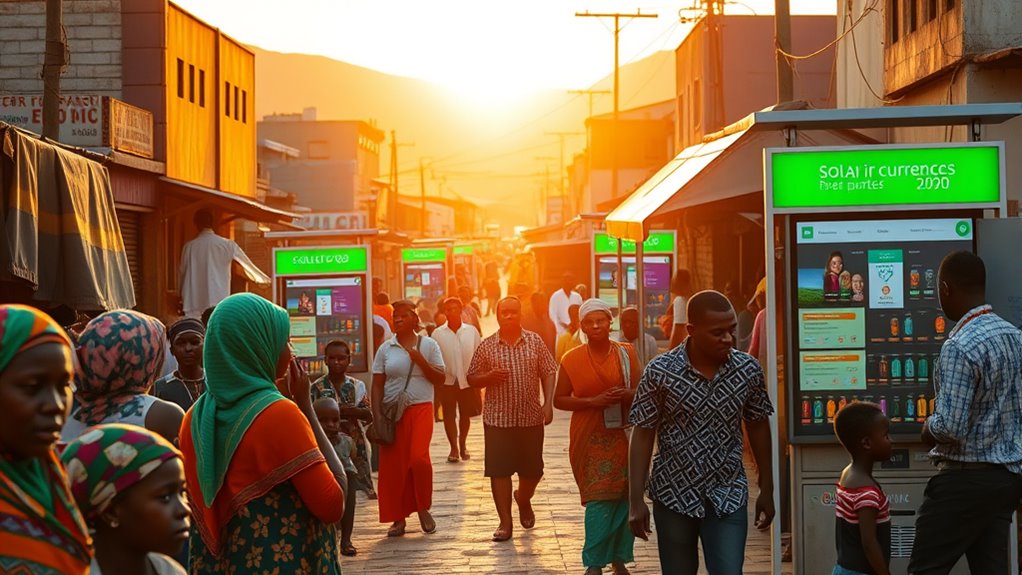
South Africa is exploring pathways to implement Universal Basic Income as a means to address persistent poverty and economic inequality. The country faces high unemployment rates and limited social protection, prompting policymakers to contemplate UBI as a solution. Proposed models include targeted cash transfers, phased pilot programs, and integrating UBI into existing social welfare frameworks. Funding options are under discussion, such as taxes on automation profits or reallocating budget resources. Challenges include ensuring fiscal sustainability, building public support, and leveraging technology for efficient delivery. Early pilots aim to assess uptake, impact on poverty, and administrative feasibility. If successful, South Africa could set a precedent for broader adoption across the continent, helping to reduce inequality and foster economic resilience in the face of ongoing structural challenges.
Addressing Job Displacement Through Universal Support

Job displacement caused by rapid automation and AI advancements poses a significant challenge for policymakers seeking sustainable solutions. To address this, universal support systems like UBI become essential. These programs can cushion the blow for workers impacted by automation, providing financial stability while they shift to new roles or skills. By ensuring a safety net, you help reduce economic insecurity and social inequality. You might focus on:
- Implementing flexible retraining programs that adapt quickly to technological shifts
- Offering targeted support for sectors most affected by automation
- Encouraging policies that promote lifelong learning and skill development
- Investing in specialized occupational training to better prepare workers for evolving industry demands
This approach not only mitigates immediate job losses but also prepares your economy for ongoing technological changes. It’s about creating a resilient workforce that benefits from automation rather than suffers from it.
Future Outlook: Opportunities and Risks

As we look ahead to 2030, the integration of Universal Basic Income presents both promising opportunities and notable risks. You could see increased economic growth, driven by automation and higher productivity, boosting global prosperity. UBI might help eradicate extreme poverty and promote financial inclusion, creating more equitable societies. However, funding remains a major challenge; proposals like robot taxes or sovereign wealth funds carry uncertainty and political hurdles. There’s also the risk of dependency or reduced motivation to work if not carefully managed. Technological advancements could streamline UBI distribution but may widen digital divides. Additionally, leveraging solar power and other renewable energy sources could provide sustainable funding mechanisms for UBI initiatives in the future. Ultimately, the success of UBI depends on balancing innovative funding strategies with safeguarding social resilience, making it a essential but complex policy tool for shaping future societies.
Frequently Asked Questions
How Will UBI Funding Mechanisms Adapt to Economic Fluctuations?
You’ll see UBI funding mechanisms adapting to economic fluctuations through diverse strategies. When the economy slows, governments might boost taxes on automation profits or implement a robot tax to sustain UBI. During growth, they could leverage sovereign wealth funds or increase progressive taxes on high earners. These adaptable approaches help guarantee UBI remains sustainable, even amid economic ups and downs, maintaining social stability and reducing inequality.
What Technological Barriers Might Hinder UBI Implementation by 2030?
Technological barriers might hinder UBI implementation by 2030, but they also offer solutions. While outdated infrastructure or limited digital access can exclude marginalized populations, advancements in AI and blockchain can streamline distribution and transparency. You’ll need to address digital divides and guarantee reliable, secure systems. Conversely, leveraging innovative tech can make UBI more efficient, inclusive, and adaptable, turning potential obstacles into opportunities for a smoother rollout.
How Will UBI Impact Traditional Social Welfare Programs?
You’ll see UBI transform traditional social welfare programs by simplifying and streamlining support. Instead of complex eligibility criteria, people receive a consistent income, reducing bureaucracy. It could replace or complement existing systems like unemployment benefits or food assistance, making aid more accessible. UBI also encourages independence, giving you a safety net during economic shifts. Overall, it shifts focus towards proactive income support, fostering social equity and economic resilience.
What Political Challenges Could Delay Global UBI Adoption?
You might imagine political resistance as a mountain standing firm, blocking the path to global UBI. Leaders and interest groups could oppose it, fearing tax hikes, reduced work incentives, or redistribution threats. Public skepticism and ideological divides may deepen these divisions, making consensus elusive. Without unified political will, implementing worldwide UBI faces delays, as governments grapple with balancing economic reforms and social equity amidst conflicting priorities.
How Will UBI Influence Income Inequality Across Different Regions?
You’ll see UBI help reduce income inequality, especially in regions with high poverty levels, by providing a safety net for marginalized populations. It promotes financial inclusion and can narrow wealth gaps. However, the impact varies—developed regions might see more balanced income distribution, while developing areas could face challenges due to funding and implementation. Overall, UBI has the potential to foster greater economic equity worldwide.
Conclusion
By 2030, over 60 countries are expected to have piloted or adopted Universal Basic Income programs, transforming social safety nets worldwide. You’ll see how automation could displace up to 30% of jobs, making UBI essential for financial stability. Embracing innovative funding and inclusive policies will be indispensable. If you stay informed and adaptable, you can help shape a future where economic security is a universal right, not just an aspiration.