
For most people seeking AI meeting transcription software, I’d start with the HiDock H1E, which pairs meeting note-taking with a desk dock, while the Philips SpeechExec suits buyers who want a more traditional transcription workflow. Wearable options such as the Fieldy 3 may fit people who need to capture conversations away from a desk. The main tradeoffs are whether you want a dedicated recorder or software, how much you value summaries and translation, and whether the device fits your routine. Hardware convenience can come with app and ecosystem dependencies, while software-first workflows may require more setup. Read on for a comparison of all 13 picks, including who each one suits and what to check before choosing.

Get business pricing on tech for your team
- Business-only prices and quantity discounts
- Tax-exempt purchasing
- Multiple users, one account, clear invoices
Key Takeaways
- Hardware and software solve different problems: the HiDock H1E combines recording with a desk setup, while Philips SpeechExec is the lineup’s dedicated transcription software option.
- Wearability is a practical dividing line: the Fieldy 3, wristband recorder, and Apple Watch-band recorder are aimed at hands-free capture rather than desk-centered meetings.
- Storage figures alone do not determine usefulness: devices such as the NOTEVOX with 128GB and several 64GB recorders still need to fit your transfer, app, and transcription habits.
- Translation and transcription are separate needs: several recorder listings include translation, but buyers should check supported languages and whether the feature works live or after recording.
- The strongest fit depends on where meetings happen: the roundup spans desk docks, pocket recorders, wearables, a pen, and standalone software, so format may matter more than a long feature list.
| viaim NoteKit AI Meeting Voice Recorder |  | Best for Meeting Follow-Through | Transcription languages: 145 | Compatible operating systems: Windows 10+ and macOS | Microphones: Dual built-in microphones | VIEW LATEST PRICE | See Our Full Breakdown |
| AI Voice Recorder with Automatic Transcription and Real-Time Translation |  | Best for Offline Capture and Multilingual Use | Storage capacity: 32 GB | Microphones: 1 bone-conduction microphone and 4 omnidirectional microphones | Maximum recording time: Approximately 2,270 hours | VIEW LATEST PRICE | See Our Full Breakdown |
| DOWAY AI Voice Recorder and Note Taker, 64GB, Silver Gray |  | Best for High-Capacity Recording | Storage capacity: 64 GB | Recording time: Up to 35 hours | Microphones: Two ENC microphones | VIEW LATEST PRICE | See Our Full Breakdown |
| RECPOINT AI Voice Recorder with Transcription and Summarization |  | Best for Simple On-Device Controls | Storage capacity: 64 GB | Battery life: Up to 30 hours | Transcription and translation languages: 150 | VIEW LATEST PRICE | See Our Full Breakdown |
| Philips SpeechExec Transcribe Software, 2-Year Subscription, Version 11.5 |  | Best for Human Transcription Workflows | Model: LFH4622/00 | Software version: 11.5 | Subscription term: 2 years | VIEW LATEST PRICE | See Our Full Breakdown |
| Wearable AI Voice Recorder Wristband with Transcription, Summaries, and Mind Maps |  | Best for Hands-Free Wearable Recording | Weight: 22 g | Storage: 1 GB | Recording duration: 10 hours | VIEW LATEST PRICE | See Our Full Breakdown |
| AI Voice Recorder with Magnetic Back, Transcription, Summaries, and Translation |  | Best for Phone-First Meeting Notes | Storage: 32 GB | Recording format: WAV | Continuous recording: Up to 8 hours | VIEW LATEST PRICE | See Our Full Breakdown |
| Fieldy 3 Wearable AI Note-Taking Device, Black |  | Best for Searchable, Privacy-Minded Notes | Weight: 8 g | Dimensions: 0.45 × 1.35 × 1.7 in | Transcription languages: 100+ | VIEW LATEST PRICE | See Our Full Breakdown |
| NOTEVOX AI Voice Recorder with 128GB Storage and Transcription App |  | Best for High-Capacity Local Recording | Storage: 128 GB | Recording time: 14 hours listed | Battery-life listings: 14 hours in specifications; 24 hours in item highlight | VIEW LATEST PRICE | See Our Full Breakdown |
| Gem AI Voice Recorder for Apple Watch Bands |  | Best for Multilingual Long-Session Recording | Compatible Apple Watch models: Series 1–11, SE, and Ultra | Recording battery life: Up to 20 hours | On-device audio storage: Up to 300 hours | VIEW LATEST PRICE | See Our Full Breakdown |
| HiDock H1E AI Meeting Note-Taker and 8-in-1 Docking Station |  | Best for a Desk-Based Meeting Setup | Transcription languages: 75 | Storage: 32 GB | Digital recording time: Up to 1,000 hours | VIEW LATEST PRICE | See Our Full Breakdown |
| Neyes AI Voice Recorder Pen with Transcription and Real-Time Translation |  | Best for Lectures and Multilingual Notes | Storage: 32 GB | Recording time: About 10 hours | Languages supported: Up to 150 | VIEW LATEST PRICE | See Our Full Breakdown |
| Tupuniu AI Voice Recorder with 64GB Storage and Transcription |  | Best for Broad Language Coverage | Storage: 64 GB | Supported languages: 255 | Display: 1.3-inch OLED | VIEW LATEST PRICE | See Our Full Breakdown |
| AI meeting transcription software | Weight |
|---|---|
| viaim NoteKit AI Meeting Voice | 0.3 oz (8.53 g) |
| AI Voice Recorder with Automat | — |
| DOWAY AI Voice Recorder and No | Approximately 1.12 oz (32 g) |
| RECPOINT AI Voice Recorder wit | — |
| Philips SpeechExec Transcribe | — |
| Wearable AI Voice Recorder Wri | 22 g |
| AI Voice Recorder with Magneti | — |
| Fieldy 3 Wearable AI Note-Taki | 8 g |
| NOTEVOX AI Voice Recorder with | — |
| Gem AI Voice Recorder for Appl | — |
| HiDock H1E AI Meeting Note-Tak | 520 g |
| Neyes AI Voice Recorder Pen wi | 1.2 oz |
| Tupuniu AI Voice Recorder with | 30 g |
More Details on Our Top Picks
viaim NoteKit AI Meeting Voice Recorder
The viaim NoteKit stands out for turning a recording into more than a transcript: its app can produce summaries, to-do lists, mind maps, and smart Q&A. That makes it a stronger fit for people who need to turn meetings into next steps than the Philips SpeechExec, which focuses on organizing dictation and transcription work rather than AI meeting notes. Its 145-language support and dual microphones rated for pickup up to 16.4 feet add flexibility for multilingual or small-room discussions. The tradeoff is that transcription and cloud features depend on authorization and the viaim service, so this is not a fully self-contained transcription workflow. The listed dimensions also conflict, making its exact physical size harder to judge from the product data.
Pros:- AI output includes summaries, to-do lists, mind maps, and smart Q&A.
- Supports transcription and translation in 145 languages.
- Dual microphones have a stated pickup range of up to 16.4 feet.
- Lightweight design and one-press recording suit quick meeting capture.
Cons:- AI transcription and cloud features require authorization and the viaim app or service.
- Product details give conflicting dimensions.
- The recorder uses AAA batteries rather than a built-in rechargeable battery.
Best for: People who record in-person meetings and want AI-generated action items, summaries, and follow-up notes across multiple languages.
Not ideal for: Buyers who need transcription without an app or cloud service, or who need precise verified device dimensions before purchasing.
- Transcription languages:145
- Compatible operating systems:Windows 10+ and macOS
- Microphones:Dual built-in microphones
- Microphone pickup range:Up to 16.4 ft (10 m)
- Recording modes:3
- Digital recording time:8 hours
- Audio format:WAV
- Encryption:AES-256/TLS
- Weight:0.3 oz (8.53 g)
Our verdict“Choose the NoteKit if meeting action items matter as much as transcripts and you are comfortable using viaim’s app-based AI workflow.”
AI Voice Recorder with Automatic Transcription and Real-Time Translation
This card-sized recorder is the clearest choice here for capturing audio when a phone or Wi-Fi connection is unavailable: it can record independently, then use the InnAIO Pro app for transcription, summaries, and translation. Its 32 GB storage and stated battery life of up to 50 hours favor longer stretches away from a charger, while the DOWAY recorder offers more storage at 64 GB but a shorter stated recording time. The five-microphone setup, including a bone-conduction microphone, is designed for varied recording situations, and translation support covers more than 140 languages. The main limitation is the split between offline recording and connected AI: transcription and some translation features still rely on the app or internet, so it is not a fully offline transcription tool.
Pros:- Records without Wi-Fi or a smartphone connection.
- 32 GB storage and up to 50 hours of stated battery life support extended capture.
- Five-microphone array includes one bone-conduction microphone.
- Supports app-based transcription, meeting summaries, and translation in more than 140 languages.
Cons:- Transcription and AI summaries require the InnAIO Pro app.
- Some translation and cross-app features may need an internet connection.
- The many translation and voice features may be unnecessary for buyers seeking only meeting transcripts.
Best for: Traveling professionals and multilingual teams who need a standalone recorder first and app-based transcription or translation after recording.
Not ideal for: Users who want transcripts generated entirely on the device or who prefer a transcription workflow that does not depend on a companion app.
- Storage capacity:32 GB
- Microphones:1 bone-conduction microphone and 4 omnidirectional microphones
- Maximum recording time:Approximately 2,270 hours
- Battery life:Up to 50 hours
- Translation languages:More than 140
- Translation latency:0.5 seconds
- Recording range:Up to 5 meters
- Connectivity:Bluetooth, USB Type-C, and Wi-Fi
- Dimensions and weight:54 × 86 × 5.3 mm; 40 g
Our verdict“Pick this recorder if independent audio capture and broad multilingual translation matter more than keeping AI processing offline.”
DOWAY AI Voice Recorder and Note Taker, 64GB, Silver Gray
The DOWAY pairs 64 GB of storage with up to 35 hours of recording, giving frequent note-takers more room for long sessions than the 32 GB AI Voice Recorder with Automatic Transcription and Real-Time Translation. Its app can turn audio into transcripts, summaries, mind maps, and action items, so the value is in carrying a substantial archive and extracting structured notes afterward. The dual ENC microphones and compact magnetic aluminum design suit everyday meeting capture, while a vibration sensor adds call recording on compatible smartphones. That call feature is less universal than ordinary room recording, and AI processing requires an internet connection and a compatible phone. Language access and transcription limits also vary by app plan, so buyers should check the applicable allowance before relying on it for regular multilingual work.
Pros:- 64 GB storage holds a large archive of recordings.
- App-generated notes include transcripts, summaries, mind maps, and action items.
- Up to 35 hours of stated recording time supports long use between charges.
- Magnetic aluminum body comes with charging and attachment accessories.
Cons:- AI processing requires an internet connection and compatible smartphone.
- Call recording depends on smartphone compatibility and recording conditions.
- Language coverage and transcription allowances vary by app plan.
Best for: People who record meetings often, want generous onboard storage, and will use a smartphone app to create structured notes after sessions.
Not ideal for: Buyers who need guaranteed phone-call recording across devices, offline AI transcription, or a fixed transcription allowance independent of app plans.
- Storage capacity:64 GB
- Recording time:Up to 35 hours
- Microphones:Two ENC microphones
- Call recording:VCS vibration sensor; compatible smartphones required
- Bluetooth:5.3
- Supported languages:152 during included first-year AI access
- Included AI transcription:Unlimited in 118 languages; 300 minutes per month in 34 additional languages
- Battery capacity:400 mAh
- Weight:Approximately 1.12 oz (32 g)
Our verdict“Choose DOWAY if storage capacity and structured AI notes are priorities and the app-dependent limits fit your workflow.”
RECPOINT AI Voice Recorder with Transcription and Summarization
RECPOINT makes the recording step especially direct: a one-touch control and OLED status screen help users start and check a session without relying on a phone for basic operation. Its 64 GB storage, dual microphones with AI noise cancellation, and support for transcription and translation in 150 languages give it a broad meeting-capture remit. Compared with the DOWAY, RECPOINT provides an OLED screen and a higher stated language count, while DOWAY specifies up to 35 hours of recording and gives clearer detail on its app’s transcription allowances. RECPOINT’s AI features include summaries, mind maps, and action items, but the listed 360 monthly minutes for transcription and summarization may constrain heavy users. The product data also omit continuous recording time per charge, making battery planning less certain.
Pros:- One-touch recording and OLED screen simplify starting and checking sessions.
- Dual microphones include AI noise cancellation.
- 64 GB storage and up to 30 hours of stated battery life support regular use.
- AI features include summaries, mind maps, and action items.
Cons:- Transcription and summarization are listed at 360 monthly minutes.
- Continuous recording time per charge is not specified.
- The listed 2.5 mm headphone jack may require an adapter for common headphones.
Best for: People who want quick physical recording controls, a visible status screen, and AI meeting notes for moderate monthly use.
Not ideal for: Heavy transcription users who may exceed the stated monthly AI minutes or buyers who need a clearly specified continuous recording time per charge.
- Storage capacity:64 GB
- Battery life:Up to 30 hours
- Transcription and translation languages:150
- Recording controls:One-touch button
- Display:OLED
- Microphones:Dual microphones with AI noise cancellation
- AI minutes:360 monthly minutes for transcription and summarization; 720 monthly minutes for translation
- Body material and thickness:Aluminum alloy; 3.5 mm
- Supported file formats:.doc, .txt, .xls, .xml
Our verdict“Choose RECPOINT if straightforward physical controls and an OLED display matter more than generous stated monthly AI minutes.”
Philips SpeechExec Transcribe Software, 2-Year Subscription, Version 11.5
Philips SpeechExec is the outlier in this group: it is workflow software for dictation and transcription work, not a meeting recorder with AI-generated summaries. It organizes audio files and resulting documents, supports coordination between authors and transcriptionists, and lets users monitor each job’s status. That makes it a better match for offices with an established human transcription process than the viaim NoteKit, which is built around automated transcripts and meeting follow-up tools. The tradeoff is equally clear: the supplied product details do not list AI transcription, meeting summaries, translation, or recording hardware. It also requires Windows 10 Pro or Enterprise, 64-bit, narrowing its fit to organizations using that specific desktop environment. Buyers seeking automatic meeting notes should choose a recorder with an explicit AI workflow instead.
Pros:- Organizes dictation audio and resulting documents in one workflow.
- Supports coordination between authors and transcriptionists.
- Allows users to monitor transcription work status.
Cons:- Product details do not specify AI transcription or automated meeting summaries.
- Requires Windows 10 Pro or Enterprise, 64-bit.
- Does not include a recording device in the supplied product description.
Best for: Windows-based offices that already assign dictation to authors and transcriptionists and need software to organize files and track work status.
Not ideal for: People seeking automatic AI meeting transcription, summaries, multilingual processing, or a standalone recorder.
- Model:LFH4622/00
- Software version:11.5
- Subscription term:2 years
- Operating system:Windows 10 Pro or Enterprise, 64-bit
- Primary workflow:Dictation file and document organization
- Work status tracking:Supported
- Country of origin:Austria
- Package dimensions:18.75 × 13.75 × 0.01 cm
Our verdict“Choose SpeechExec for managing a human dictation-to-transcription process, not for automated AI meeting notes.”
Wearable AI Voice Recorder Wristband with Transcription, Summaries, and Mind Maps
This wristband makes the most sense for buyers who want to capture a meeting or lecture without carrying a separate recorder. Its 22 g screenless design and double-press controls keep recording close at hand, while the GloryFitPro app adds speaker differentiation, summaries, and mind maps without a transcription subscription. Compared with the Gem AI Voice Recorder, it is less tied to a specific smartwatch ecosystem, but Gem offers far more recording capacity per charge and broader language support. The tradeoff here is a modest 10-hour recording limit, manual language selection, and dependence on a compatible phone for AI features. Its IP67 rating and interchangeable straps add everyday wear flexibility, though this is not a standalone transcription workflow.
Pros:- Creates speaker-differentiated transcripts, summaries, and mind maps in the companion app.
- Transcription is available without a subscription fee.
- Lightweight 22 g wristband with interchangeable nylon and silicone straps.
- IP67 dust and water resistance suits everyday wear.
Cons:- Users must select the recording language manually; automatic language detection is not supported.
- Transcription and AI tools require a compatible smartphone and the GloryFitPro app.
- Recording is limited to 10 hours, and there is no headphone jack.
Best for: People who want a lightweight wrist-worn recorder for short meetings, classes, or voice notes and are comfortable using an iOS or Android app afterward.
Not ideal for: Multilingual teams that switch languages often, or buyers who need long recording sessions and transcription without relying on a smartphone.
- Weight:22 g
- Storage:1 GB
- Recording duration:10 hours
- Battery life:About 10 days
- Microphone:Built-in omnidirectional
- Connectivity:Bluetooth
- Companion app:GloryFitPro for iOS and Android
- Water and dust resistance:IP67
Our verdict“Choose this wristband for hands-free, app-based notes from shorter sessions, but pick the Gem if longer recording capacity and broader language coverage matter more.”
AI Voice Recorder with Magnetic Back, Transcription, Summaries, and Translation
The magnetic back gives this recorder a clear niche: it can attach to a compatible phone, keeping a compact capture device close during in-person conversations. Its ZKEagle app handles transcription, summaries, translation, editing, and sharing, while WAV recording and 32 GB of storage leave room for source audio as well as text. Compared with the NOTEVOX AI Voice Recorder, it offers less onboard capacity but adds a magnetic phone attachment and wireless syncing. The app dependency is a real compromise: the AI functions are not a self-contained workflow, and continuous recording tops out at up to 8 hours per charge. Multi-microphone noise reduction and selectable pickup modes may help with speech capture, but buyers who need a full day of unattended recording should look at the Gem instead.
Pros:- App supports transcription, summaries, translation, transcript editing, and sharing.
- Multi-microphone noise reduction and omnidirectional or unidirectional modes support different recording settings.
- Wireless syncing and USB-C file transfer work with phones and Windows or Mac computers.
- Magnetic back and slim body make it easy to keep close to a compatible phone.
Cons:- Continuous recording is limited to up to 8 hours per charge.
- AI transcription and related features require the ZKEagle app.
- Its 32 GB storage is much smaller than NOTEVOX’s 128 GB.
Best for: Phone-centered professionals who record meetings or interviews, then want to edit, translate, and share transcripts from an iOS or Android app.
Not ideal for: People who need all-day continuous recording or want transcription features to work without connecting to a companion app.
- Storage:32 GB
- Recording format:WAV
- Continuous recording:Up to 8 hours
- Battery capacity:160 mAh
- Microphone modes:Noise cancellation, omnidirectional, and unidirectional
- Connectivity:Bluetooth, BLE, and USB Type-C
- App compatibility:iOS and Android
- Headphone jack:3.5 mm
Our verdict“Pick this recorder if you want app-based transcription and translation in a phone-friendly package, but choose NOTEVOX for substantially more onboard storage.”
Fieldy 3 Wearable AI Note-Taking Device, Black
Fieldy 3 is a strong fit for people who want searchable meeting notes rather than a library of audio files. It supports 100+ languages, adds speaker labels and AI summaries, and stores encrypted text instead of audio, a useful distinction for buyers who prefer not to retain recordings. Calendar and task integrations can move action items closer to the work that follows a meeting. Compared with the Gem AI Voice Recorder, Fieldy is smaller and lighter at just 8 g, but its free plan is capped at 150 transcription minutes per month, and its listed digital recording time is six hours. The optional subscription may add costs for users with heavier needs. Choose it for a discreet, text-centered workflow; skip it if keeping original audio or recording long sessions is part of your process.
Pros:- Transcribes in over 100 languages with speaker labels and AI summaries.
- Stores encrypted text rather than audio, with encryption in transit and at rest.
- Integrates with Google Calendar, Microsoft Outlook, and supported task services.
- Small 8 g wearable with silent haptic alerts and a status LED that can be turned off.
Cons:- Free Basic transcription is limited to 150 minutes per month.
- Additional features are available through an optional subscription.
- Listed digital recording time is six hours, and audio is not stored for later replay.
Best for: Professionals who want discreet, searchable notes across multiple languages, calendar links, and encrypted text storage without keeping audio files.
Not ideal for: Frequent meeting recorders who need more than 150 free transcription minutes per month or need saved audio for later review.
- Weight:8 g
- Dimensions:0.45 × 1.35 × 1.7 in
- Transcription languages:100+
- Free transcription allowance:150 minutes per month
- Digital recording time:6 hours at 16 kHz
- Battery life:168 hours
- Microphone:Built-in mono with noise filtering
- Data security:HIPAA-compliant; encrypted in transit and at rest; stores text, not audio
Our verdict“Choose Fieldy 3 for discreet, multilingual text notes and integrations, but favor Gem if you need longer recordings or want to retain audio.”
NOTEVOX AI Voice Recorder with 128GB Storage and Transcription App
NOTEVOX puts storage and direct controls ahead of wearable convenience. Its 128 GB internal capacity is the largest stated among these five options, giving buyers room to keep substantial source audio alongside app-generated transcripts, summaries, and mind maps. A color display and dedicated controls also make recording status easier to check than on the screenless wristbands. Compared with the magnetic ZKEagle recorder, NOTEVOX has four times the listed storage, while the ZKEagle is slimmer and attaches to compatible phones. The main caveats are a battery-life conflict in the listing—14 hours in the specifications versus 24 hours in an item highlight—and reliance on its dedicated app for phone-call recording. The listing claims real-time transcription in 32+ languages, but buyers should be comfortable with an app-led workflow.
Pros:- 128 GB internal storage provides substantial room for recorded audio.
- Companion app offers transcription, summaries, and mind maps.
- Color display and dedicated controls support quick recording checks.
- Phone-call recording is available through the dedicated app.
Cons:- Battery life is inconsistent in the listing: 14 hours in specifications and 24 hours in an item highlight.
- Phone-call recording requires the dedicated app.
- At 0.14 kg, it is less suited to unobtrusive wearable recording than Fieldy 3.
Best for: People who record many meetings, interviews, or calls and want ample onboard storage plus a screen and physical controls.
Not ideal for: Buyers who need verified all-day battery performance or want phone-call recording without using a dedicated app.
- Storage:128 GB
- Recording time:14 hours listed
- Battery-life listings:14 hours in specifications; 24 hours in item highlight
- Transcription languages:32+
- Recording features:Real-time transcription, summaries, mind maps, and offline recording
- Display:Color display
- Connectivity:USB 3.1 Type-C
- Headphone jack:3.5 mm
Our verdict“Choose NOTEVOX if keeping a large local audio library matters most, but consider Fieldy 3 for a lighter, text-focused wearable workflow.”
Gem AI Voice Recorder for Apple Watch Bands
Gem suits Apple Watch owners who want a recorder that can capture long stretches of conversation without requiring the phone to stay nearby after pairing. It records for up to 20 hours per charge, holds up to 300 hours of audio, and supports transcription in 153 languages and regional variants, with summaries, decisions, and action items. That gives it a wider language range and longer stated recording time than the DGGGDX wristband, while its 300-minute monthly free transcription allowance is less generous for heavy users than a no-fee transcription offer. Gem also requires a compatible Apple Watch—the watch is not included—and its IPX5 protection is not for showers or swimming. The paid plan beyond the monthly allowance makes ongoing transcription a possible extra commitment, but its cross-platform apps and calendar connections give it broader follow-up options than a simple recorder.
Pros:- Records up to 20 hours per charge and stores up to 300 hours of audio.
- Transcribes in 153 languages and regional variants, with summaries, decisions, and action items.
- Works with iOS and Android apps and supports macOS, Windows, and web platforms.
- Can record without a nearby phone after pairing and provides a red LED and tactile status feedback.
Cons:- Requires a compatible Apple Watch for co-wear; the watch is sold separately.
- Free transcription is limited to 300 minutes per month, with a paid plan needed for more.
- IPX5 protection is not suitable for swimming or showers.
Best for: Apple Watch owners who record long meetings or interviews in multiple languages and want summaries and action items across devices.
Not ideal for: People without a compatible Apple Watch, buyers who need unrestricted transcription, or anyone who plans to wear the recorder while swimming or showering.
- Compatible Apple Watch models:Series 1–11, SE, and Ultra
- Recording battery life:Up to 20 hours
- On-device audio storage:Up to 300 hours
- Transcription languages:153 languages and regional variants
- Free transcription allowance:300 minutes per month
- Microphone range:Up to 16.4 ft (5 m)
- Connectivity:Bluetooth 5
- Water resistance:IPX5; not suitable for swimming or showers
Our verdict“Choose Gem if you own a compatible Apple Watch and need long, multilingual recordings, but pick the DGGGDX wristband to avoid watch dependence and monthly transcription limits.”
HiDock H1E AI Meeting Note-Taker and 8-in-1 Docking Station
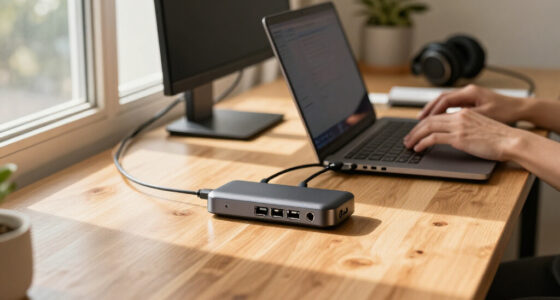
HiDock H1E is the clearest fit for someone who wants transcription built into a daily desk setup, rather than another standalone recorder to carry. Its HiNotes app supports 75 languages, AI summaries, VoiceMarks for flagging important moments, and bidirectional noise cancellation. The docking station adds 4K HDMI, Ethernet, and USB ports, so it can also serve as a work hub. Compared with the portable Tupuniu AI Voice Recorder, HiDock is less suited to capturing conversations away from your desk, but it offers a more integrated call-and-computer setup. There are tradeoffs: automatic recording must be activated in the app, and speaker identification and multi-format export require Pro membership. Its four-hour battery also makes it a weaker choice for long stretches away from power.
Pros:- Transcribes and summarizes in 75 languages through the HiNotes app.
- VoiceMarks help users return to important sections of a recording.
- Dock combines HDMI, Ethernet, USB-C, and USB-A connectivity.
- Bidirectional noise cancellation is designed to reduce noise on both sides of a call.
Cons:- Automatic recording and transcription must be enabled in the app.
- Speaker identification and multi-format export require Pro membership.
- Four-hour battery life is less suitable for extended recording away from a desk.
Best for: Remote and hybrid workers who take frequent calls at a fixed desk and want recording, transcription, and computer connectivity in one device.
Not ideal for: People who need a pocket recorder for full-day events or want speaker identification and expanded exports without a Pro membership.
- Transcription languages:75
- Storage:32 GB
- Digital recording time:Up to 1,000 hours
- Battery life:4 hours
- Microphone:Built-in mono microphone with noise cancellation
- Audio format:MP3
- Dock display support:Single 4K@60Hz HDMI display
- Dock ports:3 USB-C 3.2, 2 USB-A 3.2, 1Gbps Ethernet, 4K@60Hz HDMI, DC-In
- Weight:520 g
Our verdict“Choose HiDock H1E if you want meeting transcription alongside a practical desk dock; pick a standalone recorder if portability and longer recording sessions matter more.”
Neyes AI Voice Recorder Pen with Transcription and Real-Time Translation
The Neyes AI Voice Recorder Pen suits buyers who want a discreet recorder that can turn spoken material into more than a basic transcript. Its app offers summaries, mind maps, and real-time translation, with support for up to 150 languages and bilingual subtitles. That makes it more language-focused than the HiDock H1E, whose stronger case is a desk-based call setup with a docking station. The pen form is easy to carry to lectures or interviews, and 32 GB storage keeps recordings on the device. Still, this is not a self-contained transcription workflow: app features depend on a compatible smartphone or computer. Its listed recording time is about ten hours, so buyers covering long events should plan around that limit. The pen shape also prioritizes portability over the larger display and direct controls found on some recorders.
Pros:- Supports transcription, summaries, and mind maps through its app.
- Real-time translation and bilingual subtitles support up to 150 languages.
- Pen-sized design weighs 1.2 oz and includes replacement pen refills.
- 32 GB of storage provides room for recorded material.
Cons:- App-based transcription and related features require a compatible smartphone or computer.
- About 10 hours of recording time may not cover extended multi-session events.
- The pen form may offer fewer direct controls than a recorder with a dedicated display.
Best for: Students, interviewers, and multilingual professionals who want a pocketable recorder paired with app-based transcripts, summaries, and translation.
Not ideal for: People who need all-day recording, transcription without a phone or computer, or a dedicated desk-call dock.
- Storage:32 GB
- Recording time:About 10 hours
- Languages supported:Up to 150
- AI features:Transcription, summaries, mind maps, real-time translation, bilingual subtitles
- Microphone:Built-in
- Interface:USB 3.0 Type-C
- Dimensions:0.55 × 0.55 × 5.7 in
- Weight:1.2 oz
- Warranty:1 year
Our verdict“Choose Neyes for portable, multilingual lecture and interview notes, but favor a longer-running recorder if you routinely capture events beyond ten hours.”
Tupuniu AI Voice Recorder with 64GB Storage and Transcription
Tupuniu AI Voice Recorder is the language-coverage pick: it supports 255 languages and adds transcription, translation, summaries, mind maps, speaker identification, and live subtitles. Compared with the Neyes AI Voice Recorder Pen, it offers more stated language coverage and a display for device-level status, while Neyes takes a slimmer pen form and lists bilingual subtitles. Tupuniu also has 64 GB storage and exports in PDF, TXT, DOCX, and SRT, giving users several ways to work with transcripts after a meeting. The main constraint is its 10-hour battery and recording time, which can fall short for extended events. Transcription minutes are limited to 600 per month during the first year, and specialized professional dictionaries require the Unlimited plan, so the headline language count does not mean every workflow is included without limits.
Pros:- Supports transcription and translation in up to 255 languages.
- Includes summaries, mind maps, speaker identification, and live subtitles.
- 64 GB storage and PDF, TXT, DOCX, and SRT export support flexible file handling.
- Bluetooth 5.0 and USB-C provide two transfer options.
Cons:- Battery life and digital recording time are both listed as 10 hours.
- The first year includes 600 transcription minutes per month; additional plans are available afterward.
- Specialized professional dictionaries require the Unlimited plan.
Best for: Multilingual teams and travelers who need broad language support, speaker identification, and editable transcript exports from a compact recorder.
Not ideal for: Frequent long-session recorders or users who need unlimited monthly transcription and specialized professional dictionaries without a plan.
- Storage:64 GB
- Supported languages:255
- Display:1.3-inch OLED
- Battery life:10 hours
- Digital recording time:10 hours
- Connectivity:Bluetooth 5.0, USB-C
- Transcription allowance:600 minutes per month during the first year
- File exports:PDF, TXT, DOCX, SRT
- Weight:30 g
Our verdict“Choose Tupuniu for broad language coverage and export options, provided its monthly transcription allowance and 10-hour recording limit fit your workload.”
How We Picked
I compared these 13 options as tools for capturing and turning meetings into usable text, not as interchangeable voice recorders. The ranking prioritizes how directly each product supports a meeting workflow: recording access, transcription and summary features, ease of moving from capture to notes, and the practicality of its form factor. I also weighed the tradeoffs around app dependence, storage, translation claims, and whether a product is software-first or requires dedicated hardware.
The HiDock H1E ranks first because its meeting-note purpose is paired with a useful desk setup; Philips SpeechExec follows for buyers whose priority is transcription software rather than a wearable recorder. The remaining picks are ordered by the distinct use cases suggested by their formats and stated features, with no assumption that more storage or more bundled functions automatically means better transcripts. Product listings do not establish transcription accuracy, supported integrations, or subscription terms, so buyers should verify those details before committing.
Factors to Consider When Choosing AI Meeting Transcription Software
Choosing a meeting transcription tool starts with the way you capture conversations, then moves to what happens to the transcript afterward. I’d check the full recording-to-notes workflow before weighing extra features: an impressive feature list is of limited use if the device is awkward to carry or the transcript is hard to export.
Match the capture format to your meeting routine
A desk-based device, pocket recorder, wearable, and transcription app ask you to change your routine by different amounts. If most calls happen at one workstation, a desk-oriented option can keep capture close at hand. People moving between rooms or meeting clients may prefer a portable or wearable format, but should think about when recording is visible and appropriate. A pen-shaped recorder may be discreet, yet that form can make controls less obvious. Avoid choosing by appearance alone; check how recording starts, stops, and confirms that audio is being captured. The easiest device to use consistently is often more valuable than one with the longest feature list.
Check what happens between audio and a usable transcript
Transcription is only one step: you may also need speaker labels, searchable text, summaries, or a way to export notes to your team’s tools. Before choosing, map the workflow from ending a meeting to sharing its record. Ask whether processing happens on the device, in an app, or through an online service, and whether you need an account or an ongoing plan. A built-in summary can save time, but it does not replace checking names, decisions, and action items against the source audio. Commonly, buyers focus on whether transcription exists and overlook how transcripts are retrieved and organized. Favor a workflow that fits the way you already store meeting records.
Treat accuracy as a testable requirement
Transcript quality can vary with room noise, microphone placement, overlapping speech, accents, and technical vocabulary. Feature descriptions alone cannot tell you how a tool will handle your team’s actual meetings. If accuracy matters for decisions or compliance, test a representative recording before relying on the transcript as the official record. Look for easy playback alongside text so you can check uncertain passages, and confirm whether speaker identification is available if you need attribution. Do not assume a polished summary means every sentence in the transcript is correct. A short trial with realistic audio can reveal more than a long specification list.
Separate live translation from translated transcripts
Translation features can refer to different jobs: showing translated speech during a conversation, translating audio afterward, or converting an existing transcript into another language. Those uses are not interchangeable. If meetings involve multiple languages, identify the exact language pairs and when translation occurs before selecting a recorder. Consider whether participants need to follow the conversation live or whether a translated record afterward is enough. Also check how the tool handles names, specialist terms, and switching between languages. Paying for a translation feature that does not fit the meeting’s timing adds complexity without solving the real communication problem.
Look beyond storage capacity to access and retention
Storage capacity matters most when recordings are long, frequent, or kept on the device before transfer. It does not tell you how easily you can find a recording, back it up, or remove it when it is no longer needed. Check whether files can be exported in a format your team can use and whether transcripts remain accessible if you stop using the companion app. For work conversations, review where audio and text are processed and stored, who can access them, and how deletion works. A larger capacity can postpone file management, but it cannot replace a retention policy. Choose storage around your real capture volume and your organization’s data rules.
Compare total workflow cost and flexibility
A recorder’s purchase is only one part of the decision if transcription depends on an app, cloud processing, or a subscription. Confirm which features require recurring payments, whether usage is limited, and what happens to past transcripts if a plan ends. Software can be easier to update or use across devices, while dedicated hardware can make capturing audio more straightforward. Bundled extras such as docks, wearable bands, or mind maps are useful only when they replace something you already do. Buyers often overvalue included features and undercheck export options and plan terms. Favor the setup that keeps working with your calendar, devices, and note-taking habits over time.
Frequently Asked Questions
Should I choose transcription software or a dedicated AI recorder?
I’d choose software when meetings already happen on a computer and your main need is turning call audio into searchable notes. A dedicated recorder makes more sense when you need to capture in-person conversations or want a separate physical control for recording. Check whether the software can access the calls you actually use and whether the recorder’s app can export transcripts where you work. The listed products span both approaches, so their feature sets are not directly comparable. Your capture setting should decide the format before you compare extras.
Can I rely on an AI transcript as the official meeting record?
I would not rely on an unreviewed transcript as the sole official record, especially when decisions, names, or obligations matter. Speech recognition can mishear people in noisy rooms, overlapping conversation, and specialist discussions. Keep access to the original audio so you can verify uncertain passages, then review action items and key decisions before sharing. If your organization has rules for recording or retaining meetings, follow those rules regardless of the tool’s features. Test the product with representative meetings before making it part of a formal process.
What should I check before buying a recorder with translation?
Find out whether translation is live, applied after a recording, or limited to translated text. Confirm that the languages you need are supported and check how the feature behaves when speakers switch languages or use technical terms. Ask whether translation requires an internet connection, an app, or a separate plan. A translation label does not establish that every language pair or meeting setup is supported. If live comprehension is the goal, test that specific use rather than relying on a translated transcript example.
Is more onboard storage more important than app and export support?
For many buyers, app access and export flexibility matter more once the device has enough room for normal recording needs. Storage tells you how much audio may stay on the recorder; it does not tell you whether transcripts are easy to retrieve, back up, or share. Check file formats, transfer steps, and what happens to saved notes if you stop using the companion app. Buyers who record long sessions offline may place more weight on capacity. Match storage to your recording volume, but do not let a large number distract from the full workflow.
How can I decide whether a wearable recorder is suitable for work meetings?
Start with the setting: a wearable can suit people who move between conversations, but may be less natural for scheduled desk calls. Check how clearly it signals recording, how easily you can control it, and whether its microphone placement works for the people speaking. Think about workplace policy and participant consent before using any always-available capture device. Also verify whether recordings and transcripts transfer into a system your team can manage. A wearable is a good fit only if hands-free capture outweighs those practical and privacy requirements.
Conclusion
For a desk-centered workflow, my best overall pick is the HiDock H1E, while Philips SpeechExec is the better fit for buyers focused on transcription software. I’d call the best value the recorder that meets your capture needs without requiring features or storage you will not use; compare the 64GB options and the NOTEVOX’s 128GB against app and export support before deciding. The listings do not establish a clear best premium choice, so I would judge that by verified workflow, support, and plan terms rather than bundled extras alone. For beginners, pick the format with the simplest recording and transcript retrieval process, then test it before relying on it for important notes. For specific needs, consider a wearable for mobile capture, a translation-equipped recorder for multilingual use, or the pen format when that shape suits your routine. In every case, confirm compatibility, transcription limits, privacy handling, and export options before choosing.