
AI automation software can connect apps, run workflows, and use AI agents to handle work that once required manual steps. For this roundup, n8n AI Automation Cookbook is the best overall guide for readers who need practical workflows alongside enterprise topics, while AI Automation with Claude stands out for beginners and Self-Hosted AI Automation with n8n and MCP for readers prioritizing control. The main tradeoff is between hands-on implementation, accessible explanations, and deeper coverage of governance or self-hosting. These books differ in how much they teach you to build versus how much they explain strategy and operations. Read on for the full comparison and guidance on choosing the right starting point.

Get business pricing on tech for your team
- Business-only prices and quantity discounts
- Tax-exempt purchasing
- Multiple users, one account, clear invoices
Key Takeaways
- Practical n8n projects lead this lineup: several guides focus on building workflows, connecting services, and integrating language models, making implementation a stronger theme than platform-neutral tool comparisons.
- The best starting point depends on technical depth: AI Automation with Claude is framed for beginners, while the n8n titles and the self-hosting guide suit readers ready to work through more technical setups.
- Governance separates enterprise-focused learning from build-first instruction: n8n AI Automation Cookbook addresses governance and multi-agent systems, while Untangling AI foregrounds business success and organizational automation.
- Self-hosting is a control-versus-maintenance choice: Self-Hosted AI Automation with n8n and MCP speaks to readers seeking more control, but that direction generally calls for greater responsibility for setup and upkeep.
- Not every useful guide is a software tutorial: Agentic Software: The App Layer Wins and AI Agents: From Theory to Operations offer broader perspectives on agent systems, which may help with planning but provide a different kind of value from project-led n8n books.



| AI automation software | Format | Platform | Subject |
|---|---|---|---|
| n8n AI Automation Cookbook: Se | Cookbook | n8n | — |
| Untangling AI: Driving Busines | Book | — | — |
| n8n 2.0 AI Agents and Automati | Book | n8n 2.0 | — |
| Self-Hosted AI Automation with | Book | n8n | — |
| Agentic Software: The App Laye | Book | — | Agentic software |
| AI Agents: From Theory to Oper | Book | — | Business automation |
| AI Automation with Claude: A B | Book | — | AI automation |
| n8n AI Automation: Build Smart | Book | n8n | AI automation |
More Details on Our Top Picks
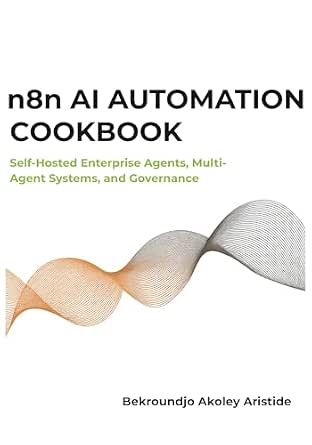
n8n AI Automation Cookbook: Self-Hosted Enterprise Agents, Multi-Agent Systems, and Governance
This cookbook is the most governance-focused choice in this group. Its emphasis on self-hosted enterprise agents, multi-agent systems, and governance suits readers who need to think beyond connecting a model to an app and account for how AI workflows are managed. Compared with n8n 2.0 AI Agents and Automation, which foregrounds app and API connections and LLM integration, this title signals a stronger focus on enterprise operating concerns. That focus may be useful for technical leads planning controlled deployments, but the supplied details do not confirm specific examples, platforms, or implementation steps. It is a narrower fit than Self-Hosted AI Automation with n8n and MCP, which lists security and observability topics alongside workflow construction. Choose this when governance and multi-agent design are your main questions; skip it if you need a clearly documented, broad build tutorial.
Pros:- Explicit focus on self-hosted enterprise agents
- Covers multi-agent systems
- Includes governance as a core topic
Cons:- Available product details do not specify practical examples or implementation depth
- Does not list security, observability, or integration coverage
- Its enterprise governance focus may be too specialized for readers starting with basic workflows
Best for: Technical leads evaluating self-hosted n8n agents who need guidance centered on governance and multi-agent design.
Not ideal for: Beginners seeking a confirmed step-by-step guide to app connections, APIs, and LLM setup, since those details are not specified.
- Format:Cookbook
- Platform:n8n
- Deployment focus:Self-hosted
- Agent topic:Enterprise agents
- System design topic:Multi-agent systems
- Governance:Covered
Our verdict“Choose this cookbook if enterprise governance and multi-agent n8n design matter more to you than a clearly specified integration tutorial.”
Untangling AI: Driving Business Success Through Enterprise Automation and AI Agents
Untangling AI is the business-oriented pick in a set otherwise weighted toward specific automation platforms and implementation topics. Its title centers on enterprise automation, AI agents, and business success, making it a plausible fit for leaders deciding where automation belongs in company operations rather than choosing a particular n8n workflow pattern. That positioning contrasts with Self-Hosted AI Automation with n8n and MCP, which names technical subjects such as local LLM workflows, RAG, and OAuth. The available information provides only the title, though, so I cannot confirm its methods, examples, or technical depth. That uncertainty makes it a less grounded choice for practitioners who need build instructions. It may suit a business audience seeking an enterprise-level framing, but readers should not assume it offers a hands-on automation playbook.
Pros:- Frames AI agents around enterprise automation
- Speaks directly to business success and organizational outcomes
- Offers a business-centered alternative to the n8n-specific titles
Cons:- Product data provides no description beyond the title
- No platform, tools, or implementation topics are confirmed
- The degree of technical detail and use-case coverage is unknown
Best for: Business leaders and operations strategists exploring how enterprise automation and AI agents could support company goals.
Not ideal for: Automation practitioners looking for verified platform-specific tutorials, code, or workflow-building instructions.
- Format:Book
- Primary subject:AI
- Automation focus:Enterprise automation
- Agent topic:AI agents
- Stated aim:Driving business success
- Platform specified:Not provided
Our verdict“Pick this for a business-level view of enterprise AI automation, but choose a more technically specified title for build guidance.”
n8n 2.0 AI Agents and Automation: Build Intelligent Workflows, Connect Apps and APIs, Integrate LLMs, and Create Powerful Agentic Systems
This is the clearest fit for readers who want to build with n8n 2.0 rather than focus mainly on enterprise policy or business strategy. The stated scope connects intelligent workflows with apps and APIs, then extends into LLM integration and agentic systems—a practical progression for someone assembling automations across services. Compared with n8n AI Automation Cookbook, this title gives more explicit attention to app and API connections, while the cookbook signals more emphasis on governance and self-hosted enterprise agents. Its tradeoff is that the supplied description does not mention security, observability, or deployment governance, topics that Self-Hosted AI Automation with n8n and MCP names directly. Buyers should also note that the available information does not establish the book’s project depth or prerequisites. It is a focused platform guide, not a confirmed enterprise operations manual.
Pros:- Specifically covers n8n 2.0
- Addresses connecting apps and APIs
- Includes LLM integration and agentic systems
Cons:- Available details do not mention security or observability
- Governance and self-hosting are not specified
- Project depth and required experience are not provided
Best for: Hands-on automation builders who want to connect apps and APIs in n8n 2.0 and add LLM-powered agent behavior.
Not ideal for: Enterprise teams whose main requirement is documented coverage of security, observability, or governance.
- Format:Book
- Platform:n8n 2.0
- Workflow topic:Intelligent workflows
- Integration topics:Apps and APIs
- AI topic:Large language model integration
- Agent topic:Agentic systems
Our verdict“Choose this for a direct n8n 2.0 path from connected workflows to LLM-based agents, not for a governance-led deployment guide.”
Self-Hosted AI Automation with n8n and MCP
Self-Hosted AI Automation with n8n and MCP has the broadest explicitly listed technical scope among these n8n titles. Alongside agents and workflow automation, it names MCP servers, local LLM workflows, RAG, APIs, and OAuth, then adds security and observability. That combination makes it a stronger match than n8n 2.0 AI Agents and Automation for readers planning a self-hosted system and weighing operational concerns as well as connections. The breadth is also a tradeoff: buyers seeking a narrow introduction to app linking may find this scope more involved than needed. The product data describes topics, not the level of instruction or whether examples are included, so it cannot confirm how hands-on the material is. For teams comparing technical subjects before choosing a guide, its stated coverage is unusually wide.
Pros:- Covers n8n alongside MCP servers and AI agents
- Includes local LLM workflows and RAG
- Names security and observability as topics
- Connects workflow development with APIs and OAuth
Cons:- Broad technical scope may be more than a basic workflow builder needs
- The available details do not confirm tutorial format or example depth
- Enterprise and self-hosting topics may be less relevant to cloud-only users
Best for: Technical practitioners planning self-hosted n8n automation who need to explore MCP, local models, RAG, and operational safeguards.
Not ideal for: Newcomers seeking a narrowly scoped introduction to basic n8n workflows or readers who do not need self-hosting and infrastructure topics.
- Format:Book
- Platform:n8n
- Protocol topic:MCP
- Deployment topic:Self-hosted AI automation
- AI topics:AI agents; local LLM workflows; RAG
- Integration topics:APIs; OAuth
- Operations topics:Security; observability
- Application focus:Enterprise automation
Our verdict“Choose this when your n8n project involves self-hosting and a mix of model, integration, security, and monitoring topics.”
Agentic Software: The App Layer Wins
Agentic Software: The App Layer Wins takes an operator’s perspective: its description centers on a founder building an AI workforce to run a real company. That makes it distinct from the n8n guides, which focus on tools, workflows, and technical building blocks. Readers interested in how AI agents might fit into day-to-day company operations may find this framing more relevant than the implementation-heavy scope of Self-Hosted AI Automation with n8n and MCP. The limitation is that the available product data does not name platforms, integrations, or specific automation techniques, so it is not a substitute for instructions on configuring an agent system. It is also identified as part of The Operator’s Playbook Library, suggesting a business-operations angle rather than a technical reference. Choose it for the operating story, not a confirmed how-to.
Pros:- Uses a real-company operating premise
- Focuses on an AI workforce rather than a single workflow
- Offers a founder and operator viewpoint distinct from the technical n8n guides
Cons:- Product data does not identify platforms or integrations
- Specific implementation methods are not described
- The available details do not establish how broadly the experience applies to other organizations
Best for: Founders and operators interested in how an AI workforce could support the running of a real company.
Not ideal for: Developers who need confirmed n8n, API, MCP, or LLM implementation instructions.
- Format:Book
- Subject:Agentic software
- Central concept:AI workforce
- Business context:Operating a real company
- Perspective:Founder
- Series:The Operator’s Playbook Library
Our verdict“Choose this for an operator-centered account of AI at work, and pair it with a technical guide if you need build instructions.”
AI Agents: From Theory to Operations
AI Agents: From Theory to Operations takes a broad business-oriented view of automation, connecting AI workflows with intelligent agents rather than centering on one platform. That makes it a useful contrast to AI Automation with Claude, which is framed for beginners building with a particular assistant, and n8n AI Automation, which emphasizes projects in a named workflow tool. The broad scope may suit readers who need to understand how agents fit into business processes before choosing an implementation path. The tradeoff is that the available description gives no detail about examples, technical depth, or supported tools, so I can’t verify how far it moves from concepts to actionable setup. Choose it for the business-automation framing; skip it if you need a clearly specified, platform-specific tutorial.
Pros:- Addresses business automation alongside AI workflows and agents
- Broad framing can help readers think beyond a single automation platform
- Its theory-to-operations focus signals an interest in applying agent concepts to work processes
Cons:- No details are provided about examples, exercises, or technical depth
- The description does not name platforms, integrations, or implementation requirements
- Less clearly project-focused than n8n AI Automation
Best for: Business operations leaders and automation planners who want a broad introduction to AI workflows and intelligent agents before committing to a particular tool.
Not ideal for: Readers who need step-by-step instructions for Claude, n8n, or another named platform; the available product information does not identify tools or project details.
- Format:Book
- Subject:Business automation
- Topics:AI workflows; intelligent agents
- Approach:Theory to operations
- Named platform:Not specified
- Project details:Not specified
Our verdict“Choose this guide for a broad business view of AI agents, but pick a platform-specific title if you need concrete build instructions.”
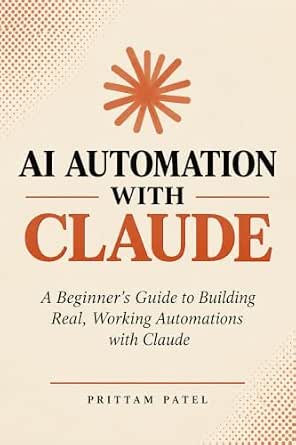
AI Automation with Claude: A Beginner’s Guide to Building Real, Working Automations with Claude
AI Automation with Claude is the clearest fit here for someone starting with a named AI assistant: its title promises beginner guidance and practical automations built with Claude. Compared with AI Agents: From Theory to Operations, it gives readers a more defined starting tool, while n8n AI Automation points toward building workflows in a dedicated automation platform. That specificity can help newcomers focus, but it also narrows the book’s apparent scope to Claude; the available description does not say whether it covers integrations, code, or ways to maintain automations. I would choose it when learning Claude-based automation is the priority, not as a general guide to agent systems or a substitute for an n8n-focused workflow tutorial.
Pros:- Clearly identifies Claude as the tool focus
- Designed for beginners rather than assuming advanced automation knowledge
- Promises practical automations, giving readers an applied learning aim
Cons:- The Claude focus may not transfer directly to other automation platforms
- No details are provided about integrations, coding requirements, or example projects
- The available description does not establish coverage of agents beyond Claude-based automation
Best for: Claude-curious beginners who want an introductory guide focused on building practical automations with that assistant.
Not ideal for: Readers seeking broad, platform-neutral coverage or detailed n8n workflow projects; the description centers on Claude and supplies no further technical specifics.
- Format:Book
- Skill level:Beginner
- Named tool:Claude
- Subject:AI automation
- Focus:Building practical automations
- Project details:Not specified
Our verdict“Pick this if you are new to automation and specifically want to build with Claude; choose n8n AI Automation for tool-based workflow projects.”
n8n AI Automation: Build Smarter Workflows, Agents, and Intelligent Systems with Real-World Projects
n8n AI Automation is the most explicitly project-oriented choice in this group: its description names n8n and promises real-world work with workflows, agents, and intelligent systems. That gives it a more concrete implementation angle than AI Agents: From Theory to Operations, whose description is broader, and a different route from AI Automation with Claude, which centers on one assistant rather than a named workflow tool. For readers who want to learn by building inside n8n, that distinction matters: the platform focus can turn concepts into repeatable workflow practice. The tradeoff is the same specificity that makes the book useful; readers who do not use n8n may find its lessons less directly applicable. The available information does not specify prerequisites, integrations, or project contents.
Pros:- Names n8n as the platform, giving the guide a clear implementation focus
- Covers workflows, agents, and intelligent systems
- Emphasizes real-world projects rather than concepts alone
Cons:- Its n8n focus may be less useful to readers working in other tools
- No project examples or specific integrations are identified in the available description
- Prerequisites and technical depth are not specified
Best for: Learners and automation builders who want to practice AI workflows and agent concepts through projects using n8n.
Not ideal for: Readers committed to Claude-only automation or looking for a platform-neutral business overview; this guide is specifically framed around n8n.
- Format:Book
- Platform:n8n
- Subject:AI automation
- Topics:Workflows; agents; intelligent systems
- Approach:Real-world projects
- Project details:Not specified
Our verdict“Choose this for practical AI automation projects in n8n; select a broader or Claude-focused guide if your preferred tool differs.”

How We Picked
I compared these eight titles as learning resources for AI automation software, rather than treating them as software platforms with interchangeable feature lists. The ranking gives more weight to practical build guidance, clarity about the intended reader, and how directly a book helps connect AI capabilities to real workflows. I also considered whether a title addresses operational concerns such as governance, self-hosting, or moving agent ideas into production.
Hands-on usefulness and fit explain the order: the n8n AI Automation Cookbook leads for its mix of workflow building and enterprise themes; the other n8n guides earn their places through distinct focus areas, including MCP, newer n8n workflows, and real-world projects. The beginner-focused Claude guide is a more approachable entry point, while strategy and theory titles rank lower for readers seeking implementation instructions—not because their perspectives lack value, but because they serve a different goal. Since these are books about automation, not automation platforms themselves, I separate learning value from claims about software performance.
| AI automation software | Format | Platform | Subject |
|---|---|---|---|
| n8n AI Automation Cookbook: Se | Cookbook | n8n | — |
| Untangling AI: Driving Busines | Book | — | — |
| n8n 2.0 AI Agents and Automati | Book | n8n 2.0 | — |
| Self-Hosted AI Automation with | Book | n8n | — |
| Agentic Software: The App Laye | Book | — | Agentic software |
| AI Agents: From Theory to Oper | Book | — | Business automation |
| AI Automation with Claude: A B | Book | — | AI automation |
| n8n AI Automation: Build Smart | Book | n8n | AI automation |
Factors to Consider When Choosing AI Automation Software
Choosing a guide to AI automation software starts with the work you want to do after reading. Match the book to your current skills, preferred tools, and need for hands-on building or broader operational guidance; the right fit is more useful than the broadest-sounding title.
Decide Whether You Need a Tutorial or a Strategy Guide
A build-focused book should help you turn a task into steps, connect the relevant services, and decide where an AI model belongs in the workflow. A strategy or theory book can help you plan adoption, but it may not supply the project-level instructions you need to build immediately. A common mistake is choosing by the word “AI” in the title without checking whether the book teaches implementation or frames the business problem. If you are responsible for delivery, prioritize examples and operational detail. If you are deciding what to automate across a team, business and governance perspectives may be more useful first. These goals can complement each other, but one book may not satisfy both equally well.
Match the Tooling to Your Existing Setup
Guides centered on n8n make the most sense if you expect to build in that workflow environment or want examples that use its approach. A Claude-focused guide narrows the learning path around a particular AI assistant, which can feel more direct for someone new to automation. Before choosing, list the services and models you already use and check whether the book’s examples map to them. Do not assume that a workflow transfers unchanged between tools: connectors, authentication, data handling, and model behavior can differ. A platform-specific guide can speed up learning while limiting how much of its instruction carries over elsewhere. If you are still choosing tools, favor concepts that explain the workflow logic as well as the interface.
Be Honest About Your Technical Starting Point
Automation projects can involve APIs, credentials, data formats, error handling, and deployment, even when an AI model writes part of the workflow. Beginners may benefit from a guided route with concrete projects instead of a title built around multi-agent systems or enterprise infrastructure. More experienced readers can gain from deeper subjects, but advanced terminology does not automatically mean the instructions suit their needs. A frequent misstep is starting with an ambitious agent design before mastering a dependable single workflow. Choose a learning curve that leaves room to practice rather than one that assumes skills you have not built yet. If you need to share the material with a mixed-skill team, plain explanations and incremental examples matter as much as technical range.
Choose Your Level of Control—and Upkeep
Self-hosting can offer more control over where workflows run and how the environment is managed, but it also places more setup and maintenance work on the operator. Hosted services may reduce infrastructure chores, though they can constrain configuration or change how data is handled. The right choice depends on your security requirements, technical support, and willingness to manage updates and failures. Do not treat self-hosting as a security feature by itself; a poorly maintained deployment can create new risks. A guide focused on self-hosted n8n and MCP is a better fit when those responsibilities are part of your plan, not merely an appealing phrase. If you lack an owner for operations, begin with a simpler learning environment before committing to a self-managed setup.
Look Beyond a Successful Demo to Operations
A workflow that succeeds once is not automatically ready for routine business use. Check whether your learning path addresses permissions, logging, failure alerts, human review, and recovery when an outside service changes. Agentic systems add another decision: which actions should an agent take on its own, and which need approval? A common mistake is automating a sensitive decision before defining a way to catch incorrect output. Governance-focused material can help teams set boundaries, while practical projects help build the underlying workflow; both perspectives may be needed. Pay for depth in operations when the automation will handle consequential data or work, rather than expecting a quick tutorial to cover every production concern.
Judge Value by Reuse, Not by Page Count
The most useful guide is one whose methods you can apply to more than a single example. Look for explanations of why a workflow is structured a certain way, how to adapt it, and how to handle predictable errors. Project-heavy books can get you moving quickly, but copied examples may break when your app versions, credentials, or data differ. Broader books may offer durable decision frameworks but less immediate build support. If you are new, a clear first project can be worth more than broad coverage; if you are leading a team, reusable governance and design principles may matter more. Decide what outcome would make the book worthwhile before choosing, then favor the title whose approach directly supports that outcome.
Frequently Asked Questions
Which guide is the best starting point if I have never built an AI automation?
AI Automation with Claude is the clearest beginner-oriented choice in this lineup because it is explicitly framed around building working automations with Claude. If you want to learn n8n instead, choose an n8n-focused title and expect a more tool-specific learning path. Start with one small, low-risk task rather than an agent that can make consequential decisions. Check whether you can follow the examples with the apps and accounts you already have. The best first guide is the one that helps you complete a useful workflow and understand how to maintain it.
Should I choose an n8n guide or a Claude-focused guide?
Choose based on what you want to learn: an n8n guide centers on workflow orchestration and connecting services, while the Claude guide offers a more focused route into automations built around Claude. If your main goal is to coordinate several apps or APIs, the n8n books are more directly aligned. If you are new and want a narrower entry point, the Claude title may be easier to approach. Neither choice guarantees that every example will match your tools or model access. Check the guide’s stated focus against the task you want to automate before committing.
Is a self-hosted AI automation approach right for a small team?
It can be a fit when the team needs greater control over its automation environment and has someone able to manage setup, updates, access, and troubleshooting. Small team size alone does not make self-hosting simpler; limited technical capacity can make maintenance a burden. Compare the control you gain with the time and responsibility you take on. If your goal is to learn the concepts, you can start with a simpler setup and decide about hosting later. Choose a self-hosting guide when infrastructure ownership is part of the real requirement, not just a preference in theory.
Do I need a guide about AI agents, or should I start with standard workflows?
Start with a standard workflow when the task has clear steps, predictable inputs, and a defined result. Agent-oriented approaches make more sense when the system must choose among actions or adapt to changing information, but they can be harder to control and troubleshoot. Books such as AI Agents: From Theory to Operations can help frame the operational questions, while project-led n8n titles focus more directly on building. Identify where fixed rules stop being adequate before adding agent behavior. For sensitive tasks, retain human review until you have a reliable way to monitor errors and limit permissions.
Which book should I choose if my organization needs governance as well as working examples?
n8n AI Automation Cookbook is the most directly matched option here because its stated scope combines practical automation with enterprise agents and governance. Untangling AI offers a more business-oriented view of enterprise automation, while the project-focused n8n titles can help with implementation. Governance is not a single chapter or tool setting; teams also need rules for data access, approvals, monitoring, and ownership. If the guide will inform an organization-wide rollout, pair implementation examples with a clear internal review process. Choose based on whether your immediate gap is building workflows, setting policy, or connecting those two needs.
Conclusion
Best overall: choose n8n AI Automation Cookbook if you want practical workflow learning alongside enterprise agents and governance. Best value for hands-on learning: n8n AI Automation: Build Smarter Workflows, Agents, and Intelligent Systems with Real-World Projects is the project-led pick for readers who want examples to work through. Best for beginners: AI Automation with Claude offers the most clearly beginner-oriented route. Best for self-hosting: choose Self-Hosted AI Automation with n8n and MCP when control and infrastructure ownership are part of your goal. Best for enterprise planning: Untangling AI suits readers focused on business adoption, while AI Agents: From Theory to Operations and Agentic Software: The App Layer Wins are better for readers seeking broader operational or strategic framing. Pick the title that matches your next task: learn a tool, build a workflow, manage an agent, or shape an organization-wide approach.