

European companies are adopting automation more slowly than their American counterparts due to regulatory hurdles, cultural resistance, and resource challenges. While Europe’s automation pace lags, sectors like automotive lead the push, with investments rising but still trailing US levels in robot density and implementation speed. If you want to understand how these differences impact productivity and what strategies could accelerate European automation acceleration, keep exploring the key factors shaping this industry gap.
Key Takeaways
- Europe’s AI adoption increased from 8% in 2023 to 13.5% in 2024, surpassing the US’s early 2025 rate of 8.7%.
- European firms, especially startups, are rapidly adopting AI for innovation; US firms focus on scaled, pragmatic integration.
- European automakers and industries are investing heavily in automation, with a 55% increase planned over three years.
- US companies lag in overall AI adoption, with slower growth due to regulatory and skills-related challenges.
- Europe’s cautious regulatory environment and cultural factors slow full AI and automation deployment compared to faster US adoption.

wlkata Mirobot 6DoF Mini Industrial Robotic Arm Professional Kit Programmable Lightweight Desktop Robotic Arm for K12 or 3D Printer
- Professional Kit Includes: Robot arm, controller, accessories, and more
- Multiple Control Methods: Software, app, and virtual control options
- Versatile Functionality: Laser engraving, drawing, handling, and expansion
As an affiliate, we earn on qualifying purchases.
As an affiliate, we earn on qualifying purchases.
Current State of AI Adoption in Europe and North America

While Europe has made notable progress in AI adoption, North American firms currently lead in overall implementation and scaling. In Europe, AI adoption among enterprises with 10 or more employees rose from 8% in 2023 to 13.5% in 2024, with large firms reaching 41.17%. UK companies increased from 9% to an expected 22%. Conversely, US firms showed an 8.7% adoption rate in early 2025, lagging behind Europe’s current figures. While European startups adopt AI rapidly—68% of digital-native companies—traditional large enterprises adopt more cautiously, often only superficially. The US demonstrates a more pragmatic, scaled approach, integrating AI into core operations faster. Despite European growth, American firms still hold a competitive edge in overall AI deployment and scaling capabilities. Moreover, emotional support plays a crucial role in addressing workforce changes associated with AI integration, ensuring employee well-being during this transition.

The AI Video Automation Factory: Build a Video Production System with Prompts
As an affiliate, we earn on qualifying purchases.
As an affiliate, we earn on qualifying purchases.
Industry Leaders and Key Sectors Driving Automation

The automotive sector remains the primary driver of automation in Europe, accounting for a significant portion of new robot installations and AI investments. This focus reinforces Europe’s industrial strengths but also highlights its reliance on legacy manufacturing. Leading companies, especially in Germany, Sweden, and Denmark, push automation to improve efficiency and competitiveness. Meanwhile, digital-native startups in Europe are rapidly adopting AI, using it for innovation and new service models. Large traditional firms are increasing investments, aiming to scale AI across operations. Additionally, Europe’s emphasis on system security assessments ensures that these technological advancements are integrated responsibly and securely across industries.

Robotic Process Automation Tools, Process Automation and Their Benefits: Understanding Rpa and Intelligent Automation
As an affiliate, we earn on qualifying purchases.
As an affiliate, we earn on qualifying purchases.
Barriers Hindering Broader Implementation in Europe

Europe faces significant hurdles that slow down the broader adoption of automation technologies. Costs, complexity, and regulatory burdens make it tough for many firms, especially SMEs, to invest confidently. Skills shortages in AI talent further delay progress, as companies struggle to find qualified workers. Fragmented funding and a lack of cohesive industrial strategy lead to uneven adoption across sectors. Cultural inertia also plays a role; many companies prefer testing AI before scaling, risking missed opportunities. Here’s a deeper look:
| Barriers | Impact |
|---|---|
| High costs | Limits SME automation |
| Regulatory hurdles | Causes risk aversion |
| Skills shortages | Slows talent development |
| Fragmented funding | Hampers coordinated growth |
| Cultural inertia | Delays full integration of AI |
Additionally, personality traits such as resistance to change can hinder organizational adaptation to new technologies.
The Four-Wheel Microchip: How Silicon Brains Power Self-Driving Cars: From Sensors to AI—The Hidden Technology Reshaping Roads, Safety, and the Future of Transportation
As an affiliate, we earn on qualifying purchases.
As an affiliate, we earn on qualifying purchases.
Investment Trends and Future Growth Projections
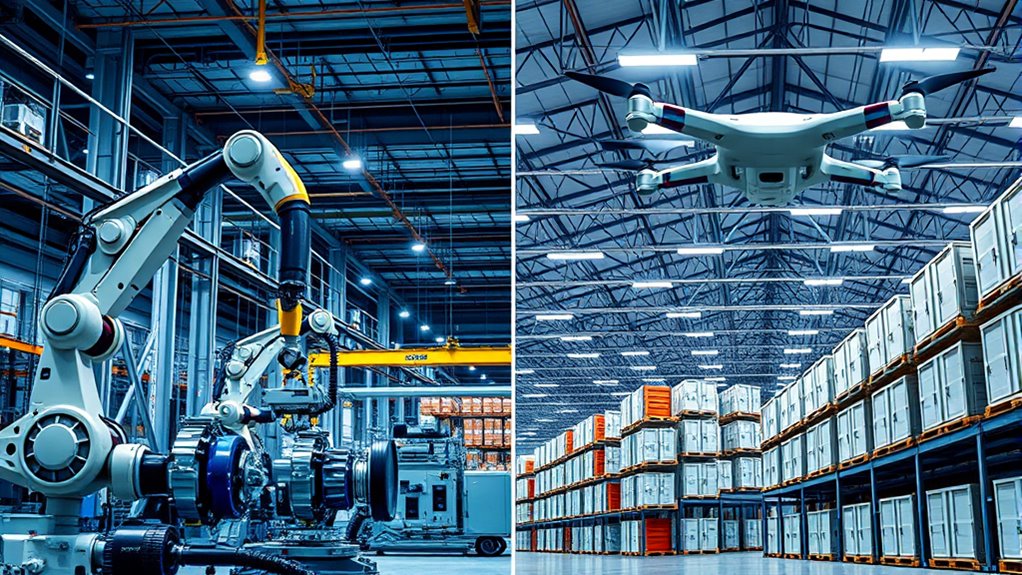
Recent investment trends indicate a strong upward trajectory in automation and AI across Europe, driven by strategic initiatives and increasing corporate commitments. You’ll see more European companies allocating funds toward scaling AI and robotics, aiming to boost productivity and competitiveness. The global AI market, valued at $391 billion in 2025, is projected to reach $1.81 trillion, signaling significant growth opportunities. European firms, especially large ones, plan to increase their AI investments by around 55% over the next three years, focusing on process optimization and talent development. AI security solutions are becoming increasingly important to safeguard these investments and ensure resilient operations. Greater investments in cloud infrastructure and data capabilities will accelerate automation adoption. Strategic collaborations and funding programs will help overcome skills shortages. Generative AI adoption is expected to rise rapidly, reaching 80% in Europe by 2026.
Differences in Robot Density and Industrial Automation Strategies

While investments in AI are gaining momentum across Europe, differences in robot density reveal contrasting automation strategies compared to North America. Europe’s average robot density stood at 219 robots per 10,000 employees in 2023, higher than North America’s 197 but below Asia’s rapid growth. Countries like Germany, Sweden, Denmark, and Slovenia rank among the top globally, mainly in automotive manufacturing. European automation is concentrated in traditional sectors, with SMEs lagging due to high costs and cautious adoption. Funding primarily targets R&D and pilot projects rather than large-scale deployment. In contrast, the US ranks 10th globally but adopts robots more pragmatically, focusing on practical deployment. This approach emphasizes scaling existing automation to improve efficiency, rather than broad, sector-wide innovation. Additionally, the emphasis on technological adoption reflects different strategic priorities that influence the pace and scope of automation across regions.
Impact on Worker Productivity and Economic Competitiveness

Your adoption of AI and automation directly impacts worker productivity and your company’s global competitiveness. When investments lag, productivity suffers, and competitors who scale faster gain an edge. Closing these gaps can unleash significant growth and strengthen your position in the international market. All Waterparks
AI’s Role in Productivity
AI plays a crucial role in boosting worker productivity and enhancing a country’s economic competitiveness. When you leverage AI tools effectively, you can automate routine tasks, freeing up your workforce for higher-value activities. This leads to faster decision-making, improved accuracy, and innovation acceleration. European firms, despite slower AI scaling, still see potential benefits, especially in sectors like automotive and manufacturing. To maximize AI’s impact, focus on:
- Scaling AI across operations to ensure productivity gains translate into tangible economic growth
- Investing in workforce skills to adapt to new automation technologies
- Fostering collaborative ecosystems that promote knowledge sharing and rapid adoption
Investment Gaps and Growth
Despite the recognized potential of AI to boost productivity, substantial investment gaps hinder European firms from fully capturing these benefits. Many European companies, especially SMEs, face high costs and complex implementation processes that slow adoption. Regulatory hurdles and safety standards foster a cautious, risk-averse culture, further delaying investment. Skills shortages in AI talent also restrict progress, making it harder to scale projects effectively. Meanwhile, American firms tend to allocate more resources toward AI and automation, enabling faster scaling and integration into core operations. As a result, Europe’s productivity lags behind, with worker efficiency at about 76% of US levels. Closing these investment gaps could release billions in revenue, considerably boosting Europe’s competitiveness and economic growth. Recognizing the importance of Beginners Guides can help companies better understand the fundamentals of automation and AI integration, accelerating their adoption efforts.
Competitiveness Through Automation
Automation plays a crucial role in shaping the competitiveness of European economies by directly impacting worker productivity and overall economic performance. When you invest in automation, you enable your workforce to operate more efficiently, reducing costs and increasing output. This boost in productivity can help your country stay competitive globally, especially against faster-adopting regions like North America.
A strategic approach to writing trailer music can also accelerate the adoption of automation by streamlining creative workflows and reducing production times.
- Accelerating automation adoption can close productivity gaps, revealing billions in revenue.
- Scaling AI and robotics enhances industry resilience and innovation capacity.
- Overcoming barriers like skills shortages and regulatory hurdles is key to maximizing economic gains.
Cultural and Regulatory Influences on Automation Adoption

You’ll notice that Europe’s cautious regulatory environment slows down automation progress, as safety standards and compliance requirements make companies hesitant to move quickly. Cultural attitudes also play a role, with many firms preferring to experiment carefully rather than fully commit to AI integration. This risk-averse mindset keeps Europe’s adoption pace behind more aggressive American approaches. Additionally, regional cybersecurity vulnerabilities, such as those exposed during the recent Cybersecurity vulnerabilities, can further influence the cautious approach toward automation.
Regulatory Caution Limits Speed
Regulatory caution considerably slows down automation adoption in Europe, as companies face strict safety standards, complex approval processes, and evolving data privacy laws. These regulations create hurdles that delay deployment and increase costs, making companies hesitant to fully integrate automation. This cautious approach stems from a desire to avoid legal risks and public backlash, often leading to pilot projects rather than large-scale rollouts. Additionally, the emphasis on vintage and rustic aesthetics in farmhouse bedroom design underscores the importance of incorporating vintage decor to enhance rustic charm and authenticity.
- Strict safety standards limit rapid deployment of new automation technologies.
- Complex approval procedures prolong decision-making timelines.
- Evolving data privacy laws constrain data-driven automation initiatives.
This regulatory environment encourages a risk-averse culture, which hampers swift adoption. While it ensures safety and privacy, it also results in slower technological progress compared to more flexible markets.
Cultural Risk Aversion
Cultural attitudes in Europe substantially influence how companies approach automation, often fostering a cautious and risk-averse mindset. You might notice European firms prioritize stability and reliability over aggressive innovation. Many leaders prefer pilot projects or limited deployments, hesitating to fully integrate AI into core operations. This conservatism stems from a strong emphasis on safety, quality, and regulatory compliance, which heightens perceived risks. Additionally, societal values around employment and social welfare make firms wary of automation’s potential job impacts. As a result, European companies tend to experiment slowly and scale cautiously, delaying widespread adoption. This cultural risk aversion creates a climate where innovation progresses steadily but at a slower pace compared to America’s bold, rapid deployment approaches.
Strategic Opportunities for Accelerating European Automation

To accelerate European automation, stakeholders must adopt a coordinated strategic approach that addresses current barriers such as high costs, skills shortages, and fragmented funding. You can unlock growth by focusing on targeted investments in talent development, streamlining funding channels, and fostering cross-sector collaboration. Emphasize the importance of aligning public policies with industry needs to create a stable environment for innovation. Encouraging shared R&D initiatives can reduce costs and de-risk automation projects. Additionally, expanding cloud infrastructure and data sharing will enable smaller firms to access scalable AI solutions. By tackling these areas, you’ll help bridge the gap with North America, boost productivity, and position Europe as a competitive leader in automation. These steps create a resilient foundation for sustained, widespread adoption.
Frequently Asked Questions
How Do Regulatory Differences Impact AI Deployment Speed in Europe Versus America?
Regulatory differences slow down AI deployment in Europe compared to America. You’ll find that Europe’s strict safety standards, data privacy laws, and complex approval processes make it risk-averse, delaying implementation. In contrast, America’s more flexible regulation allows you to test and scale AI rapidly. This regulatory environment impacts your ability to innovate swiftly, especially for SMEs, and hampers large-scale AI adoption across industries.
What Role Does Government Funding Play in Accelerating Automation in European SMES?
Government funding plays a pivotal role in accelerating automation in European SMEs by providing financial support, R&D grants, and pilot project funding. You benefit from reduced costs and risk, enabling you to experiment with AI and robotics without heavy investments. However, fragmented funding and strict regulations can slow your progress. To succeed, you should seek coordinated strategies and leverage available funds to scale automation efforts effectively across your business.
How Does Workforce Skill Availability Influence Automation Adoption Timelines?
Workforce skill availability is like fuel for a car—without it, your journey stalls. If you lack AI and automation skills, your adoption timeline slows, as you struggle to implement new technologies effectively. You might face delays, increased costs, and resistance from staff. To speed up, invest in training and talent development now, turning your workforce into a powerful engine driving faster automation, keeping you competitive and innovative.
Are There Specific Policies That Could Fast-Track AI Integration in Europe?
You can fast-track AI integration in Europe by advocating for policies that reduce regulatory hurdles, streamline funding, and promote public-private partnerships. Encouraging investments in digital infrastructure, offering tax incentives, and supporting skill development programs will also accelerate adoption. Additionally, harmonizing standards across countries and fostering innovation hubs can create a conducive environment for rapid AI deployment, ultimately boosting competitiveness and economic growth throughout Europe.
How Do Cultural Attitudes Toward Risk Affect Automation Investment Decisions?
Cultural attitudes toward risk heavily influence your automation investments, often making European firms more cautious. For instance, 56% of large European companies haven’t scaled significant AI projects, partly due to risk aversion. You might find that strict safety standards and regulatory hurdles reinforce this reluctance. Conversely, American companies tend to adopt new technologies more boldly, viewing risks as opportunities for growth, which accelerates their automation efforts.
Conclusion
Just as a river carves its path through the landscape, Europe’s automation journey is steadily shaping its economic future. While America races ahead with rapid adoption, Europe’s cautious approach offers room for strategic growth. Embrace the opportunities to innovate and overcome barriers, turning challenges into stepping stones. By staying agile and informed, you can help steer your industry toward a more automated, competitive horizon—because in this race, every step counts.