
The AI agents market is quickly becoming one of the most important segments in artificial intelligence. What began as a wave of chatbots and copilots is evolving into something much more powerful: software systems that can reason, take actions, automate workflows, and deliver outcomes with less human intervention.
That shift has created a new class of companies focused on AI agents. Some are building customer support agents. Others are creating autonomous assistants for research, legal work, sales enablement, data enrichment, or broader workflow orchestration. What unites them is a common idea: AI should not just answer questions — it should get work done.
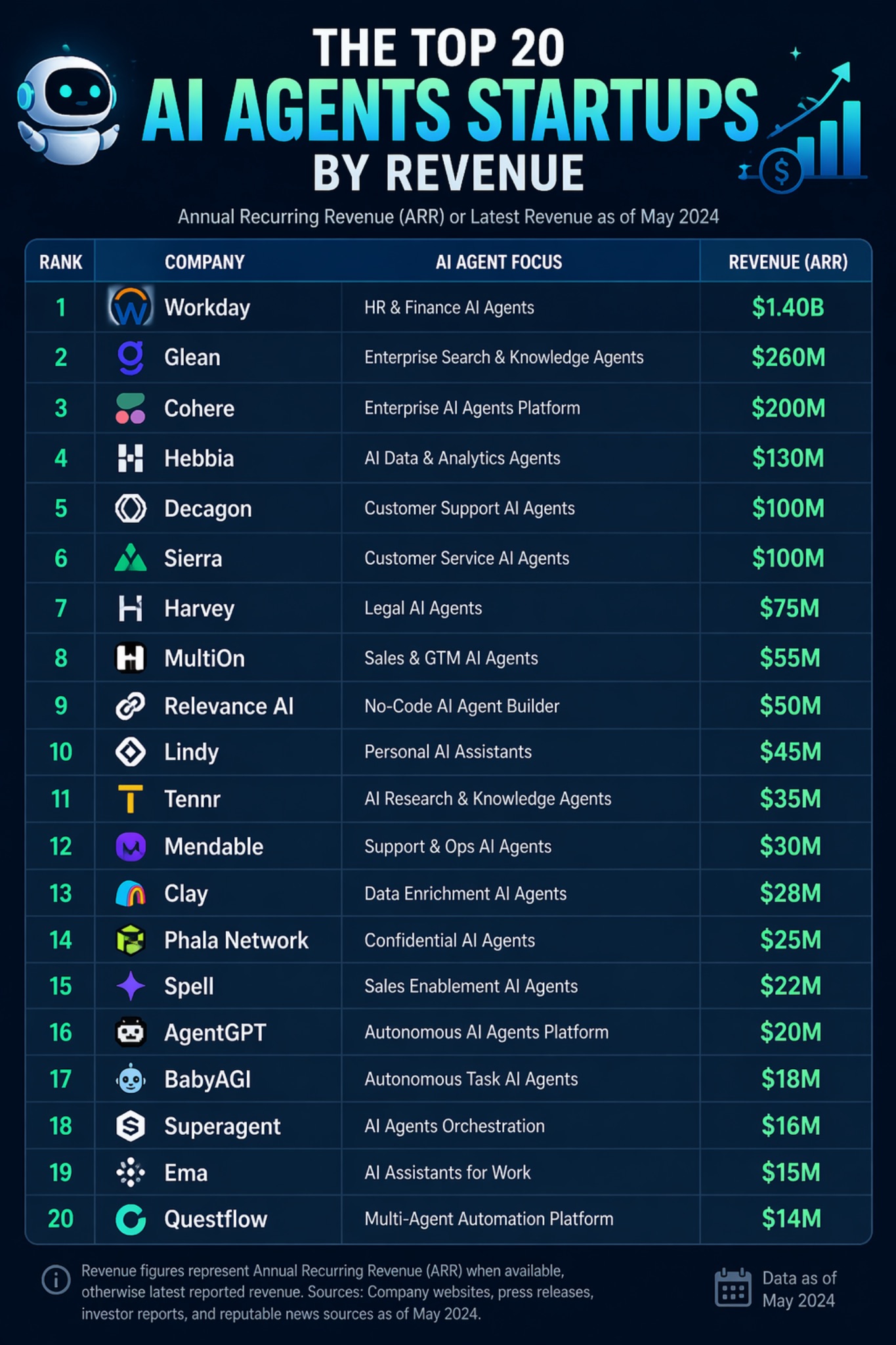
The infographic above highlights the top 20 AI agent companies by revenue or annual recurring revenue (ARR) as of May 2024. Together, these businesses show that AI agents are no longer a speculative category. They are already becoming meaningful commercial businesses.
Why Revenue Matters in the AI Agent Market
In fast-moving technology categories, hype often gets more attention than business fundamentals. But revenue tells a more useful story. It shows where customers are willing to pay, where adoption is happening, and which use cases are proving valuable enough to sustain real growth.
For AI agent companies, revenue is especially important because it reflects more than product interest. It reflects trust. Businesses will only deploy AI agents in meaningful workflows if they believe those systems can deliver consistent value, reduce labor, improve outcomes, or help them scale.
That is why this ranking matters. It does not just show which brands are getting attention. It shows which companies are building products that organizations are already spending money on.

Non-Deterministic Spec-Driven Development: Enterprise Edition: From Public Frameworks to Enterprise Practice
As an affiliate, we earn on qualifying purchases.
As an affiliate, we earn on qualifying purchases.
The Leaders at the Top
1. Workday — $1.40B
Workday leads this list by a wide margin, showing how large enterprise software companies are increasingly integrating AI agent capabilities into major business functions such as HR and finance. Its presence at the top highlights an important truth: AI agents are not confined to startups or consumer tools. They are becoming embedded in large-scale enterprise systems where automation has enormous financial value.
2. Glean — $260M
Glean has built significant momentum by focusing on enterprise search and knowledge agents. In a world where information overload slows companies down, Glean’s value is obvious: help employees find the right answers faster and make internal knowledge more actionable.
3. Cohere — $200M
Cohere has emerged as a major player in enterprise AI infrastructure and agent platforms. Its scale shows the market demand for AI systems that are not only smart, but secure, controllable, and enterprise-ready.
4. Hebbia — $130M
Hebbia sits in the intersection of AI, data analysis, and knowledge work. Its traction suggests that research-heavy and document-heavy tasks are among the best early opportunities for AI agents.
5. Decagon — $100M
Customer support is one of the clearest use cases for AI agents, and Decagon’s revenue confirms that. Businesses want agents that can resolve issues, support users, and scale service operations more efficiently.
6. Sierra — $100M
Sierra’s rise reflects the strength of AI agents in customer service. It also shows that the market is not just rewarding generic assistants, but focused products built for high-value workflows.
7. Harvey — $75M
Harvey stands out for legal AI agents. Legal workflows are information-dense, repetitive, and expensive, making them a natural fit for AI assistance and automation.

Ai For Customer Experience And Support: A Practical Guide To Automating Service, Personalizing Interactions, And Driving Customer Loyalty With Artificial Intelligence
As an affiliate, we earn on qualifying purchases.
As an affiliate, we earn on qualifying purchases.
The Next Tier of High-Growth Players
8. MultiOn — $55M
MultiOn represents the sales and go-to-market side of AI agents. This is a powerful category because businesses are always looking for ways to improve lead generation, pipeline efficiency, and workflow automation.
9. Relevance AI — $50M
Relevance AI’s no-code agent builder approach makes AI automation more accessible. That matters because one of the biggest barriers in AI adoption is complexity. Platforms that reduce technical friction can scale quickly.
10. Lindy — $45M
Lindy focuses on personal AI assistants, which points to another big opportunity in the market: agents that help individuals and small teams automate everyday work.
11. Tennr — $35M
Tennr’s focus on research and knowledge agents reinforces a recurring theme in this ranking. AI performs especially well in workflows centered on information gathering, structuring, and summarization.
12. Mendable — $30M
Mendable’s support and operations focus shows that internal workflow agents are becoming just as important as external-facing ones.
13. Clay — $28M
Clay’s data enrichment use case is a strong example of AI agents becoming practical tools for revenue teams. By helping users enrich leads, improve targeting, and automate research, Clay occupies a commercially attractive niche.
14. Phala Network — $25M
Phala Network brings a more specialized angle to the list with confidential AI agents. Privacy, security, and trusted execution are increasingly important as organizations deploy AI in sensitive environments.
15. Spell — $22M
Spell’s sales enablement focus highlights how AI agents are becoming part of modern revenue operations, helping teams move faster and work more intelligently.

AI Mastery at Work: The Complete 2026 Guide for Knowledge Workers to 10X Their Output
As an affiliate, we earn on qualifying purchases.
As an affiliate, we earn on qualifying purchases.
Emerging Players Building the Future
16. AgentGPT — $20M
AgentGPT helped popularize the idea of autonomous AI agents. Its inclusion on the list reflects how strongly the concept resonated with the market.
17. BabyAGI — $18M
BabyAGI became well known as an early symbol of autonomous task-driven AI. Its revenue figure shows that even experimental-seeming concepts can generate meaningful commercial traction when they capture market imagination.
18. Superagent — $16M
Superagent focuses on orchestration, which is a crucial layer in the AI stack. As organizations deploy multiple agents, coordination becomes just as important as intelligence.
19. Ema — $15M
Ema’s “AI assistants for work” positioning reflects the broader shift from chat interfaces to action-oriented work tools.
20. Questflow — $14M
Questflow rounds out the list with a multi-agent automation platform. Its presence reinforces a key theme in the AI market: the future may not belong to one AI agent, but to systems of agents working together.

AI Workflow Automation for Bloggers: Build a Simple Content System to Research, Write, Optimize, and Repurpose Posts Faster with AI and No-Code Tools (AI Toolkit for Bloggers 2026 Book 8)
As an affiliate, we earn on qualifying purchases.
As an affiliate, we earn on qualifying purchases.
What This Ranking Tells Us About the Market
Several clear patterns emerge from this list.
1. Enterprise Use Cases Are Winning
The strongest revenue numbers are coming from companies focused on enterprise workflows. HR, finance, legal, research, customer support, and sales are all areas where automation creates immediate measurable value.
2. Vertical Focus Matters
Many of the companies here are not trying to be everything for everyone. They are targeting specific jobs to be done. Harvey focuses on legal work. Decagon and Sierra focus on customer service. Clay focuses on data enrichment. This vertical specialization helps companies move faster toward product-market fit.
3. Knowledge Work Is a Natural Fit
A large portion of this list is built around search, research, knowledge retrieval, analysis, or workflow support. That makes sense. AI agents are particularly strong in environments where the challenge is dealing with large volumes of information.
4. Agent Platforms Are Becoming Core Infrastructure
Companies like Cohere, Relevance AI, Superagent, and Questflow show that there is also demand for broader agent-building and orchestration infrastructure. As AI agents spread, businesses will need tools to design, manage, and govern them.
5. The Market Is Still Early
Even though the top names are already generating meaningful revenue, this category is still in its early stages. The list will likely look very different in a few years as new winners emerge and today’s companies either scale or get absorbed into larger ecosystems.
Why AI Agents Are Becoming So Valuable
The reason AI agents are attracting so much attention is simple: they represent a move from passive software to active software.
Traditional software requires users to click, navigate, search, and operate tools manually. AI agents promise something more dynamic. They can interpret goals, decide on actions, and complete multi-step tasks. That makes them attractive not only as productivity tools but as digital labor systems.
If that promise holds, AI agents could reshape how companies operate. Instead of buying software only to empower employees, businesses may increasingly buy software that behaves more like a teammate — one that can handle tasks, coordinate work, and operate continuously.
That is why revenue in this category matters so much. These companies are not just selling novelty. They are selling a new model of software.
The Bigger Picture
This ranking is more than a list of companies. It is a snapshot of a changing software industry.
The rise of AI agents suggests we are moving beyond the era of static SaaS interfaces into a world where software becomes more autonomous, more context-aware, and more action-oriented. The companies on this list are early builders in that transformation.
Some will become category leaders. Some will be acquired. Some will fade as the market matures. But taken together, they show that AI agents are already becoming a real commercial force.
The next major question is not whether AI agents will matter. It is which companies will build the most trusted, most capable, and most economically valuable agent systems as the market scales.
Final Thoughts
The top 20 AI agent companies by revenue offer an early map of where the market is heading. Enterprise search, legal automation, customer support, AI assistants, orchestration, and sales workflows all appear to be strong commercial starting points.
For founders, investors, and operators, this is the signal worth watching: not just who has the best demo, but who is building repeatable value that customers are willing to pay for.
That is where real AI categories are born.