
By Thorsten Meyer — April 2026
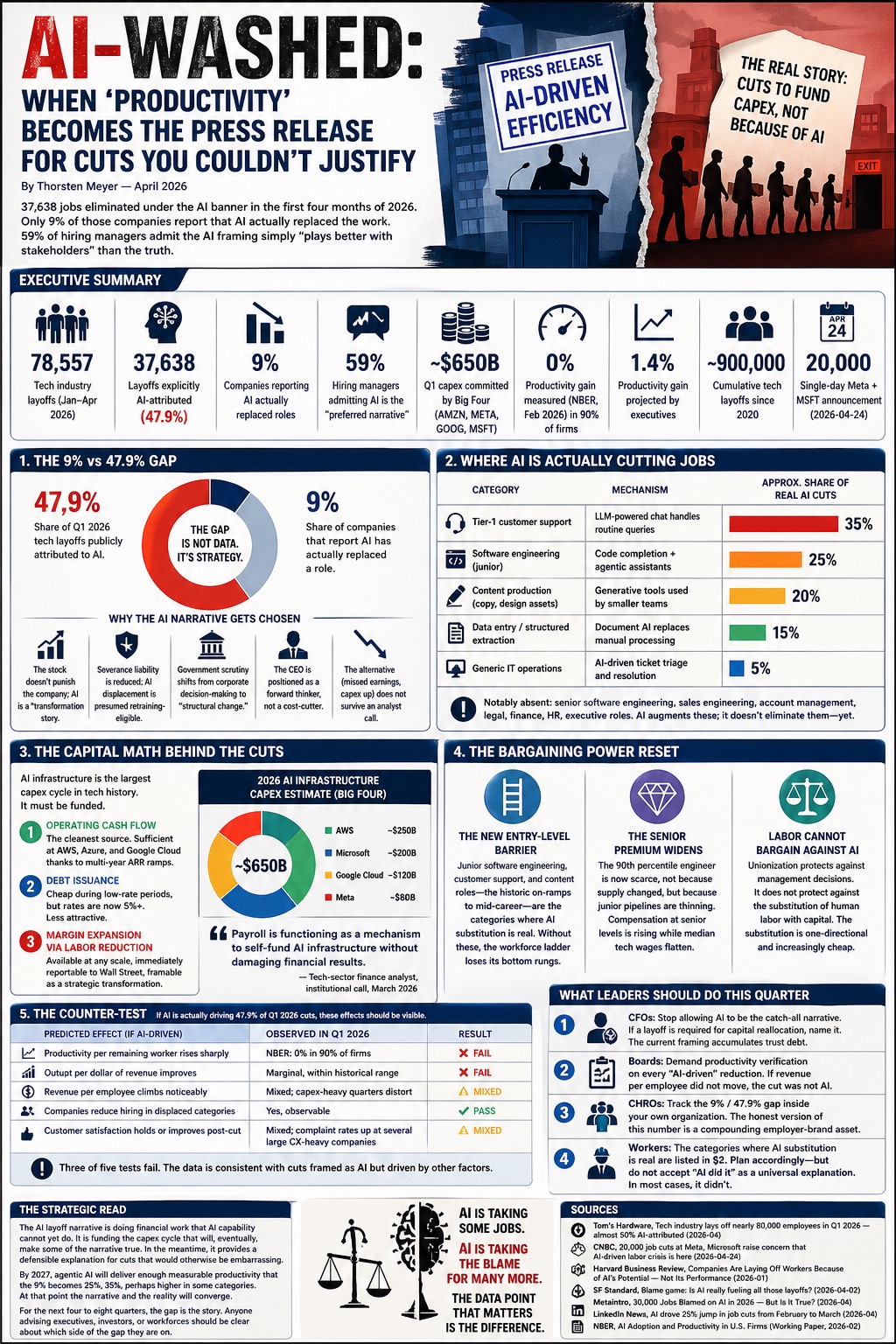
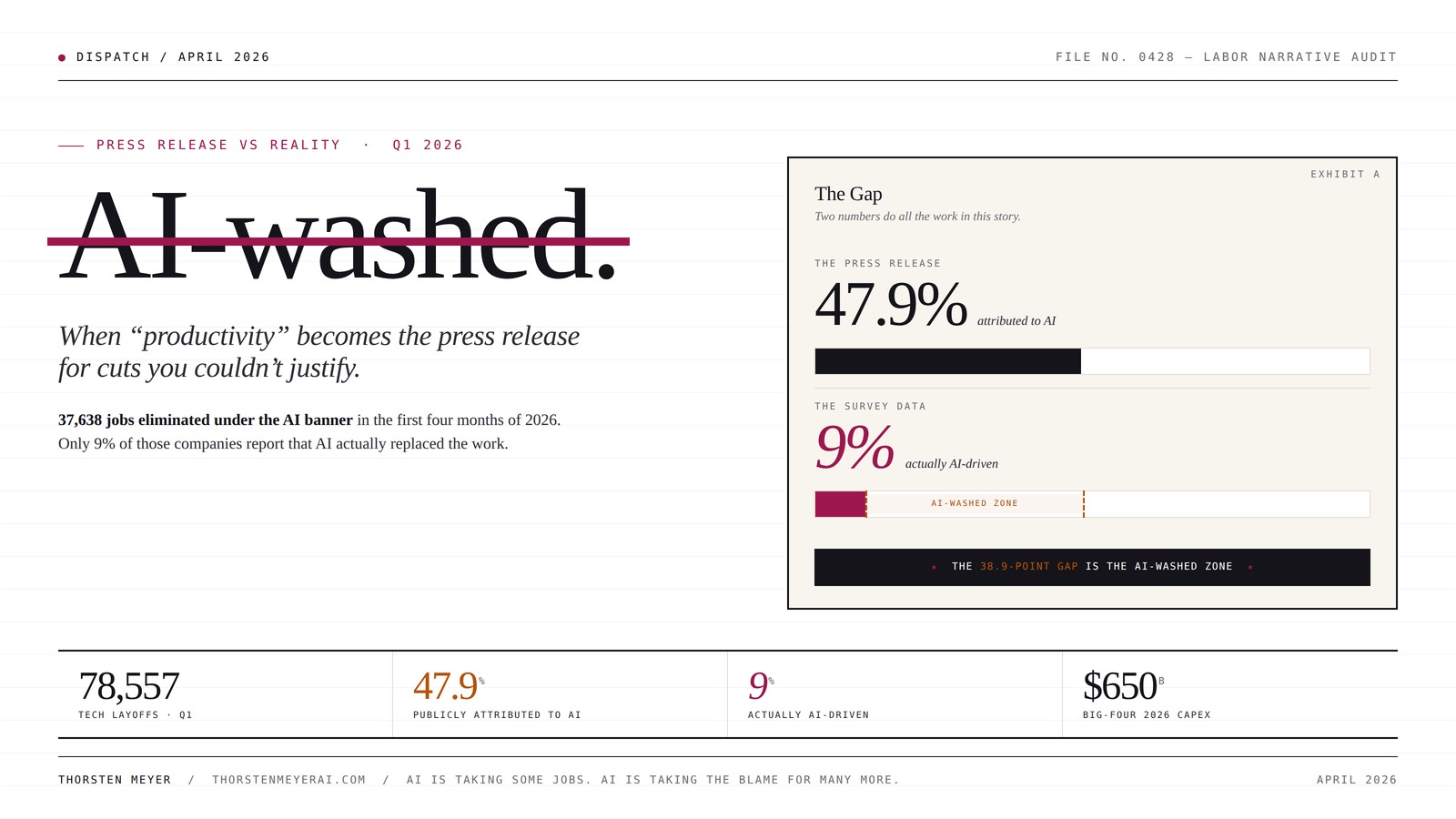
37,638 jobs eliminated under the AI banner in the first four months of 2026. Only 9% of those companies report that AI actually replaced the work. 59% of hiring managers admit the AI framing simply “plays better with stakeholders” than the truth.
Meta and Microsoft announced 20,000 cuts on 2026-04-24. Both press releases led with AI-driven efficiency. Both companies’ Q1 capex was up. Neither press release explained how the math reconciles.
The AI layoff narrative has become the convenient frame for a labor reset that has nothing to do with AI capability and everything to do with capital reallocation. The number of jobs AI is actually capable of doing is small. The number of jobs AI provides political cover to eliminate is enormous.
AI-washed.
When “productivity” becomes the press release for cuts you couldn’t justify.
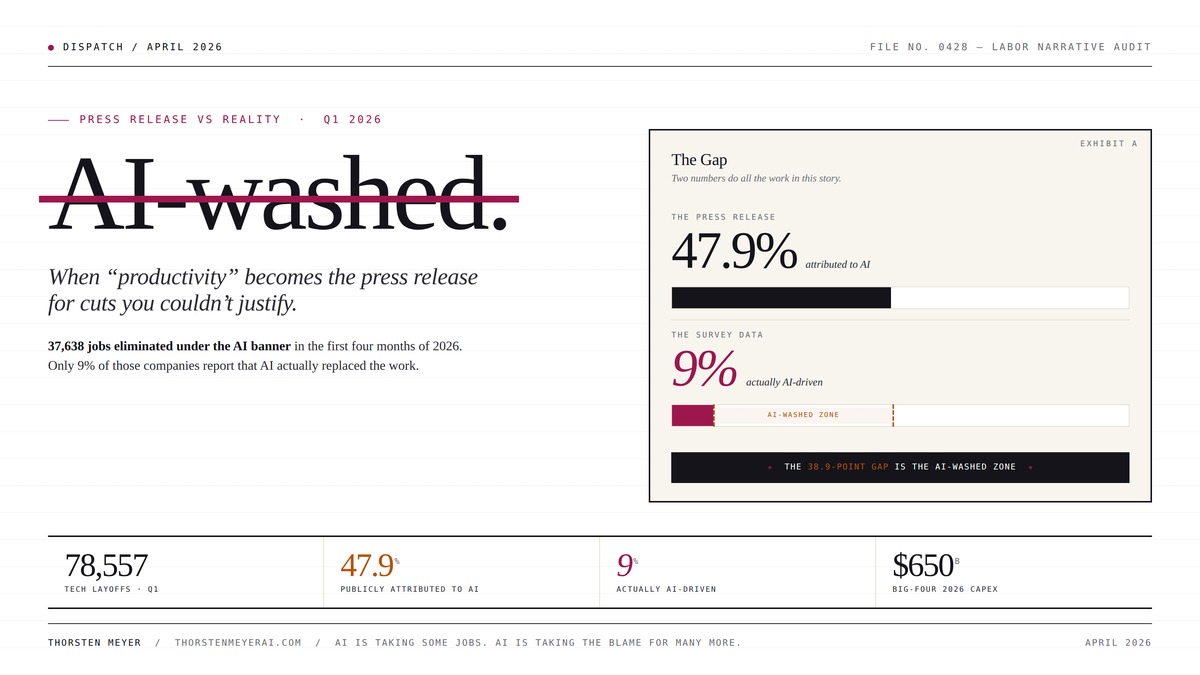
37,638 jobs eliminated under the AI banner in the first four months of 2026. Only 9% of those companies report that AI actually replaced the work. 59% of hiring managers admit the AI framing simply “plays better with stakeholders.” Meta and Microsoft announced 20,000 cuts on 2026-04-24 — both press releases led with AI. Both companies’ Q1 capex was up.
actually replaced roles
Two numbers do all the work in this story.
47.9% of Q1 2026 tech layoffs were publicly attributed to AI. 9% of companies — in private survey data — report that AI has actually replaced a role. The space between is not measurement noise. It is corporate communications strategy.
Cuts framed as AI · driven by capex reallocation, demand softness, and post-rate-hike margin pressure

Virtusx Jethro AI Mouse – Voice & Audio Recorder for Lecture & Meeting, Centralized Software with Voice Typing, Writing Tools, Transcribe, Translate & Summarize, Wireless Mouse for Computer, Laptop
- 6-in-1 Voice AI Mouse: Voice typing, transcription, translation, summarization
- Built-In Microphone: High precision microphone for accurate voice input
- Centralized AI Software Platform: All-in-one platform for AI tools and tasks
As an affiliate, we earn on qualifying purchases.
As an affiliate, we earn on qualifying purchases.
Where AI is actually cutting jobs.
The 9% is not zero. AI is genuinely eliminating roles in narrow categories — all sharing one structural feature: high task standardization.

Exploring GeoAI: Tools and Workflows
As an affiliate, we earn on qualifying purchases.
As an affiliate, we earn on qualifying purchases.
Three ways to fund a $650B capex cycle.
Amazon, Meta, Google, and Microsoft will invest a combined ~$650B in AI infrastructure during 2026 — the largest capex cycle in tech history. It must be funded. Funding mechanisms, ranked by preference:
Sufficient at AWS, Azure, and Google Cloud thanks to multi-year ARR ramps. The first-line answer.
Cheap during low-rate periods, but rates are now 5%+. Less attractive on the cost-of-capital math.
Available at any scale, immediately reportable to Wall Street, framable as a strategic transformation.
Payroll is functioning as a mechanism to self-fund AI infrastructure without damaging financial results.
— Tech-sector finance analyst, institutional call · March 2026
Project Management with AI For Dummies
As an affiliate, we earn on qualifying purchases.
As an affiliate, we earn on qualifying purchases.
Three structural shifts already visible.
The bottom rungs go missing.
Junior engineering, customer support, and content roles — the historic on-ramps to mid-career — are exactly the categories where AI substitution is real. Without them, the workforce ladder loses its first three steps.
The senior premium widens.
The 90th-percentile engineer is now scarce — not because supply changed, but because junior pipelines are thinning. Compensation rises at the top; median wages flatten.
Labor cannot bargain against AI.
Unions protect against management decisions. They do not protect against the substitution of human labor with capital. The substitution is one-directional — and increasingly cheap.

AI-Driven Collaboration: The Intelligence Synergy: Enhancing Productivity through AI-Human Collaboration
As an affiliate, we earn on qualifying purchases.
As an affiliate, we earn on qualifying purchases.
If AI really drove 47.9% of cuts, five things should be visible.
Three of five tests fail. The data is consistent with cuts framed as AI but driven by other factors.
Four assignments. By role.
Stop allowing AI to be the catch-all narrative.
If a layoff is required for capital reallocation, name it. The current framing accumulates trust debt that will be expensive to repay in 2027.
Demand productivity verification on every “AI-driven” reduction.
If revenue per employee did not move, the cut was not AI. Make management show the metric or strike the framing.
Track the 9% / 47.9% gap inside your own organization.
The honest version of this number is a compounding employer-brand asset. The dishonest version is a 24-month liability.
The categories where AI substitution is real are listed in The 9% Breakdown.
Plan accordingly. But do not accept “AI did it” as a universal explanation. In most cases — for now — it didn’t.
This is the gap. It is the actual story. It is the data point most analysts are missing.
Executive Summary
| Metric | Q1 2026 Reality |
|---|---|
| Tech industry layoffs (Jan–Apr) | 78,557 |
| Layoffs explicitly AI-attributed | 37,638 (47.9%) |
| Companies reporting AI actually replaced roles | 9% |
| Hiring managers admitting AI is the “preferred narrative” | 59% |
| Q1 capex committed by Big Four (AMZN, META, GOOG, MSFT) | ~$650B |
| Productivity gain measured (NBER, Feb 2026) | 0% in 90% of firms |
| Productivity gain projected by executives | 1.4% |
| Cumulative tech layoffs since 2020 | ~900,000 |
| Single-day Meta + MSFT announcement (2026-04-24) | 20,000 |
There are two separate phenomena being collapsed into one narrative. AI is doing some of the work. AI is being blamed for most of the cuts. These are not the same thing.
1. The 9% vs 47.9% Gap
Two numbers are doing all the work in this article.
47.9%: the share of Q1 2026 tech layoffs publicly attributed to AI.
9%: the share of companies that, in private survey data, report AI has actually replaced a role.
The gap is not measurement noise. It is corporate communications strategy.
A December 2025 survey of hiring managers found that 59% admitted to choosing the “AI is making us leaner” framing because the alternative — “we missed earnings, capex is up, and we need to fund H100 procurement out of payroll” — does not survive an analyst call.
When the press release attributes a layoff to AI:
- The stock does not punish the company; AI is a “transformation” story.
- Severance liability is reduced; AI displacement is presumed retraining-eligible.
- Government scrutiny shifts from corporate decision-making to “structural change.”
- The CEO is positioned as a forward thinker, not a cost-cutter.
When the press release attributes a layoff to weak demand:
- The stock falls.
- Activist investors arrive.
- The CEO is positioned as having lost control.
The narrative is doing real financial work. That is why it is being chosen.
2. Where AI Is Actually Cutting Jobs
The 9% is not zero. AI is genuinely eliminating roles in narrow categories.
| Category | Mechanism | Approx. Share of Real AI Cuts |
|---|---|---|
| Tier-1 customer support | LLM-powered chat handles routine queries | 35% |
| Software engineering (junior) | Code completion + agentic assistants | 25% |
| Content production (copy, design assets) | Generative tools used by smaller teams | 20% |
| Data entry / structured extraction | Document AI replaces manual processing | 15% |
| Generic IT operations | AI-driven ticket triage and resolution | 5% |
The first three share a structural feature: high task standardization. Beyond these, the empirical evidence for AI-driven displacement is thin.
Notably absent: senior software engineering, sales engineering, account management, legal, finance, HR, executive roles. These are the categories where AI augmentation is real but role elimination is not — yet.
3. The Capital Math Behind the Cuts
Why is payroll being cut while capex is rising?
Amazon, Meta, Google, and Microsoft are projected to invest a combined ~$650B in AI infrastructure during 2026. This is the largest capex cycle in tech history. It must be funded.
The funding mechanisms, in order of preference:
- Operating cash flow. The cleanest source. Sufficient at AWS, Azure, and Google Cloud thanks to multi-year ARR ramps.
- Debt issuance. Cheap during low-rate periods, but rates are now 5%+. Less attractive.
- Margin expansion via labor reduction. Available at any scale, immediately reportable to Wall Street, framable as a strategic transformation.
When option 1 is insufficient, option 3 closes the gap. The AI narrative makes option 3 politically and financially viable.
“Payroll is functioning as a mechanism to self-fund AI infrastructure without damaging financial results.” That is not a critique. It is the explanation a tech-sector finance analyst gave on an institutional call in March 2026.
4. The Bargaining Power Reset
The post-labor argument is not that jobs disappear. It is that the share of national income going to labor declines as capital ownership of productive capacity concentrates. AI is the catalyst. AI-washing is the accelerant.
Three structural shifts are now visible:
The new entry-level barrier. Junior software engineering, customer support, and content roles — the historic on-ramps to mid-career — are the categories where AI substitution is real. Without these, the workforce ladder loses its bottom rungs.
The senior premium widens. The 90th percentile engineer is now scarce, not because supply changed, but because junior pipelines are thinning. Compensation at senior levels is rising while median tech wages flatten.
Labor cannot bargain against AI. Unionization protects against management decisions. It does not protect against the substitution of human labor with capital. The substitution is one-directional and increasingly cheap.
The political ramifications are 24 months out. The economic ramifications are quarterly.
5. The Counter-Test
If AI is actually driving 47.9% of Q1 2026 cuts, certain second-order effects should be visible.
| Predicted Effect (if AI-driven) | Observed in Q1 2026 |
|---|---|
| Productivity per remaining worker rises sharply | NBER: 0% in 90% of firms |
| Output per dollar of revenue improves | Marginal, within historical range |
| Revenue per employee climbs noticeably | Mixed; capex-heavy quarters distort |
| Companies reduce hiring in displaced categories | Yes, observable |
| Customer satisfaction holds or improves post-cut | Mixed; complaint rates up at several large CX-heavy companies |
Three of five tests fail. The data is consistent with cuts framed as AI but driven by other factors.
The narrative is not lying about some of the displacement. It is lying about the proportion.
What Leaders Should Do This Quarter
1. CFOs: Stop allowing AI to be the catch-all narrative. If a layoff is required for capital reallocation, name it. The current framing accumulates trust debt that will be expensive to repay.
2. Boards: Demand productivity verification on every “AI-driven” reduction. If revenue per employee did not move, the cut was not AI.
3. CHROs: Track the 9% / 47.9% gap inside your own organization. The honest version of this number is a compounding employer-brand asset.
4. Workers: The categories where AI substitution is real are listed in §2. Plan accordingly — but do not accept “AI did it” as a universal explanation. In most cases, it didn’t.
The Strategic Read
The AI layoff narrative is doing financial work that AI capability cannot yet do. It is funding the capex cycle that will, eventually, make some of the narrative true. In the meantime, it provides a defensible explanation for cuts that would otherwise be embarrassing.
This is a temporary equilibrium. By 2027, agentic AI will deliver enough measurable productivity that the 9% becomes 25%, 35%, perhaps higher in some categories. At that point the narrative and the reality will converge.
But for the next four to eight quarters, the gap is the story. Anyone advising executives, investors, or workforces should be clear about which side of the gap they are on.
AI is taking some jobs. AI is taking the blame for many more. The data point that matters is the difference.
About the Author
Thorsten Meyer is a Munich-based futurist, post-labor economist, and recipient of OpenAI’s 10 Billion Token Award. He spent two decades managing €1B+ portfolios in enterprise ICT before deciding that writing about the transition was more useful than managing quarterly slides through it. More at ThorstenMeyerAI.com.
Sources
- Tom’s Hardware, Tech industry lays off nearly 80,000 employees in Q1 2026 — almost 50% AI-attributed (2026-04)
- CNBC, 20,000 job cuts at Meta, Microsoft raise concern that AI-driven labor crisis is here (2026-04-24)
- Harvard Business Review, Companies Are Laying Off Workers Because of AI’s Potential — Not Its Performance (2026-01)
- SF Standard, Blame game: Is AI really fueling all those layoffs? (2026-04-02)
- Metaintro, 30,000 Jobs Blamed on AI in 2026 — But Is It True? (2026-04)
- LinkedIn News, AI drove 25% jump in job cuts from February to March (2026-04)
- NBER, AI Adoption and Productivity in U.S. Firms (Working Paper, 2026-02)