€11 billion · the largest single investment in Schwarz Group’s corporate history · committed to a 200MW Lübbenau data center campus on a former coal-fired power plant site · capable of hosting 100,000 AI chips · first phase three modules completing end of 2027. Combined with the €500M (~$600M) Cohere Series E lead commitment, the existing €500M+ Aleph Alpha investments, the EU Commission framework agreement, the Dutch government Ministry of Justice and Security framework agreement, SAP, Bayern Munich, Charité Berlin, and Uvision Europe defense partnerships. Europe’s largest retailer — 575,000 employees, 32 countries, 13+ billion transactions per year — operating an AI infrastructure investment that exceeds the scale of every European venture capital AI commitment combined. Recommendation 3 from the synthesis essay identified this as the operational template for European industrial-anchor investment at scale. This piece interrogates whether the model can actually be replicated beyond Germany.
Play games included with Prime
Start a Prime free trial and play with Amazon Luna on your devices.
Start playingAs an affiliate, we earn on qualifying purchases.
By Thorsten Meyer — May 2026
This is the ninth standalone essay in the European sovereign-LLM track and the second Tier 2 expansion piece. Essay 07 · the synthesis framework crystallized five strategic recommendations for European AI policy. Recommendation 3 — “establish the industrial-anchor investment model at scale beyond Germany” — identified the Schwarz Group anchor model as the operational template for European industrial capital allocation to AI infrastructure. The replication question — whether the model can actually be scaled across additional European industrial conglomerates — was left open. This piece interrogates it empirically.
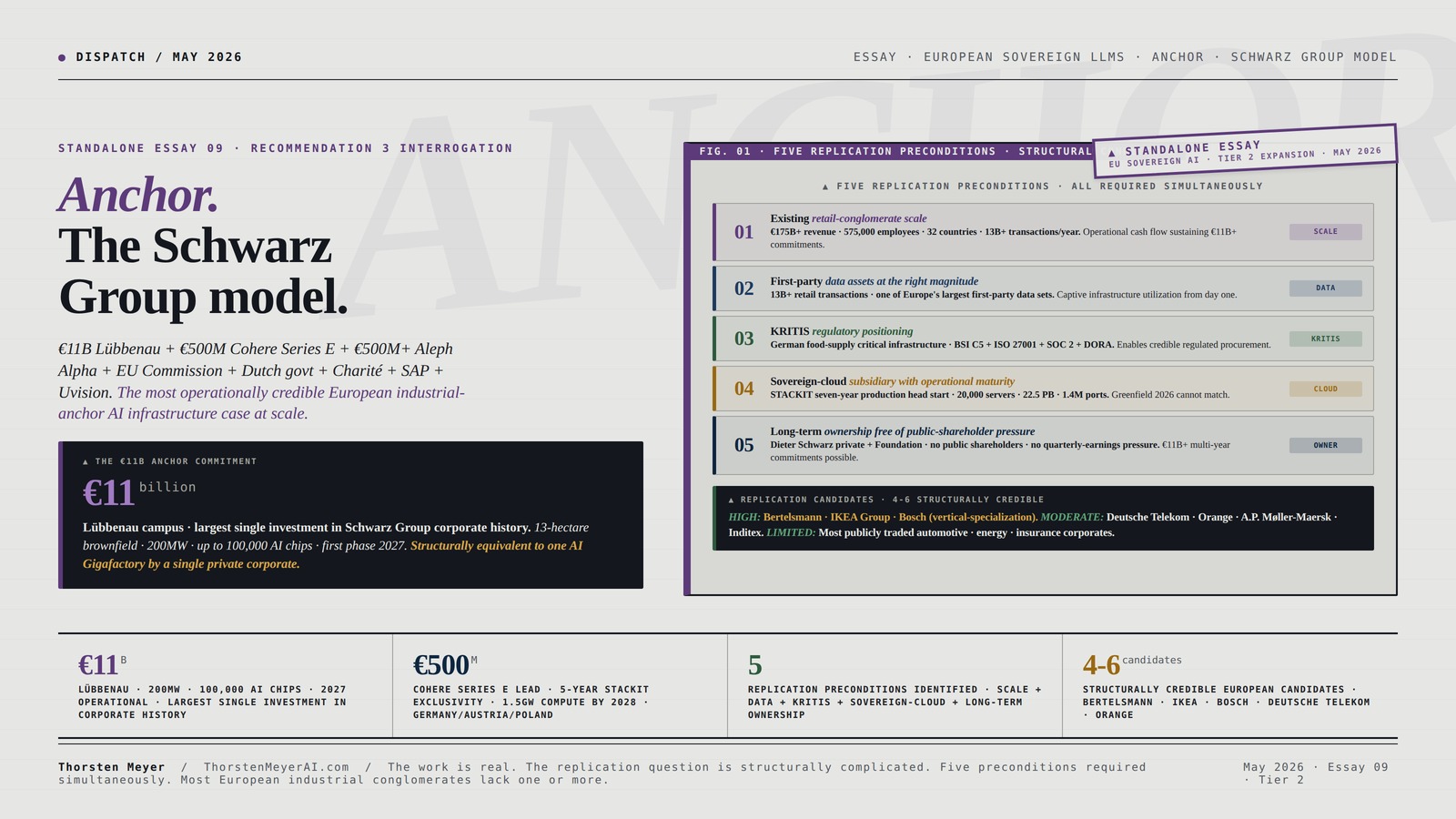
The structural argument I want to make: the Schwarz Group industrial-anchor model is the most operationally credible European AI infrastructure framework at scale beyond venture capital and public funding — but it is structurally distinctive in ways that make replication non-trivial. Five specific preconditions emerge from the operational evidence: existing retail-conglomerate scale + first-party data assets at the right magnitude + KRITIS regulatory positioning + sovereign-cloud digital subsidiary with operational maturity + long-term ownership structure free of public-shareholder quarterly-earnings pressure. Each precondition is necessary; together they are sufficient. Most European industrial conglomerates lack one or more of them. The strategic implication is that Recommendation 3 needs structural qualification: the Schwarz Group case may be partially replicable across specific industrial-conglomerate structures, but the model is not universally applicable to every large European corporate.
The headline integrative finding: the industrial-anchor investment model is operationally validated by the Schwarz Group case at scales (€11B Lübbenau commitment + €500M+ Aleph Alpha + €500M Cohere Series E + 1.5 GW contracted data-center power by 2028 + EU Commission anchor customer + Dutch government Ministry framework agreement + SAP + Charité + Uvision Europe defense) that venture capital and public funding cannot match independently. But the operational replication requires five specific structural preconditions that most European industrial conglomerates do not possess simultaneously. The strategic recommendation should be: identify the specific European industrial-conglomerate structures where the preconditions exist (or can be developed) and target replication efforts there — rather than treating the Schwarz Group model as a universal template applicable to every large European corporate.
This piece walks the empirical operational evidence of the Schwarz Group anchor model, the five replication preconditions framework that emerges from the evidence, the candidate European industrial conglomerates evaluated against the preconditions, and what the analysis implies for Recommendation 3 from the synthesis essay. The standard caveat applies: the Schwarz Group investments are still ramping (Lübbenau first phase 2027 · Cohere Series E closing 2026 · 1.5 GW contracted power by 2028), and the operational evidence may shift as specific commitments ship through 2026-2028.
Anchor.
The Schwarz
Group model.
€11B Lübbenau campus + €500M Cohere Series E + €500M+ Aleph Alpha + EU Commission anchor + Dutch government framework + Charité + SAP + Uvision Europe. The most operationally credible European industrial-anchor AI infrastructure case at scale — interrogated against the five preconditions for replication.
Recommendation 3 from the synthesis essay (Essay 07) identified the Schwarz Group anchor model as the operational template for European industrial capital allocation to AI infrastructure. The replication question — whether the model can actually be scaled across additional European industrial conglomerates — was left open. This piece interrogates it empirically. The Schwarz Group industrial-anchor model is the most operationally credible European AI infrastructure framework at scale beyond venture capital and public funding — but it is structurally distinctive in ways that make replication non-trivial. Five specific preconditions emerge from the operational evidence: existing retail-conglomerate scale, first-party data assets at the right magnitude, KRITIS regulatory positioning, sovereign-cloud digital subsidiary with operational maturity, long-term ownership structure free of public-shareholder quarterly-earnings pressure. Each precondition is necessary; together they are sufficient. Most European industrial conglomerates lack one or more of them.
€12B+. Five distinct commitments.
The Schwarz Group AI-specific commitments operate at a structurally distinct scale from venture capital and public funding frameworks. The cumulative AI infrastructure commitment exceeds the entire European public-funding pipeline for AI projects combined. Mistral’s total VC raised is €3B; OpenEuroLLM’s EU funding is €37.4M; AMÁLIA is €5.5M. The Schwarz Group commitments alone exceed €12B.
operational
2H 2026
Cohere
since 2018
2.5GW total*
industrial data center server racks
As an affiliate, we earn on qualifying purchases.
As an affiliate, we earn on qualifying purchases.
Five preconditions. All required.
The structural conditions that enable the Schwarz Group industrial-anchor model. Each is operationally evidenced in the Schwarz Group case; together they crystallize the framework for evaluating replication potential. The Schwarz Group case combines all five — making the case partly structurally unique rather than universally replicable.
As an affiliate, we earn on qualifying purchases.
Four candidates. Structural qualification required.
Systematic evaluation of which European industrial conglomerates structurally match the five preconditions. The framework is empirical, not aspirational. Replication potential ranges from HIGH (4-5 preconditions met) through MODERATE (3 preconditions met) to LIMITED (1-2 preconditions met). Most publicly traded European industrial corporates face structural constraints from Precondition 5.
replication
replication
vertical
telco-anchored
telco-anchored
retail-anchored
publicly traded
publicly traded
publicly traded
logistics-anchored
enterprise cloud computing hardware
As an affiliate, we earn on qualifying purchases.
As an affiliate, we earn on qualifying purchases.
Six anchors. Operational deployment.
The customer-anchor relationships demonstrate the industrial-anchor model at deployment scale. These are not aspirational sales pipeline; they are operationally signed framework agreements and existing customers. Each anchor relationship validates the structural-market thesis: regulated procurement increasingly evaluates sovereign-cloud architecture as a differentiating criterion.
The work is real across the Schwarz Group case. €11B Lübbenau commitment under construction. €500M+ Aleph Alpha + €500M Cohere structured. EU Commission anchor customer + Dutch government framework agreement + Charité + SAP + Bayern + Uvision Europe defense. The replication question is structurally complicated. Five preconditions required simultaneously. Most European industrial conglomerates lack one or more. Both can be true at once. The strategic discourse should integrate the five-preconditions framework — target the 4-6 structurally credible replication candidates rather than treating the Schwarz Group case as a universal template.
large-scale data center power supplies
As an affiliate, we earn on qualifying purchases.
As an affiliate, we earn on qualifying purchases.
I · The operational evidence · what Schwarz Group has actually committed
The factual baseline before the structural analysis. From the Schwarz Digits press releases, the STACKIT operational documentation, the Schwarz Digits cloud overview, the Data Center Dynamics coverage, the Techzine Global coverage, and the Xpert Digital Q1 2026 German data center boom analysis.
The corporate structure
Schwarz Group is Europe’s largest retailer. The corporate structure operates through several distinctive layers:
- Schwarz Group · holding company · Dieter Schwarz private ownership + Dieter Schwarz Foundation structure · €175B+ annual revenue · 575,000 employees · 32 countries · 13+ billion transactions per year
- Operational divisions · Lidl (one of the world’s largest discount supermarket chains) · Kaufland (major European supermarket chain) · PreZero (recycling and waste management) · Schwarz Produktion (food production)
- Schwarz Digits · IT and digital division · spun out as separate GmbH September 2023 · Co-CEOs Rolf Schumann + Christian Müller
- STACKIT · Schwarz Digits’ sovereign cloud and colocation subsidiary · founded 2018 · operational at production scale since 2018 · offered externally since 2022-2023
The structural distinctive features of the Schwarz Group corporate structure:
- Private ownership · Dieter Schwarz is among the world’s 50 wealthiest individuals · no public shareholders · no quarterly-earnings pressure on capital allocation decisions
- Foundation structure · Dieter Schwarz Foundation owns the majority of the group · long-term ownership horizon · institutional continuity beyond family-business succession
- Operational cash flow stability · STACKIT’s marketing tagline is “we always eat” referring to supermarket revenue stability · this is operationally significant for sustaining multi-year infrastructure investments
- Critical infrastructure (KRITIS) positioning · Schwarz Group operates as part of German critical infrastructure for food supply · this drives baseline regulatory requirements that STACKIT inherits architecturally
STACKIT’s existing operational scale
Per datacentermap.com STACKIT documentation, STACKIT operates at production-grade enterprise scale already, before the Lübbenau expansion:
- 20,000 servers in operational deployment
- 22.5 PB storage
- 1.4 million network ports
- One of the world’s largest SAP retail systems (operating Schwarz Group’s own retail infrastructure)
- Three data centers · DC01 + DC08 in Baden-Württemberg (Neckarsulm and Ellhofen) Germany · DC10 in Ostermiething Austria
- Two cloud regions · EU01 Germany · EU02 Austria
- PUE values of 1.5 / 1.3 / 1.2 (Power Usage Effectiveness) · slightly better than industry average of 1.55
- Certifications · BSI C5 (highest tier) · ISO/IEC 27001 · SOC 2 · DORA-compliant for financial services
- 35+ years operating own data centers · the operational maturity that distinguishes STACKIT from greenfield European cloud entrants
The structurally important detail: STACKIT was originally built to manage Schwarz Group’s own retail data as KRITIS (critical infrastructure) — it was production-tested at retail scale before being offered externally. This is structurally distinct from greenfield European cloud entrants that build sovereign cloud infrastructure with public funding before having operational customer load. STACKIT had operational load from day one.
The Lübbenau campus · the €11B commitment
Per Data Center Dynamics coverage and Xpert Digital Q1 2026 analysis:
The Lübbenau campus is the largest single investment in Schwarz Group’s corporate history.
- €11 billion total investment
- 13-hectare brownfield site · former coal-fired power plant near Lübbenau, Brandenburg · 1.5 hours south of Berlin
- 200 MW capacity across two phases
- Up to 100,000 AI chips at full deployment
- First phase three modules completing end of 2027
- Liquid cooling · waste heat to local district heating network operated by regional energy supplier Süll
- 20,000+ cubic meters of concrete · 110 tons of steel · 20 tons of wood separated, recycled, and reused from the former coal plant site (sustainability framing)
The scale comparison contextualizes this investment. Germany’s existing Frankfurt data center cluster (Europe’s largest) has just over 1.1 GW total installed capacity. The Lübbenau 200 MW commitment is approximately 1/5.5 of Frankfurt’s entire installed cluster — built by a single corporate entity. Per Xpert Digital’s analysis: “Germany is experiencing an unprecedented data center boom in the first quarter of 2026.” The Schwarz Group Lübbenau commitment is one of the largest single-corporate AI infrastructure investments in European corporate history.
The 100,000 AI chips target is structurally significant. Per the EuroHPC compute substrate analysis (Standalone Essay 08), the EU’s AI Gigafactory framework targets “over 100,000 advanced AI processors” per facility. The Schwarz Group Lübbenau campus is therefore structurally equivalent to one AI Gigafactory — built by a single private corporate entity rather than through the €20B InvestAI Facility public-private partnership framework.
The customer-anchor relationships
Per the Schwarz Digits press releases and the STACKIT customer documentation:
The operational customer base demonstrates the industrial-anchor model at deployment scale:
- EU Commission framework agreement · €180M investment · STACKIT validated as reliable partner for highly regulated sectors
- Dutch government Ministry of Justice and Security (SLM Rijk) · framework agreement · STACKIT public cloud as official data-sovereign alternative for government agencies in the Netherlands
- SAP · early STACKIT enterprise customer · ongoing partnership
- Bayern Munich · early STACKIT enterprise customer
- Charité – Universitätsmedizin Berlin · Schwarz Charité Health Data GmbH joint venture · digitalized healthcare system · medical data networking
- Uvision Europe (Aerospace defense) · sovereign cloud infrastructure for high-precision systems · German defense partnership
The Cohere-Aleph Alpha commitment crystallizes the AI-specific industrial-anchor framework:
- €500M (~$600M) Cohere Series E lead commitment · structured as preferred equity + convertible debt · allows Schwarz to underwrite the round without immediately diluting other strategic investors
- Five-year exclusivity clause · STACKIT designated as Cohere’s primary European cloud provider in exchange for committed compute capacity
- 1.5 GW contracted data-center power across Germany, Austria, and Poland by 2028
- Existing €500M+ Aleph Alpha investment · co-led $500M Series B 2023 · expanded January 2026 · folded into Cohere structure April 2026
- Schwarz Digits Co-CEOs joint statement · “With this investment, the companies of Schwarz Group position themselves as lead investors for digital sovereignty and infrastructure.”
The cumulative AI infrastructure commitment from Schwarz Group:
- €11 billion · Lübbenau data center campus (largest single investment in corporate history)
- €500M+ · Aleph Alpha investments (2023 Series B + 2026 expansion)
- €500M · Cohere Series E lead commitment (~$600M)
- Plus ongoing operational expansions of the existing three STACKIT data centers
- Plus the structural commitment to 1.5 GW of contracted data-center power by 2028 across Germany/Austria/Poland
This is the operational evidence that an industrial-anchor European corporate can sustain AI infrastructure investment at scales that venture capital and public funding cannot match independently. Per the AI funding landscape evidence: Mistral’s total VC raised across all rounds is approximately €3B; OpenEuroLLM’s EU funding is €37.4M; the entire AMÁLIA project is €5.5M. The Schwarz Group AI-specific commitments alone exceed €12B in publicly disclosed scope. The industrial-anchor model operates at a structurally distinct scale from venture-capital and public-funding frameworks.
II · The five replication preconditions framework
The structural conditions that enable the Schwarz Group industrial-anchor model. Each is operationally evidenced; together they crystallize the framework for evaluating replication potential.
Precondition 1 · Existing retail-conglomerate scale
Schwarz Group’s operational scale is the foundational enabling factor. €175B+ annual revenue · 575,000 employees · 32 countries · 13+ billion transactions per year · Europe’s largest retailer · Lidl + Kaufland + PreZero + Schwarz Produktion. This generates the operational cash flow that underwrites the €11B Lübbenau commitment without requiring external capital injection or public-debt financing.
The structural implication: AI infrastructure investments at the €11B+ scale require operational cash flow at a magnitude that few European corporates possess. The €175B+ revenue base provides approximately 6.3% of annual revenue as the implied multi-year capex absorption capacity for AI infrastructure alone — which is operationally sustainable but not trivial.
Comparable European corporates by revenue scale (top 20 ranking matters):
- Volkswagen Group (~€322B revenue · automotive)
- TotalEnergies (~€198B · energy)
- Stellantis (~€189B · automotive)
- A.P. Møller-Maersk (~€42B · logistics · but with different operating model)
- Schwarz Group (~€175B · retail · the reference case)
- Mercedes-Benz Group (~€144B · automotive)
- BMW Group (~€140B · automotive)
- Siemens (~€78B · industrial-technology)
- Allianz (~€155B insurance · financial services structure)
- Inditex (~€38B · retail · Zara parent)
- Bertelsmann (~€20B · media · privately held)
The retail-conglomerate scale precondition is operationally distinguishing because retail revenue is operationally stable (the “we always eat” framing). Other industrial-revenue businesses (automotive, energy, industrial-technology) face significantly more cyclical revenue exposure, which constrains the long-term capital commitment horizons that AI infrastructure investments require.
Precondition 2 · First-party data assets at the right magnitude
Schwarz Group’s first-party data position is structurally distinctive. 13+ billion retail transactions per year generates one of Europe’s largest first-party retail data sets. This produces three operationally significant features:
- Internal AI demand · Schwarz Group’s own retail operations have substantial AI workload requirements (inventory optimization, supply chain forecasting, customer behavior analysis, fraud detection, sustainability tracking)
- Operational use cases · the AI infrastructure has captive demand from day one, structurally similar to how AWS was originally built for Amazon retail operations
- Regulatory positioning · processing first-party retail data at KRITIS scale establishes the baseline regulatory compliance architecture that external customers inherit
The structural implication: an industrial-anchor model requires first-party data assets at sufficient magnitude to drive baseline AI infrastructure utilization. Industrial conglomerates with limited consumer-data exposure (B2B-only industrial companies, energy producers without retail operations, financial services with regulatory constraints on consumer data) cannot operationalize the same demand-pull structure.
Comparable European corporates by first-party consumer data scale:
- Inditex (Zara · ~700M annual transactions across global retail)
- A.P. Møller-Maersk (logistics data · structurally different — shipment-tracking, not consumer-transaction)
- Allianz (~125M+ insurance customers globally · structurally different — claim-frequency, not transaction-velocity)
- Deutsche Telekom (~250M+ mobile customers EU+ · telco data subject to different regulatory regime)
- Volkswagen Group (~10M+ vehicles annually · automotive data with different velocity profile)
- Schwarz Group (~13B+ retail transactions per year · the reference case)
The first-party data scale precondition is most closely matched by retail conglomerates (Inditex) and large telco operators (Deutsche Telekom) — and structurally weaker for B2B industrial, energy, or financial services.
Precondition 3 · KRITIS (critical infrastructure) regulatory positioning
Schwarz Group operates as part of German critical infrastructure (KRITIS) for food supply. This drives baseline regulatory requirements that STACKIT inherits architecturally — BSI C5 (highest tier) + ISO/IEC 27001 + SOC 2 + DORA compliance + GDPR-compliant data residency in Germany/Austria.
The structural implication: the KRITIS positioning enables STACKIT to credibly serve regulated procurement (EU Commission, Dutch government, German defense, healthcare) because the underlying corporate already operates under critical-infrastructure regulatory requirements. Building sovereign cloud infrastructure from scratch without parent KRITIS positioning is operationally more expensive and slower because the regulatory architecture must be developed without operational precedent.
Comparable European corporates with KRITIS or equivalent regulatory positioning:
- Allianz · insurance · financial-services KRITIS
- Deutsche Telekom · telecommunications · communications KRITIS
- E.ON / RWE / Vattenfall · energy · energy KRITIS
- Volkswagen Group · automotive · partially regulated supply-chain
- A.P. Møller-Maersk · logistics · partially regulated international shipping
- Bertelsmann · media · limited KRITIS positioning
- Schwarz Group · retail/food · food-supply KRITIS · the reference case
- Inditex · retail · limited KRITIS positioning (Spain-anchored)
The KRITIS positioning precondition is structurally available to financial services, telecommunications, and energy conglomerates — but the baseline regulatory architecture must extend to the cloud-infrastructure subsidiary, which most have not built yet.
Precondition 4 · Sovereign-cloud digital subsidiary with operational maturity
STACKIT has seven years of production operational maturity (founded 2018 · external offering 2022-2023). This is the operational distinguishing feature most European industrial conglomerates do not match: the sovereign cloud subsidiary must already exist and be operationally tested at parent-company scale before scaling to external customers and AI workloads.
The structural implication: building sovereign-cloud digital subsidiaries from scratch in 2026-2028 to compete with established hyperscalers (AWS, Azure, GCP) and STACKIT is operationally difficult. The seven-year operational head start STACKIT possesses — production-tested SAP retail systems + 20,000 servers + 22.5 PB storage + BSI C5 certification — is structurally non-replicable on the AI-investment timeline (2026-2030).
Comparable European corporates with existing sovereign-cloud subsidiaries:
- Deutsche Telekom · T-Systems · IBM cloud partnership · partial sovereign-cloud positioning
- OVHcloud (France) · publicly traded sovereign cloud · but not industrial-conglomerate-anchored
- Telefónica Tech / Cloud · partial sovereign-cloud positioning · primarily DACH and Iberian markets
- Orange Business Services · Bleu (with Capgemini and Microsoft) · sovereign cloud joint venture · still ramping
- Siemens Cloud / MindSphere · industrial IoT focus, not general-purpose sovereign cloud
- SAP Sovereign Cloud · enterprise software with sovereign cloud overlay
- Schwarz Group · Schwarz Digits · STACKIT · the reference case · production-tested at retail KRITIS scale
The sovereign-cloud digital subsidiary precondition is structurally available to telecommunications conglomerates (Deutsche Telekom, Telefónica, Orange) — but most retail and industrial conglomerates have not built one and cannot easily acquire one at the right scale and operational maturity.
Precondition 5 · Long-term ownership structure free of public-shareholder quarterly-earnings pressure
Schwarz Group’s Dieter Schwarz private ownership + Dieter Schwarz Foundation structure is the structurally rarest precondition. No public shareholders · no quarterly-earnings pressure · no activist-investor pressure · “no shareholder interests, no change of ownership” (per STACKIT’s own marketing) · long-term ownership horizon enabling €11B+ multi-year capital commitments.
The structural implication: publicly traded European corporates face structural constraints on long-term capital allocation that private foundation-anchored corporates do not. Quarterly-earnings pressure constrains R&D and capex commitments that exceed approximately 3-5 year payback horizons. AI infrastructure investments at €11B+ scale typically have payback horizons of 7-12 years — which is operationally difficult for public-shareholder corporates to absorb without significant share-price pressure.
Comparable European corporates by ownership structure:
- Foundation/private ownership · Schwarz Group (Dieter Schwarz Foundation · reference case) · Bertelsmann (Bertelsmann Stiftung · 80%+ foundation ownership) · IKEA Group (Stichting INGKA Foundation) · Bosch (Robert Bosch Stiftung · 92%) · Heraeus (family foundation)
- Family-controlled public · Volkswagen Group (Porsche family + Lower Saxony) · BMW Group (Quandt family) · Heineken (Heineken family) · L’Oréal (Bettencourt family)
- Public ownership · Siemens · Allianz · TotalEnergies · Stellantis · Inditex · Deutsche Telekom · Mercedes-Benz · most others
The long-term ownership precondition is structurally available specifically to foundation-anchored European industrial conglomerates: Bertelsmann, IKEA Group, Bosch, and Heraeus most prominently. These are the structurally distinctive corporates where the Schwarz Group industrial-anchor model is most credibly replicable.
III · Candidate European industrial conglomerates · evaluated against the five preconditions
The systematic evaluation of which European industrial conglomerates structurally match the five preconditions. The framework here is empirical, not aspirational. Each candidate is evaluated on whether the precondition is operationally present at the magnitude required.
Bertelsmann · the strongest replication candidate
Bertelsmann Stiftung Foundation ownership (80%+) is the closest structural match to Schwarz Group’s private-foundation ownership. The corporate structure:
- Precondition 1 · Retail-conglomerate scale · ~€20B revenue · media conglomerate (RTL Group, Penguin Random House, Gruner+Jahr, BMG, Arvato, Bertelsmann Investments) · partially met (smaller than Schwarz but operationally substantial)
- Precondition 2 · First-party data assets · Penguin Random House publishing data + RTL Group media engagement data + BMG music streaming data + Arvato services data · partially met (substantial but structurally different from retail transaction velocity)
- Precondition 3 · KRITIS positioning · limited media KRITIS · not structurally present
- Precondition 4 · Sovereign-cloud digital subsidiary · Arvato CRM Solutions · partial sovereign-cloud positioning but not production-scale comparable to STACKIT · not operationally mature
- Precondition 5 · Long-term ownership structure · Bertelsmann Stiftung Foundation (80%+) + Mohn family · fully met (closest structural match to Schwarz)
Replication potential: Bertelsmann has the strongest ownership-structure match and substantial revenue scale, but lacks the KRITIS regulatory positioning and operational sovereign-cloud subsidiary. Bertelsmann could plausibly develop the industrial-anchor model over 5-7 years with strategic investment in Arvato Cloud or acquisition of a sovereign-cloud subsidiary — but starting from operational maturity that lags STACKIT by approximately seven years.
IKEA Group · the second strongest candidate
Stichting INGKA Foundation ownership of IKEA Group is structurally aligned with Schwarz Group’s foundation-anchored model. The corporate structure:
- Precondition 1 · Retail-conglomerate scale · ~€40B revenue · 240,000 employees · 60+ countries · global retail at substantial scale · fully met
- Precondition 2 · First-party data assets · IKEA Family loyalty program + global retail transactions + e-commerce platform · partially met (substantial retail data but lower transaction velocity than Lidl/Kaufland discount-retail model)
- Precondition 3 · KRITIS positioning · limited critical-infrastructure positioning · primarily commercial-retail · not structurally present
- Precondition 4 · Sovereign-cloud digital subsidiary · IKEA Group has Inter IKEA Group digital initiatives but no production-scale sovereign-cloud subsidiary · not operationally present
- Precondition 5 · Long-term ownership structure · Stichting INGKA Foundation · fully met (foundation-anchored ownership free of public-shareholder pressure)
Replication potential: IKEA Group has the ownership structure and retail-conglomerate scale closest to Schwarz Group, but lacks the operational sovereign-cloud subsidiary and KRITIS positioning. The IKEA Group industrial-anchor model would require a strategic decision to build (or acquire) a sovereign-cloud digital subsidiary at production scale — which is a 5-7 year operational commitment that the foundation structure could support but has not yet been signaled.
Bosch · the industrial-technology candidate
Robert Bosch Stiftung Foundation ownership (92%) is structurally aligned with Schwarz Group’s foundation-anchored model. The corporate structure:
- Precondition 1 · Retail-conglomerate scale · ~€90B revenue · industrial-technology conglomerate · 430,000+ employees · global manufacturing · fully met (operationally substantial, larger than Schwarz)
- Precondition 2 · First-party data assets · industrial IoT data + automotive supply chain data + power tools and consumer products · structurally different (B2B industrial data, not consumer retail-transaction velocity)
- Precondition 3 · KRITIS positioning · automotive supply chain + industrial control systems · partial KRITIS positioning · partially met
- Precondition 4 · Sovereign-cloud digital subsidiary · Bosch.IO + Bosch Connected Industry · industrial-cloud focus, not general-purpose sovereign cloud comparable to STACKIT · partially met but structurally different
- Precondition 5 · Long-term ownership structure · Robert Bosch Stiftung Foundation (92%) · fully met
Replication potential: Bosch has the ownership structure, revenue scale, and partial KRITIS positioning closest to industrial-anchor model — but the structural difference is that Bosch’s data and cloud infrastructure is industrial-IoT-focused rather than general-purpose sovereign cloud. The Bosch industrial-anchor model would operate as a vertical-specialization sovereign cloud for industrial AI rather than a general-purpose Position 2 + Position 4 European AI infrastructure framework.
The other candidates · evaluated more briefly
Inditex (Zara · ~€38B revenue · ~700M annual transactions · publicly traded with Ortega family majority) · partially met on Preconditions 1, 2, 5 · not met on Preconditions 3, 4 · replication potential limited by lack of sovereign-cloud subsidiary and Spain-anchored regulatory positioning.
A.P. Møller-Maersk (~€42B logistics · publicly traded with A.P. Møller Foundation majority) · partially met on Preconditions 1, 5 · structurally different on Precondition 2 (logistics data not retail-transaction velocity) · replication potential moderate in logistics-specific industrial-anchor framework.
Allianz (~€155B insurance) · partially met on Precondition 1, 3 (financial services KRITIS) · publicly traded so Precondition 5 weak · no sovereign-cloud subsidiary (Precondition 4 not met) · replication potential limited by public ownership structure.
Siemens (~€78B industrial-technology · publicly traded) · partially met on Preconditions 1, 3, 4 (MindSphere industrial cloud) · publicly traded so Precondition 5 weak · replication potential limited by public ownership structure.
Deutsche Telekom (~€115B revenue · publicly traded with German government 30% stake) · met on Preconditions 1, 3, 4 (T-Systems sovereign cloud capability) · publicly traded but with government stake providing partial long-term horizon · replication potential moderate in telco-anchored industrial-anchor framework but structurally different model from retail-anchored.
TotalEnergies / Stellantis / Volkswagen Group / Mercedes-Benz / BMW Group / E.ON / RWE / Heineken / L’Oréal · all face Precondition 5 constraint (public ownership with quarterly-earnings pressure) and most face Precondition 4 constraint (no production-scale sovereign-cloud subsidiary) · replication potential limited through current corporate structures.
IV · The structural conclusion · what the replication framework implies
The integrative observation the five-preconditions framework produces. The Schwarz Group industrial-anchor model is operationally credible at €11B+ scale, but it is structurally distinctive in ways that limit universal replicability. The framework crystallizes three structural implications for the synthesis essay’s Recommendation 3.
Implication 1 · Recommendation 3 needs structural qualification
The synthesis essay’s recommendation to “establish the industrial-anchor investment model at scale beyond Germany” should be operationally qualified. The Schwarz Group model is most credibly replicable in:
- Foundation-anchored European corporates with €40B+ revenue and first-party data exposure · Bertelsmann + IKEA Group + Bosch (with industrial-IoT specialization) most credibly
- Telecom conglomerates with existing sovereign-cloud subsidiaries · Deutsche Telekom (T-Systems) + Orange (Bleu) + Telefónica (Tech/Cloud)
- Government-anchored corporates with partial public ownership reducing quarterly-earnings pressure · Deutsche Telekom 30% government stake provides operational template
It is structurally not credibly replicable in:
- Publicly traded automotive corporates · Volkswagen + Stellantis + Mercedes-Benz + BMW · quarterly-earnings constraints prevent €11B+ multi-year commitments
- Energy corporates without sovereign-cloud subsidiaries · TotalEnergies + RWE + E.ON · structural absence of Preconditions 4 and partially 2
- Most insurance corporates · Allianz + AXA + Generali · public ownership + structural absence of Precondition 4
Implication 2 · The Schwarz Group model is partly structurally unique
Five specific structural features of Schwarz Group combine in ways that make the case partly unique:
- Private foundation ownership at retail-conglomerate scale (Dieter Schwarz Foundation + Lidl/Kaufland) · structurally rare
- Operational sovereign-cloud subsidiary with seven-year head start (STACKIT 2018) · structurally rare in scale-up timeline
- KRITIS food-supply regulatory positioning + cloud-architecture inheritance · structurally rare combination
- Industrial cash flow stability through retail-discount economics (“we always eat“) · structurally rare in current European corporate structures
- Strategic alignment between AI infrastructure investment + Schwarz Foundation long-term philanthropic horizons + KRITIS sovereignty positioning · structurally rare alignment
No other European industrial conglomerate combines all five. The closest matches (Bertelsmann + IKEA Group + Bosch + Robert Bosch Stiftung) each have 3-4 of the preconditions but lack 1-2 critical operational ones.
Implication 3 · The strategic recommendation reformulation
Rather than treating the Schwarz Group case as a universal template for European industrial-anchor AI infrastructure replication, the strategic recommendation should target the 4-6 European industrial conglomerates where the precondition match is structurally credible. This is the operationally honest reformulation of Recommendation 3.
Concrete policy and corporate-strategy implications:
- European industrial policy · should identify the foundation-anchored European conglomerates (Bertelsmann + IKEA Group + Bosch) and the telco-anchored sovereign-cloud operators (Deutsche Telekom + Orange + Telefónica) as the structurally credible replication targets · provide strategic infrastructure investment support, regulatory facilitation, and procurement-policy preferences that align with the industrial-anchor model
- Foundation-anchored corporates · the Bertelsmann Stiftung, INGKA Foundation, and Robert Bosch Stiftung should each independently evaluate whether the industrial-anchor AI infrastructure model aligns with their strategic philanthropic missions · the Schwarz Foundation has effectively answered yes through Lübbenau · the others have not yet signaled
- EU AI policy · the August 2 enforcement framework should explicitly recognize industrial-anchor sovereign cloud infrastructure as a structurally distinct category of GPAI provider compliance · the regulatory architecture should accommodate the Schwarz Group model’s operational scale and customer-anchor relationships rather than treating it as a venture-capital-anchored corporate
V · The closing argument · what the Schwarz Group analysis implies for the European sovereign-AI movement
The integrative observation the industrial-anchor analysis produces for the nine-essay framework. The Schwarz Group industrial-anchor model demonstrates that European industrial capital can operationally sustain AI infrastructure investment at scales that venture capital and public funding cannot match independently — but the replication thesis from Recommendation 3 requires structural qualification. The strategic discourse should integrate the five-preconditions framework rather than treating the Schwarz Group case as a universal template.
Summary of the nine-essay framework as of mid-May 2026:
- Essay 01 · AMÁLIA · Portuguese national continuation · €5.5M state funding · Position 3 specialization
- Essay 02 · Minerva · Italian national from-scratch · Sapienza + FAIR · Position 3 specialization
- Essay 03 · OpenEuroLLM · pan-European consortium · €37.4M · Position 2 coverage
- Essay 04 · Mistral · French commercial-frontier · €3B+ VC · Position 1 attempt + Position 4 success
- Essay 05 · Aleph Alpha · German enterprise-sovereignty pivot · €500M+ → Cohere merger · retrospective case
- Essay 06 · Apertus · Swiss federal-research-institution · architectural-compliance template
- Essay 07 · Portfolio · synthesis framework · seven findings + five recommendations
- Essay 08 · EuroHPC · compute substrate analysis · three structural complications + AI Gigafactory framework
- Essay 09 · Schwarz Group (this piece) · industrial-anchor model interrogation · five-preconditions replication framework
The integrative finding crystallized: the European sovereign-AI movement operates across a portfolio of institutional structures (consortium, commercial-frontier, enterprise-sovereignty pivot, federal-research-institution, national continuation, national from-scratch, plus the compute substrate framework and now the industrial-anchor framework). Each institutional structure serves different operational requirements at different scales. The Schwarz Group industrial-anchor model is structurally complementary to the other answers — it operates at €11B+ scale targeting regulated procurement and industrial-customer-anchor demand. No other European institutional structure can match this scale through current operational frameworks.
The August 2 enforcement window remains twelve weeks away. The June 2026 AI Gigafactory selection process runs in parallel. The summer 2026 operational moment is when the European sovereign-AI movement’s strategic positioning is determined for the 2027-2029 horizon. The nine-essay framework is what the strategic discourse should integrate before the windows close.
For European industrial-policy strategists specifically, the five-preconditions analysis adds three concrete operational implications:
- Target the foundation-anchored European industrial conglomerates (Bertelsmann, IKEA Group, Bosch) for industrial-anchor AI infrastructure replication conversations · the Schwarz Group operational precedent demonstrates the model works at scale where the preconditions match
- Target the telco-anchored sovereign-cloud operators (Deutsche Telekom, Orange, Telefónica) for distinct industrial-anchor sub-models · operationally different from retail-anchored Schwarz but credibly replicable at scale
- Recognize that publicly traded European industrial corporates (Siemens, Allianz, automotive groups, energy groups) face structural constraints on the industrial-anchor model that ownership-structure reforms (long-term shareholder agreements, foundation conversions, government-stake partnerships) would have to address before the model becomes operationally credible at €11B+ scale
That’s the read on the Schwarz Group industrial-anchor model as of mid-May 2026 — twelve weeks before the August 2 enforcement window opens and approximately six weeks before AI Gigafactory selection decisions begin shipping. The work is real across the Schwarz Group case. €11B Lübbenau commitment under construction. €500M+ Aleph Alpha + €500M Cohere structured. EU Commission anchor customer. Dutch government framework agreement. Charité Berlin healthcare partnership. Uvision Europe defense partnership. The replication question is structurally complicated. Five preconditions required simultaneously. Most European industrial conglomerates lack one or more. Both can be true at once.
The strategic discourse should integrate the five-preconditions framework rather than treating the Schwarz Group case as a universal industrial-anchor template. Different European industrial conglomerates require different institutional structures depending on their precondition match. The portfolio approach (Recommendation 5 from Essay 07) extends naturally to industrial-anchor replication: target the 4-6 structurally credible replication candidates rather than picking single winners or treating the model as universally applicable.
The August 2 enforcement window is twelve weeks away. The AI Gigafactory selection timeline is operationally active. The Schwarz Group Lübbenau campus is under construction. The discourse should integrate the nine-essay framework before all three deadlines arrive.
About the Author
Thorsten Meyer is a Munich-based futurist, post-labor economist, and recipient of OpenAI’s 10 Billion Token Award. He spent two decades managing €1B+ portfolios in enterprise ICT before deciding that writing about the transition was more useful than managing quarterly slides through it. More at ThorstenMeyerAI.com.
Related Reading · the European sovereign-LLM essay track
- AMÁLIA · The Three Hard Questions — Standalone Essay 01 · Portuguese national continuation
- Minerva · The Opposite Path — Standalone Essay 02 · Italian national from-scratch
- OpenEuroLLM · The Third Path — Standalone Essay 03 · pan-European consortium
- Mistral · The Fourth Path — Standalone Essay 04 · commercial-frontier
- Aleph Alpha · The Retrospective Case — Standalone Essay 05 · enterprise-sovereignty pivot
- Apertus · The Architectural Template — Standalone Essay 06 · federal-research-institution
- Portfolio · The Synthesis — Standalone Essay 07 · synthesis framework
- EuroHPC · The Compute Substrate — Standalone Essay 08 · compute substrate analysis
- This piece — Standalone Essay 09 · Schwarz Group industrial-anchor model · five-preconditions replication framework
Sources
Schwarz Group / STACKIT / Schwarz Digits operational documentation
- STACKIT corporate documentation · sovereign cloud · GDPR + BSI C5 + ISO 27001 + SOC 2 + DORA certifications · two cloud regions
- Schwarz Digits press releases · Uvision Europe defense partnership · Charité Berlin healthcare partnership · Cyber Security Report 2026
- Schwarz Digits STACKIT cloud overview · sovereign cloud architecture · KRITIS positioning · open source technologies · vendor lock-in prevention
- Data Center Dynamics · Lidl owner Schwarz breaks ground on 200MW data center in Germany · Lübbenau campus groundbreaking · €11B commitment · 200MW capacity
- Techzine Global · Lidl’s parent company set to build 200MW German datacenter · Lübbenau campus detail · 13-hectare brownfield site · 2027 operational
- Baxtel · STACKIT Lübbenau Campus · six buildings · first completed late 2027 · waste heat to local municipality
- datacentermap.com · STACKIT data centers · 20,000 servers · 22.5 PB storage · 1.4M network ports · 35+ years operating data centers
- european.cloud · STACKIT review · operational scale · technology stack · certification overview · BSI C5
- CB Insights · STACKIT profile · 100,000 GPUs target · three modules first phase · campus 13-hectare site
- Xpert Digital · Germany’s digital powerhouses: Q1 2026 data center boom · €11B largest single investment in corporate history · 100,000 AI chips · Brandenburg
Cohere-Aleph Alpha merger · Schwarz Group $600M commitment
- TheAIWorld · Cohere & Aleph Alpha Merge at $20B Valuation · Schwarz $600M lead Series E commitment · STACKIT as technical backbone
- Tech-Insider · Cohere’s $20B Aleph Alpha Merger: Schwarz $600M Bet · €500M preferred equity + convertible debt · 5-year exclusivity · 1.5GW contracted by 2028
- HighTech Investing · Aleph Alpha & Cohere: The Quiet Sale of Germany’s AI Hope · Schwarz Group strategic shift to Cohere lead investment
- Startuprad · Aleph Alpha Merger with Cohere: Europe’s Real AI Strategy · McKinsey $600B sovereign AI projection · enterprise procurement framework
- CorpDev · Cohere Finalizes $20 Billion Merger with Aleph Alpha · 90/10 shareholder structure · transatlantic AI powerhouse framework
- TechCrunch · Why Cohere is merging with Aleph Alpha · Schwarz Group as key financial backer · €500M structured financing
- Channel Post MEA · Cohere and Aleph Alpha Join Forces · Schwarz Digits Co-CEO joint statement
- HPCwire · Cohere and Aleph Alpha Form Transatlantic Sovereign AI Partnership · transatlantic sovereign AI framework · McKinsey $1T market projection
- Benzinga · Cohere, Aleph Alpha Merge, Schwarz Group Companies Invest $600 Million · German government as key customer · sovereign AI strategy
Key operational facts crystallized
- Schwarz Group revenue: ~€175B+ annual · Europe’s largest retailer
- Schwarz Group operational scale: 575,000 employees · 32 countries · 13+ billion transactions per year
- Lidl + Kaufland as primary operating divisions · plus PreZero (recycling) · plus Schwarz Produktion (food production)
- Schwarz Digits founded: separate GmbH September 1, 2023
- STACKIT founded: 2018 · external offering since 2022-2023
- STACKIT operational scale: 20,000 servers · 22.5 PB storage · 1.4M network ports · world’s largest SAP retail systems
- STACKIT data centers (pre-Lübbenau): DC01 Neckarsulm · DC08 Ellhofen · DC10 Ostermiething Austria
- STACKIT certifications: BSI C5 (highest tier) · ISO/IEC 27001 · SOC 2 · DORA-compliant
- STACKIT PUE: 1.5 / 1.3 / 1.2 across three data centers (industry average 1.55)
- STACKIT geographic redundancy: 293 km between Neckarsulm and Ostermiething (meets BSI 200km requirement)
- Lübbenau campus investment: €11 billion · largest single investment in Schwarz Group corporate history
- Lübbenau campus scale: 13 hectares · 200 MW capacity · up to 100,000 AI chips
- Lübbenau campus timeline: first phase three modules end of 2027 · full campus over multiple phases
- Lübbenau campus location: former coal-fired power plant site near Lübbenau, Brandenburg · 1.5 hours south of Berlin
- Lübbenau sustainability: waste heat to local district heating · Süll regional energy supplier · 20,000+ cubic meters concrete recycled
- Cohere Series E commitment: €500M (~$600M) lead investment · structured as preferred equity + convertible debt
- Cohere exclusivity: five-year clause · STACKIT as Cohere’s primary European cloud provider
- Compute capacity commitment: 1.5 GW contracted data-center power across Germany/Austria/Poland by 2028
- Existing Aleph Alpha investment: co-led $500M Series B 2023 · expanded January 2026 · folded into Cohere April 2026
- EU Commission framework agreement: €180M investment · regulated-sector partnership
- Dutch government Ministry of Justice and Security: framework agreement · STACKIT as official data-sovereign alternative
- Customer-anchor relationships: SAP · Bayern Munich · Charité Berlin · Uvision Europe defense · plus EU Commission and Dutch government
- Schwarz Digits Co-CEOs: Rolf Schumann + Christian Müller
- Schwarz Group ownership: Dieter Schwarz (private) + Dieter Schwarz Foundation
- Dieter Schwarz net worth: among world’s 50 wealthiest individuals
- McKinsey 2030 projection: $1 trillion total AI services market · $600 billion sovereign AI subset
Fall yard work Picks
leaf blowers
As an affiliate, we earn on qualifying purchases.