
Yesterday’s piece was about the public idea engine, IdeaNavigator — one evidence-mined idea a day, out in the open. Today is about the private workspace it spun out of: the place an idea goes to get argued with before it ever earns a slot on a roadmap.
Most ideas don’t die from being bad. They die from being plausible — good enough that nobody pushed on them, polished enough that the room nodded along, and only revealed as hollow after the building had started. The expensive failure isn’t the obviously dumb idea; it’s the reasonable-sounding one that nobody stress-tested.
IdeaClyst exists to do the stress-testing on purpose. It runs an idea through a research pre-step and then a five-step council in which two different models — Claude and Codex — cross-examine it from opposing angles. Disagreement isn’t a bug in the process; it’s the entire point.
It’s open source under MIT, at ideaclyst.com, and the full deep-dive covers the internals. This is a dispatch — the short version of why a council beats a chat.
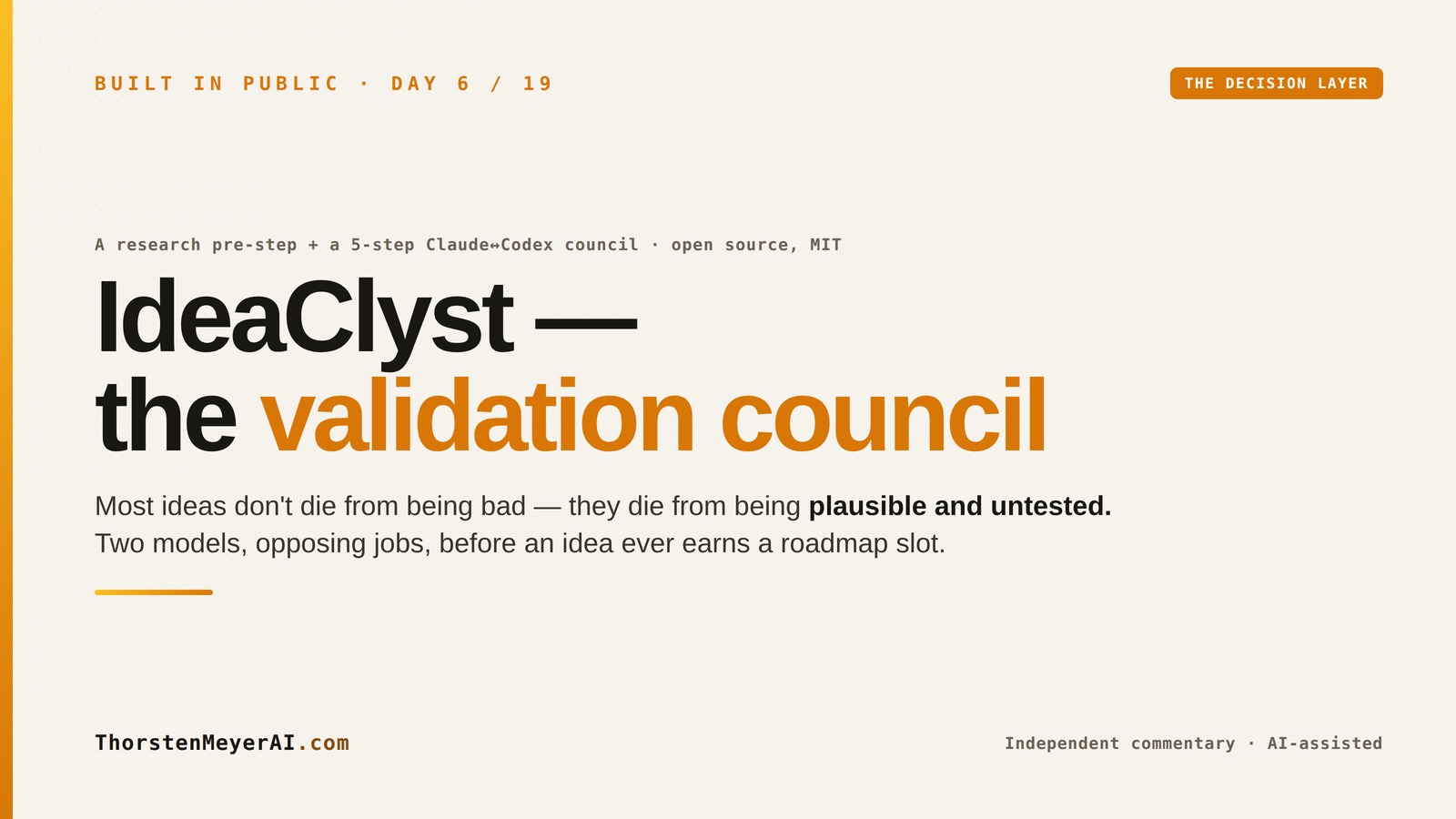
IdeaClyst — the validation council
Most ideas don’t die from being bad — they die from being plausible and untested. A research pre-step, then two models cross-examining the idea before it earns a roadmap slot.
Independent commentary, produced with AI assistance under human editorial oversight. The views are the author’s own and may change. IdeaClyst is open source under MIT, provided “as is” without warranty; see the repository LICENSE. The council’s research, deliberation and verdicts are produced by automated models and may contain errors or shared blind spots — a verdict is auditable reasoning, not validated demand; verify independently before committing. Product and company names are trademarks of their respective owners; mention does not imply endorsement.
Why a council, not a chatbot
Ask a single model “is this a good idea?” and you’ll usually get a yes. Not because the idea is good, but because agreeing is what assistants are trained to do well. A lone model is a sycophancy risk dressed up as analysis — it will help you rationalize almost anything if you let it.
A council removes that comfort. When two different models are assigned opposing jobs — one to make the strongest case for, one to tear it down — the agreement stops being free. The idea has to survive a fight, and what survives is more trustworthy than what merely got nodded through. In business terms, the cheapest leverage available to any operator is making slightly better decisions about what to do — and structured disagreement is one of the few reliable ways to get there without hiring a skeptic.
The use of two different models (Claude and Codex) matters beyond redundancy. Different models have different blind spots and different defaults; pointing them at each other surfaces objections that either one alone would have glided past.

Independent Verification and Validation: A Life Cycle Engineering Process for Quality Software
As an affiliate, we earn on qualifying purchases.
As an affiliate, we earn on qualifying purchases.
The research pre-step — argue over facts, not vibes
The council doesn’t convene cold. Before any deliberation, there’s a research pre-step: a pass that gathers context, prior art, and whatever signal already exists about the problem. (This is why the “five-step council” is precise rather than loose — it’s one research step plus five deliberation steps, and the research is doing real work upstream.)
The reason this ordering matters is simple: a debate without facts is just two confident voices. By front-loading the research, the council argues over evidence rather than impressions — the steelman has to cite something, the red-team has to attack something real. It’s the difference between a productive disagreement and a vibes-off.

Universal Methods of Design, Expanded and Revised: 125 Ways to Research Complex Problems, Develop Innovative Ideas, and Design Effective Solutions (Rockport Universal)
As an affiliate, we earn on qualifying purchases.
As an affiliate, we earn on qualifying purchases.
The five steps
Once research is in hand, the deliberation runs in five moves: frame the idea (who’s the buyer, what’s the actual problem, what’s in scope); steelman it (the strongest honest case to build); red-team it (the strongest case against, plus the risks nobody wants to name); evidence-check it (what’s genuinely proven versus quietly assumed); and verdict (synthesize the fight into a recommendation with its reasoning attached).
That last point is the one that makes it useful rather than oracular. The output isn’t a thumbs-up or a score to obey — it’s a recommendation you can inspect. You can see what the steelman claimed, where the red-team landed a hit, and which assumptions are carrying the most weight. A verdict you can audit is worth far more than a verdict you have to trust.
And, in keeping with the series’ spine: the council’s real job is subtraction. It exists to kill weak ideas cheaply, before they cost a roadmap slot and three months. A council that returns “no, and here’s exactly why” has done its most valuable possible work.

Enterprise 2.0: New Collaborative Tools for Your Organization's Toughest Challenges
As an affiliate, we earn on qualifying purchases.
As an affiliate, we earn on qualifying purchases.
Provider-agnostic, by construction
IdeaClyst is the clearest expression in the portfolio of the provider-agnostic thesis, because it doesn’t just tolerate multiple models — it requires them. A council of one is a contradiction. The architecture is built around the idea that models are interchangeable, comparable parts, and that pointing different ones at the same problem is a feature you can only have if you never welded yourself to a single vendor.
It runs local-first on owned compute, like the rest of the stack, which means convening the council costs essentially nothing per idea — and an idea-validation process that’s nearly free to run is one you’ll actually use every time, instead of saving it for the “important” decisions and winging the rest.
On the operator constellation, IdeaClyst is the first Decision node to light up — the private counterpart to the public IdeaNavigator, and the start of the layer that decides what’s worth doing.

Progressive Decision-Making Tools and Applications in Project and Operation Management: Approaches, Case Studies, Multi-criteria Decision-Making, … in Systems, Decision and Control, 518)
As an affiliate, we earn on qualifying purchases.
As an affiliate, we earn on qualifying purchases.
The honest bear case
The hard limit is unavoidable: a council of models is still just models. Two AIs disagreeing can both be confidently wrong, share the same training blind spots, and produce a polished verdict that feels rigorous while resting on the same shaky assumption. Adversarial structure reduces sycophancy; it does not manufacture ground truth. The council can tell you an idea is internally weak — it cannot tell you the market is real. Only buyers do that.
There’s also a process-theater risk. Five steps and two models can lend a decision the appearance of rigor that makes it harder to question — “the council approved it” is a dangerous sentence if it ever stops meaning “and here’s the auditable reasoning.” The value is entirely in reading the argument, not in deferring to the verdict.
The bull case, plainly
With those caveats: IdeaClyst turns the cheapest, highest-leverage activity an operator has — deciding what not to do — into something structured, repeatable, and nearly free. It replaces a lone model’s reflexive agreement with a fight you can watch, grounds that fight in research, and hands back reasoning you can inspect rather than a number to obey. It’s open source, multi-model by design, and it feeds straight into the roadmap layer that comes next.
It won’t validate your market. But it will make sure that by the time an idea reaches your roadmap, it has at least survived someone genuinely trying to kill it — which is more than most ideas ever get.
IdeaClyst is open source under MIT and provided “as is,” without warranty; see the repository LICENSE. This article was produced with AI assistance and reviewed under human editorial oversight — it is independent commentary and analysis, and the views are the author’s own and may change. The council’s research, deliberation, and verdicts are produced by automated models and may contain errors or shared blind spots; a verdict is auditable reasoning, not validated demand — verify independently before committing. Product and company names are trademarks of their respective owners; mention does not imply affiliation, sponsorship, or endorsement. © 2026 Thorsten Meyer · Powered by Thorsten Meyer AI. See Imprint/Impressum and Privacy Policy.