
By Thorsten Meyer

Get business pricing on tech for your team
- Business-only prices and quantity discounts
- Tax-exempt purchasing
- Multiple users, one account, clear invoices
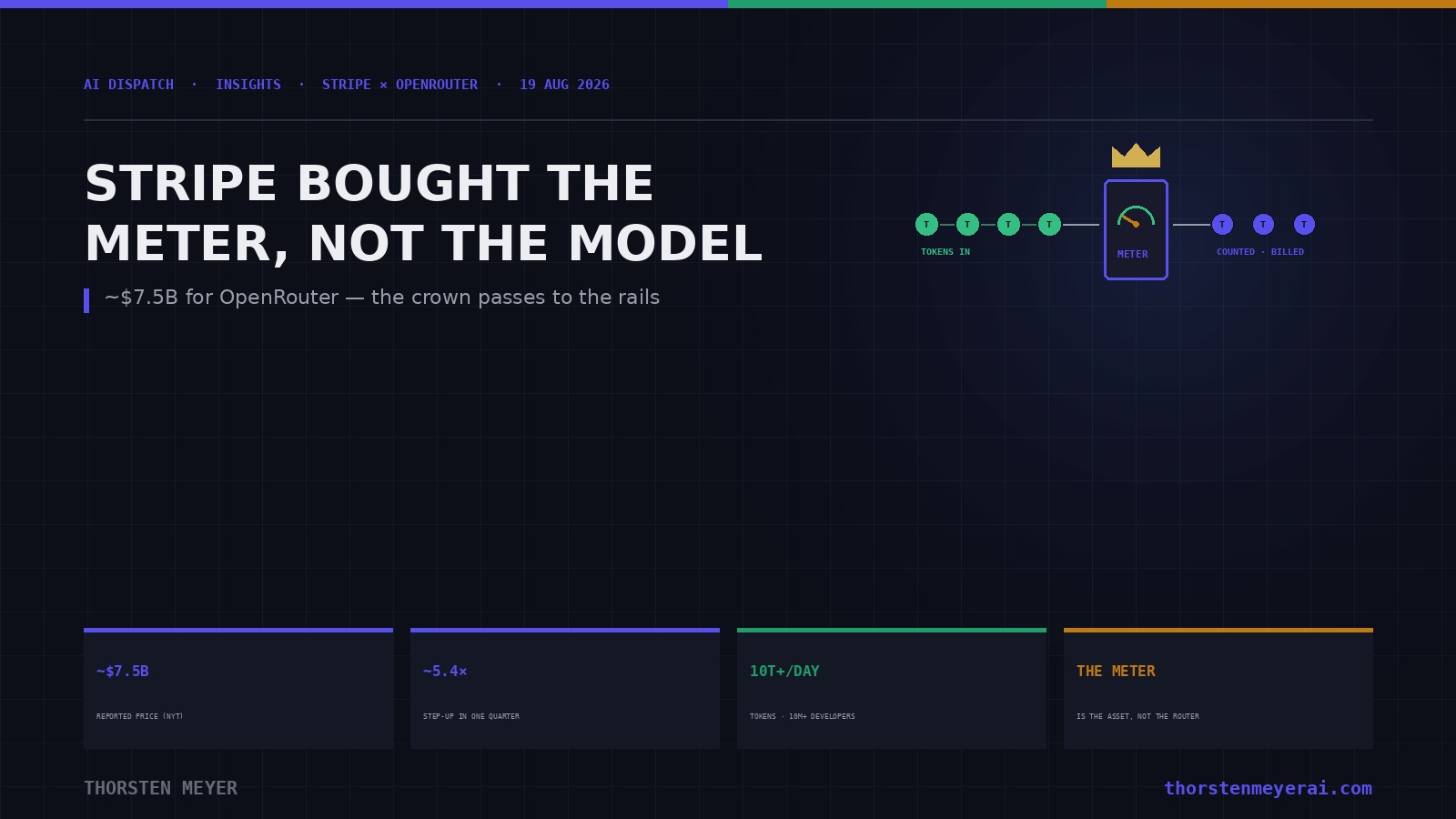
Stripe did not pay roughly $7.5 billion for a piece of software that routes prompts between AI models. You could rebuild the routing in a weekend, and half the internet said so the moment the deal leaked. Stripe paid that price for something a weekend of code can’t reproduce: the position of counting and billing the tokens that flow through the fastest-growing spend category in software. It bought the meter. And once you see the deal that way, it stops looking like a payments company overpaying for a router and starts looking like exactly the move I argued was coming when I wrote that fintech’s crown was passing from the interface to the rails.
Let me separate what’s confirmed from what’s reported, lay out what Stripe actually acquired, and then get to the part that’s genuinely contestable.
Confirmed versus reported
Be precise about the number, because the coverage blurred it. Stripe officially confirmed the acquisition on 19 August 2026, in a newsroom post framing the purchase around helping businesses optimize token routing and usage — but it did not disclose a price. The roughly $7.5 billion figure, with about $1.5 billion of it going to OpenRouter’s founders, comes from New York Times sources; Bloomberg’s earlier reporting said “more than $7 billion.” So the acquisition is confirmed; the headline number is a well-sourced media estimate, not a disclosed term. Treat “$7.5B” as reported, not official.
You could rebuild the router in a weekend. What a weekend of code can’t reproduce is the position of counting and billing the tokens flowing through the fastest-growing spend category in software.
Whoever sits where token usage is counted, priced, and billed owns the spend relationship for the AI economy — the same position Stripe holds for payments. “Tokens are the central currency for companies building with AI.” — Patrick Collison
As an affiliate, we earn on qualifying purchases.
What Stripe actually bought
OpenRouter, founded in 2023, is the largest AI model gateway — a single neutral interface to more than 400 models from over 80 providers, with observability, cost management, and routing that optimizes for price, performance, and uptime. Its own numbers are the tell of why this was worth a strategic premium: it processes more than 10 trillion tokens per day for a community north of 10 million developers and companies, and says it has seen at least tenfold growth in inference volume every year since founding. Its CEO, Alex Atallah, had described the company for years as "Stripe for AI." That framing just got taken literally.
Now weigh the price against the recency. OpenRouter raised a $113 million round in May 2026 at a reported $1.3 billion valuation, backed by Sequoia, a16z, Menlo, and Alphabet's CapitalG. Three months later it's a ~$7.5 billion acquisition — a roughly 5.4x step-up in a single quarter, with the founders alone reportedly clearing more than the company's entire valuation from the spring. Stripe reportedly had to outbid others, including Databricks, to get it. That is not the price of a router. That is the price of a position.
As an affiliate, we earn on qualifying purchases.
Why the meter is the prize
Here's the logic, and it's clean once you stop looking at the routing and start looking at the billing. AI products charge by the token. Token consumption is already enormous and compounding — one late-2025 Deloitte survey of large US enterprises found a third of them already burning between one and ten billion tokens a month, and another third burning more than ten billion. Stripe has spent a year building into exactly this: it launched Token Billing and had been previewing an LLM proxy for routing and metering model calls before it ever bid for OpenRouter. Its CEO, Patrick Collison, put the thesis in one line — tokens, he said, are the central currency for companies building with AI.
Follow that currency. Whoever sits at the point where token usage is counted, priced, and billed owns the spend relationship for the entire AI economy — the same position Stripe already occupies for payments. Routing cleverness is the visible feature; the meter underneath it is the asset. OpenRouter's gateway already produces precisely the data a billing layer needs — per-request prompt, completion, reasoning, and cached token counts, plus the underlying provider cost separated from what the customer is charged. Stripe didn't buy a router with a billing feature. It bought a metering layer with a router attached, and the meter is the part that's worth $7.5 billion.
API token counting and billing system
As an affiliate, we earn on qualifying purchases.
As an affiliate, we earn on qualifying purchases.
This is the crown passing to the rails, in real time
I need to connect this to something I wrote days ago, because it's almost too on-the-nose. In "Fintech is Dead, Long Live Fintech," I argued that the value in fintech had relocated from the pretty interface to the underlying rails — that the crown was passing to whoever owned the toll booth on machine-initiated commerce, and that it would be the established payment networks and processors, not the disruptors, who captured it. This is that thesis wearing a new outfit. A payments incumbent, worth around $160 billion, is buying its way into the toll booth on machine-initiated AI consumption — the layer where software agents spend tokens the way they'll soon spend dollars. The same company bought a stablecoin platform, Bridge, last year for $1.1 billion. Stripe is methodically buying the meters for every kind of machine-initiated money movement, and OpenRouter is the token meter.
That's the bull case, and I think it's largely right. But I'd be doing the thing I keep criticizing if I stopped there.
AI developer token management platform
As an affiliate, we earn on qualifying purchases.
As an affiliate, we earn on qualifying purchases.
The honest bear case
Is it a $7.5 billion router? The skeptics aren't wrong that the artifact is reproducible. The value has to live in the position, the data, and the network — not the code — and if a rival aggregator or a hyperscaler can rebuild neutral routing and win developers on trust, the moat is thinner than the price implies. Paying 5.4x a three-month-old valuation is a bet that the position compounds faster than it can be copied. That bet might be wrong.
The meter is contested, not captured. Ramp, the spend-management company, is reportedly building its own AI model-routing product as token costs become a top line-item for its customers. When two of the most valuable financial-infrastructure firms both move to sit between applications and models, the metering layer is a race, not a prize already won. It's entirely possible Stripe paid this much precisely because it couldn't afford to lose the meter to someone else — which is a different, more defensive story than the visionary one.
And the neutrality problem is the real one. OpenRouter's entire value proposition was that it was a neutral layer — no stake in which model you picked, optimizing only for you. Both companies say it will run independently and keep making routing decisions in the user's interest. Watch that closely, because a neutral aggregator owned by a party with commercial interests in the flow is the single most reliable way neutral layers stop being neutral. The incentive to nudge routing, bundle billing, or favor partners doesn't have to be acted on to change how much developers can trust the neutrality — the mere fact of interested ownership erodes the thing that made OpenRouter valuable in the first place. That's not a prediction of bad behavior; it's a structural tension that now sits permanently inside the product.
The part that's mine to make
Here's where I land, through the lens I can't switch off. The meter is the new toll booth, and this deal is it consolidating into the same small set of hands that already run the rails — the oligopoly-plus-tail pattern I keep tracing, now reaching the AI-token layer. For most of the market, that's fine; Stripe is genuinely good at this, and a well-run meter is useful.
But for anyone who cares about sovereignty, this deal is an argument, not a reassurance. The moment the neutral aggregator gets bought by an interested party, the case for owning your own routing and metering — running a neutral layer you actually control, over inference you can actually see — gets stronger, not weaker. The whole reason a third-party neutral router was valuable is that it saved you from building your own. When its neutrality becomes a question mark, the build-your-own math changes for exactly the builders who most need to trust the meter. I don't think Stripe-OpenRouter is a bad deal; I think it's a clarifying one. It tells you precisely where the value in the AI economy is relocating — to the layer that counts the tokens — and it tells you that layer is being bought up by the people who already own the money rails. What you do with that information depends on whether you'd rather rent the meter or own it.
Where I land
Stripe bought the meter, not the model, and the price makes sense only through that frame — as a bet on owning the spend relationship for the token economy, the same way it owns it for payments. It's the clearest confirmation yet of the thesis that fintech's value relocated to the rails of machine-initiated money. The open questions are whether the position compounds faster than it can be copied, whether Ramp and others turn the meter into a fragmented race, and whether a neutral layer survives interested ownership. My honest read: the strategic logic is sound, the price is a real gamble, and the neutrality question is the one that matters most — both for OpenRouter's users and for anyone deciding whether the safest meter is the one you run yourself.
Analysis and opinion from a builder, founder, and post-labor economist running a local-first inference operation. The acquisition is confirmed by Stripe's newsroom announcement (19 August 2026); the ~$7.5B price and founder allocation are reported by the New York Times and Bloomberg and were not officially disclosed. Figures on OpenRouter's scale, funding, and valuation, Stripe's Token Billing work, and enterprise token-consumption data are verified at time of writing against Stripe's and OpenRouter's own posts and reporting from Bloomberg, TechCrunch, CNBC, The New Stack, and others; reported figures may be revised. Interpretation and the fintech-rails framing are the author's own. This is analysis, not investment advice. Point-in-time as of 19 August 2026.
Halloween Picks
halloween
As an affiliate, we earn on qualifying purchases.