The hardest decision in any portfolio isn’t what to start. It’s what to stop.
Starting things is fun and cheap and socially rewarded. Stopping things is none of those. Every initiative you’ve kept alive too long is being propped up by some combination of sunk cost (“we’ve already put so much in”), identity (“this is who we are”), and effort-justification (“look how hard everyone worked”). None of those are reasons to continue. All of them feel like reasons to continue. That’s the trap.
Outcome-First Decisions is a small, opinionated framework built to spring that trap. It judges every initiative by a single question — what outcome is this producing right now, and is that outcome worth its ongoing cost? — and returns one of three verdicts: keep, change, or kill. The mechanism that forces the question is what it calls the Worth Filter, and the verdict it exists to make sayable is kill.
It’s open source under AGPL-3.0, on GitHub. This is a dispatch — the short version of why a portfolio needs a way to stop.
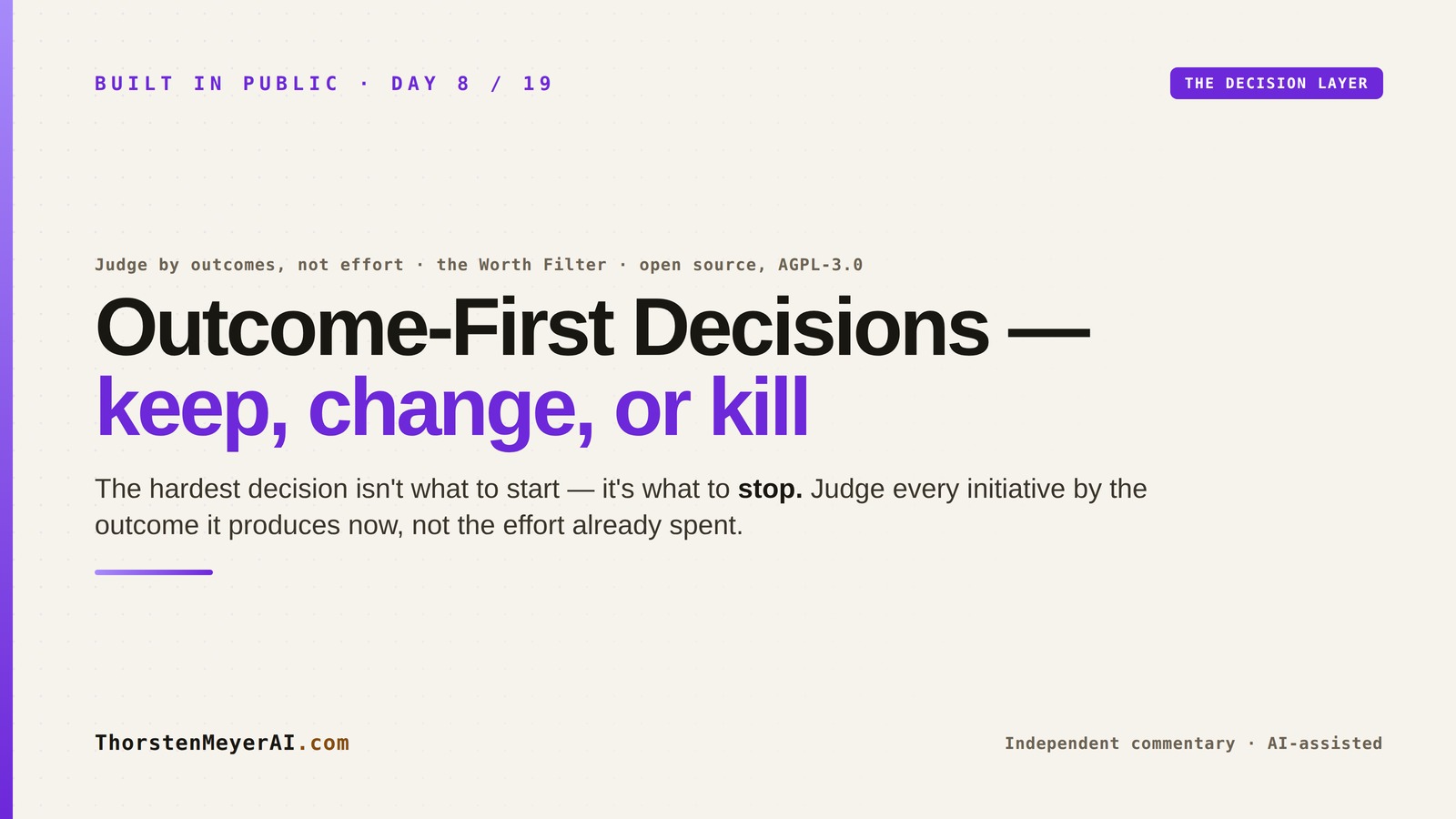
Outcome-First Decisions — keep, change, or kill
The hardest decision isn’t what to start — it’s what to stop. Judge every initiative by the outcome it produces now, not the effort already spent.
Independent commentary, produced with AI assistance under human editorial oversight. The views are the author’s own and may change. Outcome-First Decisions is open source under AGPL-3.0, provided “as is” without warranty; see the repository LICENSE. The framework’s verdicts are reasoning aids based on the inputs given and may be wrong — decision support, not decisions; verify independently before acting. Product and company names are trademarks of their respective owners; mention does not imply endorsement.
The stopping problem
Look at almost any collection of projects, products, or commitments and you’ll find a long tail of things that are neither succeeding nor being killed. They’re just… continuing. Quietly consuming attention, maintenance, and capital, defended by the fact that nobody wants to be the one to call it.
The cost of that is rarely a line item, which is exactly why it’s dangerous. A dead project doesn’t bill you; it taxes you — in focus, in upkeep, in the opportunities you can’t take because your attention is spread across things that stopped earning their place. For an operator running many things at once, the cheapest available growth isn’t a new launch. It’s reclaiming the capacity currently trapped in things that should have ended.
So the discipline that matters most isn’t generating more — it’s pruning. And pruning is hard precisely because the signals telling you to continue are emotional and the signal telling you to stop is a spreadsheet nobody wants to read.

The Decision Book: Fifty Models for Strategic Thinking
As an affiliate, we earn on qualifying purchases.
As an affiliate, we earn on qualifying purchases.
The Worth Filter: outcomes, not effort
The Worth Filter does one deceptively simple thing: it makes you judge forward, not backward.
Backward-looking questions — how much have we invested? how hard did we work? how attached are we? — are exactly the ones that keep dead things alive, and the filter refuses to weight them. The only thing that counts is the forward question: given where this is now, is the outcome it will produce worth the cost of continuing? What you’ve already spent is gone either way; it’s irrelevant to whether the next month is worth it.
That reframing is the whole trick, and it’s why the three verdicts are what they are. Keep: the outcome justifies the cost, continue. Change: the underlying thing is worth something but the current shape isn’t working, so alter it deliberately rather than drifting. Kill: the outcome doesn’t justify the cost, and no amount of past investment changes that — end it cleanly and reclaim the capacity.
The bias of the tool is unapologetically toward making kill easy to say, because kill is the verdict everything else in human nature is organized to avoid.

Bucket Boss – Contractor’s Portfolio, Tool Bags – Original Series (62200), Brown
- Multiple organizer pockets: Stores pens, pencils, phone, cards
- Total of 11 pockets: Ample storage space
- Exterior file pocket: Easy access to documents
As an affiliate, we earn on qualifying purchases.
As an affiliate, we earn on qualifying purchases.
Where it sits: closing the decision loop
On the operator constellation, Outcome-First is the third and final Decision node, and it’s the one that closes the loop. The decision layer now reads as a full cycle: IdeaClyst decides what’s worth doing → Threlmark turns that into an ordered plan → Outcome-First reviews what’s running and decides what keeps living.
Validate, plan, review. The first two answer “should we start this?” and “in what order?” Outcome-First answers the question they can’t: “now that it’s real and running, should it still exist?” Without that third step, a portfolio only accretes — it can add but never subtract, which is how operators end up buried under their own past decisions. Outcome-First is the garbage collection for a portfolio: the routine that keeps the whole thing from silting up.
That makes the decision layer complete. Everything before it produced and proposed; this layer decides — including the hardest decision, which is to undo a previous one.
![Express Schedule Free Employee Scheduling Software [PC/Mac Download]](https://m.media-amazon.com/images/I/41yvuCFIVfS._SL500_.jpg)
Express Schedule Free Employee Scheduling Software [PC/Mac Download]
- User-friendly drag & drop planning: Simple shift scheduling interface
- Manage time-off and holidays: Add sick leave, breaks, holidays
- Email schedules to staff: Send schedules directly via email
As an affiliate, we earn on qualifying purchases.
As an affiliate, we earn on qualifying purchases.
Provider-agnostic, local-first, AGPL
It carries the portfolio’s spine like the rest. Local-first, running on owned compute, so a review costs nothing and can be run as often as honesty requires rather than saved for an annual reckoning. Provider-agnostic, because the reasoning isn’t welded to a single model.
The AGPL-3.0 license is a deliberate choice for a decision framework: strong copyleft keeps it genuinely open and ensures that anything built on top stays open too, rather than being quietly absorbed into a closed product. A method for deciding what to keep is exactly the kind of thing that should stay inspectable.

The Decision Filter: How to use personal rules, clear priorities, and simple self-management to choose with less stress
As an affiliate, we earn on qualifying purchases.
As an affiliate, we earn on qualifying purchases.
The honest bear case
The deepest risk is that outcomes can be mismeasured or gamed. A filter that judges by outcomes is only as good as the outcomes it’s fed — pick the wrong metric and you’ll confidently kill something healthy or keep something hollow. Garbage in, confident verdict out.
There’s also a real danger of premature killing. Some of the most valuable things compound slowly and look like failures for an embarrassingly long time; a tool biased toward making kill easy can, in the wrong hands, become a machine for strangling things in the cradle. The Worth Filter reframes the question well, but it cannot supply the judgment to know which slow starts are dying and which are merely early.
And finally, the uncomfortable one: a framework doesn’t supply courage. Outcome-First can make the case for killing something undeniable on paper and you can still refuse to do it. The tool removes the analytical excuse for keeping dead things alive; it cannot remove the emotional one. That part is still on you.
The bull case, plainly
With those caveats: Outcome-First institutionalizes the single hardest and highest-leverage discipline an operator has — stopping. It strips sunk cost and ego out of the decision, makes kill a normal verdict rather than a failure, and closes the decision loop so the portfolio can subtract as fluently as it adds. It’s open source, local-first, and pointed squarely at the thing most people avoid.
It won’t kill anything for you. But it will make sure that everything still alive in your portfolio is alive for a reason you can actually defend — which, over time, is most of the game.
Outcome-First Decisions is open source under AGPL-3.0 and provided “as is,” without warranty; see the repository LICENSE. This article was produced with AI assistance and reviewed under human editorial oversight — it is independent commentary and analysis, and the views are the author’s own and may change. The framework’s verdicts are reasoning aids based on the inputs it is given and may be wrong; they are decision support, not decisions — verify independently before acting. Product and company names are trademarks of their respective owners; mention does not imply affiliation, sponsorship, or endorsement. © 2026 Thorsten Meyer · Powered by Thorsten Meyer AI. See Imprint/Impressum and Privacy Policy.