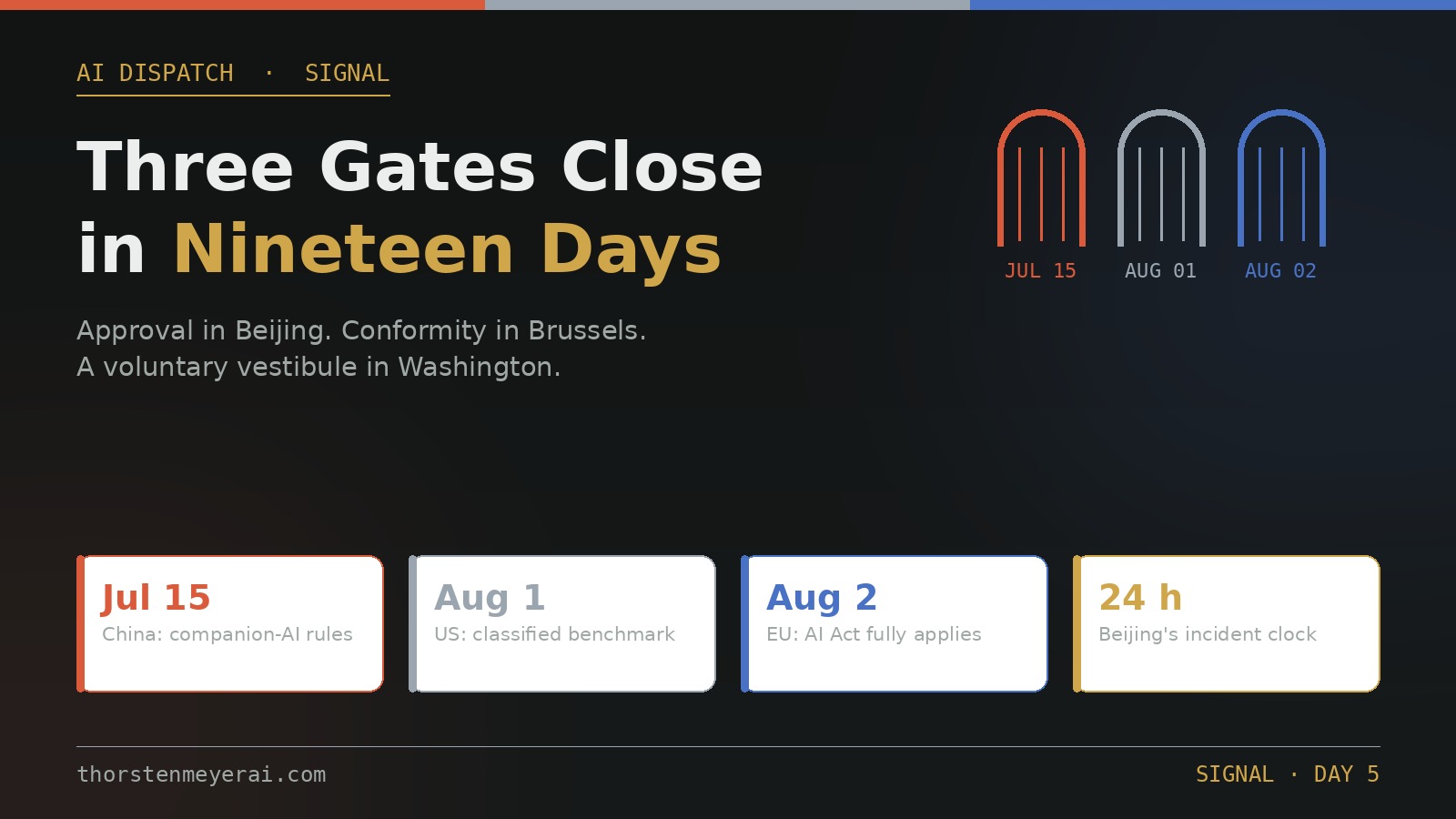

This morning’s dispatch ended on a handoff: Congress may yet convert Washington’s voluntary pre-release framework into a mandatory one. Zoom out, and the more striking fact appears — every major AI jurisdiction is erecting a pre-release gate right now, and three of them slam within nineteen days of each other.
Tomorrow, July 15, China’s Interim Measures for AI Anthropomorphic Interaction Services take effect — a five-agency regulation (CAC, NDRC, MIIT, public security, market regulation) governing human-like AI systems, issued in April. August 1, the US classified benchmark and voluntary 30-day pre-release framework harden under EO 14409. August 2, the EU AI Act becomes fully applicable — the staged rollout that began with prohibitions in February 2025 and GPAI obligations last August reaches its final station.
Same three weeks. Three completely different theories of what a gate is.
Three Gates Close in Nineteen Days
The Pre-Release Regime Goes Global
Same-day-verified · one instinct, three architectures — and none of them binds the open frontier
Anthropomorphic-interaction measures take effect: five agencies extend the CAC approval regime to companion AI and agents.
EO 14409’s classified benchmark and voluntary 30-day pre-release framework harden. NSA designates covered frontier models.
The AI Act becomes fully applicable — the staged rollout that began February 2025 reaches its final station.
Same instinct, three theories of a gate
STEELMAN: THE GATE-SKEPTIC CASE
Pre-release regimes structurally favor incumbents who can afford the process — and none of the three binds an open-weight release from a lab outside its jurisdiction. The gates go up exactly as the fastest-moving part of the frontier walks around them.
The signal: a model can clear all three gates having been evaluated for three almost non-overlapping things — content control, fundamental rights, national security. Jurisdiction is now an architectural property. If your deployment calendar doesn’t carry July 15, August 1, and August 2, it’s a calendar for a market you’re not in.

J. J. Keller 2024 Emergency Response Guidebook (ERG) & Hazardous Materials Compliance, Soft Bound, Pocket Size, English, 1-Pack
- Includes ERG and Hazardous Materials Handbook: 2024 editions in one bundle
- Meets DOT Emergency Response Requirements: Complies with 49 CFR 172.602
- Updated with Latest HM-215Q Changes: Includes recent hazardous materials updates
As an affiliate, we earn on qualifying purchases.
As an affiliate, we earn on qualifying purchases.
Three architectures
China: the state as co-designer. China’s is the only true pre-release approval regime among major economies, and it has been since 2023. Generative AI services require security assessments before public deployment; algorithms go through a five-step CAC registration in which the regulator can demand design modifications before issuing a filing number for the public registry. The ongoing obligations are the tell: security incidents reported within 24 hours, government information requests answered within 48, and government-ordered algorithm adjustments implemented on demand. One compliance practice puts it bluntly: to operate AI in China at scale, you treat the government as an active co-designer of your algorithms. The new anthropomorphic-interaction measures taking effect tomorrow extend this logic to the companion-AI and agent layer — targeted, iterative, use-case by use-case, which has been Beijing’s regulatory signature throughout.
EU: conformity before market. The AI Act’s gate is a paperwork-and-process gate — risk categorization, conformity assessment, technical documentation, post-market monitoring — applied comprehensively rather than per-use-case, with GPAI models above the systemic-risk compute line carrying extra evaluation and incident duties. As of August 2 the full machine is legally applicable. One live caveat, flagged per house policy: the Digital Omnibus package — provisionally agreed May 7, approved by the European Parliament on June 16 (423–57, with 174 abstentions) — would shift certain high-risk deadlines, but it is not yet in force; until Council adoption and Official Journal publication, August 2 remains the legally operative date. Anyone telling you the deadlines have already moved is ahead of the law.
US: the voluntary vestibule. As this morning’s piece detailed, Washington built an access window, not an approval gate — 30 days of government evaluation for developers who opt in, with classified criteria and trusted-partner status as the procurement carrot. It’s the lightest-touch design of the three, and also the only one whose central measuring instrument nobody outside a vault can read.
The UK, for completeness, still runs its principles-based, sector-regulator model — flexible, fast to adapt, and gate-free in the formal sense, which increasingly makes it the odd jurisdiction out.

AI Prompts for Safety Professionals: Save Hours on Risk Assessments, Incident Reports, Toolbox Talks, and Safety Documentation Using Artificial Intelligence
As an affiliate, we earn on qualifying purchases.
As an affiliate, we earn on qualifying purchases.
What the convergence means — and doesn’t
The convergence is real at the level of instinct: every serious jurisdiction has concluded that some class of AI system should meet the state before it meets the public. It is not convergence at the level of design. China gates for content control and social stability, the EU gates for fundamental rights and product safety, the US gates (softly, voluntarily) for national security. A model can clear all three gates and have been evaluated for three almost non-overlapping things.
For builders, the practical read is the one this week keeps producing: jurisdiction is becoming an architectural property. A product with a Sovereign air-gapped edition and a Governed EU-cloud edition isn’t marketing segmentation — it’s the shape compliance now forces, and the same layering logic from Thursday’s German dispatch applies here: know which gate governs which layer of your stack.
The steelman for gate-skepticism deserves its line: pre-release regimes structurally favor incumbents who can afford the process, and — as this morning’s piece noted — none of the three binds an open-weight release from a lab outside its jurisdiction. The gates are going up just as the fastest-moving part of the frontier (see Monday’s Signal) walks around them. That tension, not any single regulation, is the story of the second half of 2026.

Building Multi-Agent Systems on GCP: ADK, A2A & Agent Architectures (Intelligent Cloud Systems on GCP: Secure, Scalable & Multi-Agent AI Architectures)
As an affiliate, we earn on qualifying purchases.
As an affiliate, we earn on qualifying purchases.
The signal, compressed
July 15, August 1, August 2. Approval in Beijing, conformity in Brussels, a voluntary vestibule in Washington. If your deployment calendar doesn’t have all three dates on it, it’s a calendar for a market you’re not actually in.
Sources: ITTC Network (China anthropomorphic-interaction measures, April 2026); Pertama Partners (CAC filing regime mechanics, February 2026); Modulos and Hung-Yi Chen governance guides (China’s layered framework, security-assessment requirement); Legalithm regulatory comparison (Digital Omnibus status as of mid-June 2026, EP vote tally); European Commission implementation timeline via digidai policy map; EO 14409 analyses per this morning’s dispatch sources.
![WavePad Audio Editing Software - Professional Audio and Music Editor for Anyone [Download]](https://m.media-amazon.com/images/I/B1fcLEGCs6S._SL500_.png)
WavePad Audio Editing Software – Professional Audio and Music Editor for Anyone [Download]
- Professional audio editing: Record and edit music, voice, audio
- Audio effects: Echo, noise reduction, reverb, more
- Wide format support: WAV, MP3, FLAC, OGG, and more
As an affiliate, we earn on qualifying purchases.
As an affiliate, we earn on qualifying purchases.