
Every other jurisdiction on this map is, in part, responding to a future the United States is building. The frontier labs are American. The capital is American. Most of the models now reshaping work were trained within a few hours’ drive of San Francisco.
Open a free Amazon Business account
Business pricing, bulk buying and tax-exempt orders.
Create a free accountAs an affiliate, we earn on qualifying purchases.
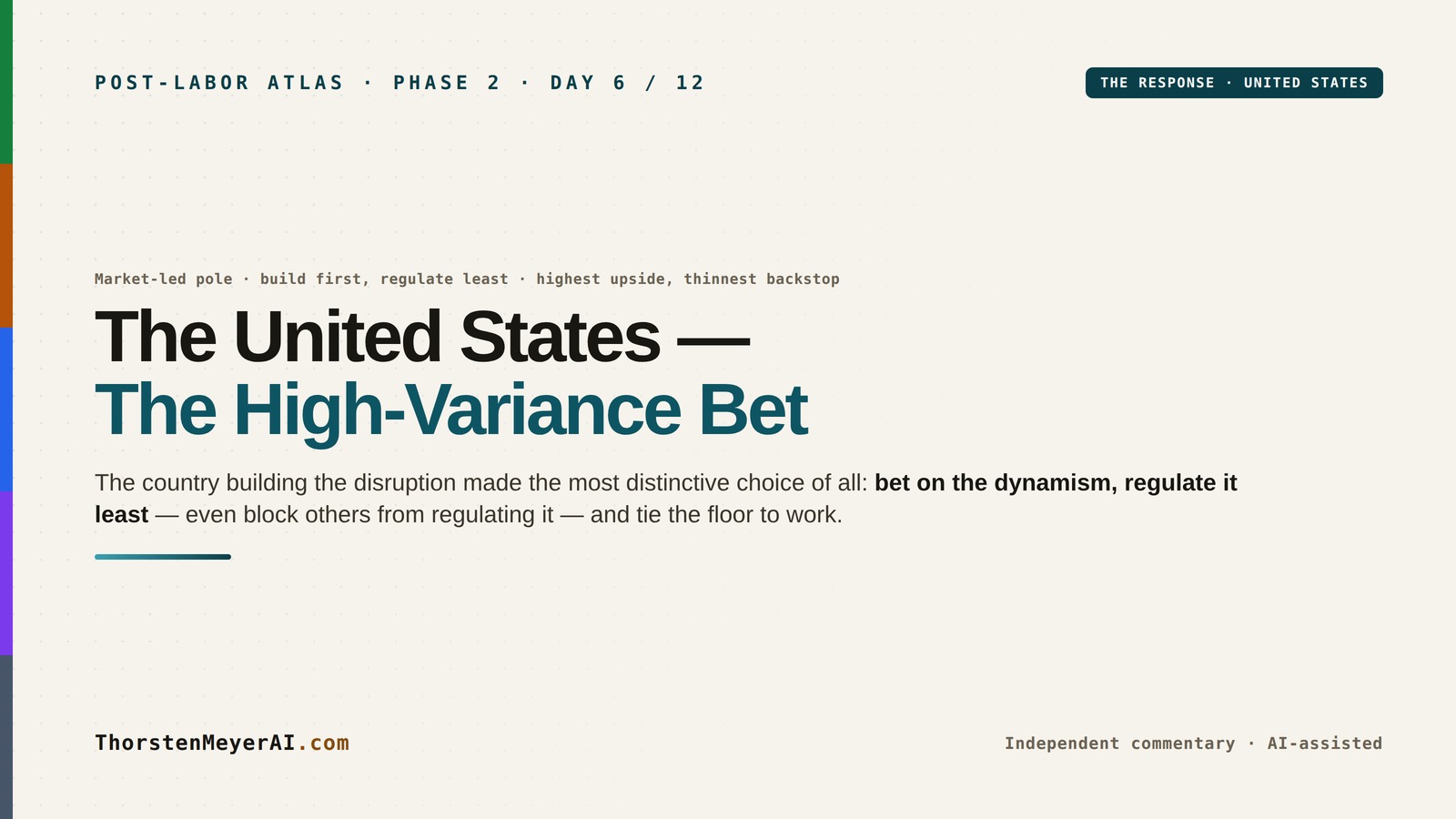
So it matters enormously that the country building the disruption has made the most distinctive choice of all about how to respond to it: bet on the dynamism, regulate it as little as possible, and tie the floor to work.
Where Britain keeps its AI rules deliberately light, Washington has gone a step further — moving not just to avoid regulating but to actively prevent it, including challenging the state governments that try. And the country’s central income support, the Earned Income Tax Credit, pays you only if you work, and almost nothing if you work without children.
On the Response Matrix, the result is the thinnest row of all: minimal on nearly every lever, with the gaps filled not by the federal government but by cities improvising on their own. This is the market-led pole, and it’s the highest-variance bet on the map.
The High-Variance Bet
The country building the disruption made the most distinctive choice of all: bet on the dynamism, regulate it least — even block others from regulating it — and tie the floor to work. The thinnest row on the map.
Independent commentary, produced with AI assistance under human editorial oversight. The views are the author’s own and may change. This is analysis, not policy, economic, investment, or legal advice. Descriptions of US federal AI executive actions, the EITC, “Trump accounts,” and municipal guaranteed-income pilots reflect publicly reported information as of mid-2026 and may change as litigation and legislation evolve. This phase maps differing approaches and endorses none; characterizations of contested policies present competing views, not a verdict, and references to specific administrations and programs are factual and analytical, not partisan. Country and program names are referenced for analysis and imply no affiliation.
The model’s logic
It would be a mistake to read the American approach as simply an absence of policy. It’s a wager with a real and coherent argument behind it.
The bet is on the engine, not the airbag. The United States is the builder — the deepest pools of AI investment, the leading labs, the most liquid capital markets on earth. The argument runs: heavy guardrails would slow the very innovation that generates the wealth everyone else wants to redistribute, so grow the pie as fast as possible first. Distribute it two ways — through work, which the EITC rewards by topping up low earnings, and through broad private capital ownership, since a large share of American households hold equities through retirement accounts and the new “Trump accounts” seed investment accounts for children born this decade. Keep government out of the way, let a flexible labour market reallocate people quickly, and trust that the same dynamism that destroys old work has historically created more new work than it erased.
That last clause is doing a lot of work, but it isn’t naive. It has been true for two centuries of technological change. The American bet is, in essence, that this time rhymes with every previous time — and if it does, the country positioned to build and own the new economy wins biggest. Bet on the engine.
As an affiliate, we earn on qualifying purchases.
The federal posture
The institutions lever is where the American choice is most pronounced, and most easily misread as mere inaction. It isn’t inaction; it’s conviction.
The trajectory is consistent. In January 2025 the administration revoked the previous AI executive order’s emphasis on oversight and equity, and replaced it with one titled “Removing Barriers to American Leadership in Artificial Intelligence.” July 2025 brought “America’s AI Action Plan,” a roadmap for AI “dominance” through minimal regulation. A December 2025 executive order went furthest: it set up a Department of Justice task force to challenge state AI laws in court, signalled that states with rules deemed “burdensome” could lose certain federal broadband funds, and directed regulators to treat some state-mandated AI requirements as deceptive practices. By March 2026 the White House was formally asking Congress to preempt state AI laws outright.
The point worth holding onto is the difference from Britain. The UK declines to regulate AI heavily. The US is moving to ensure that no one in its territory does — including the states, several of which had begun writing their own worker and consumer protections. There are carve-outs, notably for child safety after a bipartisan coalition of state attorneys general pushed back. But the throughline is unmistakable: the most deliberately minimal guardrails on the map, defended not as neglect but as a competitiveness strategy.
As an affiliate, we earn on qualifying purchases.
The levers it pulls
The American row is the sparest in the Atlas. Income floor: minimal — the EITC is real and reaches tens of millions of working families, but it’s entirely work-gated and shrinks to almost nothing for adults without children; there’s no universal floor, and guaranteed-income programs exist only as local pilots. Capital and ownership: minimal as a matter of state policy — no sovereign fund, no dividend — though the country leans hard on private ownership instead. Work and time: minimal — the most flexible labour market in the rich world, at-will employment, no short-time-work scheme. Skills and transition: partial — community colleges and federal workforce programs exist but are fragmented and modestly funded. Institutions: minimal — and, as above, deliberately so.
Four minimals and a partial. Set against the heavy European and Nordic rows, the contrast is the whole story.
local government AI pilot programs
As an affiliate, we earn on qualifying purchases.
As an affiliate, we earn on qualifying purchases.
The signature: a federal void, filled from below
The defining American pattern is a vacuum at the center and improvisation at the edges.
At the top, Washington is clearing the path — pulling back oversight, deregulating across sectors, and moving to block sub-national rules. At the bottom, a very different thing is happening: more than 150 cities and counties have run guaranteed-income pilots, from Stockton’s pioneering $500-a-month experiment to Cook County, which made its $500 monthly payments a permanent budget line in 2026. The response to the post-labor transition is underway in America — but it’s bottom-up, philanthropically seeded, city-budget-dependent, and unscaled, happening in spite of the federal posture rather than because of it.
That’s the signature: the country building the future has a hole where its national response would be, and a patchwork of local experiments trying to fill it — while the center moves to keep both the hole and, increasingly, the patches from being filled by the states. The void isn’t merely being left. In the case of AI rules, it’s being enforced.
As an affiliate, we earn on qualifying purchases.
The honest read
The fair way to assess this is as a high-variance bet, because that’s what it is.
The upside is genuine and large. If the dynamism holds — if AI generates new work and broad gains the way past waves did — the United States is positioned to win more than anyone: it builds the technology, owns the most of it, and distributes the returns through the widest base of private shareholders in the world. No other jurisdiction is set up to capture as much of the good case.
The downside is equally real, and it stacks. The floor is the thinnest among rich nations and almost entirely tied to work — the exact wrong design if work is the thing that thins out, and sharp enough that the federal tax system actually taxes millions of childless working-poor adults into poverty. The “own stocks” answer to the ownership question only helps those who already own stocks, and American equity ownership is highly concentrated — so “private markets will distribute the gains” mostly distributes them upward, toward the very concentration the post-labor worry is about. The local pilots are admirable but far too small to function as a national backstop. And the move to preempt state AI laws forecloses the one path a federation usually has when the center won’t act: letting the states experiment.
Put it together and the shape is clear. America is making the bet with the most upside and the least cushioning — and it’s the most exposed of any jurisdiction here to the precise risk it has chosen not to hedge: capital concentrating without any public claim attached. Boom or bust, with comparatively little in between.
And the whole wager rests on a single contested premise — the one this Atlas opened with. The reallocation camp says new work has always appeared and will again, which makes thin guardrails not recklessness but wisdom: don’t smother the engine that bails everyone out. The displacement camp says the speed and breadth of AI could be the case where the pattern finally breaks. The United States has, in effect, placed the largest chip on the reallocation camp being right. If it is, the bet looks visionary in hindsight. If it isn’t, no jurisdiction will have less to fall back on.
What travels
The dynamism engine itself is the thing every other jurisdiction wants and almost none can copy — it’s downstream of decades of capital depth, risk appetite, and institutional scale. The EITC’s in-work-subsidy design travels well and is widely imitated. The local-pilot model travels as a way to generate evidence cheaply, but it cannot scale into a real floor without the center deciding to build one — and the American preemption fight is a live demonstration that a determined federal government can actively foreclose even the bottom-up path.
The deepest lesson is structural: the United States is running the experiment that the rest of this map is reacting to, and it is doing so with the fewest hedges of all.
Row five
The United States is the market’s wager: build the future fastest, guardrail it least — even block others from guardrailing it — tie the floor to work, and trust that growth, private markets, and local improvisation will catch whoever falls. It is a coherent strategy, and one that two centuries of technological history have repeatedly vindicated.
It is also, unmistakably, the highest-variance position on the map: the most to gain if this transition rhymes with the last ones, and the least to fall back on if it doesn’t. Row five — the market-led pole, and the reference point the next five jurisdictions, each in its own way, will define themselves against.
Independent commentary, produced with AI assistance under human editorial oversight; the views are the author’s own and may change. This is analysis, not policy, economic, investment, or legal advice. Descriptions of US federal AI executive actions and the National Policy Framework, the EITC, “Trump accounts,” and municipal guaranteed-income pilots reflect publicly reported information as of mid-2026 and may change as litigation and legislation evolve. This phase maps differing approaches and endorses none; characterizations of contested policies present competing views rather than a verdict, and references to specific administrations and programs are factual and analytical, not partisan. Country and program names are referenced for analysis and imply no affiliation. © 2026 Thorsten Meyer · Powered by Thorsten Meyer AI. See Imprint/Impressum and Privacy Policy.
NFL season / tailgating Picks
team gear
As an affiliate, we earn on qualifying purchases.