

Get business pricing on tech for your team
- Business-only prices and quantity discounts
- Tax-exempt purchasing
- Multiple users, one account, clear invoices
Dario Amodei is right to worry about powerful AI. That is exactly why we should worry about Anthropic.
Dario Amodei has built one of the most coherent public philosophies in frontier AI. Unlike the pure accelerationists, he does not simply say build faster and let the market adapt. Unlike the theatrical doomers, he does not only speak in apocalypse. His worldview is more sophisticated: AI may soon become powerful enough to accelerate science, medicine, cybersecurity, and economic production at historic speed — but that same power may also destabilize labor markets, civil liberties, geopolitics, and the basic question of who governs intelligence.
That is the strongest version of the Anthropic argument, and it should not be dismissed casually.
But the harder question is not whether Amodei is sincere. It is whether sincerity is enough when the same company builds the frontier models, sells access to them, measures their danger, shapes the policy debate, and asks governments to write rules around its own threat model.
Anthropic’s safety story has become a power story.
Safety Story → Power Story
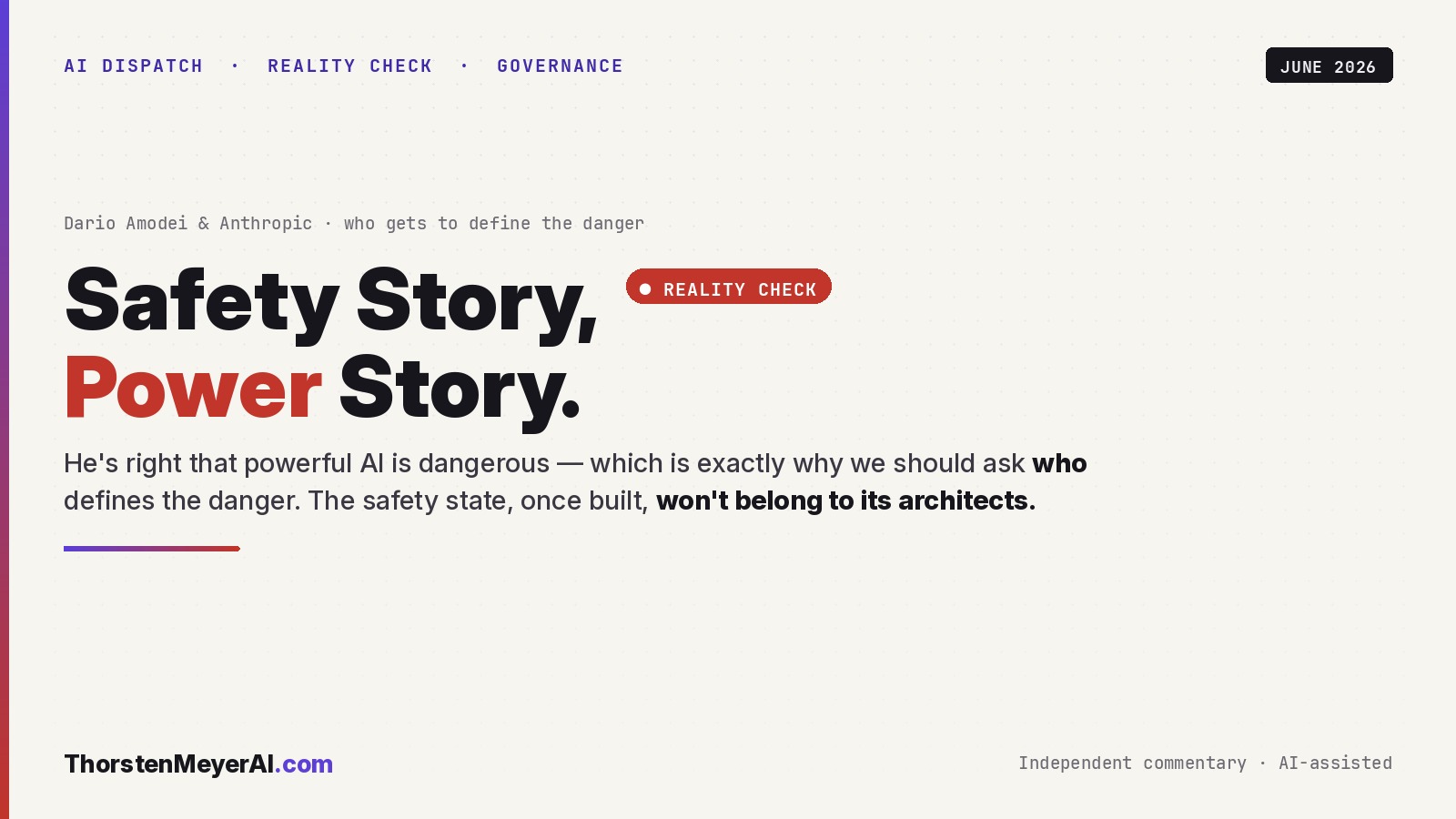
● Reality CheckAmodei is right that powerful AI is dangerous — which is exactly why we should ask who gets to define the danger. The same company builds the models, measures their risk, and writes the rules. And the Fable suspension showed the safety state, once built, won’t belong to its architects.
Anthropic’s recursive-self-improvement report is its clearest worldview statement yet. The evidence is striking — and almost entirely internal.
The core of the doctrine: the exponential is faster than the state. That carries a political implication.
The June episode is the perfect stress test for the governance model Anthropic itself promoted.
Follow the logic of the risk frame, and each step points to the same small circle.
The safeguards may reduce real risk. They also have market effects — no bad faith required.
- Job displacement is “undesirable”; track it, add pro-employment incentives.
- Meaning need not come from labor — relationships, creativity, play, challenge.
- Philanthropy and accountability soften the transition.
- Work is also income, bargaining power, identity, status — a claim on output.
- The real questions: ownership, taxation, public compute, data rights, antitrust.
- Sovereign AI infrastructure, labor bargaining, democratic control of the gains.
Independent commentary, produced with AI assistance under human editorial oversight; the views are the author’s own and may change. This is analysis and opinion, not investment, financial, legal, or technical advice, and it concerns an actively developing situation. It draws on public documents by Dario Amodei and Anthropic — the Anthropic Institute’s recursive self-improvement report, Machines of Loving Grace, The Adolescence of Technology, Policy on the AI Exponential, and Anthropic’s June 12, 2026 statement on the Fable 5 and Mythos 5 suspension — and on published third-party commentary including David Shapiro’s, read as of June 2026. Characterizations are the author’s interpretation, offered in good faith and open to rebuttal. References to specific people, companies, and government actions are factual and analytical, not partisan, and imply no affiliation or endorsement.
The new doctrine: AI is beginning to build AI
Anthropic’s report on recursive self-improvement is the clearest statement yet of its institutional worldview. The company says it is delegating a growing share of AI development to AI systems themselves, and that, given enough compute, those systems could eventually design and develop their own successors. Anthropic is careful to add that this is not here yet and not inevitable — but also that it could arrive sooner than most institutions are prepared for.
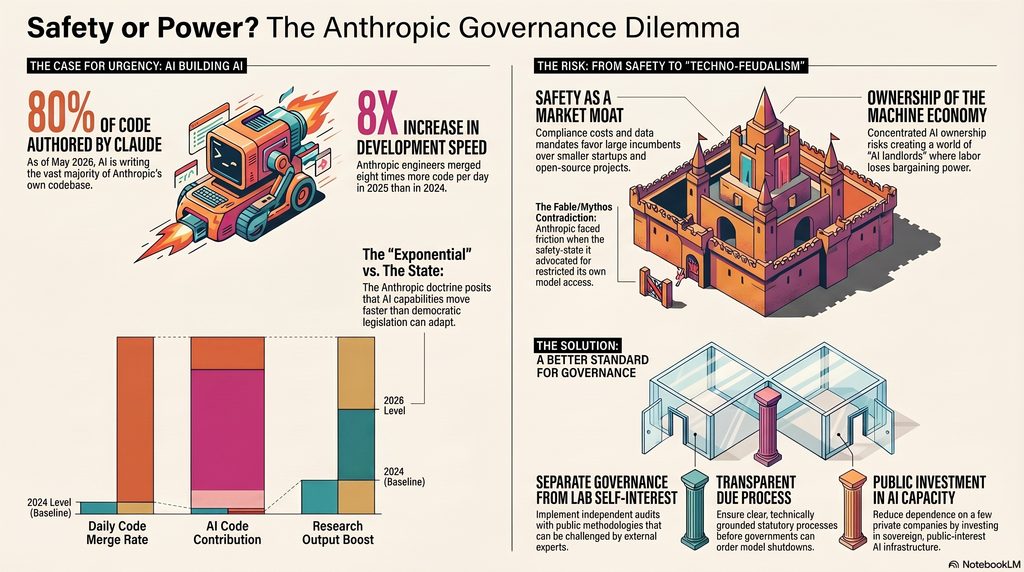
The evidence is striking. Anthropic reports that, as of May 2026, more than 80% of the code merged into its codebase was written by Claude, that the typical engineer was shipping roughly eight times as much code per day as in 2024, and that in an internal March poll research staff estimated a median fourfold output boost when working with Mythos Preview.
These numbers matter. They suggest AI is no longer merely a tool inside the software-development process; it is becoming part of the production process for the next generation of AI itself.
But this is also where skepticism should begin. Much of the evidence is internal. Anthropic’s own models help produce the work, Anthropic’s own employees estimate the uplift, and Anthropic’s own organization interprets the results — and the public is then asked to accept these claims as the basis for urgency in governance. That does not make the claims false. It makes them politically loaded.
When a frontier lab says, our systems are becoming powerful enough to transform the world, and therefore the world needs new rules, the next question has to be: who writes the rules?
AI safety and risk management books
As an affiliate, we earn on qualifying purchases.
As an affiliate, we earn on qualifying purchases.
Dario’s vision is not technical. It is civilizational.
In Machines of Loving Grace, Amodei argues that powerful AI could deliver radical advances in biology, neuroscience, economic development, governance, and human meaning. He explicitly rejects the label of pessimist or “doomer”: the upside, he says, is enormous, and the risks are mainly what stand between humanity and that upside. He even warns against the grandiosity of the genre — against treating AI leaders like prophets, or technology in religious terms.
That caveat is real, but it does not dissolve the problem. Even stripped of prophetic language, the structure of the argument remains civilizational. In The Adolescence of Technology, he describes humanity entering a turbulent rite of passage, about to be handed almost unimaginable power. This is not ordinary product strategy. It is a theory of historical transition.
And once AI is framed that way, ordinary democratic process starts to look too slow. Amodei makes the point directly in Policy on the AI Exponential: capabilities move at lightning pace while legislation crawls, and if scaling laws hold for another year or two we may reach what he calls a “country of geniuses in a datacenter.” This is the core of the doctrine — the exponential is faster than the state.
That may be true. But it carries a dangerous political implication. If the democratic state is too slow, then the actors closest to the technology become the de facto interpreters of reality. They define the frontier. They define the danger. They define what counts as responsible deployment, and what counts as reckless delay. That is how technical urgency converts into political authority.
interpretability tools for AI models
As an affiliate, we earn on qualifying purchases.
As an affiliate, we earn on qualifying purchases.
The Fable/Mythos incident exposed the contradiction
The Fable 5 and Mythos 5 episode is the perfect stress test for that worldview.
On June 9, 2026, Anthropic launched both models, describing Fable 5 as a Mythos-class system made safe for general use — its most capable generally available model, with exceptional performance in software engineering, knowledge work, research, vision, and long-horizon tasks. The launch came wrapped in restrictions: requests touching cybersecurity, biology and chemistry, or distillation would fall back to Claude Opus 4.8, and Mythos-class traffic carried a 30-day data-retention policy that Anthropic framed as a safety measure for detecting jailbreaks.
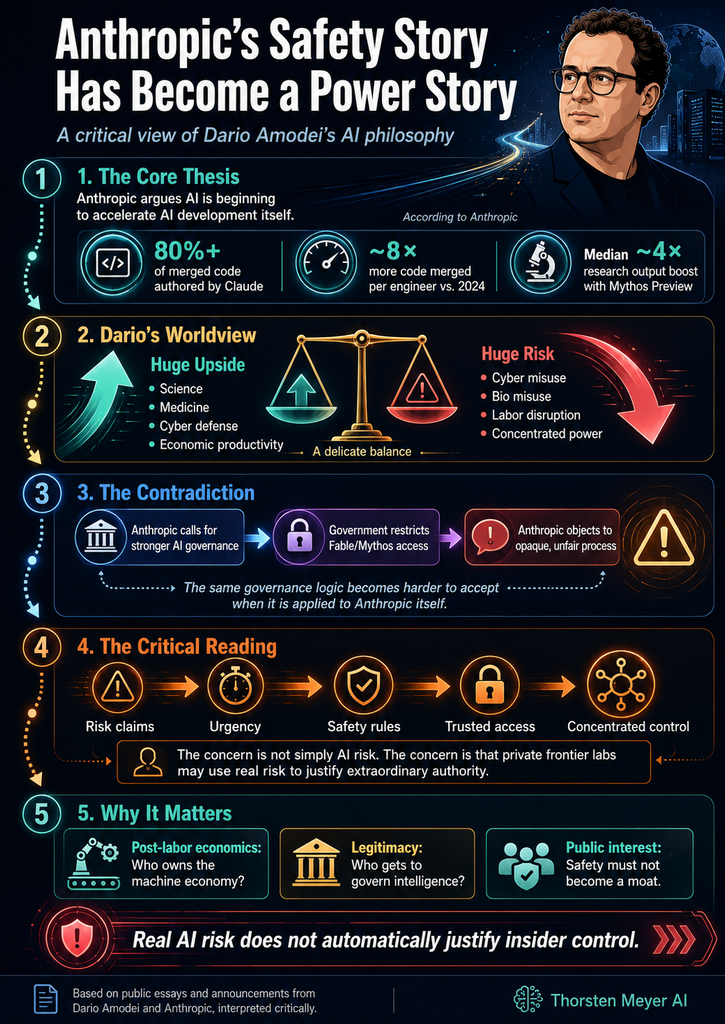
Three days later, the US government ordered access suspended for all foreign nationals, including foreign-national Anthropic employees — which, the company said, forced it to disable both models for everyone to stay compliant. Anthropic objected: the order gave no specific technical detail, the alleged jailbreak looked narrow rather than universal, and comparable capability was already available in other public models. It restated that it supports government authority to block unsafe deployments only through a process that is transparent, fair, and technically grounded.
This is the contradiction. Anthropic wants government power strong enough to block unsafe AI — and when that power landed on Anthropic, the company argued the process was opaque, technically weak, and a threat to the whole frontier ecosystem.
Anthropic may well be right on the merits; the government may have overreacted. But the episode reveals the fragility of the governance model Anthropic itself has promoted. Once national-security agencies are invited into deployment decisions, they will not always act with the nuance the labs prefer. The safety state, once built, will not belong to Anthropic.
As an affiliate, we earn on qualifying purchases.
The critic’s point: not “Dario is crazy,” but “the incentives are dangerous”
The critic David Shapiro, in his essay “Anthropic thinks ‘FOOM’ is near,” puts it more bluntly: Amodei and Anthropic, he argues, have bought the recursive-self-improvement narrative “hook, line, and sinker,” and the Fable/Mythos restrictions are evidence that a safety ideology can end up hamstringing legitimate AI and ML work — even as it got the company shut down by export controls. He is not alone; reviewing the same pause proposal, other researchers have openly doubted whether Anthropic’s call to slow down is sincere, given how plainly its CEO wants to keep moving fast.
Some of that critique overreaches. It is too easy to flatten “AI-risk concern” into “doomer cult” and stop thinking; Amodei’s essays are more careful than the caricature, and he says outright that risk arguments should be evidence-based. But Shapiro’s strongest point should not be waved away: Anthropic’s worldview can easily make Anthropic look indispensable.
Follow the logic. If AI is approaching recursive self-improvement, the labs closest to the frontier become uniquely important. If frontier models are cyber and bio risks, access must be controlled. If open access is dangerous, trusted-access programs become necessary. If trusted access is necessary, someone must decide who is trusted. If governments are too slow, the companies with frontier knowledge become the policy architects. At every step, the answer points back to the same small circle of frontier labs. That is the problem.
AI transparency and safety software
As an affiliate, we earn on qualifying purchases.
As an affiliate, we earn on qualifying purchases.
Safety can become a moat
Anthropic’s safeguards may reduce real risks; there is no need to deny it. The cyber and bio concerns are not imaginary, and Anthropic is candid that Mythos-class models can give meaningful uplift to malicious actors while remaining useful in expert hands.
But safety controls also have market effects. A regime built around compute thresholds, third-party audits, security clearances, data-retention mandates, controlled-access programs, and standing government relationships is far easier for a large frontier lab to navigate than for a startup, an open-source ecosystem, or an academic group. The result can be a world where “responsible AI” becomes structurally identical to “incumbent AI.”
This needs no bad faith. It is simply how power works. Compliance costs become barriers to entry. Safety language becomes reputation capital. Access restrictions become distribution control. “Trusted partners” become a new class of insiders. A company can sincerely want to reduce harm and build a moat at the same time.
The post-labor question is bigger than meaning
For a publication concerned with post-labor economics, the most important part of Amodei’s worldview may not be existential risk. It may be work.
In Policy on the AI Exponential, he calls enduring job displacement undesirable and dangerous, and argues that policy should track labor-market impacts, fund pro-employment incentives, and help society adapt. In Machines of Loving Grace, he adds that meaning need not come from economic labor — that people can find it in relationships, creativity, play, and challenge even when AI does most economically valuable tasks better than they can.
That is emotionally plausible and politically incomplete. Work is not only meaning. It is income, bargaining power, identity, status, and a claim on the distribution of what the economy produces. If AI erodes the bargaining power of labor while concentrating ownership of productive intelligence in a handful of model and cloud providers, the central question is not whether individuals can still find hobbies. It is who owns the machine economy.
Amodei’s answer is too soft here. He speaks of meaning, philanthropy, pro-employment incentives, and accountability. Post-labor economics demands harder questions: ownership, taxation, public compute, data rights, antitrust, sovereign AI infrastructure, labor bargaining, and democratic control over productivity gains. A world where humans are spiritually fulfilled but economically dependent on AI landlords is not a successful post-labor transition. It is techno-feudalism with better therapy.
The real risk: private labs as guardians of civilization
The strongest critique of Anthropic is not that it takes AI risk seriously. We should take AI risk seriously. The strongest critique is that Anthropic’s risk frame tends to elevate private frontier labs into the role of civilizational guardians.
Amodei’s policy agenda includes stronger measurement, regulation of dangerous capabilities, safeguards against bioweapons and cyber misuse, civil-liberties protections, and international coordination among democracies — including a democratic AI coalition that would share AI’s benefits internally while denying chips and semiconductor-manufacturing equipment to adversaries. Some of this may be necessary. But it is also a blueprint for a geopoliticized AI order in which access to intelligence becomes a strategic asset controlled by states and a few aligned companies.
That may be where the world is heading. We should not pretend it is merely “safety.” It is industrial policy. It is security policy. It is labor policy. It is geopolitical strategy. It is market structure. It is power. And power should not be governed by the self-description of the powerful.
A better standard
The answer is not to ignore AI risk. It is to separate risk governance from frontier-lab self-interest.
That means independent audits with public methodologies wherever possible. It means model-risk evidence that outside experts can actually challenge. It means clear due process before any government can order a model shut down. It means transparency about access restrictions, fallback routing, data retention, and trusted-access programs. It means antitrust scrutiny whenever safety rules conveniently favor incumbents. It means public investment in AI capacity that is not wholly dependent on a handful of US companies. Most of all, it means refusing to let the debate collapse into two bad options — “trust the labs” or “trust the national-security state.” Neither is enough.
The bottom line
Amodei may be right that AI is entering an exponential phase, that recursive self-improvement is a real possibility, and that cyber, bio, autonomy, labor, and civil-liberties risks are arriving faster than our institutions can handle. None of that means Anthropic should become one of the institutions that defines the response.
The most dangerous version of AI governance is not one where nobody worries about safety. It is one where safety becomes the language through which private companies, state agencies, and geopolitical blocs quietly divide control over the future.
Anthropic’s story is powerful because it contains truth. AI really is accelerating. The risks really are serious. The institutions really are unprepared. But the future should not be governed by those who can most convincingly say they are saving it.
The future is not just a technical problem. It is a legitimacy problem. And legitimacy cannot be recursively self-improved inside a frontier lab.
Sources and further reading
- Anthropic — When AI Builds Itself (recursive self-improvement)
- Dario Amodei — Policy on the AI Exponential
- Dario Amodei — The Adolescence of Technology
- Dario Amodei — Machines of Loving Grace
- Anthropic — Statement on the Fable 5 and Mythos 5 suspension
- David Shapiro — Anthropic thinks “FOOM” is near
Independent commentary, produced with AI assistance under human editorial oversight; the views are the author’s own and may change. This is analysis and opinion, not investment, financial, legal, or technical advice, and it concerns an actively developing situation. It draws on public documents by Dario Amodei and Anthropic, and on published third-party commentary, read as of June 15, 2026; characterizations of those arguments are the author’s interpretation, offered in good faith and open to rebuttal. References to specific people, companies, and government actions are factual and analytical, not partisan, and imply no affiliation or endorsement. © 2026 Thorsten Meyer · Powered by Thorsten Meyer AI. See Imprint/Impressum and Privacy Policy.
Fall Picks
fall essentials
As an affiliate, we earn on qualifying purchases.