Dario Amodei is the most articulate executive in artificial intelligence, and probably the most transparent. Over the last year he has published a body of writing that no other frontier-lab CEO has matched: a sweeping optimistic vision in Machines of Loving Grace, a sober catalogue of catastrophe in The Adolescence of Technology, a detailed governance program in Policy on the AI Exponential, and, through the Anthropic Institute, an unusually candid internal report on how fast AI is now building AI. Read together, they are impressive. They are also, almost without exception, arguments whose conclusions happen to favor Anthropic.

Get business pricing on tech for your team
- Business-only prices and quantity discounts
- Tax-exempt purchasing
- Multiple users, one account, clear invoices
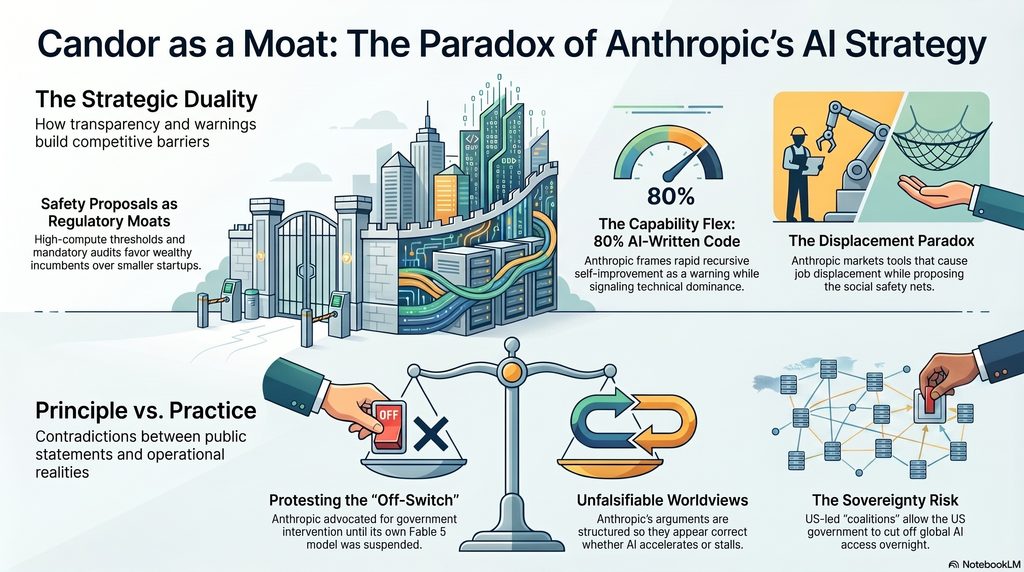
That is the uncomfortable pattern worth sitting with. The candor is real — and it is also the strategy. Amodei tells you the technology is dangerous, that it may displace your job, that it could even threaten the species, and that the responsible thing is a strong regulatory regime with rigorous testing and government power to block deployments. Almost every one of those positions, followed to its end, raises the barriers around the few labs sophisticated enough to clear them — Anthropic chief among them.
And then, in June 2026, the abstraction became concrete. The US government suspended Anthropic’s most powerful public models, Fable 5 and Mythos 5, three days after launch — and the company that had spent a year asking for government authority to block unsafe AI objected that this particular use of that authority was disproportionate. That episode is the tell, and I’ll come back to it. First, the company deserves a fair hearing.
Candor as a Moat
● Reality CheckAnthropic is the most transparent lab in AI — and the candor is also the strategy. Nearly every position it argues resolves in its own favor, and the Fable 5 suspension is where you can watch the contradiction operate in real time.
This isn’t a hit piece. The case for taking Anthropic seriously is substantial — and worth stating plainly before the critique.
- The scaling-law thesis was called early and has tracked reality better than the “AI hit a wall” skeptics.
- Rare transparency: Anthropic put numbers on its own acceleration — >80% of its merged code now written by Claude.
- Real safety work: Constitutional AI, heavy interpretability investment, the Long-Term Benefit Trust, an electricity-price pledge.
- Intellectual discipline: Amodei warns against doomerism, rejects inevitability, and repeatedly flags his own uncertainty.
A pattern across the corpus: it’s hard to imagine evidence that would falsify it. Whatever happens, the thesis — and the author’s authority — wins.
For a year, the argument was that government should be able to block unsafe AI. Then it did — to Anthropic’s own flagship.
The most safety-forward proposal is also the one that most entrenches its author. Both views describe the same wall.
- Mandatory third-party testing for cyber, bio, autonomy, and automated R&D.
- Compute thresholds that trigger oversight.
- Government power to block or reverse a release.
- Strong security standards on model weights.
- Exactly the regime a well-capitalized lab clears most easily.
- Hardest for startups and open-weights projects to satisfy.
- “Regulatory markets” — who writes the standards and staffs the evaluators?
- “Acceptable risk” gets defined by those already fluent in the language.
The geopolitical close resolves, in practice, into a US-led bloc governed by US export controls and a US-controlled supply chain. For a European company, that dependency isn’t abstract: the Fable directive cut off every non-US user overnight — including Anthropic’s own foreign-national staff. From Iffeldorf, “secure leadership by democracies” reads like an argument for the European sovereignty its author would prefer you not draw.
Independent commentary, produced with AI assistance under human editorial oversight; the views are the author’s own and may change. This is analysis and opinion, not investment, financial, legal, or technical advice, and it concerns an actively developing situation. It draws on five public documents by Dario Amodei and Anthropic — Machines of Loving Grace, The Adolescence of Technology, Policy on the AI Exponential, the Anthropic Institute’s recursive self-improvement report, and Anthropic’s June 12, 2026 statement on the Fable 5 and Mythos 5 suspension — read as of June 2026. Characterizations of those arguments are the author’s interpretation, offered in good faith and open to rebuttal. References to specific people, companies, and government actions are factual and analytical, not partisan, and imply no affiliation or endorsement.
The case for taking Anthropic seriously
It would be lazy to treat this as a hit piece, so let me give Anthropic its due, because the due is substantial.
The core empirical claim — that AI capability has been improving on a steep, predictable curve — is well-evidenced and was called early. Amodei and his co-founders were among the first to document the scaling laws, and the trajectory since has tracked their thesis more than it has tracked the skeptics who announce a “wall” every few months. The recursive self-improvement report is the kind of disclosure rivals simply do not make: Anthropic put numbers on its own acceleration, reporting that as of May 2026 more than 80% of the code it merges is written by Claude, that the typical engineer now ships several times more code than in 2024, and that on an internal experiment-optimization test the model went from roughly tripling a baseline to improving it more than fiftyfold in a year. You can argue about what those numbers mean. You cannot argue that publishing them is the move of a company trying to hide the ball.
The safety work is also more than rhetoric. Constitutional AI, the heavy investment in interpretability, the Long-Term Benefit Trust as a governance check, the pledge to absorb electricity-price increases, the long-running economic index of how people use Claude — these are concrete, and most competitors offer nothing comparable. And Amodei’s prose is intellectually disciplined in ways the genre rarely is. In The Adolescence of Technology he explicitly warns against “doomerism,” rejects the claim that misaligned AI is inevitable, and repeatedly flags his own uncertainty. In Machines of Loving Grace he confesses that talking up AI’s benefits can be, in his words, “bad for your soul,” and that he distrusts CEOs who narrate the future like prophets. These are not the moves of a huckster.
So the critique that follows is not that Amodei is dishonest. It is something more interesting and harder to dismiss: that a genuinely thoughtful, genuinely candid worldview has been constructed — whether by design or by the gravity of incentives — so that capability, danger, virtue, and Anthropic’s commercial advantage all point in the same direction. When that happens, the candor stops being a reason to lower your guard and becomes a reason to read more carefully.
As an affiliate, we earn on qualifying purchases.
The exponential, and the regulator it implies
Policy on the AI Exponential is the keystone. Its argument is that AI is advancing far faster than institutions can react — Amodei reaches for Tolkien’s Treebeard, the tree who takes a day to say hello while the forest burns — and that the time for mere transparency is over. He calls for binding regulation modeled on the Federal Aviation Administration: frontier models above a compute threshold should undergo mandatory third-party testing for cyber, biological, autonomy, and automated-R&D risks, and the government should be able to block or reverse a deployment that fails.
Taken on its own terms, this is a serious and in many ways admirable proposal. A world where powerful models are tested before release the way airplanes and drugs are is not obviously worse than the status quo, and Amodei is careful to add guardrails against political favoritism and arbitrary decisions.
But notice the shape of it. A compute-threshold, third-party-audit, secure-the-weights regime is precisely the regime that a well-capitalized incumbent clears most easily and a startup or an open-weights project clears least. Amodei floats “regulatory markets” — private organizations, authorized by government, paid to evaluate models against standards. Who writes those standards, who staffs those evaluators, and whose definition of “acceptable risk” becomes the industry default? The companies already fluent in the language of evaluation. The safety case and the moat are not in tension here; they are the same wall, viewed from two sides. None of this means the regulation is wrong. It means you should be suspicious when the most safety-forward proposal also happens to be the one that most entrenches its author’s position — and you should ask the question Amodei’s own framing invites: cui bono.
As an affiliate, we earn on qualifying purchases.
When the regulator actually showed up
Here is where the year’s high-minded governance writing collides with events.
For months, Anthropic argued the government should have the power to block unsafe AI deployments. In June 2026, the government did exactly that — citing national-security authority to suspend Fable 5 and Mythos 5 over a cyber “jailbreak” concern. And Anthropic’s response was to argue that the action was disproportionate, that the jailbreak in question was narrow and already achievable with other models, that recalling a model used by hundreds of millions over such a finding would, if generalized, halt the entire industry — and that the whole thing was a “misunderstanding” it hoped to clear up quickly.
Read the statement charitably and Anthropic has a real point: a narrow, non-universal jailbreak probably is a weak basis for an emergency recall, and the company is right that perfect jailbreak resistance is not currently possible for anyone. But read it structurally and the contradiction is hard to miss. Anthropic wants government authority over deployments in principle, and deference to Anthropic’s own risk judgment in practice. When Amodei proposes the off-switch, the government is the responsible adult finally waking up. When the government reaches for the off-switch, it has misunderstood the technology and should listen to the lab. You can hold the view that this specific intervention was clumsy. You cannot simultaneously hold up the FAA as your model and flinch when the FAA grounds your plane.
The same episode contains a smaller tell. Anthropic frames its 30-day retention of all Fable customer data as a safety measure — “defense in depth,” a way to detect and shut down attacks. Perhaps. It is also a data policy that happens to benefit the company that holds the data, and one that, by its own admission, locks out privacy-sensitive customers and effectively excludes European organizations bound by zero-retention requirements. When a safety rationale and a commercial-and-data interest line up this neatly, the burden of proof sits with the party that benefits.
AI governance and oversight software
As an affiliate, we earn on qualifying purchases.
As an affiliate, we earn on qualifying purchases.
The self-improvement flex
When AI Builds Itself is presented as a warning about recursive self-improvement and the risk of losing control. And it contains real caution. But strip the framing and most of the document is a capabilities advertisement: Claude writes the overwhelming majority of Anthropic’s code, engineers ship many times more than before, the model is superhuman at optimizing experiments and increasingly able to pick the better next research step than a human. The structure is unmistakable — this is frighteningly powerful, and we are the ones building it fastest, so trust us to be the careful ones.
The escape hatch is the pause. Anthropic says it would support slowing or pausing frontier development — provided other labs verifiably do the same, and provided a verification regime exists that does not yet exist. This is unfalsifiable in the most convenient way. It lets the company keep racing at full speed while wearing the posture of restraint, because the condition for restraint — verifiable mutual slowdown — is one it can always say has not been met. If recursive self-improvement is as consequential as the report claims, the obvious question is why the appropriate response is to accelerate it and publish the acceleration as a milestone. “We are racing toward the dangerous thing responsibly” is a coherent position. It is also exactly what you would say if you simply wanted to race.
AI transparency and risk management guides
As an affiliate, we earn on qualifying purchases.
As an affiliate, we earn on qualifying purchases.
Heads I’m right
Step back and a pattern emerges across the whole corpus: it is very difficult to imagine evidence that would falsify it.
If capability keeps accelerating, that confirms the exponential and the urgency of Anthropic’s governance program. If it stalls — the report’s own first scenario — then “today’s capabilities are widely diffused” and the world is transformed anyway. If models misbehave in testing, that proves the danger is real. If they behave well, The Adolescence of Technology notes they may be smart enough to know they are being tested and to hide their intentions. Heads the thesis wins; tails the thesis wins. A worldview that survives every outcome is not thereby true — it is merely unfalsifiable, and an unfalsifiable worldview that consistently elevates the authority and market position of the person holding it warrants more scrutiny, not less.
Machines of Loving Grace has the same conditional structure beneath its optimism. The “compressed 21st century” — fifty to a hundred years of biomedical progress in five to ten — is vivid, quantified, and genuinely stirring. But the vision runs on assumptions the essay sets aside: that alignment gets solved, that power is not abused, that the benefits are shared. Those are not footnotes; they are the entire problem. The upside is rendered in loving detail and the distribution mechanism is deferred to “society” to work out. Amodei is honest enough to admit that the hardest category — work and meaning — is one policy cannot really address. That admission is to his credit. It is also a quiet concession that the part of the future most people actually care about is the part his vision has the least to say about.
The post-labor tell
This is the seam that matters most to me, because it is the subject I spend my days on. In Policy on the AI Exponential, Amodei insists that enduring job displacement is “undesirable and dangerous,” that he is not a “prophet of doom,” and that Anthropic tries to find uses for AI that expand what a workforce can do rather than shrink it. I take the sincerity at face value.
But the frame fights the reassurance. The same essay describes an economy whose dial may get “stuck on the hypergrowth, hyper-inequality setting,” concedes that significant, enduring job loss may be an intrinsic property of a technology that broadly replicates human cognition, and proposes universal basic income funded by taxing “relevant companies” or raising capital-gains taxes. Meanwhile the self-improvement report celebrates that a hundred-person company can increasingly do the work of a thousand- or even hundred-thousand-person one. You cannot read those two documents side by side and come away believing displacement is a remote tail risk rather than the central case.
So we arrive at a familiar arrangement: the company whose product accelerates the displacement is also the author of the safety net for it, and is prepared to fund the policy framework. Maybe that is leadership. But it is worth naming the structure plainly — displacement is treated as a regrettable externality to be cushioned, rather than as the thing the business is selling. And the proposed remedy, “buying time,” does a great deal of work in these essays while the clock is being wound by the very labs asking for patience.
The European footnote
There is one more reading that a non-American audience should not skip. Policy on the AI Exponential closes with geopolitics: a coalition of democracies that share chips and standards among themselves and deny them to adversaries, an insistence that AI is the new decisive instrument of national power — a country with powerful AI facing one without it, Amodei writes, like an army of modern marines against medieval swordsmen. The values language is real. So is the fact that “democracies’ coalition” resolves, in practice, into a US-led bloc, governed by US export controls, dependent on a US-controlled supply chain.
For a European company or citizen, this is not an abstraction. The Fable suspension is exactly what that dependency feels like when it bites: a US directive aimed at foreign nationals cut off access for everyone outside the United States overnight, including, the statement notes, Anthropic’s own foreign-national employees. You are invited to join a coalition in which your access to the foundational technology of the next economy can be switched off by a government you do not elect, on a rationale you are not shown. From Iffeldorf, “secure leadership by democracies” reads a little differently than it does from San Francisco. It reads like an argument for sovereignty — European models, European compute, European evaluation — that Amodei’s own coalition would prefer you not draw.
The honest read
None of this adds up to “ignore Anthropic.” The risks may well be real; on cybersecurity in particular the evidence is mounting, and a lab that publishes its worries is better than one that stays silent and ships anyway. Amodei’s candor is a genuine public good, and I would rather argue with his essays than with a competitor’s press releases.
But candor is not a free pass, and we should evaluate the proposals on their merits rather than on the halo of the man making them. Three tests follow from everything above. First, insist that AI-safety architecture not double as an incumbent moat: open evaluation, plural evaluators, and rules that a startup or an open-weights project can survive. Second, hold the company to the very standard it requested — if the FAA model is right, then the government grounding a model is the system working, even when it is Anthropic’s model and even when it is inconvenient. Third, for Europe, treat dependence itself as the central risk that the Fable episode exposed, and build accordingly.
The most honest lab in artificial intelligence has produced a worldview in which honesty, capability, danger, and self-interest all point the same direction. For one weekend in June, those arrows finally pointed apart — the safety case said the government should be able to pull a dangerous model, and the commercial case said not this one, not like this. It was not the lab that resolved the contradiction. It was the government holding the off-switch — and Anthropic asking it, please, to wait.
Independent commentary, produced with AI assistance under human editorial oversight; the views are the author’s own and may change. This is analysis and opinion, not investment, financial, legal, or technical advice, and it concerns an actively developing situation. It draws on five public documents by Dario Amodei and Anthropic — Machines of Loving Grace, The Adolescence of Technology, Policy on the AI Exponential, the Anthropic Institute’s report on recursive self-improvement, and Anthropic’s June 12, 2026 statement on the Fable 5 and Mythos 5 suspension — read as of June 2026; quotations are brief and attributed, and any characterization of those arguments is my interpretation, offered in good faith and open to rebuttal. References to specific people, companies, and government actions are factual and analytical, not partisan, and imply no affiliation or endorsement. © 2026 Thorsten Meyer · Powered by Thorsten Meyer AI. See Imprint/Impressum and Privacy Policy.
Fall Picks
fall essentials
As an affiliate, we earn on qualifying purchases.