
Start with the fact that reframes everything else: most of the world’s business transactions still pass through SAP. Purchase orders, invoices, payroll runs, supply-chain movements, the general ledger of a large share of the Fortune 500 and the German Mittelstand — that data sits in SAP systems. SAP’s entire AI strategy follows from that single positional advantage, and it explains why the company is making a bet almost opposite to the frontier labs’: not “build the smartest model,” but “own the data the smart models need, and meter access to it.”
This is a profile of that bet — what SAP has shipped, why the architecture is shrewd, and where it could break.
Own the system of record.
Rent nobody’s brain.
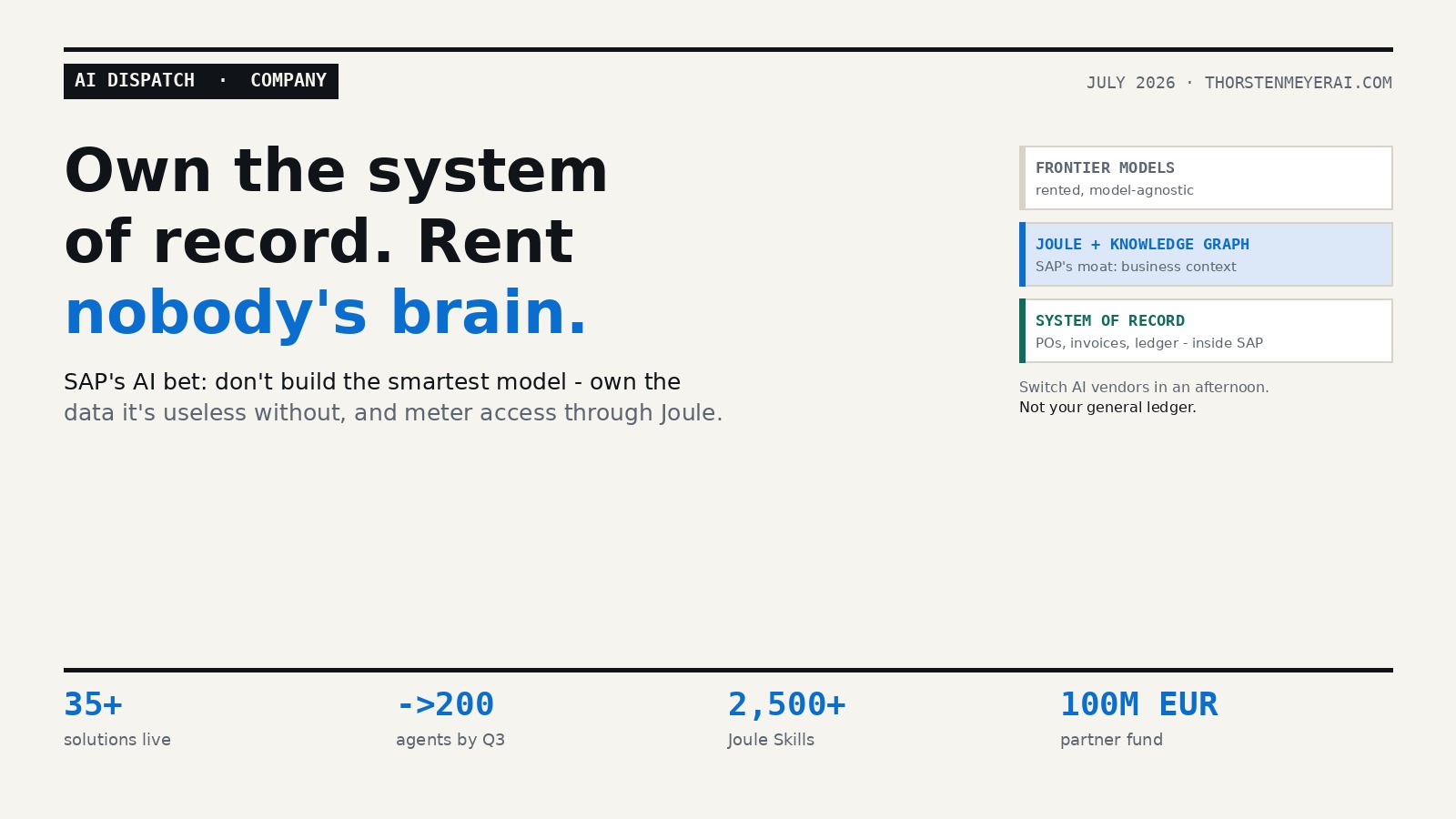
SAP’s AI bet is the incumbent’s inversion of the frontier race: don’t build the smartest model — own the data smart models are useless without, and meter access through Joule, an orchestration layer indifferent to which model wins.
The stack — where SAP chose to stand
You can switch AI vendors in an afternoon. You cannot switch your general ledger.
Honest bull / bear
Bull
- Best data-layer position of any incumbent — the one place hyperscalers can’t reach
- Knowledge Graph is context no model scale substitutes for
- Model-agnostic: owns the layer above commoditizing models
- Named, operational customer outcomes (40–60% HR cycle time, 90% admin cut)
Bear
- Consumption pricing is hard for CFOs to forecast — adoption stalls
- “Activated” ≠ “adopted”: the €100M fund admits demand needs subsidizing
- Depends on frontier models it doesn’t control
- Innovation tax: everything must work across a regulated installed base

Agentic Hybrid RAG on SAP BTP: A Hands-On Guide with LangGraph, HANA Cloud, and Google Vertex AI
As an affiliate, we earn on qualifying purchases.
As an affiliate, we earn on qualifying purchases.
What SAP actually shipped
The vehicle is Joule — SAP’s AI layer, positioned not as a chatbot bolted on but as the new interface to the business itself. As of mid-2026 the numbers SAP cites are concrete: Joule live across 35+ solutions (S/4HANA Cloud, SuccessFactors, Ariba, Datasphere, and more), 30+ specialized agents and 2,500+ “Joule Skills” as of Q1, with a stated roadmap to 50 assistants and 200 agents by Q3 2026. At Sapphire in May, SAP committed a €100 million partner fund to get systems integrators building custom agents on Joule Studio, its low-code-to-pro-code agent builder that now ships a VS Code extension and a CLI for DevOps workflows.
The customer outcomes SAP publishes are the pitch, and they’re specific enough to check: a global retailer cutting HR process cycle times 40–60% with a Joule agent; an Argentine airport operator’s winter-operations agent cutting direct costs 16% and administrative effort 90%; developers reporting ~20% productivity gains on routine coding. Vendor-published figures, weight accordingly — but specific, named, and operational rather than hypothetical.
The strategic frame SAP uses is “the Autonomous Enterprise,” and the through-line of 2026’s releases is agents as first-class users of enterprise software — SAP’s phrase is that agents join humans as “the only other non-deterministic operators” of the system.
As an affiliate, we earn on qualifying purchases.
Why the architecture is shrewd
Three design choices make this more than a copilot skin.
The Knowledge Graph is the moat. Joule doesn’t pull generic answers from the open internet — it reads business metadata directly from SAP’s Business Technology Platform, so it understands that “invoice” in a procurement context carries different workflows and legal implications than “invoice” in sales. This is the thing no frontier lab has and no amount of model scale substitutes for: structured, permissioned, context-rich enterprise data with the relationships already mapped. SAP isn’t competing on model IQ; it’s competing on the substrate the IQ operates over.
Model-agnostic by design. SAP consumes frontier models rather than betting the company on training one — the June acquisition of Prior Labs (covered separately this week) added tabular foundation models for the structured-data modality LLMs handle worst, and the Joule orchestrator can be consumed “headlessly” and slotted into a customer’s broader agent hierarchy. This is the model-routing thesis from earlier this week, applied at the ERP layer: SAP wants to be the orchestration-and-data layer, indifferent to whose model runs underneath. When models are commoditizing, owning the layer above them is the defensible position.
Clean Core as forcing function. Adopting Joule effectively requires customers to reduce custom code (z-objects) so the AI can read standard data structures — which conveniently accelerates the S/4HANA cloud migration SAP already wanted. The AI strategy and the platform-migration strategy reinforce each other. That’s not an accident; that’s design.

The Enterprise Data Catalog: Improve Data Discovery, Ensure Data Governance, and Enable Innovation
As an affiliate, we earn on qualifying purchases.
As an affiliate, we earn on qualifying purchases.
The honest bear case
Four real risks, stated plainly.
Consumption pricing is a forecasting problem. AI features on BTP are consumption-priced, tying cost to usage volume in ways that are genuinely harder to forecast than traditional named-user licensing. For CFOs who chose SAP partly for predictable cost, variable AI billing is friction — and a reason adoption can stall in the “activated but not deployed” phase that SAP’s own partner ecosystem keeps flagging.
“Activated” is not “adopted.” The recurring critique from the SAP consulting world in 2026 is that many organizations switch Joule on and then don’t operationalize it — no roadmap, no clean-core discipline, no measurable ROI. SAP’s 50-assistants-200-agents roadmap is a supply number; the binding constraint is demand-side adoption, and the €100M partner fund is essentially an admission that adoption needs subsidizing.
Dependence on models it doesn’t control. The model-agnostic strategy is a strength until access, pricing, or capability of the underlying frontier models shifts. SAP’s early Joule limitations were explicitly attributed to model quality and integration gaps; the improvements came from better third-party models and the Knowledge Graph. SAP owns the second half of that equation, not the first.
The incumbent’s innovation tax. Everything SAP ships must work across an enormous installed base of regulated, mission-critical, heavily-customized deployments — which is exactly why “trustworthy, repeatable, auditable” leads its agent messaging, and also why it moves slower than a startup. The moat and the ballast are the same thing.

Audio-Technica AT634a Record Care Solution
- Product Type: Audio-Technica Record Care Solution
- Volume: 2 fl oz / 60 ml
- Effective Cleaning: Removes dust, fingerprints, static
As an affiliate, we earn on qualifying purchases.
As an affiliate, we earn on qualifying purchases.
The bull case, fairly
Against all that: SAP is doing the thing the frontier-lab hype cycle keeps underrating. It isn’t trying to win the model race. It’s positioned at the data layer of enterprise AI — the one place hyperscalers and frontier labs can’t easily reach, because the data is already inside SAP, already permissioned, already governed. If the 2026 thesis is that value migrates from models to the systems that give models useful context, SAP starts from the best position of any incumbent on earth. Its €100M partner fund, Prior Labs acquisition, and Knowledge Graph investment are all the same bet placed three ways: the brain is rentable; the body of record is not.
Bottom line
SAP’s AI strategy is the incumbent’s answer to the frontier era, and it’s more coherent than it’s usually credited for: don’t build the smartest model, own the data the smartest models are useless without, and meter access to it through an orchestration layer indifferent to which model wins. The risks are real and mostly demand-side — variable pricing, adoption inertia, dependence on models SAP doesn’t train. But the core position is genuinely hard to dislodge. You can switch AI vendors in an afternoon. You cannot switch your general ledger.
Sources
- SAP News Center, “SAP Business AI: Release Highlights Q2 2026” (July 2026) — Joule Work, developer productivity ~20%, LC Waikiki HR cycle-time 40–60%, Aeropuertos Argentina SNOW agent (16% cost, 90% admin reduction); vendor-published customer figures
- SAP News Center, “SAP Business AI: Release Highlights Q1 2026” (April 2026) — Joule across 35 solutions, 30+ agents, 2,500+ Joule Skills, Agent Hub, “non-deterministic operators” framing
- Quartr / BofA C-Suite TMT Conference summary (June 10, 2026) — AI fully integrated into strategy, Joule Work 2.0, roadmap to 50 assistants and 200 agents by Q3, headless orchestrator, Knowledge Graph accuracy gains
- SAP Community, “SAP Sapphire 2026 Announcements” (May 13, 2026) — €100M partner fund, Joule Studio service packages, Validated Partner Designation, 680+ agent submissions
- E3 Magazine, “SAP Business AI Q1/2026: Joule for Developers and Data Experts” (July 2026) — Joule Studio CLI, VS Code editor, Datasphere GA, DevOps orientation
- Soltius, “2026 SAP AI Joule Adoption Roadmap” (May 2026) — BTP metadata grounding, context-awareness example, Clean Core requirement
- 2Data, “SAP Joule and AI in 2026: Getting Past the Marketing” (June 2026) — capability-by-module breakdown, BTP consumption-pricing forecasting critique
- ThorstenMeyerAI.com, “SAP’s €1 Billion Bet Is on Tables, Not Chatbots” (July 22, 2026) — Prior Labs / tabular-model context
Customer outcome metrics are SAP-published; roadmap figures (50 assistants, 200 agents) are targets, not shipped counts. Adoption critiques are drawn from the SAP consulting ecosystem and dated.