
The startup graveyard is full of ideas that felt brilliant and had nothing behind them. The single most expensive mistake in building software isn’t writing bad code — it’s building the wrong thing well. Months of effort poured into a product that, it turns out, nobody was waiting for.

Get business pricing on tech for your team
- Business-only prices and quantity discounts
- Tax-exempt purchasing
- Multiple users, one account, clear invoices
The reason that mistake is so common is that idea generation has always been cheap and idea validation has always been expensive. Anyone can brainstorm ten products before lunch. Finding out whether even one of them solves a problem people actually have is the hard, slow, unglamorous part — so most people skip it and build on a hunch.
IdeaNavigator AI is built to invert that. It mines real complaints — what people are genuinely, publicly frustrated by — turns them into fully-scoped software ideas, and scores each one 0–100 on the evidence before anyone writes a line of code. It ships one such idea a day, publicly. (Under the hood, the pipeline actually produces two; the public cadence is the conservative half of what it generates.)
And it does the whole loop — generate, validate, deploy, syndicate — autonomously, from a single Mac mini. It’s the public-facing spin-off of IdeaClyst, the private validation workspace, which means today’s piece is also the bridge in this series: where the content machine meets the decision layer.
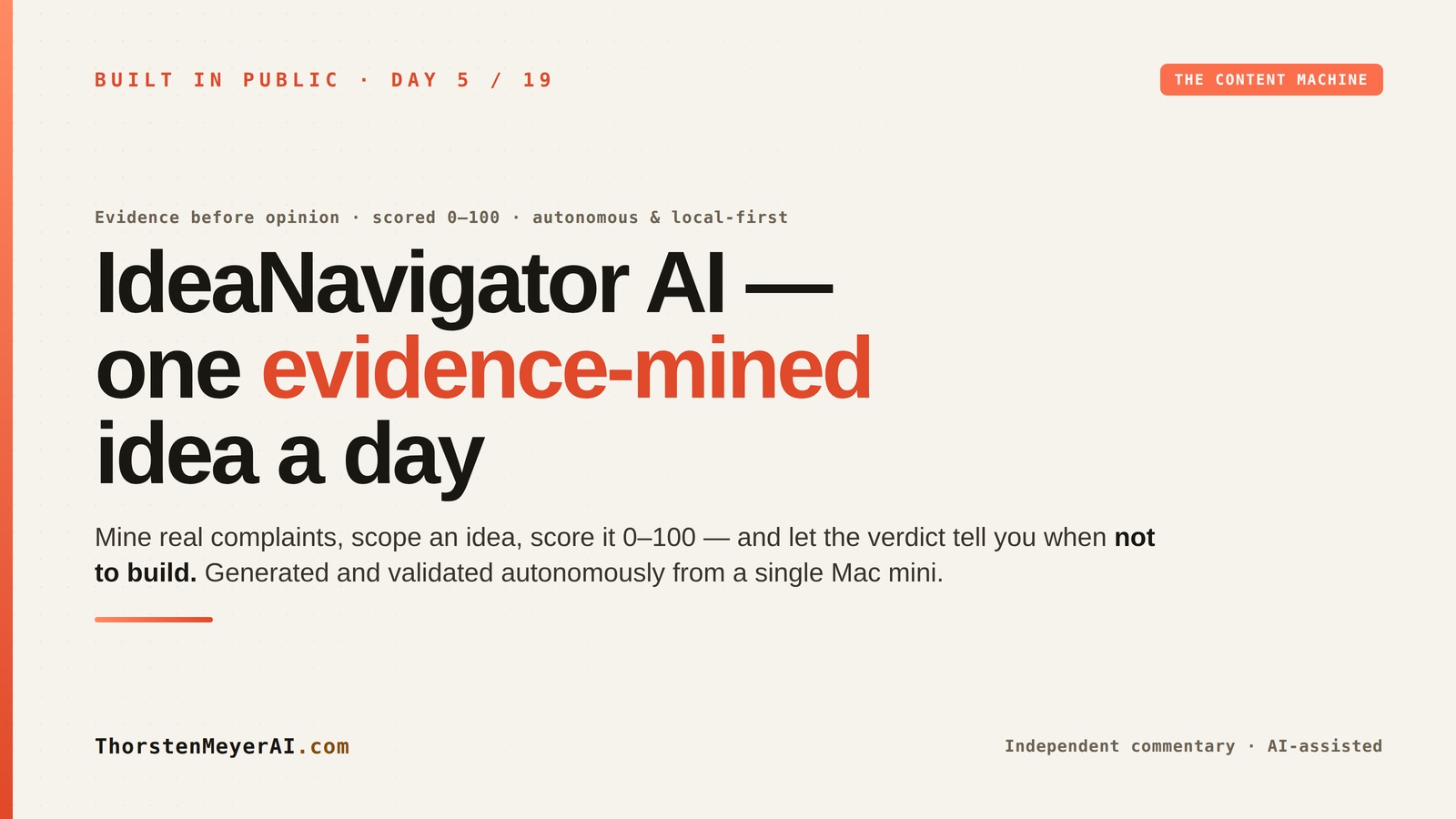
IdeaNavigator AI — one evidence-mined idea a day
Idea generation is cheap; validation is the bottleneck. Mine real complaints, scope an idea, score it 0–100 — and let the verdict tell you when not to build.
Verdict: Validate. Promising — but a high score is a prior, not a proof. The point of the gauge is the verdicts that say not yet.
Independent commentary, produced with AI assistance under human editorial oversight. The views are the author’s own and may change. IdeaNavigator AI generates, mines and scores ideas via automated pipelines; scores and verdicts are programmatic priors that may contain errors or bias and are not validated demand — verify independently before building. As an Amazon Associate the author earns from qualifying purchases; pages may contain affiliate links. Product and company names are trademarks of their respective owners; mention does not imply endorsement.
As an Amazon Associate I earn from qualifying purchases; some links across the network are affiliate links, and if you buy through them I may earn a commission at no extra cost to you.
Evidence before opinion
The premise is simple and a little uncomfortable: your opinion about your idea is worthless as evidence. So is mine. The only thing that counts is whether real people are already demonstrating the problem — complaining about it, working around it, begging for a fix in a forum thread at 2am.
That demand signal already exists, scattered across the internet in the form of frustration. IdeaNavigator's job is to go find it. Instead of starting from "here's a cool idea, is there a market?", it starts from "here's a market's pain, what should be built?" — which is the right direction to run the question. Demand first, product second.
In business terms, this is de-risking the most expensive decision you make. Every hour spent building toward evidence is cheaper than every hour spent building toward a hunch. A tool that consistently points you at problems people have already proven they care about is attacking the costliest failure mode in the whole software business.
Products Worth Considering

DJI Osmo Mobile 8 Gimbal with Mic Mini Transmitter, Infinity Black

Logitech MX Master 4 for Mac, Ergonomic Bluetooth Mouse with Haptic Feedback, Ultra-Fast Scrolling, USB-C Charging, for MacOS, iPadOS, Windo

Sony WH-1000XM6 Wireless Noise-Canceling Over-Ear Headphones, Blue, Bundle
As an affiliate, we earn on qualifying purchases.
Where the evidence comes from
The signal is only as good as its sources, so it's worth being concrete about where IdeaNavigator looks. It mines complaints from the places people actually voice them:
App Store reviews — the one-star rants that describe, in detail, exactly what an existing product fails to do. Hacker News — where technical audiences argue about what's broken and what they wish existed. GitHub issues — feature requests and bug reports that are, in effect, a public backlog of unmet needs. Stack Overflow — the questions people keep asking because no good tool answers them. And a trend bridge on top, to weight whether a given pain is rising or fading.
Each of those is a different flavor of the same thing: people taking the time to complain. Complaint is one of the most honest demand signals there is, because it costs effort to produce and nobody fakes frustration for fun. Aggregating it across four very different communities — consumers, hackers, developers, problem-solvers — and cross-referencing against trends is a more grounded starting point than any whiteboard session.
The 0–100 scorecard, and the verdict that matters
Once an idea is scoped, IdeaNavigator scores it 0–100 and assigns one of four verdicts: Build, Validate, Research, or Rethink.
It's tempting to assume the point is to find the "Build" ideas. It isn't. The point — and the part that makes this honest rather than a hype machine — is the verdicts that say don't. A scorecard that returns "Rethink" on an idea you were excited about has just saved you months. The "Research" verdict tells you the signal is real but thin. "Validate" says promising, but unproven. Only at the top does "Build" appear, and it should appear rarely.
This is "edit by subtraction" applied one level up from the writing — applied to ideas themselves. The discipline isn't generating more ideas; it's killing most of them on evidence before they cost anything. A pipeline that produces two ideas a day and is honest enough to stamp most of them "not yet" is far more valuable than one that calls everything a winner.
A necessary caveat, stated plainly: the score is a prior, not a proof. It's a fast, evidence-weighted opinion about where to point your limited validation effort — not a guarantee that a market exists. Which is exactly why the verdicts above "Build" all amount to go get more evidence, not go build.
The autonomous loop, on a Mac mini
Here's the operational fact that makes it a system rather than a tool: the entire daily loop — generate the idea, mine the evidence, score it, deploy the writeup, and syndicate it to the network — runs autonomously on a single Mac mini.
No human refreshes a dashboard to make the day's idea appear. The marginal cost of producing one more scored, scoped, evidence-mined idea is essentially the electricity to run a small computer. That's the local-first economics that show up everywhere in this portfolio: own the compute, and a pipeline that would otherwise be a recurring cloud bill becomes a fixed cost you've already paid.
It also means the constraint on the system isn't money — it's discipline. Because producing ideas is nearly free, the value isn't in volume; it's in the filtering. Which is why the public cadence is deliberately one a day even though the machine makes two. Shipping less than you produce is a choice, and it's the right one.
The bridge: IdeaNavigator meets IdeaClyst
On the operator constellation, today's connection is the first cross-family one: IdeaNavigator ↔ IdeaClyst. IdeaNavigator is the public spin-off; IdeaClyst is the private validation workspace it came out of (and tomorrow's piece). The relationship is the whole point of the bridge: the content machine that has occupied the series so far hands off to the decision layer that comes next.
That's not a coincidence of branding. An evidence-mining idea engine and a validation council are the same instinct pointed at two audiences — one public and fast, one private and rigorous. Watching the constellation, this is the moment the map stops being "ways to produce content" and starts being "ways to decide what's worth doing."
The honest bear case
The deepest risk is baked into the method: loud complaints are not the same as large markets. The people who rant on Hacker News or leave one-star reviews are a vocal, unrepresentative slice. A pain can be intensely felt by a tiny group and invisible to everyone else. Complaint-mining is a real signal, but it has a selection bias toward the loud, and a high score built on loud-but-narrow pain will point you confidently in a small direction.
Second, a score is not validation. No amount of mined evidence substitutes for a real person paying, signing up, or otherwise putting something on the line. IdeaNavigator can tell you where to look; only buyers can tell you whether you're right. Treating the number as a verdict rather than a hypothesis would reintroduce the exact overconfidence the tool is supposed to cure.
Third, autonomous volume is a double-edged sword. A machine that produces evidence-scored ideas every day, forever, can just as easily produce a flood of plausible-looking mediocrity. The value lives entirely in the filtering — and as idea-generation commoditizes for everyone, "here's a scored idea" stops being scarce. The durable edge is judgment about which signals to trust, not the raw output.
And the public side depends on discovery it doesn't control — the same search-and-platform risk that hangs over the rest of the content machine.
The bull case, plainly
With the risks acknowledged: IdeaNavigator attacks the single most expensive decision in software — what to build — and attacks it with evidence instead of opinion, at near-zero marginal cost, run autonomously and locally. It grounds prioritization in demonstrated frustration, it's honest enough to tell you not to build most of the time, and it feeds directly into the decision layer rather than standing alone.
It will not tell you the future, and it shouldn't be trusted to. But "point my limited time at problems people have already proven they care about" is a genuinely valuable thing for an operator to have running in the background every single day — especially when the thing running it costs about as much as a light bulb left on.
There's a quieter advantage, too. Because the pipeline is autonomous and local, it produces a standing record of where demand was clustering over time — a log of which pains kept showing up and which faded. That history is itself an asset: it turns a daily novelty into a slowly-compounding map of the market's frustrations, which is exactly the kind of thing that's hard to buy and easy to underestimate.
This article was produced with AI assistance and reviewed under human editorial oversight; it is independent commentary and analysis, and the views are the author's own and may change. IdeaNavigator AI generates, mines, and scores ideas via automated pipelines; scores and verdicts are programmatic priors that may contain errors or bias and are not validated demand — verify independently before building or investing. As an Amazon Associate the author earns from qualifying purchases; pages may contain affiliate links. Product and company names are trademarks of their respective owners; mention does not imply affiliation, sponsorship, or endorsement. © 2026 Thorsten Meyer · Powered by Thorsten Meyer AI. See Imprint/Impressum and Privacy Policy.