
By Thorsten Meyer

Get business pricing on tech for your team
- Business-only prices and quantity discounts
- Tax-exempt purchasing
- Multiple users, one account, clear invoices
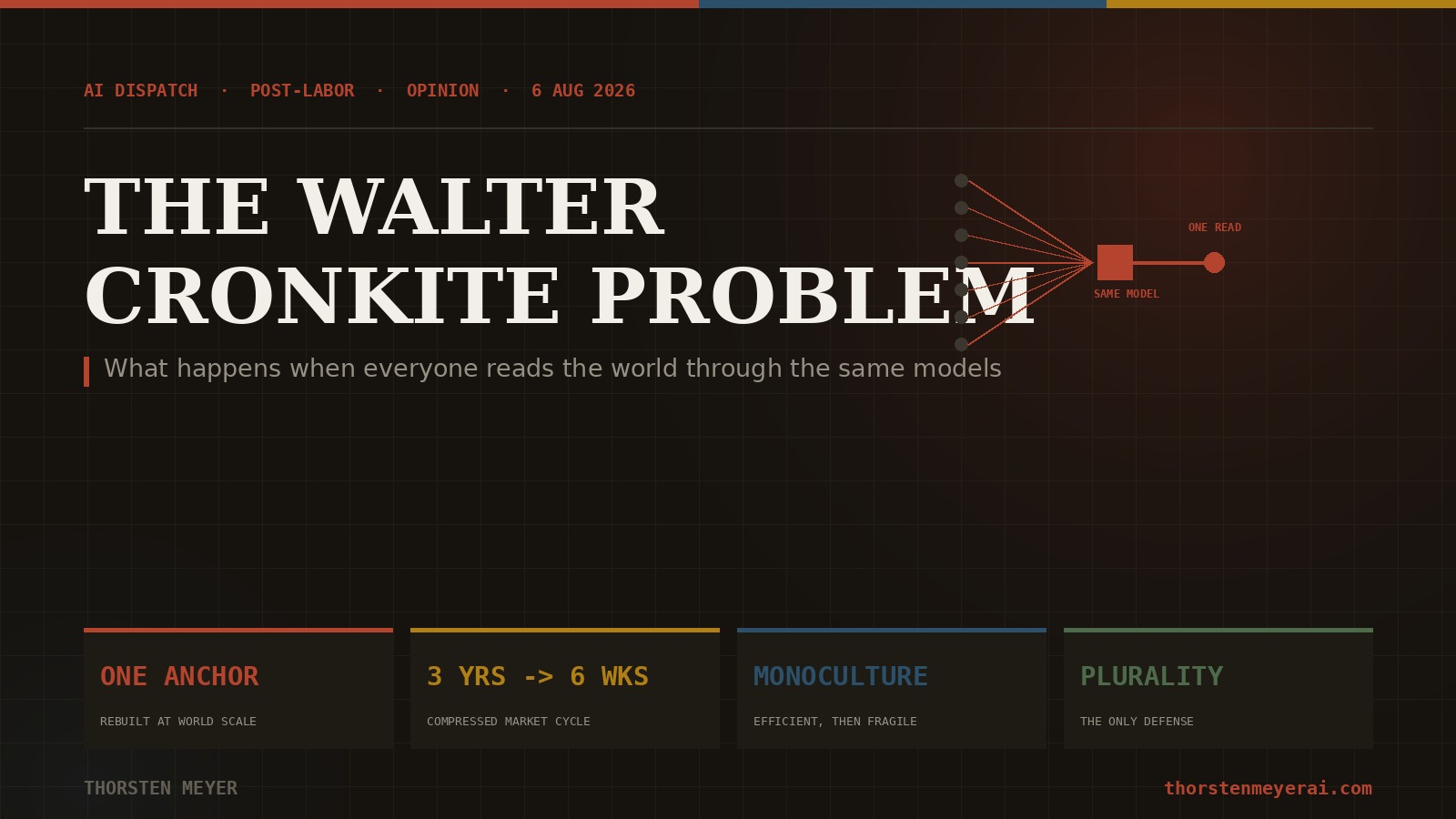
There is a failure mode building quietly underneath the AI economy that I think is more dangerous than any of the ones people argue about loudly, and it has almost nothing to do with the models getting too smart. It is the opposite. It is the models becoming a single shared lens — one anchor through which an enormous number of people come to see the same events the same way at the same time.
I have started calling it the Walter Cronkite problem, and once you see it, you cannot unsee it.
A failure mode is building quietly under the AI economy, and it has nothing to do with the models getting too smart. It’s the opposite: they’re becoming a single shared lens — one anchor through which vast numbers of people read the same events the same way at the same moment.
▲ Opinion & analysis · not investment adviceInterpreting the world is a Bayesian problem — the kind where diversity of prior isn’t a nicety but the mechanism. Feed the same input to the same model and you get the same read, delivered to millions as if it were the answer.
A market works because buyers and sellers disagree about what news means; the price is that disagreement, resolved. Collapse the diversity and you don’t get a smarter market — you get a violently compressed one.
Each person routing their thinking through the best model behaves rationally. The aggregate is a monoculture — efficient until one shared blind spot takes the whole field at once.
Not worse tools or fewer of them — many genuinely different ones. This is where an abstract worry meets a case I’ve made from a completely different starting point.
Keep the interpreters plural — that is the whole defense.
The most trusted man in America
For a stretch of the twentieth century, a large share of a nation received its picture of reality from one man reading the news each evening. When he said it, that was what had happened. That kind of shared anchor has real virtues — a common baseline of fact, a sense of a country experiencing events together. But it also has a structural cost that only becomes obvious when you remove it: a single trusted interpreter is a single point of failure for a society's understanding of itself. Whatever he emphasized, the nation emphasized. Whatever framing he chose, the nation inherited.
Media fragmented after that, and we spent decades lamenting the fragmentation — the filter bubbles, the loss of a common baseline. Fair enough. But fragmentation had one under-appreciated benefit: interpretation stayed diverse. Different outlets read the same event differently, argued with each other, and the disagreement itself did useful work. It kept any single reading from becoming the reading.
We are now, very quickly and almost without noticing, rebuilding the single anchor — except this time it is not a person, and it is not one nation's evening news. It is a handful of frontier models, and it is nearly everyone, everywhere, all at once.
As an affiliate, we earn on qualifying purchases.
The homogenization is the product
Here is the mechanism, and it is worth being precise because the danger lives in the details.
More and more people, and more and more institutions, now form their understanding of complex events by feeding the same raw material — the same news, filings, reports, data — through the same two or three frontier models and acting on the output. This is not a hypothetical trend; it is how a growing share of analysis, from trading desks to newsrooms to boardrooms, is actually produced now. And these models, for all their capability, are not diverse interpreters. They are trained on overlapping data, aligned with overlapping techniques, and tuned toward a similar register of measured, plausible, consensus-seeking output. Feed the same input to the same model and you get, near enough, the same read — a homogeneous, probabilistic interpretation of reality, delivered to millions of people simultaneously as if it were simply the answer.
That word probabilistic matters, because interpreting the world is a Bayesian problem, and Bayesian problems are exactly the ones where diversity of prior is not a nicety but the mechanism. A market, a democracy, a scientific field — these systems work because participants disagree, weight evidence differently, and arrive at different conclusions that then get tested against each other. Disagreement is not a bug in collective sense-making; it is the engine. Remove it and the machine stops doing the thing it was for.
As an affiliate, we earn on qualifying purchases.
Why this breaks markets first, and worst
The place this shows up earliest is markets, because markets are the fastest and most legible collective-interpretation machine we have, and I have watched it happen this year in real time.
A market functions because buyers and sellers disagree about what a piece of news means. One reads an earnings report as a warning, another as an opportunity, and the price that emerges from their disagreement is the market doing its job — aggregating diverse interpretation into a signal. Now collapse that diversity. Let a large fraction of participants run the same news through the same model and receive the same probabilistic read. Suddenly the disagreement that produced orderly price discovery is gone, and the market stops behaving like a crowd of independent minds and starts behaving like a single animal — everyone turning the same direction at the same instant, because they are all acting on the same interpretation of the same input.
The result is not a smarter market. It is a violently compressed one. I have watched entire sub-industries run a full boom-and-bust cycle — the kind of move that used to take years to play out as information slowly diffused and interpretations slowly aligned — compressed into a handful of weeks, driven not by the facts on the ground changing but by the homogeneity of interpretation changing. When everyone reads the same way, everyone moves the same way, and the cushioning that diverse belief used to provide simply is not there. The cycle happens before the fundamentals it is supposedly about have even arrived.
And markets are only the first and most visible instance. The same dynamic applies anywhere collective sense-making matters — to how institutions assess risk, how the public reads a crisis, how a field decides what is worth investigating. Anywhere a single homogeneous interpretation replaces a diverse one, you get the same brittleness: faster consensus, thinner cushioning, larger and more correlated errors when the consensus is wrong.
As an affiliate, we earn on qualifying purchases.
This is not an argument against the models
I want to be careful here, because the lazy version of this argument is a technophobic one, and that is not what I am saying. The models are extraordinary, and running the world's information through them is often genuinely the best available analysis. The problem is not any individual use. The problem is the correlation — the fact that millions of individually-reasonable uses of the same few models sum to a society-scale loss of interpretive diversity that no single user chose or even noticed.
This is a collective-action problem in the purest sense. Each person routing their thinking through the best available model is behaving rationally. The aggregate is a monoculture. And monocultures, whether in agriculture, in finance, or in cognition, share one property: they are efficient right up until the moment a single pathogen — a single shared blind spot, a single correlated error — takes down the entire field at once, precisely because everything in it was identical.
As an affiliate, we earn on qualifying purchases.
What actually defends against it
The defense is not to use worse tools or fewer of them. It is plurality — and this is where the abstract worry connects to something concrete I have argued for all along, from a completely different starting point.
I have made the case for open weights and model diversity on grounds of cost, of sovereignty, of not depending on two vendors charging oligopoly margins. This is a further reason, and I have come to think it may be the deepest one: a world with many genuinely different models — trained on different data, aligned with different values, reasoning in different styles — is not just more competitive and more sovereign. It is epistemically healthier. It preserves the interpretive diversity that collective sense-making requires. Many models producing many readings is the digital-age version of a free press with many independent voices, and it defends against exactly the single-anchor fragility that a two-model world reintroduces.
So the argument for plurality is no longer only economic or political. It is about keeping the human capacity for diverse interpretation alive in an age when it is dangerously cheap to outsource all of it to the same place. When I run my own models, on my own hardware, and deliberately consult several rather than one, I am not only buying independence from a vendor. I am refusing, in a small way, to add my own judgment to the monoculture. That is a civic act as much as a technical one.
Where this lands
The twentieth century learned, slowly and painfully, that a single trusted interpreter of reality is a fragile arrangement no matter how good the interpreter — and it spent decades building pluralism as the correction. We are now rebuilding the single interpreter at a scale and speed the twentieth century could not have imagined, and calling it progress, and mostly not noticing that we are doing it.
The models are not the danger. The sameness is. The most valuable thing we can protect as intelligence becomes abundant is not any particular model's quality but the diversity of readings that keeps a market, a democracy, and a mind from all turning the same direction at the same moment. Keep the interpreters plural. That is the whole defense, and it is worth building for deliberately, because the drift toward the single anchor is happening on its own.
Opinion and analysis from the perspective of a local-first builder and post-labor economist; part of an ongoing series on the economics and epistemics of abundant intelligence. The "compressed cycle" observation reflects the author's own read of 2026 market behavior and is offered as analysis, not as a claim about any specific security or event. Not investment advice. Point-in-time as of 6 August 2026.
Fall Picks
fall essentials
As an affiliate, we earn on qualifying purchases.