
Yes, LLMs like GPT-4 and LLaMA 3.1 are automating many aspects of creative work, from coding and data analysis to content creation and artistic design. They speed up workflows, generate high-quality text, and assist with complex tasks, transforming how you work and innovate. While they boost efficiency, balancing human oversight with their use is vital to guarantee originality and authenticity. Want to discover how these tools are reshaping your creative landscape?
Key Takeaways
- LLMs like GPT-4 automate coding tasks, especially in data science, speeding workflows and reducing manual effort.
- They generate high-quality content, enabling scalable copywriting and content creation with minimal human input.
- AI tools assist artists and designers, streamlining workflows and fostering hybrid collaborations in creative projects.
- While automation increases efficiency, human oversight remains essential to ensure originality, accuracy, and ethical standards.
- The widespread adoption of LLMs indicates significant automation of both technical and creative work, transforming industry practices.

AI-Assisted Coding: A Practical Guide to Boosting Software Development with ChatGPT, GitHub Copilot, Ollama, Aider, and Beyond (Rheinwerk Computing)
As an affiliate, we earn on qualifying purchases.
As an affiliate, we earn on qualifying purchases.
The Role of LLMs in Modern Coding Practices
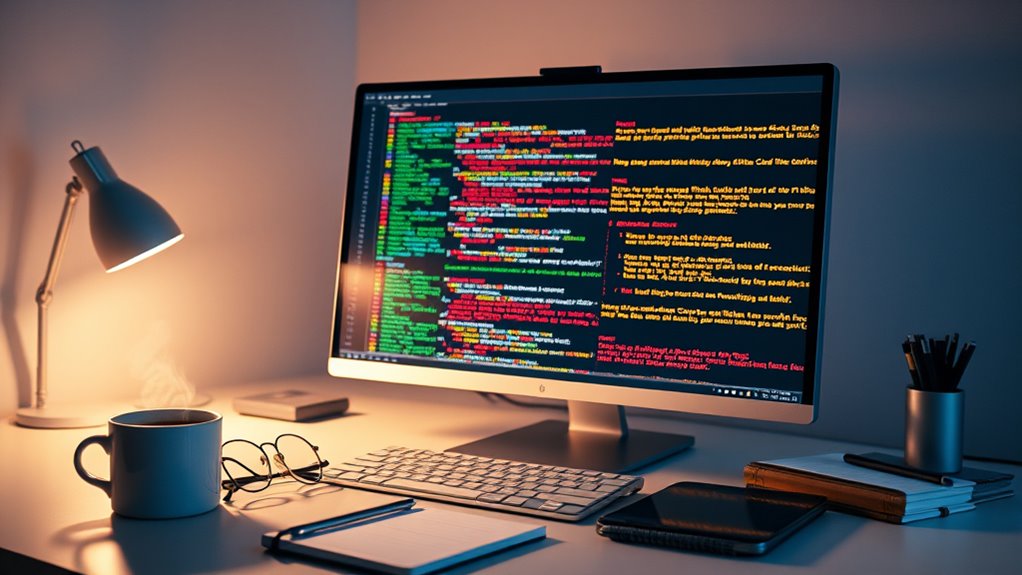
How are Large Language Models transforming modern coding practices? These models like GPT-4, GPT-3.5, and LLaMA 3.1 are revolutionizing how you approach coding, especially in data science and statistical tasks. They can generate code snippets that often produce correct outputs on the first try, especially with feedback, which speeds up your workflow. LLMs help automate repetitive coding chores, reducing manual effort and accelerating project timelines. As models improve with new versions, their code quality, readability, and accuracy get better, but you still need to review and refine their outputs for *ideal* results. They serve as powerful coding assistants, enabling faster prototyping and lowering barriers for non-experts, making complex tasks more accessible and streamlining your development process. Additionally, they can assist in understanding and applying content from the knowledge such as creating a cozy farmhouse bedroom ambiance. Recognizing the importance of best vacuums for dust removal in 2024 can help you keep your environment clean and allergen-free, further supporting a healthy workspace or home. Incorporating special occasions knowledge can also enhance personalized project features, particularly in areas like greeting card automation or celebratory content generation. Moreover, understanding how to optimize home theatre projectors can significantly improve your entertainment setup.
automated content creation software
As an affiliate, we earn on qualifying purchases.
As an affiliate, we earn on qualifying purchases.
Automating Content Creation and Its Impact on Copywriting
Large Language Models (LLMs) are rapidly transforming content creation by automating tasks that once required significant human effort. They generate high-quality text quickly, making marketing and communication more efficient. You should consider these key impacts:
Large Language Models streamline content creation, boosting efficiency and quality while highlighting the need for human oversight.
- Automation of repetitive tasks frees you to focus on strategic, creative work.
- Content scalability allows your business to produce more material with less cost.
- Ethical considerations, like data sourcing and privacy, demand your attention to maintain trust, especially as integration with other tools becomes more prevalent.
- The importance of ethical hacking in safeguarding data as automation increases is becoming more evident.
- Understanding emotional support principles can help ensure that automated content remains sensitive to human needs and emotional nuances.
- Incorporating attention to detail ensures that automated outputs meet high-quality standards and reduce errors.
- Proper management of email marketing databases is essential to ensure that automated content reaches the right audience effectively.
According to market projections, the LLM industry is expected to grow exponentially, influencing a wide range of sectors and applications.
While LLMs enhance productivity, they lack the personal touch and deep creativity humans bring. Human verification remains essential to guarantee accuracy and relevance. As these models evolve, their role in content creation will expand, but your oversight will stay crucial for meaningful, authentic results.
As an affiliate, we earn on qualifying purchases.
AI’s Influence on Artistic Processes and Design Innovation

AI is transforming how you create and innovate in art and design, offering new tools and collaboration opportunities. But with this shift, questions about originality and authenticity arise, challenging traditional creative boundaries. As you incorporate AI into your work, you’ll need to balance its benefits with the potential challenges it brings. Recognizing the importance of emotional connection in creative processes can help maintain genuine expression amid technological advancements.
AI-Driven Artistic Creation
Have you noticed how AI is transforming artistic processes and sparking design innovation? The AI art market surged to $298.3 million in 2023 and is expected to hit $8.6 billion by 2033, growing at 40% annually. Visual art dominates over half of this sector, showing AI’s strong foothold. Here’s what it means for you:
- Generative AI’s commercial potential reaches $5 billion by 2025, opening new revenue streams.
- North America leads with 38% of the market, making it a hub for AI-driven creativity.
- Over 34 million AI-generated images are created daily, reflecting prolific innovation.
According to industry reports, the integration of AI tools into creative workflows is accelerating, making them indispensable for modern artists and designers. AI tools streamline workflows, enable experimentation, and foster hybrid collaborations—reshaping how artists create and innovate. Additionally, the creative workflows are increasingly incorporating AI-driven solutions to enhance efficiency and inspire new artistic directions. This integration is driven by the rapid advancement of AI technologies, making such tools more accessible and powerful for creators. Furthermore, the growing adoption of predictive analytics in creative fields helps artists anticipate trends and tailor their work to audience preferences, expanding creative possibilities and innovative potentials in the artistic landscape. Recognizing the importance of mindfulness techniques in fostering focused creativity can also help artists manage the mental demands of rapid innovation.
Challenges in Originality
As creative professionals increasingly incorporate AI tools into their workflows, questions about maintaining originality and authenticity become more pressing. AI enhances design innovation by breaking traditional constraints and exploring new creative territories, improving output by up to 26%. However, concerns about authenticity grow, as AI-generated work blurs the line between human and machine creativity. The quality and diversity of training data heavily influence originality, raising issues around infringement and intellectual property. Ethical questions also emerge, prompting calls for regulations and transparency about AI’s role. Human oversight remains crucial to ensure content remains distinct and genuine. While AI models evolve to address these challenges, the need for clear standards and disclosure practices becomes essential to preserve the integrity of artistic processes. Training data diversity plays a critical role in shaping the uniqueness of AI-generated outputs, further emphasizing the importance of responsible AI development. Additionally, understanding cultural intelligence can help creators navigate and incorporate diverse cultural elements responsibly.
As an affiliate, we earn on qualifying purchases.
Ethical Challenges and Risks of Using LLMs in Creative Fields

As you incorporate LLMs into creative work, you need to consider risks like bias and discrimination that can unfairly influence content. Misinformation and deepfakes pose threats to trust and authenticity, while privacy issues raise concerns about data security. Addressing these ethical challenges is vital to guarantee responsible and fair use of AI in creative fields.
Bias and Discrimination Risks
Bias and discrimination pose significant ethical challenges when using large language models (LLMs) in creative fields. These models can reinforce harmful stereotypes and perpetuate societal biases. For example, you should be aware that:
- Gender bias often sees LLMs assigning men to prestigious roles while women are undervalued.
- Racial bias can lead to lower scores for Black candidates, despite equal qualifications.
- Implicit biases may remain hidden, subtly influencing outputs even when models are designed to be unbiased. Recognizing how algorithmic bias impacts model outputs is crucial for ethical development and application.
- The use of crochet kits for beginners and other crafting tools in creative projects highlights the importance of diverse and inclusive representation to avoid reinforcing stereotypes. Additionally, understanding how cookie categories are managed can help ensure ethical use of data and prevent bias amplification.
- Ongoing bias detection and mitigation techniques are essential to address these challenges effectively and promote fairness in AI-driven creative work. Incorporating diverse datasets into training processes is also vital to reduce the risk of bias and improve model fairness.
These biases impact creative work by limiting diverse perspectives and reinforcing stereotypes. As a user, you need to recognize that addressing these risks requires ongoing bias detection, mitigation techniques, and ethical oversight to foster fairness and prevent discrimination in your projects.
Misinformation and Deepfakes
Have you considered how the growing use of deepfakes in creative fields poses serious ethical challenges? The deepfake market is booming, with over 60% of content creators planning to adopt these tools by 2025. This surge increases the risk of misinformation, as nearly 70% of deepfake content is almost indistinguishable from real media, making detection difficult. Celebrities face frequent targeted deepfakes, damaging reputations and fueling public distrust. As the market valuation reaches $5.82 billion, concerns about misuse for fraud and explicit content grow. Ethical issues around authenticity, authorship, and the potential for deception intensify. Without proper regulations and ethical guidelines, deepfakes threaten to undermine trust in media and distort reality, posing a significant challenge for creative professionals and society alike.
Privacy and Data Security
Did you know that deploying large language models (LLMs) in creative work can inadvertently expose sensitive information? When using LLMs, you risk:
- Disclosing private data like PII or trade secrets embedded in training sets.
- Falling victim to prompt injection or data poisoning, which can leak confidential info or manipulate outputs.
- Facing large-scale breaches if access controls are weak or proprietary data isn’t properly secured.
- Ignoring the importance of data security measures can leave systems vulnerable to attacks or leaks.
These vulnerabilities raise ethical concerns, such as generating biased or harmful content, and compliance risks under regulations like GDPR or CCPA. To mitigate these issues, you should:
- Use data anonymization before training.
- Implement strict access controls and monitoring.
- Opt for secure, private deployments to safeguard sensitive data.
Future Developments in AI-Driven Creative Technologies
Future developments in AI-driven creative technologies are poised to revolutionize how content is generated and tailored. You’ll see AI models that generate code and handle complex workflows, boosting software development efficiency. Customizable models are emerging for specific industries, making workflows faster and more precise. Autonomous AI agents could soon automate routine coding tasks, freeing you up for more creative work. On the content side, multimodal AI systems are advancing—creating videos and images from text inputs, personalizing content based on user preferences, and automating parts of video production. Additionally, improved natural language processing enables AI to engage in more natural, context-aware conversations. As generative AI in media and entertainment continues to grow, it will enable new forms of storytelling and creative collaboration. The integration of content creation tools with AI will further streamline the production process. These innovations will reshape how you create, manipulate, and deliver digital content, opening new possibilities while increasing productivity across creative industries. Furthermore, advancements in sustainable materials for AI hardware will support eco-friendly growth in AI technologies. Moreover, the increasing importance of AI ethics and fairness ensures responsible deployment of these powerful tools, fostering trust and transparency. As the demand for creative automation increases, more intuitive interfaces and user-friendly platforms will emerge to empower creators of all skill levels.
Economic Implications of Automating Creative Tasks
The automation of creative tasks through AI is already transforming industries by boosting efficiency and reducing costs, but it also raises important economic questions. You should consider that AI could displace about 16% of jobs globally by 2025, impacting creative roles. At the same time, it’s expected to create 9% of new jobs, particularly in AI development and application. To understand the broader impact:
- AI enhances creative output by up to 26%, raising quality and competitiveness.
- The market’s value skyrockets, with a projected five-fold growth in the next five years.
- Companies are investing heavily—92% plan to increase AI spending, aiming for higher revenues and operational savings.
These shifts could reshape job markets, economic stability, and industry dynamics, requiring strategic adaptation.
The Shift in Skill Requirements for Creatives and Developers
As AI tools become more integrated into creative work, your skill set needs to evolve beyond traditional methods. You’ll need a basic understanding of AI applications and the ability to adapt quickly to new workflows. Despite these changes, your human creativity and originality remain essential for standing out in this AI-driven landscape.
Evolving Skill Sets
The rise of AI tools is transforming the skill sets required for both creatives and developers, demanding new competencies to stay relevant. You now need to master AI integration, data analysis, and strategic thinking. Specifically:
- Develop interdisciplinary collaboration skills to work effectively across creative and technical teams.
- Enhance communication and AI literacy to ensure smooth adoption and understanding of AI limitations.
- Embrace continuous learning to keep pace with evolving AI technologies and maintain a competitive edge.
These shifts mean you must adapt quickly, acquiring specialized skills in AI development, ethical considerations, and problem-solving. Staying current isn’t optional—it’s essential for leveraging AI’s full potential and avoiding obsolescence in a rapidly changing landscape.
Emphasis on Creativity
AI tools are reshaping creative work by boosting efficiency and expanding possibilities for both creatives and developers. With 83% of professionals using AI, your workflow now benefits from faster concept generation, asset variation, and research—saving you up to 50% of time. This automation frees you to focus on high-value tasks like refining ideas and exploring new creative directions. The role of AI shifts your skills toward strategic thinking, emotional insight, and innovation, rather than routine execution. As AI handles repetitive tasks, your emphasis on originality and storytelling becomes even more crucial. This evolution demands a deeper mastery of creative concepts and the ability to leverage AI as a collaborative partner, fostering richer, more impactful work. The future emphasizes human ingenuity complemented by AI’s efficiency.
Enhancing Productivity vs. Stifling Originality in AI-Generated Work
While AI-driven tools dramatically boost productivity across creative fields, they also raise concerns about diminishing originality. You can automate routine tasks, freeing time for innovation, and streamline iterative processes to refine work faster. However, over-reliance on AI might lead to homogenized styles, a loss of emotional nuance, and dependence on the quality of training data. To balance these effects, consider these points:
- Automate repetitive tasks to focus on high-value, original ideas.
- Use AI-generated starting points to spark creativity, not replace it.
- Recognize that AI enhances efficiency but requires human oversight to preserve emotional depth and uniqueness.
Striking this balance ensures you maximize productivity without sacrificing your creative authenticity.
Regulatory and Transparency Considerations for AI-Generated Content
As creative work increasingly relies on AI-generated content, establishing clear regulations and transparent practices becomes vital to guarantee ethical use and protect rights. Current laws aim to prevent copyright infringement, mandate disclosures, and ensure content provenance. For example, laws like HB369 require provenance data to verify origins, while states demand disclaimers on political AI content. Despite progress, federal mandates for watermarking or automatic labeling remain absent, complicating enforcement. You must navigate a landscape where platforms are required to retain provenance data and support third-party verification tools. Consider this visualization:
| Content Type | Regulation Focus | Enforcement Method |
|---|---|---|
| Political Ads | Disclaimers and provenance data | State laws and platform compliance |
| Visual/Audio Content | Embedding provenance data | Platform retention and user queries |
| Deepfake Media | Ban on nonconsensual AI-generated images | Criminal penalties and filtering mechanisms |
| General Content | Transparency and responsible use | Federal and private sector oversight |
Balancing Human Creativity With Machine Automation
Balancing human creativity with machine automation involves leveraging the strengths of both to achieve ideal results. You can do this by understanding that AI boosts efficiency but can’t replace emotional intelligence or cultural nuance. To make the most of this synergy:
Harness human creativity and AI efficiency together for optimal results and authentic connections.
- Use AI to handle data analysis, trend spotting, and routine tasks, freeing your time for strategic thinking.
- Rely on human insight for humor, sarcasm, and cultural sensitivity, which AI struggles to grasp.
- Collaborate with AI to generate ideas and personalize content, enhancing creativity without losing authenticity.
Frequently Asked Questions
How Do LLMS Handle Cultural Nuances in Creative Content?
You might wonder how LLMs handle cultural nuances in creative content. They often struggle because of limited diverse data, leading to cultural biases. Fine-tuning with culture-specific info and prompt engineering can help, but models still sometimes misrepresent or overlook certain cultural norms. Human feedback from diverse backgrounds is essential to improve sensitivity, ensuring the content respects and accurately reflects different cultures.
Can LLMS Truly Replicate Human Emotional Expression in Art?
You wonder if LLMs can truly replicate human emotional expression in art. While they simulate emotions effectively through pattern recognition and generate resonant text, they lack genuine feelings and deep understanding. Their emotional mimicry depends on training data and algorithms, which may not capture the nuance and depth humans bring to art. So, they can imitate emotion, but authentic human emotional depth remains beyond their reach.
What Are the Legal Rights of Ai-Generated Creative Works?
Ever wonder who owns AI-generated content? Legally, AI works can’t be copyrighted unless there’s significant human input. You need human authorship and control over the creative process for protection. Just providing prompts isn’t enough. As laws stand, works created entirely by AI lack copyright, but those assisted by humans might qualify. It is crucial to stay aware of evolving legal standards and include clear contracts to manage rights effectively.
How Do LLMS Affect the Job Security of Creative Professionals?
You might worry that LLMs threaten your job security, as they can automate up to half of certain creative tasks. While automation may displace some roles, it also opens new opportunities for skilled professionals to focus on high-value, strategic work. To stay relevant, you should adapt, reskill, and leverage LLM tools to augment your creativity, ensuring you remain competitive in an evolving industry driven by AI advancements.
Are Current Regulations Sufficient to Oversee Ai’s Role in Creative Industries?
You might think current regulations are enough to oversee AI’s role in creative industries, but they fall short. Existing laws mainly protect human authorship, leaving AI-generated works in a regulatory grey area. They lack clarity on ownership, enforcement, and international standards. You need updated, adaptable policies that address AI’s unique challenges, guarantee fair protection, and foster innovation—because the current legal frameworks aren’t sufficient to keep pace with AI’s rapid growth.
Conclusion
So, here you are, watching AI take over your creative turf—coding, copywriting, even art. As machines handle more, you might wonder if your unique touch still matters. Ironically, the very tools designed to boost your creativity could end up replacing it. But maybe, just maybe, your human spark will be what keeps your work truly original—something AI can’t quite replicate, no matter how smart it gets.