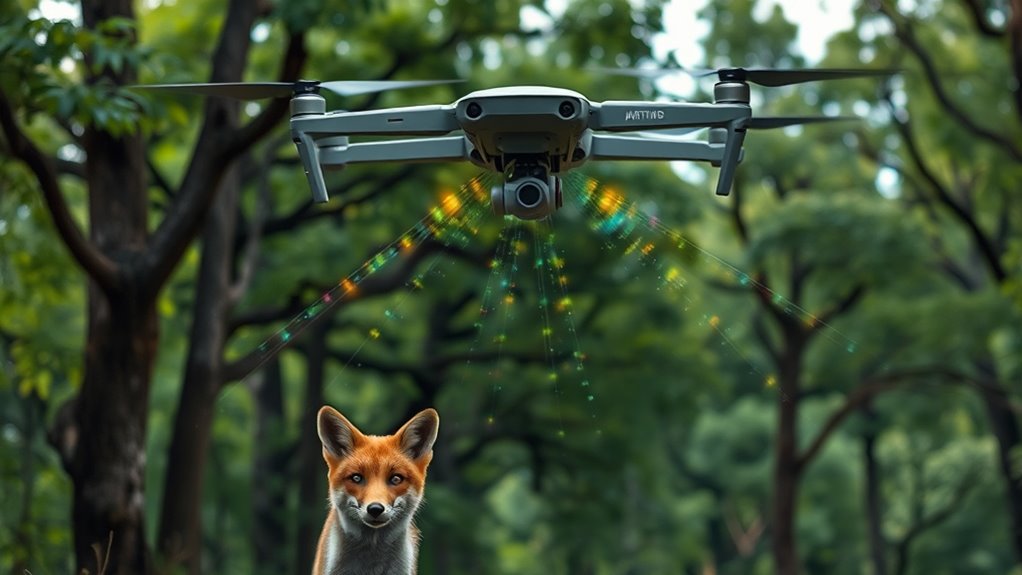

Artificial intelligence is indeed shaping the future of animal communication, enabling us to interpret complex signals like vocalizations, body language, and chemical cues that were once inaccessible. With advanced projects decoding whale sounds, dolphin clicks, and more, AI helps improve conservation and animal welfare efforts. While technical and ethical challenges exist, ongoing breakthroughs suggest AI could become the key to understanding animals on a whole new level. Keep exploring to discover how this evolving technology is transforming our connection with animals.
Key Takeaways
- AI analyzes complex acoustic and behavioral data, revealing patterns and meanings in animal communication beyond human capabilities.
- Projects like CETI and Earth Species Project demonstrate AI’s potential to decode and interpret multi-species signals.
- AI facilitates non-invasive, real-time monitoring of animal populations, improving conservation and welfare efforts.
- Advances in AI uncover linguistic structures and syntax in animal calls, deepening understanding of animal cognition.
- Ethical and technical challenges remain, but ongoing innovations suggest AI is a promising next step in animal communication.

BERRY Veterinary Monitor for Pet,Data storage, analysis, export, Monitoring 6 Parameters for Animal(include Dogs and Cats) as Clinical Equipment
- Accurate Monitoring: Tracks SpO2, pulse, ECG with high precision
- Clear Display: 2.4-inch screen shows vital signs clearly
- User-Friendly Operation: One-button operation for easy use
As an affiliate, we earn on qualifying purchases.
As an affiliate, we earn on qualifying purchases.
AI’s Role in Deciphering Animal Signals

AI plays a crucial role in deciphering animal signals by analyzing vast amounts of acoustic and behavioral data collected from natural habitats. With portable microphones, cameras, biologgers, and drones, you can gather continuous, 24/7 recordings in environments like the Arctic and Amazon. Digital bioacoustics technologies now detect subtle, infrasound, and ultrasonic signals that humans can’t hear. Interdisciplinary teams, including zoologists and ecologists, collaborate to guarantee data relevance and ethical collection. Before analysis, preprocessing steps such as noise reduction, segmentation, and behavioral labeling prepare the data for machine learning models. These models then identify patterns in vocalizations—like whale codas or bird songs—that may correlate with specific behaviors or emotional states. AI transforms raw data into meaningful insights about animal communication and leverages high-resolution imagery to enhance understanding of complex behaviors.
bioacoustic monitoring equipment
As an affiliate, we earn on qualifying purchases.
As an affiliate, we earn on qualifying purchases.
Breakthrough Projects Advancing Communication Studies

Recent breakthroughs in animal communication research stem from innovative projects that leverage advanced AI technologies. You can see this in initiatives like the Cetacean Translation Initiative (CETI), which uses AI to decode sperm whale sounds, aiding marine protection. The Earth Species Project is developing AI systems to understand communication across multiple species, fostering cross-species insights. Projects like Dolphin Whispers explore AI-assisted dialogue with dolphins, contributing to conservation efforts. Additionally, bioacoustic data analysis from seafloor sensors helps track dolphin populations and environmental impacts. These projects employ deep neural networks, pattern recognition, and IoT devices to process vast datasets efficiently. Interdisciplinary collaboration among zoologists, ecologists, and AI experts ensures these projects advance understanding while supporting conservation and animal welfare. Enhancing communication understanding through AI-driven analysis can also open new pathways for maximizing space and organization in research environments by streamlining data management and collaboration tools.
As an affiliate, we earn on qualifying purchases.
Ethical Considerations in AI-Driven Animal Research
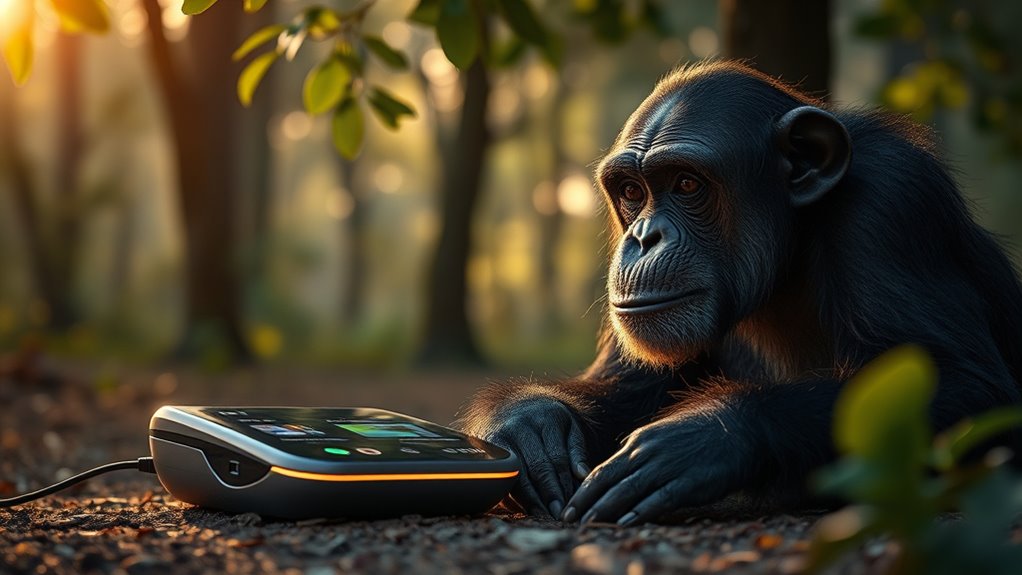
Innovative projects decoding animal communication with AI raise important ethical questions that demand careful attention. You must consider accountability: AI developers, vendors, and users need clear moral responsibility, especially since AI must detect harms animals can’t report themselves. Including animal welfare experts in AI design helps identify suffering risks and prevents unintentional harm. Be aware of potential exploitation, like increasing factory farm densities under the guise of welfare improvements. Currently, oversight mechanisms are lacking, heightening the need for ethical frameworks. Addressing bias is vital, as AI algorithms can perpetuate speciesism and societal prejudices, normalizing harmful practices. The legal landscape is underdeveloped, requiring new regulations and stakeholder involvement. Ensuring ethical standards, transparency, and human oversight are essential to responsibly advance AI in animal research. Furthermore, integrating insights from the Law of Attraction can help foster a more compassionate and mindful approach to technological development that prioritizes animal well-being.
animal behavior recognition camera
As an affiliate, we earn on qualifying purchases.
As an affiliate, we earn on qualifying purchases.
Insights Into Animal Linguistics Through Technology

You can now explore how AI uncovers complex syntax patterns in animal calls, revealing linguistic features once thought unique to humans. By comparing cross-species communication, AI highlights shared structures and differences that deepen our understanding of animal cognition. These discoveries pave the way for more accurate translation systems and richer insights into animal languages.
Unveiling Animal Syntax Patterns
How can technology help us understand the complex syntax patterns in animal communication? By analyzing vocal sequences with frameworks designed to examine syntax–semantics relationships, you can uncover how calls are structured and how meaning depends on sequence and context. Techniques developed for human language, such as identifying compositionality and hierarchical patterns, enable you to detect whether animals combine meaningful units or follow rules similar to syntax. Research shows animals use various syntactic combinations, like phonological, combinatorial, and potentially compositional syntax, although hierarchical syntax remains unconfirmed. Advances in artificial intelligence help you analyze these patterns, revealing animals’ pragmatic use of call sequences to influence social behavior and indicating that, despite limitations, some animals display surprising syntactic complexity beyond simple call pairs. Additionally, employing expert voice actors in research presentations can enhance the clarity and engagement of your findings.
Cross-Species Linguistic Features
Advances in technology are opening new avenues for comparing animal communication systems across species, revealing unexpected similarities to human language features. You can now observe vocal learning in animals like birds, whales, bats, and elephants, where they acquire sounds from adults during critical developmental periods, shaping dialects and demonstrating cultural transmission. These patterns challenge the idea that complex communication is unique to humans. You also find diverse syntactic structures: phonological syntax in songbirds, combinatorial signals in monkeys, and even elements resembling human syntax. Additionally, optionality allows animals to assign multiple functions to signals, echoing human language flexibility. Recognizing these shared features helps you understand how complex communication may have evolved across species, highlighting the deep roots of linguistic capabilities in the animal kingdom. This growing body of evidence supports the idea that some animals possess more sophisticated communication abilities than previously thought, blurring the line between simple calls and complex language systems. Furthermore, the presence of preppy dog names and other culturally influenced naming conventions in human societies reflects the complex social structures that can influence communication styles.
AI-Driven Communication Discoveries
Artificial intelligence is revolutionizing the study of animal communication by enabling you to analyze vast and complex datasets with unprecedented accuracy. AI tools process diverse data types—audio, visual signals, and chemical cues like pheromones—allowing for detailed pattern recognition. Machine learning detects links between sounds or behaviors and emotional states such as distress or happiness. Portable bioacoustic recorders facilitate continuous, 24/7 data collection across different environments, vastly expanding datasets for AI analysis. Advanced AI systems can identify species, age, and behavioral contexts solely from vocalizations. Large Language Models, once designed for human language, are now adapted to uncover structure and meaning in animal vocal sequences like whale codas. These advances are paving the way for deeper understanding and potential bidirectional communication with animals. The integration of multimodal data analysis is further enhancing AI’s ability to interpret complex animal signals beyond just sounds, including emotional cues, which are vital for understanding animal welfare and social interactions.
Challenges Facing AI in Animal Communication

Understanding animal communication through AI faces numerous challenges, primarily due to the complexity of signals animals use. These signals include vocalizations, body language, chemical cues, and hierarchical patterns that are difficult to model computationally. Capturing infrasonic and ultrasonic sounds adds technical hurdles, requiring specialized equipment. Additionally, signals vary with context, environment, and individual history, making interpretation tricky. Data collection is limited by remote habitats, ambient noise, and ethical constraints, leading to scarce, biased datasets. AI can detect call types but struggles with semantic understanding, emotional cues, and individual variations. The table below summarizes key challenges:
| Challenge | Explanation |
|---|---|
| Signal complexity | Multi-modal, hierarchical, and context-dependent signals |
| Data collection | Remote habitats, noise, ethical limits |
| Semantic interpretation | Meaning, emotion, and individual variation |
| Technical limitations | Capturing ultrasonic/infrasonic sounds |
| Ethical concerns | Welfare risks, misuse, and misinterpretation |
A significant hurdle is also the standardization of data, as inconsistent recording methods can impede the development of reliable AI models.
Transformative Impacts on Conservation and Welfare

AI-powered acoustic monitoring is revolutionizing conservation efforts by enabling continuous, real-time tracking of animal populations in even the most remote or dense habitats. You can now analyze thousands of hours of audio data to identify species, assess biodiversity, and detect rare or endangered animals without disturbing their environment. In the Gulf of Mexico, AI processed 52 million “clicks” from underwater sensors to monitor dolphin populations and environmental impacts. Passive ultrasonic recorders and bioacoustic devices support large-scale ecosystem monitoring, increasing accuracy and reducing invasive fieldwork. This real-time data allows you to respond quickly to population declines, habitat changes, or poaching threats, profoundly improving conservation outcomes. Proper planning can help avoid costly errors and maximize benefits. AI’s role helps protect species while minimizing human interference.
Future Possibilities and Emerging Trends

Advancements in technology are opening exciting new avenues for animal communication research. You can now use AI-enhanced devices like smart sensors, audio recorders, and wearable tech to monitor animals continuously. These tools filter out environmental noise, making it easier to detect signals accurately. Researchers are expanding beyond vocalizations to include body language, scent marking, and tactile cues by fusing audio, video, and olfactory data. This holistic approach helps decode complex communication patterns. Market growth is accelerating, with AI tools becoming more affordable and accessible across research, pet care, and conservation. While systems currently focus on decoding animal signals, breakthroughs in generative AI could enable two-way conversations. Transfer learning allows models to adapt across species, paving the way for more generalizable and scalable animal communication solutions. Incorporating Kia Tuning concepts like sensor calibration and performance optimization may further enhance the accuracy and reliability of these AI systems.
Frequently Asked Questions
How Accurate Are AI Systems in Interpreting Complex Animal Emotional States?
AI systems are quite accurate in interpreting complex animal emotional states, with studies showing up to 89.49% accuracy in detecting emotions across various species. You can rely on AI to analyze vocalizations, facial cues, and behaviors, especially with multimodal approaches that combine different data types. As AI algorithms improve, expect even higher precision, making real-time emotion monitoring a practical tool for enhancing animal welfare and conservation efforts.
Can AI Decode Communication in Highly Social or Multi-Species Environments?
Decoding communication in highly social or multi-species environments is like trying to solve a complex puzzle—you’re making progress. You can use AI to sort overlapping sounds, recognize patterns, and identify social cues that humans miss. With advanced classifiers and neural networks, you can interpret vocalizations across species, even in noisy habitats. While challenges remain, AI is increasingly capable of unraveling these intricate communication webs, unveiling new insights into animal societies.
What Are the Privacy Implications of Monitoring Animal Communications Remotely?
Monitoring animal communications remotely raises significant privacy concerns. You risk exposing sensitive data about your pets and household through unsecured devices and apps that often lack proper encryption. Malicious actors could intercept location, behavior, or health info, compromising your privacy. Additionally, the lack of regulation means your data may be misused or leaked without your knowledge, emphasizing the need for more transparent and secure pet monitoring technologies.
How Might AI Development Influence Laws Protecting Animal Rights?
AI development acts like a key opening new legal protections for animals. You might see laws evolve to recognize animals’ complex communication and cognition, leading to expanded rights and protections. As you support these changes, you’ll help guarantee animals aren’t just seen as property but as sentient beings deserving moral consideration. This progress could influence regulations on habitats, research, and industry practices, fostering a more compassionate, ethically aware society.
Will AI Be Able to Translate Animal Languages Into Human Languages in the Future?
AI will likely improve at translating animal sounds into human language in the future, but it’s not a certainty. You’ll see advancements in decoding vocalizations and emotional cues, helping us understand animals better. However, full translation remains complex due to the nuanced, context-dependent nature of animal communication. Ethical questions and technical challenges still need addressing, so while progress is promising, complete translation might still be years away.
Conclusion
As you stand at the crossroads of innovation and nature, AI acts like a bridge connecting you to the silent worlds of animals. It’s as if technology becomes the key to deciphering their secret language, revealing stories long hidden in their signals. While challenges remain, the promise of understanding and protecting these creatures shines like a beacon. Embrace this journey, for you’re part of a revolution that could rewrite the very language of life itself.