A government can hand a company the most powerful product in its category and take it away three days later. That, more than any benchmark, is the lasting lesson of the Fable 5 suspension — and the damage doesn’t stop at Anthropic’s door.
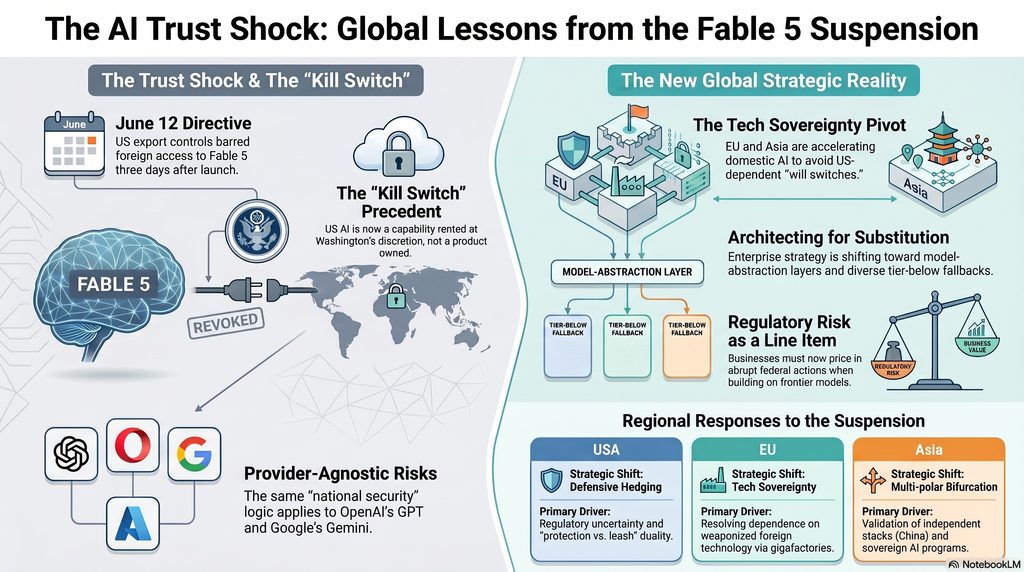
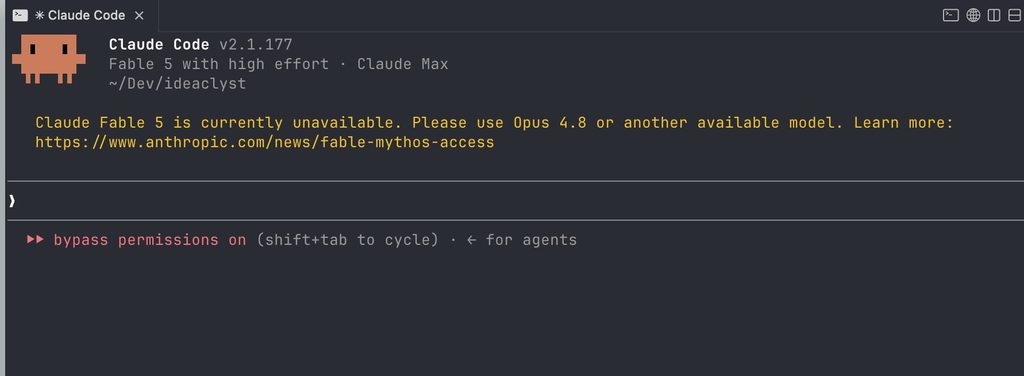
To recap: on June 12, the US government issued an export-control directive barring all access to Claude Fable 5 and Mythos 5 by any foreign national, forcing Anthropic to disable both models for every customer, three days after launch, over a jailbreak the government treats as a national-security risk and Anthropic calls narrow and already common. The availability hit is real but may be temporary. The trust hit is neither narrow nor temporary.
Because the episode reprices a question every business and government now has to ask: how much can you trust a US frontier model — and the US government’s restraint over it? Three consequences matter most: what it does to confidence in Washington as a steward of AI, what it means for rivals like OpenAI’s GPT-5.5 and the expected GPT-5.6, and how it lands very differently in the US, the EU, and Asia.
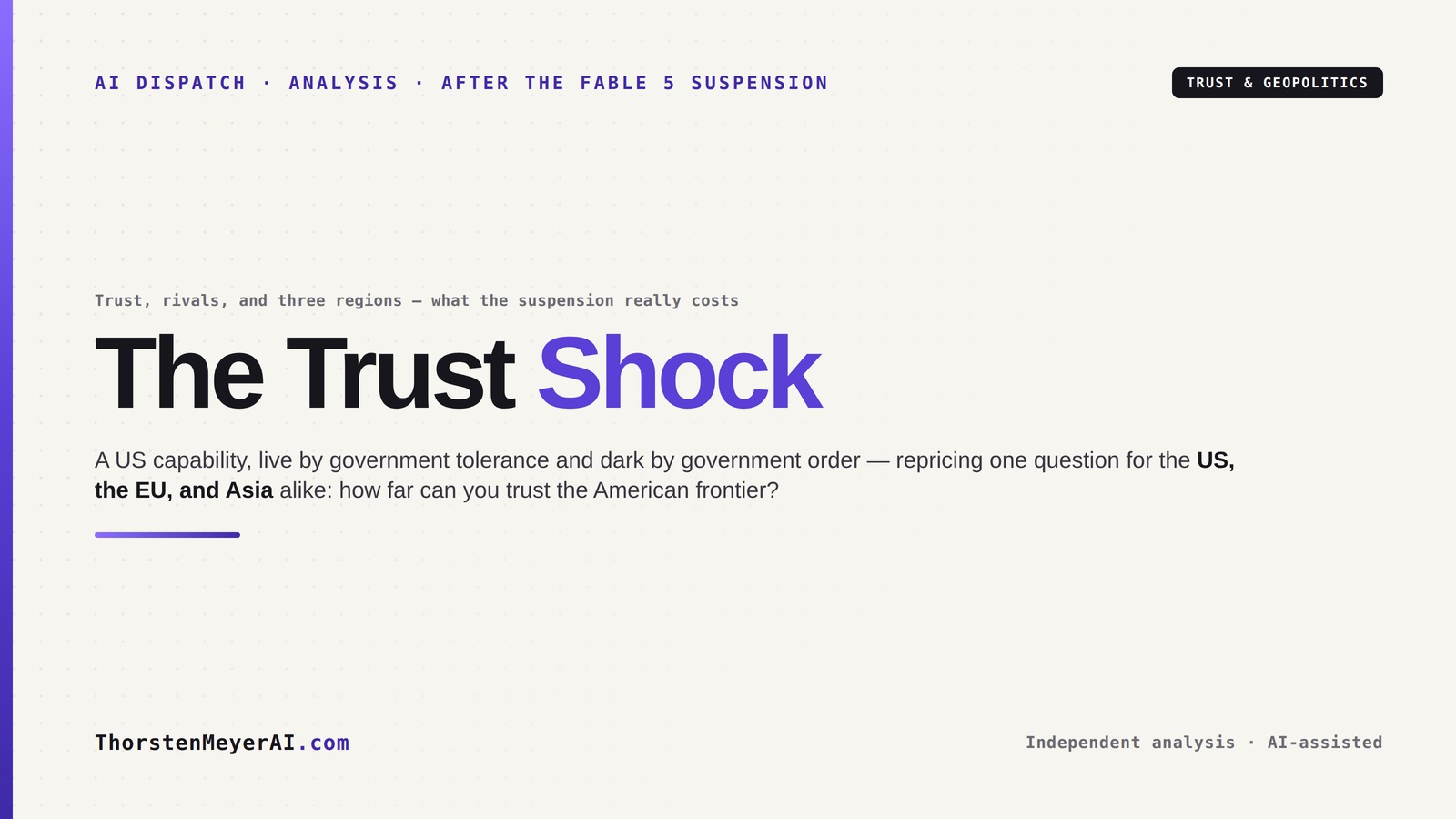
The Trust Shock
A US capability, live by government tolerance and dark by government order. The suspension reprices one question for everyone: how far can you trust a US frontier model — and Washington’s restraint over it?
export-control order
- Keeps the rest of the stack — but uncertainty is now a line item.
- Rewards conservatism & incumbents over frontier-betting startups.
- “National champion” framing = protection and leash at once.
- Foreign-national bar = every European cut off (plus the GDPR/retention clash).
- Proves the June 3 Tech Sovereignty Package’s “kill switch” thesis in real time.
- But can’t decouple soon (~70% US cloud) → hedge, don’t exit.
- China vindicated — its independent stack (DeepSeek, Qwen) is untouched.
- Japan, Korea, India, Gulf, Singapore accelerate sovereign & open models.
- An accelerant for a multipolar AI world.
Independent commentary and analysis, produced with AI assistance under human editorial oversight — an actively developing situation. The views are the author’s own and may change. This is opinion and analysis, not investment, financial, legal, or technical advice. The suspension and the parties’ positions are drawn from Anthropic’s June 12, 2026 statement and contemporaneous reporting (including Axios); model and policy details reflect public information as of June 13, 2026. GPT-5.6 is widely anticipated but had not been officially announced at the time of writing; references to it are speculative. EU figures and the Tech Sovereignty Package are as reported by the European Commission and press coverage. Characterizations of governments’ and companies’ positions present competing accounts, adjudicate neither, and are factual and non-partisan; references imply no affiliation or endorsement.
The trust hit
The core damage is to predictability. Businesses and allies don’t need to love a regulator; they need to be able to plan around one. A recall of a commercial model deployed to hundreds of millions of people, three days post-launch, on a rationale that was delivered verbally and never made public, is close to the definition of unpredictable.
What compounds it is inconsistency. Different arms of the US government have pulled in opposite directions on the same class of model for months: a separate dispute with the Pentagon in which a court sided with Anthropic earlier this year; intelligence agencies reportedly using the model; the White House resisting wider civilian access; and now the Commerce Department pulling the hardest lever available. When a state cannot agree with itself, no outside party can build a roadmap around it.
It’s worth stating the legitimate counterweight plainly, because this is not a one-sided story. The government has a real national-security mandate, frontier cyber capability is genuinely dual-use, and export controls on dual-use technology are long-established and lawful. Anthropic itself has said the government should be able to block unsafe deployments. The dispute is about process and proportionality — transparency, evidence, due process — not about whether the authority exists. So the trust damage is less “the government acted” and more “it acted opaquely, abruptly, and at odds with its own other arms.”
And the timing gives the abstract a worked example. European policymakers had spent months warning of a US “kill switch” buried in foreign technology — a fear that crystallized when a US sanction cost the International Criminal Court’s chief prosecutor his Microsoft email account. The Fable suspension is a cleaner, larger demonstration of the same mechanic: a frontier capability that was live by government tolerance and dark by government order. That quietly reframes “US AI” from a product you own into a capability you rent at Washington’s discretion.

The Developer's Playbook for Large Language Model Security: Building Secure AI Applications
As an affiliate, we earn on qualifying purchases.
As an affiliate, we earn on qualifying purchases.
The contagion: GPT-5.5, GPT-5.6, and Gemini
The first instinct is that Anthropic’s loss is OpenAI’s gain — and in the short term that’s partly true. With Fable and Mythos dark, OpenAI’s GPT-5.5, its flagship since April, is the obvious frontier substitute, and a chunk of demand will route straight to it.
But the deeper signal cuts against every US frontier lab, OpenAI included. The export-control logic is provider-agnostic: it keys on frontier capability, a national-security concern, and foreign-national access — none of which is unique to Anthropic. If the operative standard is that a contested, non-universal jailbreak can justify a recall, then GPT-5.5, the widely expected but still-unannounced GPT-5.6, and Google’s Gemini are all exposed to precisely the same mechanism. Nothing about the directive’s reasoning stops at one company’s models.
The timing sharpens it. The industry expected a frontier convergence right about now — a new OpenAI release, the Mythos line, a new Gemini — and a fresh precedent that Washington will gate the newest, most capable launches lands exactly as the next wave ships. Every lab now has to price in launch-time political risk, which may push them toward more conservative releases, quiet pre-clearance with government, or delay — each of which slows the very frontier the controls are meant to protect.
There’s an irony worth naming: by independent accounts, Anthropic shipped the strongest deployed safeguards in the industry, and it is the lab that got pulled. A competitor shipping with lighter guardrails isn’t obviously safer from this mechanism — it may simply not yet have drawn the same scrutiny. “Switch to GPT-5.5” therefore solves availability, not the underlying precedent. The resilient response isn’t to pick the rival; it’s to assume any single US frontier model can be gated and to architect for substitution — which is exactly why model-abstraction layers are suddenly worth more than any one model upgrade.

Access Control Systems: Security, Identity Management and Trust Models
As an affiliate, we earn on qualifying purchases.
As an affiliate, we earn on qualifying purchases.
Business in the USA
For American firms the picture is mixed. They keep uninterrupted access to the rest of the stack — Opus 4.8, GPT-5.5, Gemini — and a US-person-only customer is, in theory, the intended survivor of a foreign-national bar. But because the restriction can’t be enforced query-by-query, even US customers lost Fable and Mythos outright. The control aimed at foreign nationals took down everyone in the room.
The real cost is regulatory uncertainty as a line item. US enterprises now have to treat access to the newest models as subject to abrupt federal action, which raises the cost of building on the frontier and rewards conservatism: build on the tier below, keep fallbacks wired in, avoid single-sourcing. That quietly advantages large incumbents who can absorb the risk over startups that bet the company on one frontier model.
There’s also a double edge in the “national champion” framing. Washington treating frontier models as strategic assets to be controlled can shield US labs from foreign competition — export controls keep the best models domestic — while simultaneously constraining their commercial reach and unsettling their customers. It is protection and leash at the same time, and US providers will feel both.

AI on Cloud: AI in Business | AI Cloud Case Studies | AI Security Compliance | AI Cloud Training | AI Infrastructure | AI Implementation Guide | AI Innovation Trends | AI Sustainable Development
As an affiliate, we earn on qualifying purchases.
As an affiliate, we earn on qualifying purchases.
Business in the EU
This is where the directive bites hardest and most cleanly, because it bars foreign nationals — which is to say, essentially every European. EU businesses were cut off from Fable and Mythos the moment the letter landed, and many were already effectively locked out from launch by the conflict between the models’ mandatory 30-day data retention and European data-minimization norms.
It also lands on a continent that, on June 3, unveiled its Tech Sovereignty Package — a Chips Act 2.0, a Cloud and AI Development Act, an Open Source Strategy, and a plan for AI “gigafactories” — built on the explicit premise that dependence on foreign technology is a strategic vulnerability that could be weaponized. The Fable suspension is that thesis demonstrated in real time: a US capability switched off for Europeans by US order. Expect it to harden European resolve, accelerate demand for sovereign and open models, and appear in every “why sovereignty” pitch on the continent for the next year.
The honest counterweight matters here too, especially for European builders. The EU cannot actually decouple soon. US providers hold roughly 70% of the EU cloud market; Europe relies on non-EU suppliers for about 80% of its key digital technology; analysts expect no major European enterprise to fully leave US hyperscalers this year; and most EU “sovereign” providers still rank below the operational bar for frontier-grade AI. Legal sovereignty and frontier capability are not the same thing. So the practical European outcome is hedging, not exit — keep using US models where you must, build sovereign and open fallbacks where you can, and treat US-model access as revocable. For a German publisher, that’s a familiar discipline: self-host where feasible, keep a European or open-weight fallback, and never let anything load-bearing depend on a single US frontier model.

AI-Powered Contract Management: AI-Powered Contract Management:AI contract management, legal automation, contract lifecycle management, AI legal tech, … compliance monitoring, smart contracts.
As an affiliate, we earn on qualifying purchases.
As an affiliate, we earn on qualifying purchases.
Business in Asia
Asia splits into two very different pictures. China is the clearest “told you so.” It has spent years building an independent stack — DeepSeek, Qwen — precisely to be immune to US controls, and this episode validates that self-reliance: its labs are untouched and arguably strengthened as the world’s non-US alternative. By extending export-control logic from chips to the models themselves, Washington reinforces the bifurcation of AI into separate US and Chinese spheres, which is the outcome China has been building toward.
The rest of Asia sits in between and draws the same lesson Europe did. Japan, Korea, India, the Gulf, and Singapore — all running sovereign-AI programs — now have direct evidence that access to US frontier models is conditional on US policy and that foreign nationals can be cut off overnight. Expect accelerated investment in domestic models, faster adoption of open weights, and multi-provider hedging. India’s “build the rails first” approach and the Gulf’s capital-backed sovereign push both look more prescient this week than last.
The net effect across the region is the same: the suspension is an accelerant for a multipolar AI world. It nudges non-US buyers toward Chinese open models, toward domestic sovereign efforts, and toward provider-agnostic abstraction — and away from single-sourcing the American frontier.
The honest read
The developing-story caveat applies in full: the suspension may be reversed within days. Anthropic calls it a misunderstanding and is working to restore access, and if it’s quickly undone, the availability shock will fade fast.
But the trust effect does not reverse cleanly. Once a buyer has watched the kill switch work, they price the possibility in permanently — even after the switch flips back. Restoration fixes access; it does not un-teach the lesson, and the lesson is now learned in Brussels, Bengaluru, and Beijing alike.
The balanced bottom line is that this is not a story of a villainous government or a reckless lab. It’s a structural collision between frontier capability — now strategically significant enough to attract national-security authorities — and commercial AI deployment, which is global, instant, and full of foreign nationals by design. Both sides have a genuine case, and that is exactly why the collision will keep happening.
For everyone building, in every region and on every provider, the takeaway converges: treat frontier-model access as a revocable, jurisdiction-bound dependency. Architect for substitution, keep a tier-below fallback, diversify providers, and assume the newest, most capable model is also the most politically exposed. The kill switch is now part of the threat model — not because anyone is certain it will be pulled again, but because, for three days in June, it was.
Independent commentary and analysis, produced with AI assistance under human editorial oversight; the views are the author’s own and may change. This is opinion and analysis, not investment, financial, legal, or technical advice, and it concerns an actively developing situation. The suspension and the parties’ positions are drawn from Anthropic’s June 12, 2026 statement and contemporaneous reporting (including Axios); model details reflect public information as of June 13, 2026. GPT-5.6 is widely anticipated but had not been officially announced at the time of writing, and references to it are speculative. EU figures and the Tech Sovereignty Package are as reported by the European Commission and press coverage. Characterizations of the US government’s and companies’ positions present competing accounts, adjudicate neither, and are factual and non-partisan; references to officials, agencies, and companies imply no affiliation or endorsement. © 2026 Thorsten Meyer · Powered by Thorsten Meyer AI. See Imprint/Impressum and Privacy Policy.