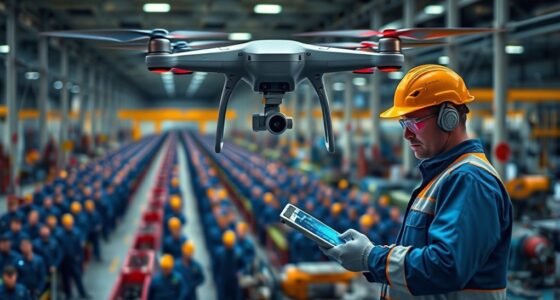

At next year’s 3D printing meetup, you’ll see how AI is revolutionizing fabrication by improving efficiency, customization, and innovation across industries. AI-driven automation enhances quality control, reduces waste, and speeds up production with real-time monitoring and self-correcting features. Generative design and scalable multi-laser systems are enabling faster, more precise manufacturing of aerospace, medical, and consumer products. Stay tuned, as upcoming insights will show you how these advancements are shaping the future of fabrication.
Key Takeaways
- The meetup will showcase AI-driven generative design enabling rapid creation of optimized, lightweight components for aerospace and automotive industries.
- Discussions will cover AI-enabled real-time quality control systems reducing failed prints and enhancing manufacturing reliability.
- Participants will explore how AI automates detection of fabrication issues, minimizing human intervention and increasing efficiency.
- The event will highlight advances in multi-laser 3D printers boosting speed and capacity for scalable, on-demand production.
- Future trends like self-correcting systems and decentralized manufacturing driven by AI will be key topics.

As 3D printing continues to evolve rapidly, industry professionals and enthusiasts are coming together at meetups to explore the latest advancements, especially in AI integration. These gatherings are shaping the future of fabrication by highlighting how artificial intelligence is transforming design, production, and quality control processes. The market’s projection reaching $28.68 billion by 2025 and expected to hit $33.76 billion in 2026 reflects growing confidence in this technology’s potential, with a significant portion of industry respondents optimistic about favorable conditions ahead. Industrial printers still dominate revenue, but the desktop segment is expanding at a 15.5% CAGR, indicating increased accessibility and innovation at smaller scales. North America currently leads, yet Asia-Pacific’s rapid growth, especially in desktop 3D printing, signals a shifting global landscape. By 2029, the market could reach nearly $84 billion, driven largely by AI and automation advancements.
At the meetup, you’ll see how AI now plays a central role in optimizing every stage of 3D printing. From design to post-processing, AI-powered systems are enabling real-time quality monitoring, reducing failed prints by up to 50%. These systems can automatically detect issues like filament tangles or bed adhesion problems, halting or correcting issues without human intervention. Future developments may include self-correcting features like nozzle cleaning or recalibration, ensuring higher yields and lower costs. Machine learning continually improves these detection systems, making manufacturing more reliable and efficient. Recent studies show that integrating AI with 3D printing can improve overall productivity and reduce waste by up to 40% according to industry reports.
Generative design, powered by AI, is also a hot topic. It allows for rapid creation of thousands of optimized component variations, supporting lightweight, durable parts critical for aerospace and automotive industries. This accelerates prototyping, shrinks time-to-market, and fosters innovation. AI’s collaboration with human expertise ensures designs are precise and ethically compliant. You’ll also hear about industry-specific applications—whether crafting high-performance aerospace parts, custom medical implants, or personalized consumer products—AI-driven manufacturing is making these possible faster and more affordably.
Finally, the meetup will explore how localized, on-demand production is becoming more feasible with large-format, multi-laser systems. As 3D printing scales up, it’s reshaping manufacturing from mass production to a more flexible, decentralized model, aligning with the industry’s ongoing shift toward efficiency and sustainability. [This trend is supported by recent technological breakthroughs in multi-laser systems, which significantly increase printing speed and capacity.
Top picks for "next year print"
Open Amazon search results for this keyword.
As an affiliate, we earn on qualifying purchases.
Frequently Asked Questions
How Can AI Improve 3D Printing Material Selection?
AI improves your 3D printing material selection by analyzing vast amounts of data to identify the best resins, filaments, or powders for your project. It helps you choose materials that meet strength, durability, and cost requirements confidently. AI also simulates material behavior before printing, reducing trial-and-error, and optimizes material composition and printing settings, ensuring better quality, fewer defects, and less waste throughout your fabrication process.
What Ethical Concerns Arise From Ai-Driven Fabrication?
You should be aware that around 80% of AI models have biases that can lead to unfair manufacturing outcomes. Ethical concerns include discrimination, privacy violations, and lack of transparency. You might find it challenging to hold AI accountable due to its “black box” nature, risking unsafe products or biased decisions. Ensuring fairness, transparency, and human oversight is essential to prevent harm and build trust in AI-driven fabrication.
Will AI Make Traditional 3D Printing Skills Obsolete?
AI will likely make some traditional 3D printing skills obsolete, especially manual modeling and slicing. You’ll spend less time on routine tasks and more on overseeing AI systems, interpreting data, and validating designs. While your manual craft may diminish, you’ll need new skills like AI platform familiarity and data analysis. Embracing collaboration between human creativity and AI will be essential, transforming your role rather than eliminating it entirely.
How Secure Is Ai-Controlled 3D Printing Data?
AI-controlled 3D printing data isn’t fully secure yet. You face risks like cyberattacks, data interception, and malicious modifications that can compromise part integrity. If you don’t implement strong encryption, VPNs, and blockchain, hackers could manipulate your designs or hijack your printers. Staying vigilant with updated software and robust cybersecurity measures is vital to protect sensitive data and guarantee safe, reliable manufacturing processes.
Can AI Help Reduce 3D Printing Production Costs?
Yes, AI helps reduce your 3D printing production costs substantially. It optimizes designs to use less material, shortens development time, and automates workflows for scalability. AI also predicts maintenance needs, preventing costly downtime, and monitors print quality to avoid waste. By streamlining processes and improving efficiency, AI cuts labor, material, and operational expenses, making your manufacturing more cost-effective and competitive in the market.
Conclusion
As you explore next year’s 3D printing meetup, you’ll see AI transforming fabrication like a master sculptor reshaping raw marble into art. This fusion isn’t just a trend; it’s a revolution that will carve new paths and reveal endless possibilities. Embrace these innovations, for they’re the chisel and hammer shaping the future of manufacturing. Stay curious and ready—because this is only the beginning of what’s possible when AI and 3D printing collide.