
TL;DR
NVIDIA has introduced Cosmos-H-Dreams, an action-conditioned simulator that generates surgical video from live robot commands. NVIDIA says the distilled model runs in real time on one RTX PRO 6000 GPU, but independent performance and medical-validity data were not provided.
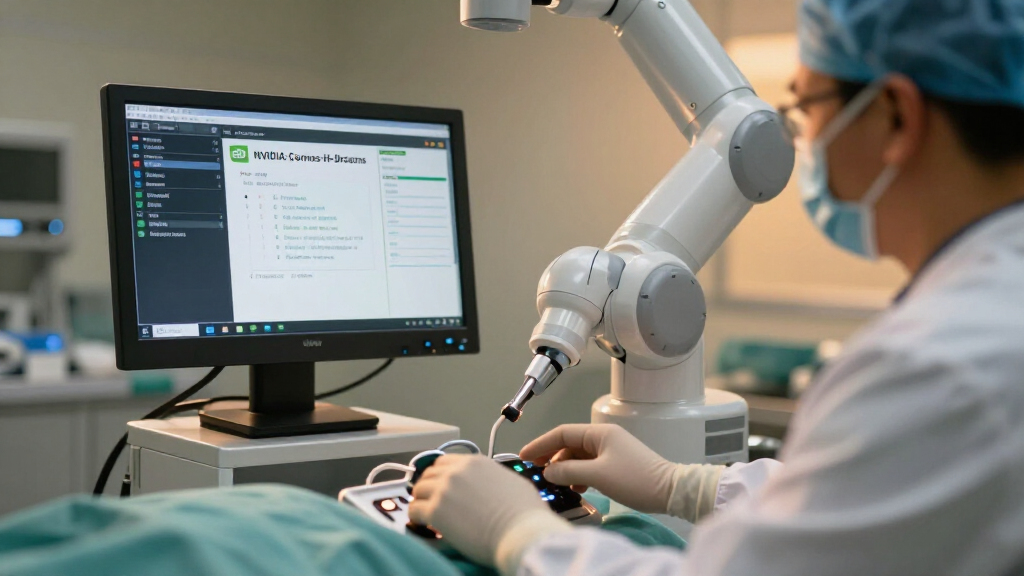
NVIDIA has introduced Cosmos-H-Dreams, a generative simulator that produces surgical video from an initial camera frame and a live stream of robot movements. The company says the system can operate in real time on one RTX PRO 6000 GPU, allowing a person or learned policy to control a simulated surgical environment in a closed loop without repeatedly using physical instruments or biological material.
Cosmos-H-Dreams is a distilled version of Cosmos-H-Surgical-Simulator, NVIDIA’s action-conditioned world model based on Cosmos-Predict2.5-2B. The earlier system generated future video from a starting scene and a planned robot trajectory, supporting offline policy evaluation and synthetic-data production. The new model processes actions sequentially and generates the next block of frames while receiving further commands.
NVIDIA specialized the released model for da Vinci Research Kit tabletop suturing. Its training mixture included successful demonstrations as well as needle drops, missed throws and failed knot ties. According to the company, including unsuccessful and out-of-distribution episodes helps the simulator represent the consequences of poor actions rather than producing only ideal outcomes.
The company says its teacher-to-student pipeline combines causal attention, a streaming key-value cache and self-forcing distillation. During training, the student conditions on its own generated history while a frozen teacher guides its output. NVIDIA reports that the resulting model can use as few as two denoising steps per latent frame and is served through its FlashDreams streaming-inference library.
Surgical robotics × generative world models
NVIDIA Cosmos-H-Dreams: Real-Time Surgical Simulation
An action-conditioned model turns an initial camera frame and live robot commands into a continuously generated surgical scene—opening a faster path for closed-loop policy testing while leaving crucial questions about physical and clinical validity unanswered.
What Cosmos-H-Dreams changes
The earlier Cosmos-H-Surgical-Simulator generated offline video rollouts from planned trajectories. The distilled H-Dreams model accepts actions sequentially, generates the next block of frames and keeps taking commands while the simulation runs.
See the starting scene
The simulator receives an initial RGB camera image that establishes the tools, work surface, needle and visible scene state.
Read live movement
A stream of robot kinematics conditions each new output, allowing a person or learned policy to influence the generated environment.
Generate what happens next
Successive video frames depict the predicted visual consequence—including missed throws, needle drops and failed knot ties.
From command to generated consequence
The system is designed as an interactive loop, not a one-time video request. New commands arrive while frames are being generated, letting a controller respond to the model’s evolving output.
Offline rollouts vs. interactive simulation
H-Dreams extends the earlier research workflow into a continuously controlled environment. That matters for responsiveness—but a realistic-looking rollout is not automatically a physically accurate one.
| Capability | Physical robot testing | Cosmos-H-Dreams | Earlier offline simulator |
|---|---|---|---|
| Live sequential commands | ✓ Native | ✓ Reported | ✗ Planned trajectory |
| Fast repeatability | ~ Limited | ✓ Intended | ✓ Supported |
| No instrument or material wear | ✗ No | ✓ Yes | ✓ Yes |
| Direct physical evidence | ✓ Yes | ✗ Generated video | ✗ Generated video |
| Clinical validity established | ~ Study-dependent | ✗ Not documented | ✗ Not documented |
Promising claims, substantial validation gaps
NVIDIA describes real-time operation and efficient inference, but the supplied announcement does not provide the measurements needed to judge latency, fidelity, stability or transfer to physical surgical robots.
Disclosure completeness
Questions still open
The proof chain that matters
The central test is not whether generated suturing looks convincing. It is whether decisions developed inside the model continue to work safely and consistently on real hardware.
A potentially important research accelerator—not evidence of an autonomous, clinically validated surgical system.
What readers need to know
The announced system is best understood as a controllable visual simulator for research and development.
Does it control a real surgical robot?
No clinical autonomy is described. The model generates simulated video in response to commands. NVIDIA reported integration with the Versius surgeon controller, not commercial clinical deployment.
Why train on failed demonstrations?
Needle drops, missed throws and failed knot ties help the model represent poor actions instead of generating only ideal outcomes—important when evaluating unsafe or ineffective policies.
What comes next?
Independent closed-loop studies should measure latency, rollout stability, physical accuracy and simulation-to-hardware transfer across tasks beyond da Vinci Research Kit tabletop suturing.
Real-Time Rollouts Could Cut Testing
Interactive simulation could give surgical-robot developers faster feedback when testing control policies. Physical experiments can be costly, difficult to reproduce and capable of damaging instruments or biological material. A simulator that responds fast enough for closed-loop control could support more frequent testing before a system is placed on physical hardware.
The approach may also reduce dependence on manually constructed physics environments. Surgical scenes involve deformable tissue, reflective surfaces and fine tool interactions that are difficult to reproduce. Cosmos-H-Dreams instead learns visual dynamics from video and robot kinematics, although visual plausibility does not by itself establish physical or clinical accuracy.

PNY VCNRTXPRO6000B-PB RTX PRO 6000 96GB GDDR7 Graphic Card
- Streaming Multiprocessor: Blackwell Streaming Multiprocessor
- Tensor Cores: 5th Gen Tensor Cores
- Ray Tracing Cores: 4th Gen Ray Tracing Cores
As an affiliate, we earn on qualifying purchases.
As an affiliate, we earn on qualifying purchases.
From Offline Rollouts to Streaming
The original Cosmos-H-Surgical-Simulator was post-trained on the Open-H-Embodiment dataset and used a 44-dimensional action representation spanning different robot configurations. Developers could submit a recorded or policy-generated trajectory, generate a video rollout and inspect it without executing the same movement on a robot.
Cosmos-H-Dreams moves that process into a streaming format. NVIDIA also said it worked with CMR Surgical and Cambridge Consultants to connect the simulator to the Versius surgeon controller. The source describes real-time operation on the Versius platform, but does not indicate a commercial deployment or clinical use.
“a real-time, action-conditioned generative simulator for surgical robotics”
— NVIDIA, in its Hugging Face announcement

Surgery Simulation and Soft Tissue Modeling: International Symposium, IS4TM 2003. Juan-Les-Pins, France, June 12-13, 2003, Proceedings (Lecture Notes in Computer Science, 2673)
- Condition: Used Book in Good Condition
As an affiliate, we earn on qualifying purchases.
As an affiliate, we earn on qualifying purchases.
Performance and Validation Gaps
The announcement does not provide frame-rate, latency or image-quality measurements, nor comparisons with other simulators. It is also unclear how long the model can maintain a coherent rollout before errors accumulate, how often generated scenes diverge from physical behavior or how performance changes on GPUs other than the RTX PRO 6000.
The supplied material does not cite peer-reviewed validation, independent testing or evidence that results transfer to clinical settings. NVIDIA presents Cosmos-H-Dreams as a research and development tool; the source does not establish that it can predict patient outcomes, tissue forces or safety-critical events with medical reliability.

Student Minor Traning Surgical KIT of 18 PCS.
- Complete 18-Piece Surgical Kit: Includes all tools in a carrying case
- Premium Stainless Steel Construction: Durable and corrosion-resistant materials
- Ideal for Students and Professionals: Perfect for practice and dissection
As an affiliate, we earn on qualifying purchases.
As an affiliate, we earn on qualifying purchases.
Closed-Loop Trials Are the Test
The next milestone will be testing whether policies trained or evaluated in Cosmos-H-Dreams perform comparably on physical surgical robots. Independent studies will need to measure latency, rollout stability and simulation-to-hardware transfer across tasks beyond tabletop suturing.
NVIDIA identifies closed-loop surgical physical AI as the broader direction and says the model can be adapted to additional data. Future releases may clarify access terms, hardware requirements and supported robot platforms, none of which are fully detailed in the supplied source.
generative surgical scene simulator
As an affiliate, we earn on qualifying purchases.
As an affiliate, we earn on qualifying purchases.
Key Questions
What is NVIDIA Cosmos-H-Dreams?
It is an action-conditioned generative simulator that receives an initial RGB image and live robot kinematics, then produces successive frames of a simulated surgical scene.
Does Cosmos-H-Dreams control a real surgical robot?
The model generates a visual simulation in response to robot commands. NVIDIA demonstrated integration with the Versius surgeon controller, but the source does not describe autonomous clinical operation.
What hardware does the simulator require?
NVIDIA says it runs in real time on a single RTX PRO 6000 GPU. The announcement does not report performance on lower-cost hardware or provide detailed latency figures.
Is the simulator clinically validated?
No clinical validation is documented in the supplied material. The reported capabilities are NVIDIA’s technical claims, and no peer-reviewed or independent medical evaluation is cited.
Why include failed surgical demonstrations in training?
NVIDIA says examples such as needle drops and unsuccessful knot ties help the model reproduce poor outcomes. That capability matters when a simulator is used to evaluate unsafe or ineffective policy actions.
Source: Hugging Face