
Thorsten Meyer | ThorstenMeyerAI.com | March 2026
Executive Summary
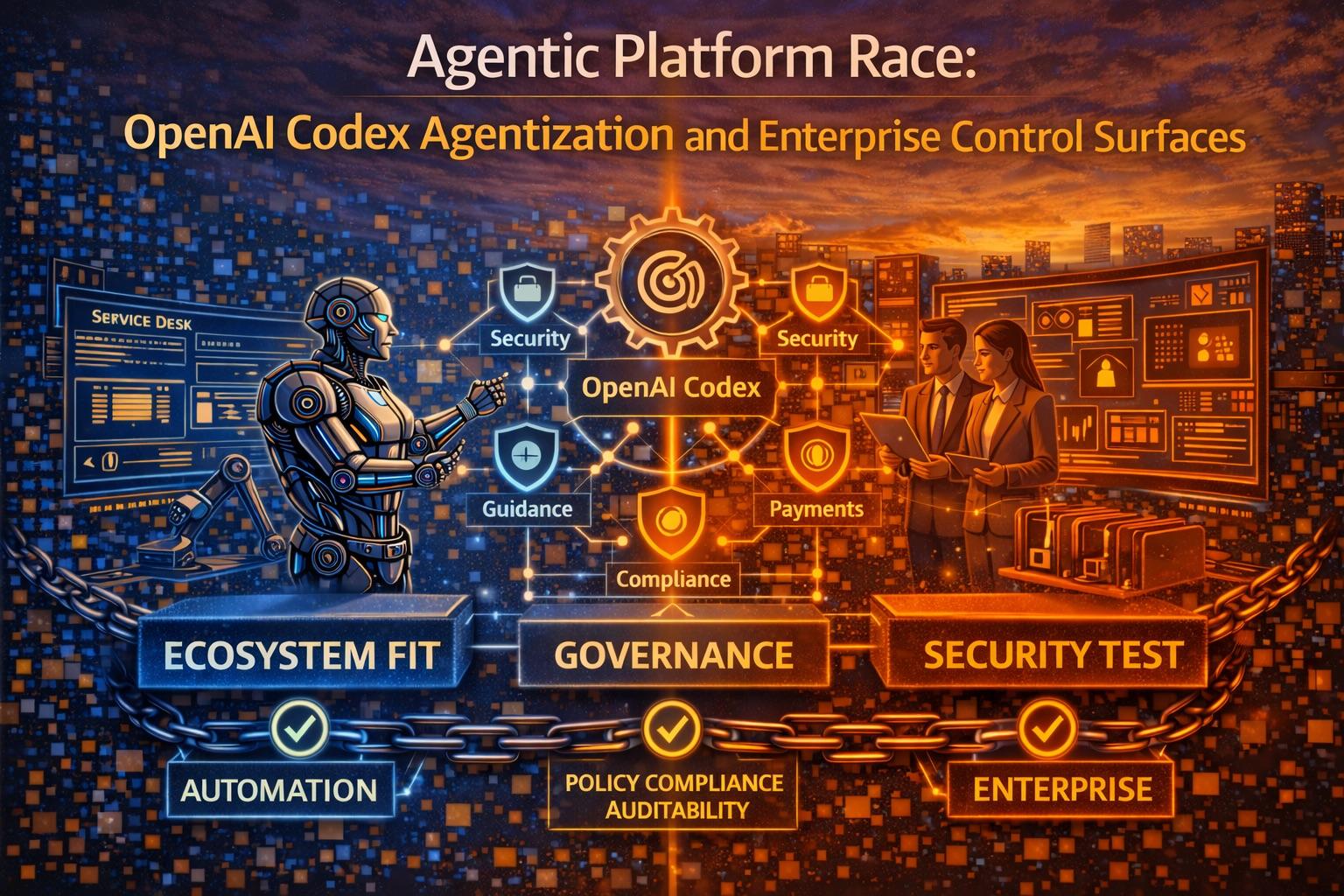
OpenAI is building the managed enterprise AI stack. Codex — the coding agent — and Frontier — the enterprise agent platform launched February 2026 — together represent a strategic bet: deep model capability tied to controlled services, with governance built into the platform rather than bolted on by the adopter.
The numbers frame the stakes. The AI coding agent market was valued at $4.7 billion in 2025, projected to reach $14.62 billion by 2033. 85% of developers now use AI coding tools. GitHub Copilot has 20+ million users and 90% Fortune 100 adoption. OpenAI’s Codex completes tasks in 1–30 minutes, generates pull requests, and runs test harnesses — bundled into existing ChatGPT Enterprise licenses.
Frontier adds the governance layer: identity management, permissions, compliance controls, audit trails, data residency in 10+ regions, and the promise that every agent action is logged, every permission explicit, every data access auditable.
The enterprise question is not whether managed platforms are capable. It is whether the speed-to-compliance trade-off justifies the concentration risk: 67% of enterprises cite data privacy as their primary AI barrier, 45% worry about cost unpredictability, and developer teams are already building “emergency escape hatches” from vendor lock-in.
| Metric | Value |
|---|---|
| AI coding agent market (2025) | $4.7B |
| AI coding agent market (2033) | $14.62B |
| Developers using AI coding tools | 85% |
| GitHub Copilot users | 20+ million |
| Copilot Fortune 100 adoption | 90% |
| Copilot code generation share | 46% average (61% Java) |
| Copilot task completion speedup | 55% faster |
| Copilot enterprise orgs | 50,000+ |
| Copilot enterprise growth (Q2 2025) | 75% QoQ |
| Codex task completion time | 1–30 minutes |
| Frontier launch | February 5, 2026 |
| Frontier data residency regions | 10+ (US, EU, UK, JP, CA, KR, SG, AU, IN, UAE) |
| Enterprises: data privacy barrier | 67% |
| Enterprises: cost unpredictability | 45% |
| Enterprise apps with agents (2026) | 40% (Gartner) |
| Agentic projects canceled by 2027 | 40%+ (Gartner) |
| OECD unemployment | 5.0% (stable) |
| OECD broadband (advanced) | 98.9% |

Enterprise AI Observability and Monitoring: Monitoring, Governing Production AI Systems Drift Detection, LLM Monitoring, Agentic AI, Governance, and FinOps … (Enterprise Machine Learning Operations)
As an affiliate, we earn on qualifying purchases.
As an affiliate, we earn on qualifying purchases.
1. What Is Emerging: The Managed Agent Stack
OpenAI’s trajectory is clear: a vertically integrated enterprise platform where model capability, agent execution, governance, and compliance are delivered as a managed service.
The Platform Architecture
| Layer | Component | What It Does |
|---|---|---|
| Model | o3, o4-mini, codex-1 | Reasoning, code generation, multimodal capability |
| Agent execution | Codex (coding), Frontier (general) | Task decomposition, tool use, parallel execution, memory |
| Enterprise context | Business Context (Frontier) | Semantic layer connecting enterprise data sources |
| Governance | Identity, permissions, audit | Every action logged, every permission explicit |
| Compliance | Data residency, retention, reporting | 10+ regions; regulatory reporting built in |
| Optimization | Evaluation loops | Built-in feedback for agent performance improvement |
Codex: The SDLC Agent
Codex is not a code completion tool. It is a coding agent: it reads codebases, writes features, fixes bugs, runs tests, proposes pull requests, and operates in parallel across projects using built-in worktrees and cloud environments.
| Codex Capability | Enterprise Implication |
|---|---|
| Reads and edits files | Full codebase access within scope |
| Runs test harnesses, linters, type checkers | Automated quality validation |
| Proposes pull requests | Integrates with existing review workflows |
| Agent skills (reusable instruction bundles) | Standardized task execution |
| Parallel execution across projects | “Weeks of work in days” (OpenAI) |
| Bundled into ChatGPT Enterprise licenses | No separate procurement |
| CLI + IDE extensions + web app | Multiple deployment surfaces |
Frontier: The Governance Platform
Frontier launched February 5, 2026 in limited availability. It is OpenAI’s answer to the governance gap: a platform where agent execution and enterprise controls are unified.
| Frontier Component | What It Provides |
|---|---|
| Business Context | Semantic layer connecting enterprise data; agents understand org information flow |
| Agent Execution | Reasoning, tool use, memory from past interactions |
| Evaluation & Optimization | Built-in feedback loops for agent performance |
| Security & Governance | Identity, permissions, compliance, audit trails |
| Data Residency | Content stored at rest in US, EU, UK, JP, CA, KR, SG, AU, IN, UAE |
| Audit Trails | Data accessed, decisions made, actions taken, outcomes produced |
| Enterprise Data Commitment | Customer data not used for training without explicit permission |
“OpenAI is not selling a model. It is selling a managed enterprise agent stack — with governance, compliance, and audit trails as first-class features, not afterthoughts.”

Coding with AI For Dummies (For Dummies: Learning Made Easy)
As an affiliate, we earn on qualifying purchases.
As an affiliate, we earn on qualifying purchases.
2. The Enterprise Upside: Speed to Compliance
For enterprises whose primary bottleneck is governance (79% lack mature governance, per Deloitte), a managed platform that ships governance as a feature rather than an integration project is a significant value proposition.
What Managed Platforms Solve
| Enterprise Need | Managed Platform Approach | Build-Your-Own Approach |
|---|---|---|
| Compliance boundary | Unified — single vendor SLA | Fragmented — multiple integrations |
| Data residency | 10+ regions, built-in | Custom infrastructure per region |
| Audit trails | Automatic — every action logged | Must be designed and maintained |
| Identity management | Platform-native | Enterprise IAM integration required |
| Procurement path | Bundled into existing licenses | Separate procurement per component |
| Time to production | Weeks (limited availability) | Months (custom governance stack) |
| Regulatory reporting | Built-in features | Custom development |
The Procurement Advantage
OpenAI’s bundling strategy — Codex included in ChatGPT Enterprise licenses — eliminates the separate procurement cycle that slows open-source adoption. For enterprises where procurement takes 3–6 months, this is a material competitive advantage.
Virgin Atlantic and Gap are already experimenting with Codex agents. 50,000+ organizations use GitHub Copilot, which now integrates both Claude and Codex agents through Agent HQ. The enterprise distribution channel is established.
The Compliance Pre-Position
| Compliance Requirement | Frontier Readiness |
|---|---|
| EU AI Act (Aug 2026) | Data residency in EU; audit trails; identity management |
| SOC 2 | Audit trail infrastructure in place |
| GDPR | Data residency controls; retention policies |
| HIPAA | ChatGPT for Healthcare variant available |
| Industry-specific | Regulatory reporting features |
“The fastest procurement path is the one that does not require a separate procurement. Codex in every ChatGPT Enterprise license is OpenAI’s distribution moat.”

DATA ENGINEERING AND AI FOR BEGINNERS: Revolutionizing Data Processing and Analytics by Leveraging Artificial Intelligence for Efficient Input Collection, Storage, and Transformation (World of AI)
As an affiliate, we earn on qualifying purchases.
As an affiliate, we earn on qualifying purchases.
3. The Enterprise Downside: Concentration Risk
The same integration that makes managed platforms fast to procure makes them expensive to leave. This is not theoretical — enterprise teams are already building escape plans.
The Three Concentration Risks
| Risk | What It Means | Evidence |
|---|---|---|
| Vendor lock-in | SDK coupling, prompt tuning, embedding dependencies, operational tooling all tied to one provider | 67% cite data privacy barriers; teams building “escape hatches” |
| Cost unpredictability | Usage-based pricing that scales faster than budgets; opaque long-running agent costs | 45% worry about cost unpredictability; developer pricing less priority |
| Roadmap dependency | Enterprise workflow tied to vendor’s feature timeline and deprecation decisions | LLM pace of change makes neutral control planes preferable |
Lock-In Surfaces
| Lock-In Vector | How It Binds | Portability Cost |
|---|---|---|
| Provider SDK coupling | Code depends on OpenAI-specific APIs | Rewrite to alternative API |
| Prompt tuning | Prompts optimized for specific model behavior | Re-optimization for each model |
| Tool/function schema | Custom tool definitions tied to platform format | Schema translation layer |
| Embedding dependencies | Retrieval systems built on specific embeddings | Re-embedding entire corpus |
| Enterprise knowledge search | Citations, security rules tuned to one provider | Ripples across every workflow |
| Operational tooling | Monitoring, alerting, dashboards built for one platform | New observability stack |
The Multi-Model Reality
GitHub’s Agent HQ now integrates Claude, Codex, and other agents into a single platform. The market is moving toward multi-model architectures. 85% of developers use AI coding tools, but they are increasingly choosing models per task — Claude for complex reasoning, Codex for trusted long-running jobs, Copilot as the default IDE presence, Cline for open-source flexibility.
The implication for managed platforms: enterprises that commit deeply to a single vendor’s agent stack may find themselves at a disadvantage when the winning pattern is multi-model orchestration with a vendor-neutral control plane.
“The lock-in that matters is not the model. It is the workflow: prompts tuned, schemas defined, retrieval built, security configured. Switching models is easy. Switching platforms is not.”

Privacy-Preserving AI Blueprint: Distributed AI Strategies | AI and Privacy Engineering | Federated AI Techniques | Decentralized AI Applications | AI Security and Privacy | Innovative AI Solutions
As an affiliate, we earn on qualifying purchases.
As an affiliate, we earn on qualifying purchases.
4. OECD Context: Decisions Are About Governance Fit, Not Connectivity
OECD regional broadband data shows household penetration exceeding 98% in advanced economies (e.g., German TL3 regions at 98.9%). Infrastructure readiness is sufficient. Procurement decisions are now dominated by governance fit, legal assurances, and operating model alignment.
What Drives Enterprise Platform Selection
| Decision Factor | Data | Implication |
|---|---|---|
| Data privacy | 67% primary barrier | Data residency commitments are table stakes |
| Cost predictability | 45% worry about unpredictability | Usage-based pricing is a risk, not just a model |
| Governance maturity | 21% (Deloitte) | Platforms that ship governance win procurement |
| Security requirement | 75% top requirement (KPMG) | Managed compliance is a value proposition |
| Project cancellation | 40%+ by 2027 (Gartner) | Governance gaps → failure regardless of platform |
Labour Market Context
| OECD Signal | Value | Platform Implication |
|---|---|---|
| Unemployment | 5.0% (stable) | Tight labour → coding agents augment scarce developers |
| Youth unemployment | 11.2% | Entry-level coding tasks automate first |
| Developer AI adoption | 85% | Near-universal; platform choice is the differentiator |
| Broadband | 98.9% (advanced) | Not a constraint |
Transparency note: OECD does not directly measure enterprise platform selection criteria or managed vs. open-source adoption rates. The indicators above are infrastructure, labour market, and survey proxies.
5. Practical Actions for Leaders
1. Run dual-track pilots: managed suite vs. portable architecture. Deploy OpenAI Codex/Frontier alongside an open-source or multi-model alternative on the same workflow. Measure: time to production, governance setup cost, total cost at scale, and portability friction. The data — not the vendor pitch — should drive the platform decision.
2. Negotiate exportability of logs, prompts, and workflow definitions. Before scaling commitment to any managed platform, secure contractual rights to export: audit logs (in standard format), prompt libraries, agent skill definitions, and workflow configurations. If you cannot export your governance artifacts, you cannot leave.
3. Build an exit plan before scale commitment. Map every integration point, every custom schema, every embedded dependency. Estimate the cost and timeline of migration to an alternative platform. If the exit cost exceeds 6 months of engineering time, the lock-in is too deep.
4. Define “minimum viable control surface” for any managed platform. Before adoption, specify the controls you require: audit trail format, data residency options, identity management integration, permission granularity, and incident response SLAs. No platform adoption without passing the control surface checklist.
5. Watch the multi-model trajectory. GitHub Agent HQ integrating Claude + Codex signals the future: multi-model orchestration with a vendor-neutral control plane. Architect your agent workflows to be model-portable from day one, even if you start with a single vendor.
| Action | Owner | Timeline |
|---|---|---|
| Dual-track pilot | CTO + CIO | Q2 2026 |
| Exportability negotiation | Legal + CTO | Q2 2026 |
| Exit plan development | CTO + Architecture | Q2 2026 |
| Control surface definition | CISO + CIO | Q2 2026 |
| Multi-model architecture | CTO + Engineering | Q2–Q3 2026 |
What to Watch
Enterprise contract terms around data residency, audit rights, and interoperability commitments. These will shape long-term platform power more than feature demos. The vendor that offers the strongest contractual commitments on data export, audit access, and interoperability standards wins the enterprise buyers who are thinking beyond the pilot.
The convergence of managed and open platforms. GitHub Agent HQ already hosts Claude and Codex side by side. If managed platforms open up to multi-model orchestration and open ecosystems add enterprise governance layers (Runlayer pattern from article #45), the distinction between “managed” and “open” may dissolve into a governance quality spectrum rather than a binary choice.
Codex pricing transparency at scale. Developers report that long-running agent costs feel opaque. As Codex moves from pilot to production-scale enterprise deployment, pricing predictability becomes a procurement requirement, not a nice-to-have. Watch for fixed-price or outcome-based pricing models that address the 45% cost unpredictability concern.
The Bottom Line
$4.7B coding agent market. 85% developer adoption. 90% Fortune 100 on Copilot. 20M+ users. 67% cite data privacy as barrier. 45% worry about cost unpredictability. 21% have mature governance. 40%+ projects canceled.
OpenAI’s managed stack — Codex + Frontier — is the fastest path to governed agent deployment for enterprises that cannot build their own governance layer. The compliance pre-position is real. The procurement simplification is real. The audit trail infrastructure is real.
But so is the concentration risk. SDK coupling, prompt tuning, embedding dependencies, and operational tooling create lock-in that is measured in months of engineering time to unwind, not hours. The multi-model future — Claude, Codex, Copilot, open-source agents orchestrated through a vendor-neutral control plane — is already visible in GitHub Agent HQ.
The right strategy is not to choose managed or open. It is to adopt managed platforms with contractual exit rights, minimum viable control surfaces, and architecture that remains model-portable. The organizations that do this capture the procurement speed of managed platforms without the strategic fragility of full lock-in.
The agentic platform race is not won by the best model or the best governance. It is won by the platform that gives enterprises the fastest path to governed deployment with the lowest cost of changing their mind.
Thorsten Meyer is an AI strategy advisor who believes the phrase “we’ll just switch providers later” should be accompanied by the same nervous laughter as “we’ll just refactor the monolith later.” More at ThorstenMeyerAI.com.
Sources
- OpenAI — Codex: Coding Agent, 1–30 Min Tasks, PR Generation, Agent Skills
- OpenAI — Frontier Platform Launch (Feb 5, 2026): Business Context, Agent Execution, Governance
- OpenAI — Data Residency: 10+ Regions (US, EU, UK, JP, CA, KR, SG, AU, IN, UAE)
- OpenAI — Enterprise Data Commitment: No Training Without Permission
- OpenAI — Codex Bundled into ChatGPT Enterprise Licenses
- GitHub — Agent HQ: Claude + Codex Integration (Feb 2026)
- GitHub — Copilot: 20M+ Users, 90% Fortune 100, 46% Code Gen, 55% Faster
- AI Coding Market — $4.7B (2025), $14.62B (2033)
- Developer AI Adoption — 85% Use AI Coding Tools (2026)
- Enterprise Surveys — 67% Data Privacy Barrier, 45% Cost Unpredictability
- Gartner — 40% Enterprise Apps with Agents (2026)
- Gartner — 40%+ Agentic Projects Canceled by 2027
- Deloitte — 21% Mature Governance
- KPMG — 75% Security/Compliance Top Requirement
- OECD — 5.0% Unemployment, 11.2% Youth (Feb 2026)
- OECD — Regional Broadband Data (98.9% German TL3)
- Virgin Atlantic, Gap — Codex Enterprise Experimentation
© 2026 Thorsten Meyer. All rights reserved. ThorstenMeyerAI.com