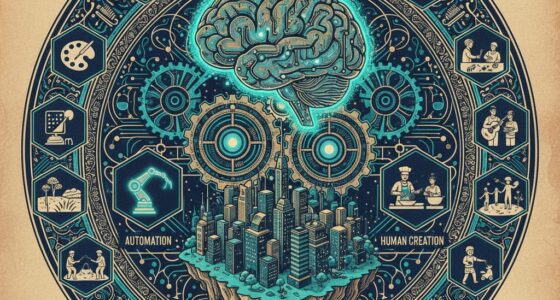
Automation and AI are advancing rapidly in developing countries, often outpacing their ability to industrialize. You might worry that robots will replace jobs before these nations fully develop their industries, especially given infrastructure and skills gaps. While automation brings risks of job displacement, it also offers opportunities if managed well with policies focused on workforce reskilling and inclusive growth. To understand how these challenges and solutions come together, keep exploring the evolving landscape of global industrialization.

Get business pricing on tech for your team
- Business-only prices and quantity discounts
- Tax-exempt purchasing
- Multiple users, one account, clear invoices
Key Takeaways
- Developing countries risk job displacement if automation is adopted prematurely without adequate infrastructure.
- Limited investment and skills hinder early adoption, potentially delaying industrialization and economic growth.
- Robotics can boost productivity in agriculture and manufacturing, but may widen inequality without proper policies.
- Infrastructure gaps and digital divides can cause automation to benefit only already advanced regions.
- International cooperation and inclusive strategies are essential to ensure developing nations benefit from automation without losing jobs.
industrial robot arms for manufacturing
As an affiliate, we earn on qualifying purchases.
As an affiliate, we earn on qualifying purchases.
The Growth of Automation in Emerging Economies

Emerging economies are experiencing a rapid rise in automation, driven by increasing investments in robotics and artificial intelligence. You’ll notice these countries importing more robots, especially in manufacturing sectors, to boost productivity. This surge helps them integrate into global value chains faster and improves plant performance. Automation also creates spillover effects, leading to more employment opportunities in local manufacturing and services. As AI becomes more accessible, small and medium-sized enterprises start adopting these technologies, enhancing efficiency. However, the pace of automation varies across countries, depending on their income levels and infrastructure. While automation can help developing nations catch up economically, it also raises concerns about skill gaps and job displacement. Overall, this trend signals a significant shift towards smarter, more automated industries in these regions.
As an affiliate, we earn on qualifying purchases.
How AI Adoption Differs Across Regions

You’ll notice that AI adoption varies widely across regions, with high-income countries leading the way due to better infrastructure and investment. Developing nations often face income-based gaps that slow their progress, widening regional disparities. Addressing these differences requires tailored policies to bridge the technological divide and promote equitable growth. Additionally, the focus on data privacy challenges in many regions can hinder the rapid implementation of AI solutions in developing countries.
Income-Based Adoption Gaps
AI adoption varies considerably across regions, primarily influenced by income levels. Higher-income countries can invest more in AI infrastructure, research, and workforce training, leading to faster adoption. Lower-income regions often face barriers like limited capital, inadequate digital infrastructure, and skills gaps, slowing AI integration. This creates an income-based adoption gap, risking further economic divides. Additionally, ethical considerations play a crucial role in shaping AI policies globally.
High-Income Country Leadership
High-income countries lead the way in AI adoption due to their advanced digital infrastructure, substantial investment capabilities, and large-scale research initiatives. They set the pace for technological innovation, attracting talent and funding that accelerates AI development. These nations have established regulatory frameworks and policies that support AI integration across industries, from healthcare to finance. Their large markets enable economies of scale, encouraging companies to adopt and refine AI technologies quickly. As a result, high-income countries enjoy competitive advantages, driving productivity and economic growth. This leadership also influences global standards and best practices, shaping AI’s future trajectory. Moreover, their technological infrastructure provides the foundation necessary for rapid AI deployment and experimentation. However, this concentration of AI capabilities risks widening the gap with developing regions, emphasizing the importance of strategic investments worldwide.
Regional AI Disparities
Despite the rapid advancements in artificial intelligence, its adoption varies widely across regions, reflecting underlying economic, infrastructural, and policy differences. You’ll notice high-income countries lead the charge, investing heavily in AI research, infrastructure, and skilled talent. In contrast, developing regions face hurdles like limited internet access, scarce digital skills, and fewer investments, slowing AI integration. This gap creates a cycle where wealthier nations enhance productivity and innovation faster, widening economic disparities. You may see some developing countries adopting AI selectively in sectors like healthcare or agriculture, but overall, their progress lags behind. These regional disparities threaten to entrench global inequalities, making it *essential* for policymakers to foster inclusive strategies and international cooperation. Without intervention, AI benefits could remain concentrated, leaving developing regions even further behind. Additionally, fostering creative practice and encouraging experimentation can help these regions develop innovative solutions to their unique challenges.
robotic automation kits for small business
As an affiliate, we earn on qualifying purchases.
As an affiliate, we earn on qualifying purchases.
Sectoral Impact of Robotics and AI in Developing Countries

You’ll see how automation is transforming key sectors like agriculture, mining, healthcare, finance, manufacturing, and retail in developing countries. These industries are adopting AI and robots to improve efficiency, productivity, and service delivery. Understanding these sectoral shifts is essential to grasp the broader economic and social impacts of automation in these regions. Additionally, the integration of home furnishings such as heated mattress pads and mattress toppers reflects how technological advancements are extending into everyday consumer comfort, illustrating the broader reach of automation and innovation.
Agriculture and Mining Automation
Agriculture and mining sectors in developing countries are increasingly adopting AI and robotics to boost productivity and efficiency. These technologies help optimize resource use, reduce labor costs, and improve safety. In agriculture, AI-driven machines can plant, monitor, and harvest crops with minimal human input. Mining operations benefit from autonomous vehicles and drilling robots, increasing extraction rates and safety. However, adoption varies based on infrastructure and investment capacity. Here’s a snapshot of AI and robotics impact:
| Sector | Technologies Used | Benefits |
|---|---|---|
| Agriculture | Drones, automated harvesters | Higher yields, reduced labor |
| Mining | Autonomous trucks, drilling robots | Safer, faster extraction |
| Crop Monitoring | Sensors, AI-powered analytics | Better decision-making |
| Resource Management | AI for soil and water analysis | Sustainable practices |
| Safety | Robots for dangerous tasks | Worker protection |
Healthcare and Finance Advances
Healthcare and finance are rapidly transforming in developing countries thanks to advancements in robotics and AI. In healthcare, AI-powered diagnostics improve accuracy and speed, enabling earlier detection of diseases and better patient outcomes. Telemedicine platforms powered by AI expand access to remote communities, reducing disparities. Robots assist in surgeries and automate routine tasks, increasing efficiency and safety. In finance, AI enhances fraud detection and risk assessment, making transactions more secure. Digital banking platforms use AI to provide personalized services, broadening financial inclusion. These innovations boost productivity and quality, but also require new skills and infrastructure investments. As AI becomes more embedded, your country can experience improved health and financial services, yet must address challenges like data privacy, inequality, and ensuring equal access to these transformative tools. Additionally, understanding how spiritual energy can influence human resilience and innovation may offer new perspectives on adapting to technological change.
Manufacturing and Retail Shifts
Manufacturing and retail sectors in developing countries are experiencing rapid transformation due to advancements in robotics and AI. You’ll notice factories becoming more automated, with robots handling repetitive tasks, increasing productivity and reducing costs. Retail businesses are adopting AI-driven systems for inventory management, customer service, and personalized marketing, improving efficiency and competitiveness. These shifts enable faster production cycles and better supply chain coordination. Additionally, the integration of high refresh rates in automation systems enhances operational responsiveness and real-time decision-making. However, automation may threaten some low-skill jobs, especially in assembly lines and retail cashier roles. At the same time, new opportunities emerge for skilled workers in programming, maintenance, and data analysis. Overall, these sectoral changes push developing countries toward industrial modernization, but they also raise questions about employment stability and the need for worker upskilling to adapt to the evolving landscape.
digital infrastructure development tools
As an affiliate, we earn on qualifying purchases.
As an affiliate, we earn on qualifying purchases.
Employment Shifts and Skill Demands in a Robotic Age
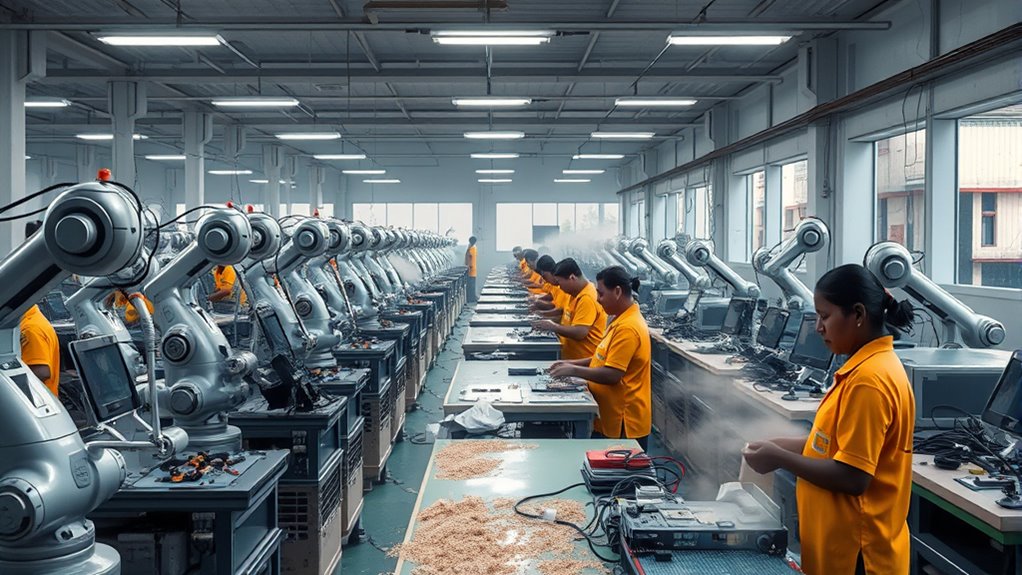
As automation and AI continue to evolve, they are fundamentally reshaping the employment landscape, demanding new skills and altering job roles across industries. You’ll find that routine tasks are increasingly automated, while demand rises for skills in technology, data analysis, and problem-solving. Workers must adapt by upskilling or reskilling to stay relevant. The table below highlights how skill demands are shifting:
| Skill Type | Current Demand | Future Outlook |
|---|---|---|
| Technical Skills | Moderate | High |
| Soft Skills | High | Essential |
| Manual Tasks | Declining | Minimal |
| Analytical Skills | Growing | Critical |
You need to focus on developing these skills to thrive in the changing job market, as automation continues to transform industries worldwide. Furthermore, understanding personality traits can be valuable in identifying how individuals adapt to these shifts and develop the necessary skills.
Potential Risks of Premature Automation

Premature automation can pose significant risks, especially when industries or regions adopt AI and robotic technologies without thorough planning or adequate infrastructure. If you rush into automation without evaluating local skills, resources, or market needs, you might face job losses that communities aren’t prepared to handle. Overreliance on untested technologies can disrupt supply chains and reduce competitiveness, leaving your economy vulnerable. Additionally, premature automation risks widening inequality, as benefits may accrue only to those with existing skills or capital. Without proper regulation and support systems, you could see increased social unrest or economic stagnation. It is crucial to consider Vetted – Grobal World insights to ensure that automation is implemented thoughtfully. It’s essential to adopt a careful, phased approach, ensuring that infrastructure, workforce development, and social safety nets are in place before fully embracing automation.
Strategies for Sustainable Industrialization Amid AI Advancements
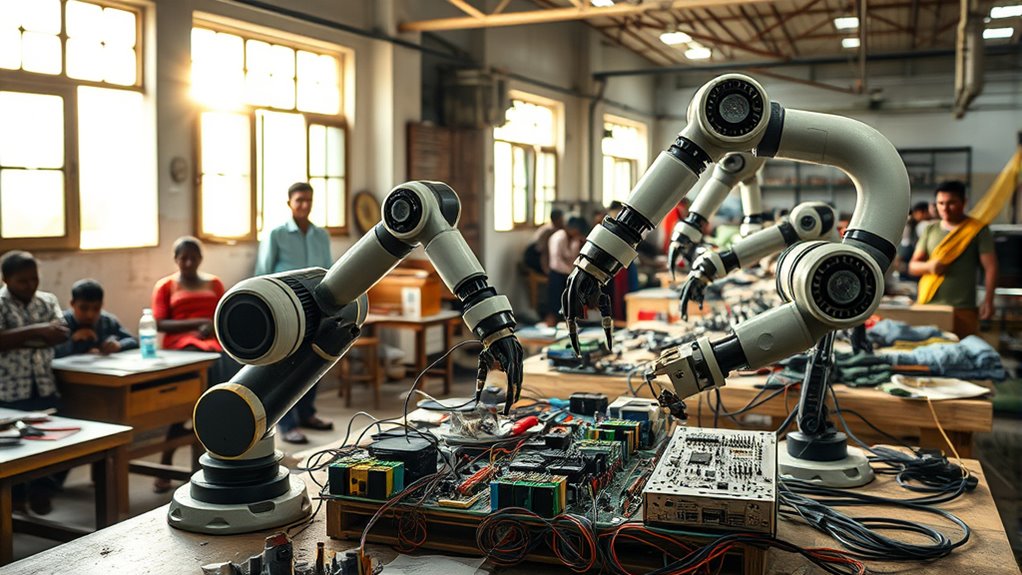
To achieve sustainable industrialization in the era of AI advancements, developing countries must adopt strategies that balance technological growth with social and environmental responsibility. You should prioritize investing in infrastructure that supports digital transformation while ensuring equitable access to technology. Emphasize building a skilled workforce through targeted upskilling and reskilling programs, preventing job displacement and fostering innovation. Incorporate environmentally sustainable practices to reduce carbon footprints and resource depletion, aligning growth with ecological preservation. Collaborate with international partners to access affordable AI solutions and share best practices. Focus on sectors where AI can complement human labor rather than replace it, such as healthcare, agriculture, and manufacturing. Additionally, integrating AI in sound design can foster creative industries that support local economies and cultural identity. By integrating these strategies, you can promote resilient, inclusive, and environmentally conscious industrial progress amid AI-driven change.
Policy Approaches to Balance Innovation and Workforce Preservation

How can policymakers strike a balance between fostering innovation through automation and protecting workers from displacement? You need to implement policies that encourage innovation while ensuring social safety nets are in place. Invest in upskilling and reskilling programs to prepare workers for evolving job markets, especially in sectors likely to be affected by AI. Promote inclusive growth by supporting small businesses and rural communities, helping them adapt to new technologies. Establish phased automation strategies that allow workers to transition gradually. Additionally, consider implementing tax incentives for companies that prioritize human employment or invest in workforce development. By balancing technological progress with social protections, you create an environment where innovation benefits everyone without leaving vulnerable workers behind.
Frequently Asked Questions
How Can Developing Countries Leverage Automation for Sustainable Growth?
You can leverage automation for sustainable growth by investing in education and upskilling your workforce to adapt to new technologies. Embrace AI and robots to boost productivity, improve industries like healthcare and agriculture, and integrate into global value chains. Focus on policies that promote innovation, reduce inequality, and guarantee technology benefits all. This approach will help you create resilient industries, increase employment opportunities, and achieve long-term economic development.
What Policies Best Support Upskilling Workers in Ai-Driven Economies?
Prioritize policies that promote proactive, practical, and persistent upskilling. You should invest in inclusive education, incentivize innovative training, and encourage continuous learning to keep pace with AI advancements. By building bridges between basic and advanced skills, you help workers adapt aptly. Implementing accessible apprenticeship programs and fostering flexible, forward-thinking frameworks guarantees workers remain relevant, resilient, and ready for the evolving, AI-augmented economy.
How Does Automation Influence Income Inequality in Emerging Markets?
Automation can widen income inequality in emerging markets by concentrating productivity gains among those with advanced skills and access to technology. You might find that high-skilled workers benefit with higher wages, while low-skilled workers face job displacement or stagnant wages. To address this, you should focus on policies promoting equitable access to education, upskilling, and social safety nets, ensuring that automation benefits everyone rather than deepening economic divides.
Can AI Adoption Reduce or Widen Regional Development Gaps?
AI adoption can both narrow and widen regional development gaps. You might see developing regions leap ahead with new technologies, boosting local industries and reducing disparities. However, if AI benefits stay concentrated in wealthier areas, existing inequalities could deepen, leaving poorer regions behind. Ultimately, your success depends on strategic policies that promote equitable access, ensuring AI acts as a bridge rather than a barrier to regional growth.
What Measures Ensure Fair Job Transition During Rapid Automation?
You should focus on investing in upskilling and reskilling programs that help workers adapt to new technologies. Encourage policies that promote job shift support, like social safety nets and career counseling. Collaborate with industry to create training opportunities aligned with evolving job markets. By fostering continuous learning and providing accessible resources, you can guarantee a fair transition, reducing unemployment risks and helping workers thrive amid rapid automation.
Conclusion
As automation accelerates, it’s essential to strike a balance between embracing innovation and protecting jobs. Did you know that by 2030, up to 14% of jobs in developing countries could be at risk due to AI? Staying ahead means adopting smart policies that foster skills development and sustainable growth. You can help shape a future where technology uplifts communities instead of displacing them, ensuring developing nations industrialize without being left behind.
Halloween Picks
halloween
As an affiliate, we earn on qualifying purchases.