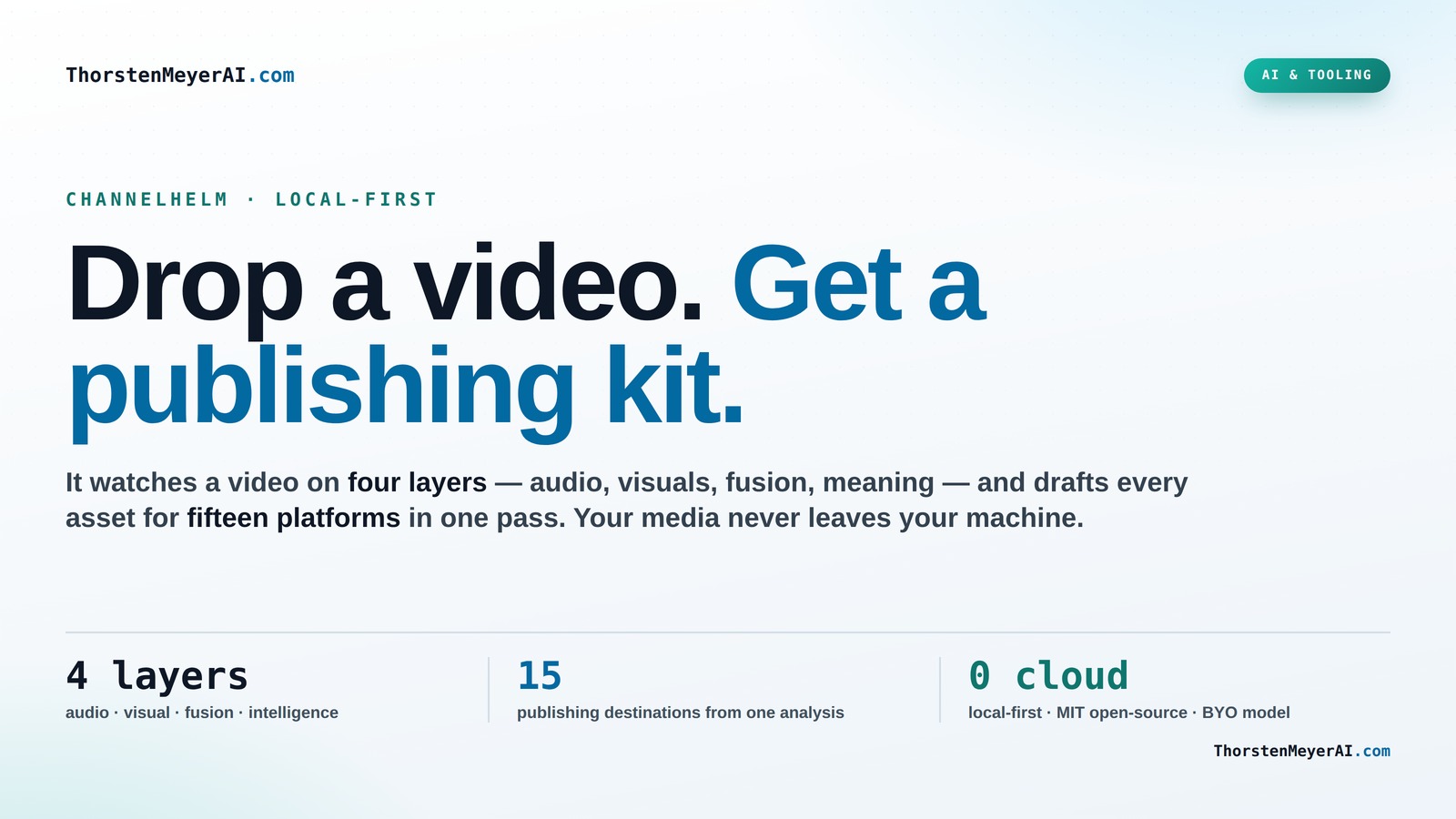

One Video In, a Whole Publishing Kit Out — Without the Cloud
Every creator who publishes seriously knows the shape of the afterwork. You finish a video, and the real job starts: a YouTube title that earns the click, a description with chapters and tags, a thumbnail concept, short vertical cuts for TikTok and Reels and Shorts, a blog draft, a newsletter blurb, and a different post for each of a dozen social networks — every one on-brand, every one slightly different. One upload becomes hours of repackaging. Most of it is first-draft work that a machine could do, if a machine actually understood the video.
ChannelHelm is my attempt to make that true. It is a local-first, video-to-publishing command center: drop in a file or paste a YouTube link, and it watches the audio, the visuals, and the meaning, then drafts every asset for every platform. You review, edit, approve, and ship. The media never leaves your machine.
I want to walk through how it works, because the how is the whole argument — and then be honest about the tradeoff it asks you to accept.
Drop a video. Get a publishing kit.
A local-first command center that watches a video on four layers — audio, visuals, fusion, meaning — and drafts every asset for fifteen platforms in one pass. You review, edit, approve, ship. The media never leaves your machine.
![WavePad Audio Editing Software - Professional Audio and Music Editor for Anyone [Download]](https://m.media-amazon.com/images/I/B1fcLEGCs6S._SL500_.png)
WavePad Audio Editing Software – Professional Audio and Music Editor for Anyone [Download]
- Professional audio editing: Record and edit music, voice, audio
- Audio effects: Echo, noise reduction, reverb, more
- Wide format support: WAV, MP3, FLAC, OGG, and more
As an affiliate, we earn on qualifying purchases.
As an affiliate, we earn on qualifying purchases.
One upload. A dozen platforms. Hours of repackaging.
A single video needs a different on-brand asset for every destination. Most of it is first-draft work — the kind a machine could do, if it actually understood the video.

AI Tools for YouTube Creators: Scripts, Thumbnails, SEO & Channel Growth with AI (AI Workflow Series Book 29)
As an affiliate, we earn on qualifying purchases.
As an affiliate, we earn on qualifying purchases.
Four layers, not a transcript
Most tools stop at speech-to-text. ChannelHelm reads a video on four layers that build on each other — and the depth of that read is what makes the drafts worth editing instead of deleting. Press play to watch the pipeline fill.
The understanding pipeline
Each layer feeds the next. By the time it writes a title, it isn’t guessing from a wall of text — it’s drafting from a structured read of what the video is.
Hooks: 00:12 “without the cloud” · 02:48 the four-layer reveal · 07:30 provenance demo
Retention windows: strong 00:00–01:10 and 06:50–08:20 → clip candidates flagged
![Roxio Creator NXT Pro 9 | Multimedia Suite + Photo Editor and CD/DVD Disc Burning Software [PC Download]](https://m.media-amazon.com/images/I/51ZWiA7A2nL._SL500_.jpg)
Roxio Creator NXT Pro 9 | Multimedia Suite + Photo Editor and CD/DVD Disc Burning Software [PC Download]
- Complete multimedia suite: 25+ applications for media editing and burning
- User-friendly media editing tools: Modify videos, photos, and audio easily
- Pro-exclusive features: Advanced editing, PhotoMirage Express, PaintShop Pro
As an affiliate, we earn on qualifying purchases.
As an affiliate, we earn on qualifying purchases.
One package, every platform
The unit is a Publishing Package: one source video, every derivative asset in one place — scored where it counts, editable everywhere.
YouTube
Scored title options · description with chapters + hashtags · scored tags · thumbnail concepts · clean transcript
Clips & Shorts
Plans cut from highest-retention moments · rendered vertical clips · 6 animated subtitle styles · word-snap trim
Editorial
Article briefs · blog drafts · newsletter summaries · routed to your local editorial service
Social
Posts & threads tailored per network — drafted in your brand voice
WavePad Audio Editing Software – Professional Audio and Music Editor for Anyone [Download]
- Professional audio editing: Record and edit music, voice, audio
- Audio effects: Echo, noise reduction, reverb, more
- Wide format support: WAV, MP3, FLAC, OGG, and more
As an affiliate, we earn on qualifying purchases.
As an affiliate, we earn on qualifying purchases.
Review the way you think
The per-package review is where you live — three layouts a keystroke apart, because reviewing isn’t one job. Underneath all of them: provenance on everything.
The daily driver
Two-pane review: platform rail, video + live pipeline + stacked assets, and a confident approval panel.
Go deep
File tree of every asset, a focused single-asset editor with side-by-side comparison, and a provenance inspector.
The overview
A canvas of every platform with completion %. Triage what’s ready; click in to focus.
model, provider, prompt version and inputs that produced it. Auditable by design.A choice, not a free lunch
ChannelHelm v1 does not run as a cloud SaaS. It runs on your own machine or Mac fleet. The architecture is deliberately boring in the best way — small enough to own and understand.
Your media stays put
Media & transcripts never touch a cloud. Provider keys encrypted at rest (AES-256-GCM). Only external dep: your publishing API.
Bring your own model
OpenAI, Anthropic, OpenRouter, Ollama, LM Studio, OpenClaw or local Codex CLI — routed per task or as a default.
~150-line queue
A custom SKIP LOCKED Postgres queue — no Redis, no BullMQ. N parallel slots finish a package several times faster.
Local ML, four scripts
MLX Whisper · pyannote · Qwen2.5-VL · Apple Vision OCR — all on-device. Everything else is TypeScript.
Your footage, transcripts and strategy never leave the machine — no retention, no training, no per-seat subscription eating your margin. For European data expectations, that’s a compliance posture, not a slogan.
You run the infrastructure — Postgres, workers, the ML CLIs, the boot order. It wants capable Apple Silicon to be fast, and visual analysis is heavy. You trade a monthly bill for setup effort and hardware you own.
The difference between a transcript and understanding
Most "AI video tools" start and end at the transcript. They run speech-to-text, hand the text to a language model, and ask for ten tweets. The output reads like what it is: a summary of words, blind to everything the words don't carry.
ChannelHelm reads a video on four layers, and the difference compounds.
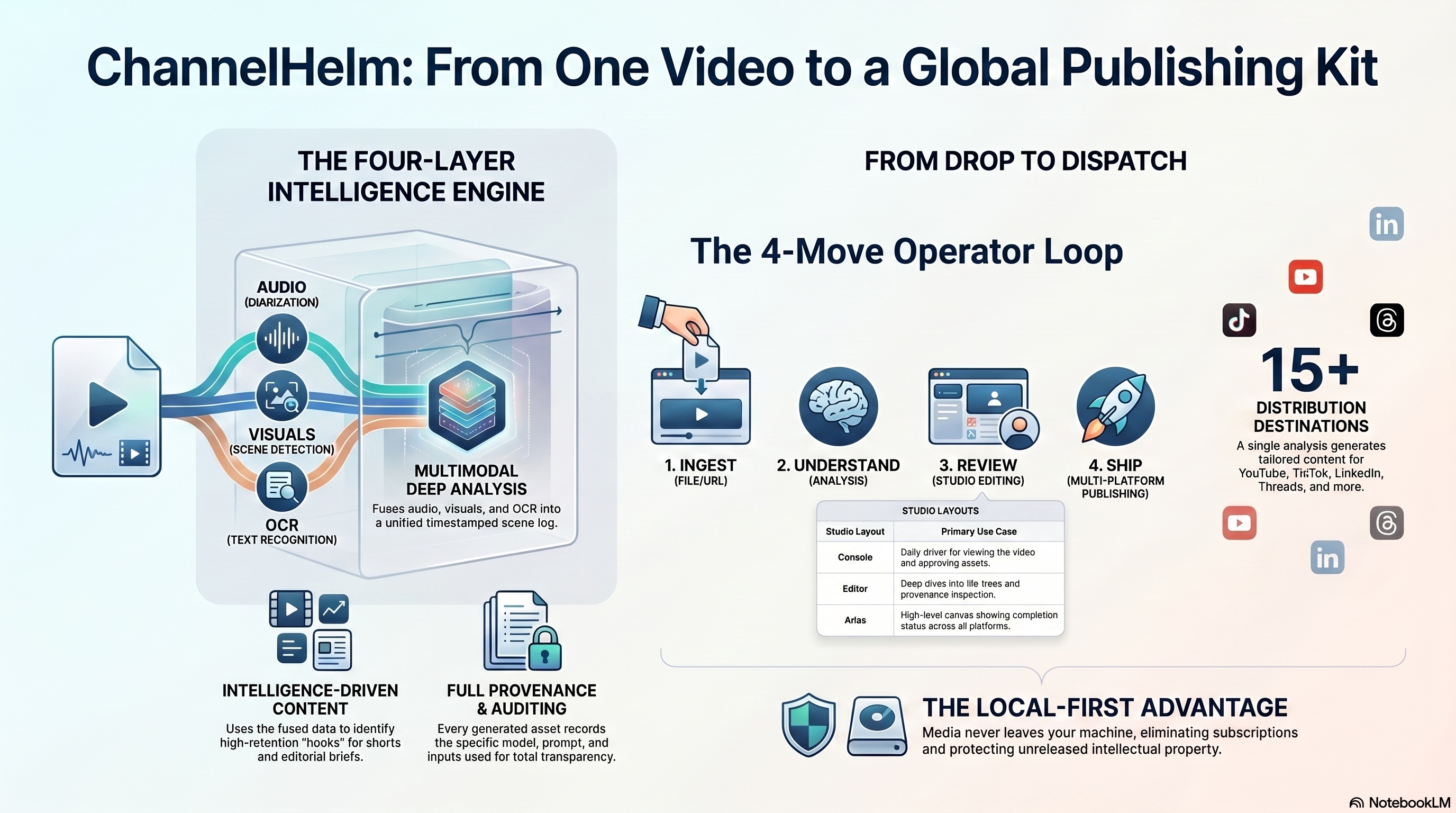
The audio layer does transcription with speaker diarization and word-level timing — not just what was said, but who said it and exactly when. The visual layer detects scene cuts, describes frames with a vision-language model, and reads on-screen text with OCR, so the system knows what's actually shown — the chart you cut to, the title card, the product on the table. The fusion layer aligns those two streams into a single timestamped scene log: a unified record where spoken claims and visual moments line up on the same clock. And the intelligence layer reads that fused log for topics, hooks, and retention windows — the brief that every downstream asset is drafted from.
That ordering matters. By the time ChannelHelm writes a title, it isn't guessing from a wall of text; it's drafting from a structured read of what the video is. A Short isn't cut from a random high-energy minute — it's cut from a moment the intelligence layer flagged as a genuine hook, with the trim snapping to whole-word boundaries so a clip never starts or ends mid-syllable. The depth of the read is what makes the drafts worth editing instead of worth deleting.
From drop to dispatch, in four moves
The operator loop is deliberately short. Ingest: drop a file or paste a link — and for a YouTube URL, the brand is auto-detected from the channel, so running many channels doesn't mean picking the right one by hand every time. Understand: background workers transcribe, analyze the visuals, fuse them, and extract the intelligence brief. Review in the Studio: every asset is drafted and waiting — you read scored options, edit inline, regenerate a single section you don't like, or generate an empty one on demand, and watch the rest fill in as the pipeline completes. Approve and ship: dispatch the approved assets to their destinations and track each one through to published.
The piece I'm proudest of is that "partially ready" is a first-class state. You don't wait for the whole pipeline to finish before you start working. The titles can be ready while the clips are still rendering, and the Studio shows you exactly which of the four layers is done and which is still grinding. A four-layer progress indicator means the system is never a black box you stare at.
One package, every platform
The unit ChannelHelm produces is a Publishing Package: one source video, every derivative asset, gathered in one place. The YouTube set includes title options each scored 0–100 against a character budget, a full description with chapters and hashtags built in, scored tags, thumbnail concepts pulled from the hook moments, and a clean transcript. The clips group turns the highest-retention moments into short-clip plans and then rendered vertical videos, each with an auto-written description. The editorial group produces article briefs, blog drafts, and newsletter summaries. The social group writes posts and threads tailored per network — and the network list is long: YouTube, X, LinkedIn, Instagram, TikTok, Facebook, Threads, Pinterest, Reddit, Bluesky, Telegram, Snapchat, WhatsApp, Discord, and Google Business. Fifteen destinations from a single analysis.
The scoring is there for a reason. When five title options each carry a number and a character count, the best pick is obvious at a glance — and still editable the moment you disagree with the score. The tool has an opinion; you have the final say.
The Studio: review the way you think
The per-package review screen is where you actually live, and it offers three layouts a keystroke apart, because reviewing is not one job. Console is the two-pane daily driver: a platform rail, the video with its live pipeline and stacked assets, and a confident approval panel. Editor is for going deep: a file tree of every asset, a focused single-asset editor with side-by-side comparison, and a provenance inspector. Atlas is the overview canvas — every platform with its completion percentage, so you can triage what's ready and click in to focus.
Underneath all three sits a principle I wasn't willing to compromise: provenance on everything. Every generated asset records the model, the provider, the prompt version, and the inputs that produced it. Nothing in the package is a black box. If a title came from a local model on a Tuesday and you want to know which prompt version wrote it, the answer is right there. In an era where "the AI made it" is supposed to be an acceptable shrug, ChannelHelm treats every output as something you should be able to audit.
The Shorts editor
Clips deserve a special mention because they're where most tools get lazy. ChannelHelm's Shorts editor is a two-minute review-and-publish loop. You drag the trim handles freely and they snap to whole-word boundaries on release — enforced on both the client and the server, so a clip can't ship cut mid-word. There are six animated subtitle styles (Word Highlight, Pop, Single Word, Typewriter, Motion, Banner), and the styling previews live as a DOM overlay on the video with no re-render needed. An empty clip description writes itself from the clip's transcript and your brand voice. And per-clip publishing fans one post out to TikTok, Instagram, and YouTube Shorts at once.
There's a quiet bit of engineering discipline here that matters more than it sounds: the clip plan is the editable source of truth, and the rendered clip is a build output the render worker upserts idempotently. Re-rendering never clobbers your edits. That's the kind of detail that separates a tool you trust with real work from a demo.
The tradeoff: local-first is a choice, not a free lunch
Here is where I'll hold two views at once, because honesty is the point.
ChannelHelm v1 deliberately does not run as a cloud SaaS. It runs on your own machine, or your own Mac fleet. The only external network dependency is your social-publishing API; editorial routing goes to a local service over your LAN. Provider API keys are encrypted at rest with AES-256-GCM. The transcription runs on MLX Whisper, frame description on Qwen2.5-VL, diarization on pyannote, OCR on Apple Vision — all locally. And the language model is yours to choose: OpenAI, Anthropic, OpenRouter, Ollama, LM Studio, OpenClaw, or a local Codex CLI, routed per task or set as a default.
The upside is real. Your raw footage, your unreleased transcripts, your strategy — none of it is uploaded to someone else's servers to be processed, retained, or used as training data. There's no per-seat subscription metabolizing your margin every month. For anyone publishing under European data expectations, "the media never leaves the machine" is not a marketing line; it's a compliance posture.
The cost is equally real, and I won't pretend otherwise. Local-first means you run the infrastructure: PostgreSQL, the worker daemon, the Python ML CLIs, the boot order. It wants a reasonably capable Apple Silicon machine, ideally a small fleet, to be fast — and the visual analysis, even after the optimization work that made it roughly ten-to-fourteen times faster, is genuinely heavy. There is no "sign up and it just works" cloud convenience here. You trade a monthly bill and a privacy compromise for setup effort and hardware you own. That is a real fork in the road, and which branch is right depends entirely on what you value.
For me, the architecture was the point. Under the hood it's deliberately boring in the best way: a single PostgreSQL 16 database, a custom queue of about a hundred and fifty lines built on SELECT FOR UPDATE SKIP LOCKED — no Redis, no BullMQ — with workers running independent claim-run-acknowledge slots that finish a package several times faster in parallel. Exactly four Python scripts do all the ML; everything else is TypeScript. It's a system small enough to understand and own.
Why I built it this way
ChannelHelm is, in the end, an argument made in software. The argument is that the tedious, repetitive layer of creative work — the repackaging, the reformatting, the drafting of the fortieth variation — can be handed to a machine that genuinely understands the source, without surrendering your media to a cloud, your wallet to a subscription, or your trust to an unauditable black box. The machine does the first draft of everything. You keep the judgment, the edits, and the approval.
That balance — automation that amplifies a person rather than replacing their control — is the whole idea. Drop a video. Get a publishing kit. Keep your hands on the wheel.
ChannelHelm is open-source (MIT) and local-first. Source on GitHub; overview at channelhelm.com. Technical details reflect the public repository as of May 2026 and will evolve.