By Thorsten Meyer | November 29, 2026 | ThorstenMeyerAI.com

Get business pricing on tech for your team
- Business-only prices and quantity discounts
- Tax-exempt purchasing
- Multiple users, one account, clear invoices
AI already helps at several steps of 3D printing. It can shape a part around the loads it must carry, and it can watch a printer and fix mistakes while the part is being made. But it cannot yet turn a sentence into a part you can trust. And every part that carries real weight still needs human checks and real tests.
This is the written companion to our explainer video. It follows one question: where does AI actually help when you design and print a part today, and where is it still hype? We walk the whole path once, from the idea to the finished part, and stop at every place where AI sits.
Key takeaways
- Design is the strongest case: NASA engineers let software shape parts around loads and keep-out zones, and report lighter, stiffer parts in hours instead of days.
- Checking still needs people: NASA’s own engineer says the algorithm “can sometimes make structures too thin,” and printed parts still need tests.
- Printing can be watched by a camera: a Cambridge system learned to spot and correct common nozzle errors while the print runs.
- Text-to-CAD is research, not a tool you can trust yet: code that runs is not the same as a part that is right.
- Rules lag behind: purely AI-made output gets no US copyright, and only humans can be named as inventors.
From idea to printed part: where AI looks over your shoulder
The orange marker shows where AI helps today. The last word still belongs to a real test.
Design: you set the loads, bolts and keep-out zones. The software proposes the shape.
Check: simulation predicts how the part bends. Only a real test shows how strong it is.
Print: a camera next to the nozzle spots common errors and corrects them during the print.
Every step: AI guesses from patterns. For parts that carry weight, people still test.
Products Worth Considering

Samsung Galaxy Tab A11+ 11-Inch Tablet, 6GB RAM, 128GB Storage, Expandable Storage, Gray

Anker SOLIX C1000 Gen 2 Portable Power Station

Logitech MX Master 4 Ergonomic Wireless Mouse with Haptic Feedback, Graphite
As an affiliate, we earn on qualifying purchases.
What this means for you
If you print at home, AI will most likely reach you through the printer itself: a camera that notices when something goes wrong. Treat it as a second pair of eyes, not as a guarantee. You still check the first layers yourself.
If you design parts at work, generative design can save you real time. But the computer only solves the problem you describe. If you forget a load, a screw or a hand that needs room, the result will be wrong in a very convincing way.
If a part holds weight, protects people or flies, nothing in this article changes the rule: test it. NASA wrote a whole standard for printed flight hardware, and its own AI-designed parts go through the usual stress analysis and testing.
What is 3D printing, in plain words?
A 3D printer builds an object one thin layer at a time. That is why experts call it additive manufacturing: material is added, not cut away.
There are three families you will meet most often. A nozzle printer melts a plastic string and lays it down line by line. The US standards lab NIST calls this material extrusion and says it is “commonly used by personal and commercial 3D printers.” A resin printer hardens a liquid with ultraviolet light. A powder printer melts thin layers of powder, often metal, with a laser or an electron beam.
The Cambridge researchers we meet below call material extrusion “the most widespread additive manufacturing method.” So when this article talks about a printer watching itself, it means that kind: the nozzle printer.
How does a part get from an idea to the printer?
Every printed part walks the same short path. First, someone draws it in CAD, short for computer-aided design. That is the software engineers use to build exact 3D models with real dimensions.
Second, the model gets checked. Will it bend? Will it break? Engineers use simulation for this, a computer test of how forces travel through the part.
Third comes the slicer. A NASA engineer describes it simply: the CAD model goes into software “usually called a slicer due to the layered nature” of printing. The slicer cuts the model into layers and writes the machine’s instructions, often in a format called G-code. Think of G-code as a recipe of moves: go here, push this much plastic, go there.
Fourth, the printer follows that recipe. And here is the catch. The same NASA paper says it is “common to iterate on AM fabrication due to unexpected failures during printing.” In plain words: prints fail, and people print again.

Where does AI sit on that path?
Here is a picture that helps. Imagine an experienced workshop master standing behind you. At every step, she glances over your shoulder. While you design, she points at material that carries nothing and tells you to leave it out. While you print, she hears that too much plastic is coming out and tells you to slow down.
That is roughly what AI does today, at four places: design, checking, printing and production. But keep the limit of this picture in mind. The real master has held thousands of parts in her hands. The AI has not held a single one. It has seen patterns in data, and it guesses from them. Sometimes that guess is excellent. Sometimes it is confidently wrong.
Can AI really design a better part?
This is the best-documented case, and it comes from NASA’s Goddard Space Flight Center. Research engineer Ryan McClelland uses commercial generative design software to make what he calls “evolved structures.” Generative design means: you describe the job, and the software proposes the shape.
You don’t draw the part. You draw the rules. A CAD specialist marks where the part must connect, where the bolts go, and where it must not be, for example the path of a laser beam. Then, as NASA puts it, “the AI connects the dots.”
Under the hood sits a method called topology optimisation. In plain words, the computer starts with a solid block, tests where forces flow, and removes material that carries little load. McClelland’s paper explains that it “effectively eliminates low stressed elements” by running stress tests again and again. That is why these parts look like bones.
The real case is a small bracket for EXCITE, a balloon telescope. Two expert engineers designed it the classic way. According to McClelland’s paper, their design “took two days of effort by two engineers.” The AI version took “about 30 minutes of effort from one engineer to encode the requirements and about 1 hour” of computing.
The result was not only faster. The AI designs were stiffer for their weight. The third human design reaches 240 Hz/kg. (A fourth one met the requirements but was not readily manufacturable.) The AI part milled from aluminium reaches 740 Hz/kg, and the printed AI part 885 Hz/kg. Higher means stiffer per kilogram. That is roughly three times better (our calculation).

NASA states figures for the whole programme: three times better performance and ten times less development time and cost. Those are NASA’s own numbers about its own process. And here is the part that matters most: McClelland himself says, “The algorithms do need a human eye.” Left alone, the software “can sometimes make structures too thin.”
So can we skip the testing?
No. And NASA’s own test results show why. The engineers built several versions of the same bracket and broke them on purpose. The computer predicted the stiffness very well: the first vibration mode came within 3 percent of the prediction.
But the strength surprised them. The parts were much stronger than predicted, and the milled metal part was stronger than the printed ones, “despite predictions to the contrary.” The paper’s explanation: printed metal can behave differently depending on the machine and the software that made it.
That is the gap in the checking step. Software can predict the shape’s behaviour well. It still struggles to predict the printing itself. The same paper lists the “inability to accurately simulate manufacturing” as a reason parts often have to be printed again.
For flight hardware, NASA does not leave this to luck. Its standard NASA-STD-6030 sets rules for printed parts in spaceflight, and it covers “all crewed spaceflight hardware.” NASA describes printing as “process-sensitive,” which is why the standard asks for qualified processes and test pieces. An AI-designed shape does not skip any of that.
Can you just describe a part in words and get it?
Not reliably yet. This is where research is moving fastest, and where the hype is loudest.
Text-to-CAD means: you describe a part in words, and an AI writes the CAD model. A team presented a system called Text2CAD at the NeurIPS conference in 2024. It learned from about 170,000 CAD models with about 660,000 text descriptions. The authors are open about the limits: their training data is dominated by simple rectangular and cylindrical shapes.
A second team, at Georgia Tech, tested big AI models that write CAD code. Their paper warns that “the resulting 3D object may not meet the specified requirements.” The best model produced code that ran in 96.5 percent of their test prompts. That sounds great. But code that runs is not a correct part.
Their own example makes it clear. A desk with small gaps between its legs and its top can still score as almost identical to the right desk. Yet those gaps make it useless. Even their self-checking step, where the AI asks itself questions about its design, answered correctly only about two times in three. And gold-standard feedback from a human still did slightly better.
So, is it true that AI can design any part from one sentence? Partly. It can draft simple shapes. For anything that must fit, move or carry weight, a person still has to check every dimension. We explained why AI can sound sure and still be wrong in our guide to AI hallucinations.
Can a printer really watch itself?
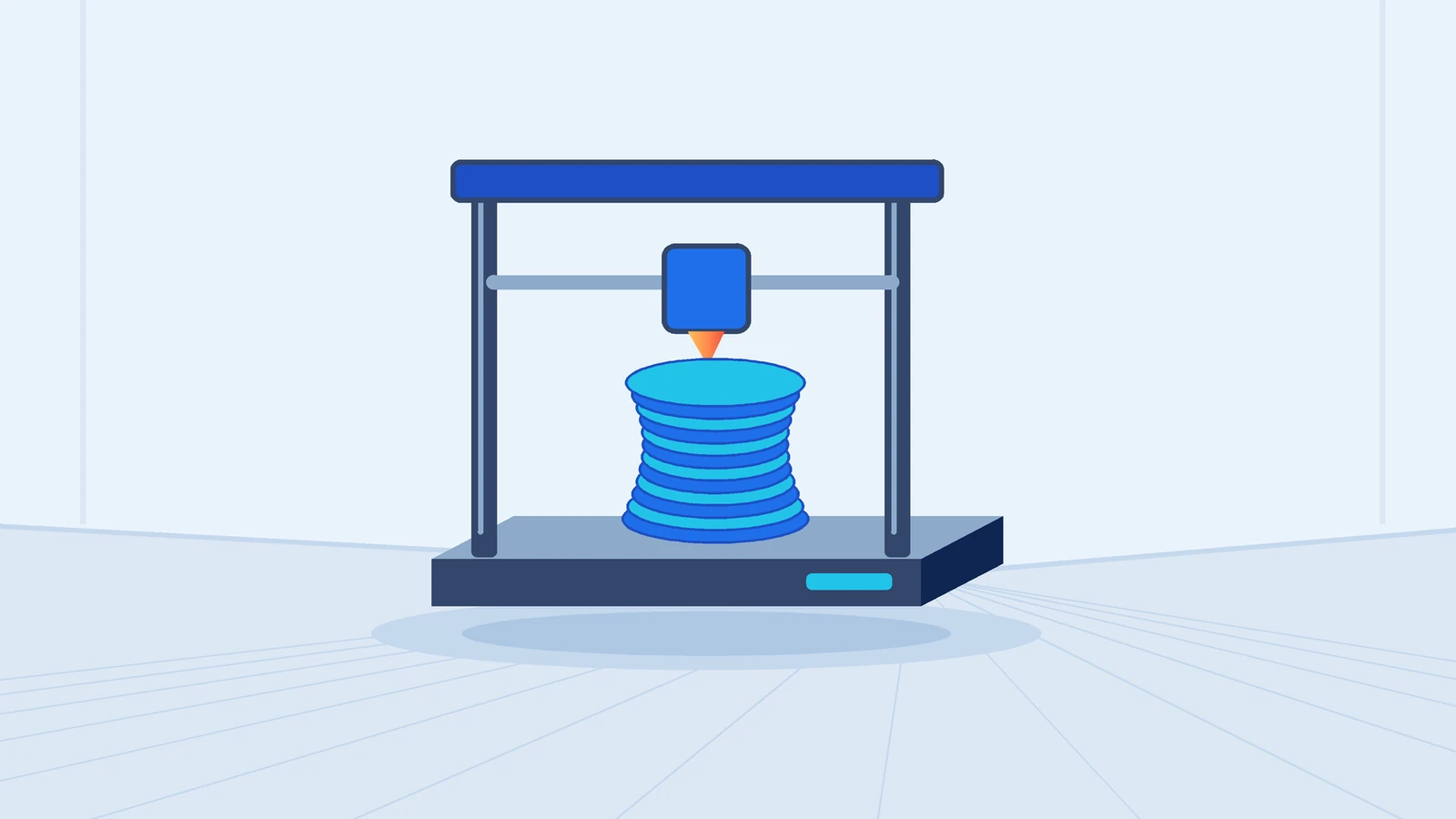
Yes, in the lab, and this is the second strong case. Researchers at the University of Cambridge put a cheap camera next to the nozzle of ordinary nozzle printers. Their system, called CAXTON, learned what a good line of plastic looks like and what a bad one looks like.
The trick was in the training data. Instead of people labelling photos, the printers labelled themselves. They printed with deliberately wrong settings and saved each image together with the exact setting. That gave a dataset of “1.2 million images from 192 different parts.”
The network watches four settings: how much plastic flows, how fast the nozzle moves, how high the nozzle sits, and how hot it is. For each one it says: too low, good, or too high. On test images it was right 84.3 percent of the time overall. That is about five times out of six (our rounding). It did worst on temperature, at 78.3 percent.
The best part is the fix. When the system sees too much plastic, it turns the flow down while the print continues. In one test, the team printed two chess rooks with the same bad settings. The one without correction “dramatically failed.” The corrected one was completed. It even worked on a different printer, and with ketchup and mayonnaise.

The paper is honest about its limits. Corrected prints “do not match a perfectly printed part,” and now and then it corrects something that was fine. Big failures such as cracking, warping, or a part coming loose from the bed are “not entirely solved.” And it was trained only on one common plastic.
What about whole print farms?
A print farm is a room full of printers running at once. Nobody can watch them all. The Cambridge paper names exactly that problem: errors get missed “if multiple printers are in operation simultaneously.”
Its senior author, Sebastian Pattinson, describes the goal: an algorithm “that can look at all of the different printers that you’re operating, constantly monitoring and making changes as needed.” The team built its data with a small fleet of eight printers.
What we could not find is independent, public data on how well such systems work in large commercial farms. So for production, the honest label is: promising in research, unproven at scale in public data.
Who owns an AI-designed part?
This is still being sorted out, and it differs by country. In the US, the Copyright Office concluded in January 2025 that “Copyright does not extend to purely AI-generated material.” It also said that prompts alone “do not provide sufficient human control” to make you the author.
For inventions, the US patent office changed its guidance in November 2025. It now applies “the same legal standard” to every invention, whether AI helped or not. And only humans can be named as inventors. What that means for a specific part depends on what the person actually contributed. This is not legal advice; if money depends on it, ask a patent attorney.
What we know, and what we don’t
What is documented: generative design at NASA, with a published human-versus-AI comparison and real tests. Camera-based error correction on nozzle printers, in a peer-reviewed paper. Text-to-CAD research with honest error reports.
What is claimed: big programme-wide gains, stated by NASA about its own process, and the hope, voiced by the Cambridge team, that one system could watch a whole room of printers.
What we don’t know: how often text-to-CAD parts are right on the first try in real work, how well camera systems hold up across large farms, and how courts will treat AI-assisted designs.
What would tell us more: independent benchmarks with real, load-bearing parts, and public failure data from print farms that use AI monitoring.
So, where does AI really help?
Back to our workshop master. She is great at two things: suggesting a lighter shape, and noticing when the printer starts to go wrong. She is weak at one: knowing whether your part will hold in the real world. She has never held it.
That is the core of it: AI makes the path from idea to printed part faster, but it does not replace the test at the end. Use it to explore shapes and to watch your printer. Then measure, test, and decide yourself.
Further reading on ThorstenMeyerAI.com
- How AI Actually Works: Data In, Probabilities Out, and Why That Explains the Errors
- Why AI Makes Things Up With a Straight Face, and How You Can Catch It
- How Large Language Models Work: From Your Prompt to the Answer, and When to Trust It
- What Is Inside an AI Chip? Dies, HBM Stacks and Packaging, Explained in 3D
- Robots in the Factory
Sources
- NASA (K. B. Hille), “NASA Turns to AI to Design Mission Hardware,” NASA Goddard, February 9, 2023
- NASA Goddard Engineering and Technology Directorate, “Generative Design” (Evolved Structures capability page)
- R. McClelland, “Generative Design and Digital Manufacturing: Using AI and robots to build lightweight instruments,” SPIE 2022 (NASA Technical Reports Server)
- NASA Technical Standards System, NASA-STD-6030, “Additive Manufacturing Requirements for Spaceflight Systems”
- NASA Engineering and Safety Center, “NASA Additive Manufacturing Standards Support Human Spaceflight”
- NIST, “Additive Manufacturing Technologies”
- D. A. J. Brion, S. W. Pattinson, “Generalisable 3D printing error detection and correction via multi-head neural networks,” Nature Communications 13, 4654 (2022)
- University of Cambridge, “Algorithm learns to correct 3D printing errors for different parts, materials and systems,” August 16, 2022
- M. S. Khan et al., “Text2CAD: Generating Sequential CAD Models from Beginner-to-Expert Level Text Prompts,” NeurIPS 2024, arXiv:2409.17106
- K. Alrashedy et al., “Generating CAD Code with Vision-Language Models for 3D Designs,” ICLR 2025, arXiv:2410.05340
- U.S. Copyright Office, “Copyright and Artificial Intelligence, Part 2: Copyrightability,” January 2025
- USPTO, “Revised inventorship guidance for AI-assisted inventions,” November 26, 2025
Disclosure: Researched and drafted with AI assistance, including Anthropic’s Claude. The narration in the video is an AI voice clone of Thorsten Meyer. Statements by NASA and by research teams about their own work are reported as theirs. Our own text and graphics contain no affiliate links; offer and product boxes added by the site may contain Amazon affiliate links. Our graphics and 3D models are our own and schematic where marked; they show no real people and no logos. Boxes added by the site may show product photos or people. Not investment, legal or tax advice.