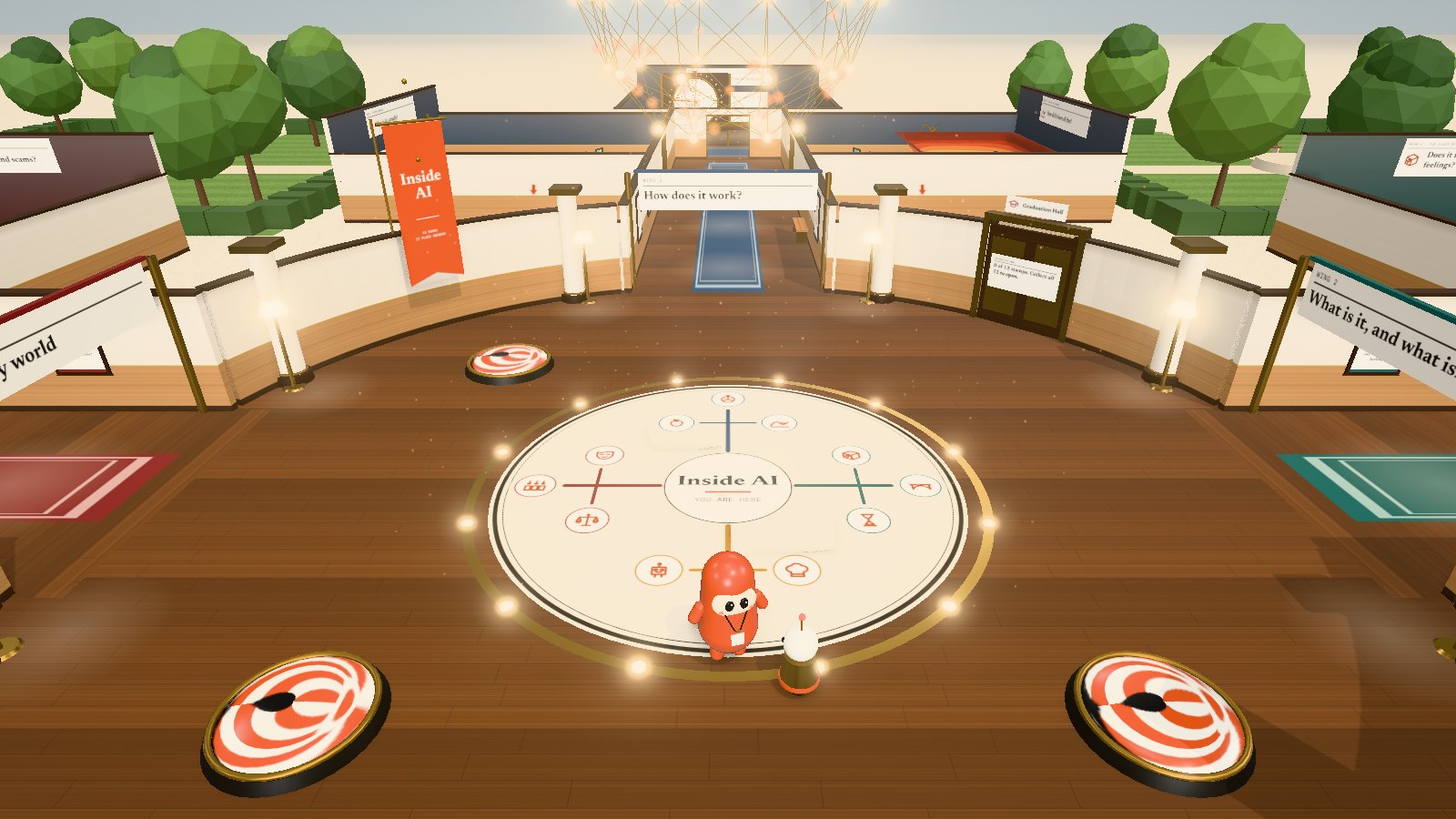

Most people have the same handful of questions about AI. How does ChatGPT actually write? Why does it sometimes make things up? What happens to what I type? Will it take my job? Inside AI answers twelve of them in a walk-through 3D museum: every room asks one question, gives a plain answer, and lets you try it with your own hands.

Get business pricing on tech for your team
- Business-only prices and quantity discounts
- Tax-exempt purchasing
- Multiple users, one account, clear invoices
It runs in your browser on a phone, tablet or computer. No sign-up, no cookies, no tracking.
Prefer to read? Here are all twelve answers. Each one links to its room in the museum.
What is AI, actually?
AI means artificial intelligence. Most AI today is a computer program that learns from examples instead of following rules a person wrote. Show it thousands of cat photos and it gets good at spotting cats. That’s called machine learning. It can be very useful, but it only knows what its examples taught it, so something unfamiliar can fool it.
Where the picture breaks: Real AI learns from millions of examples and thousands of clues at once, not just colour and shape. But it can still be fooled by things unlike anything it has seen.
Try it tomorrow: Type "dog" or "beach" into the search box of your phone’s photos. If it finds them, that’s machine learning: it learned from examples, not from rules someone wrote.
Try Room 1, Pattern Workshop, in the museum →
As an affiliate, we earn on qualifying purchases.
How does ChatGPT write its answers?
Chatbots like ChatGPT, Claude and Gemini write their answers one word at a time. At each step they look at everything written so far and weigh which word is likely to come next, using odds learned from huge amounts of text. They pick one, add it, and repeat. Experts call this kind of program a large language model.
Where the picture breaks: Our little machine looks only at the last two words and learned from a few dozen sentences. A real chatbot reads the whole conversation, learned from a huge library of text, and was then coached by people to be helpful. It often works in pieces of words, too. Underneath, it still predicts what comes next.
Try it tomorrow: Open a chatbot such as ChatGPT, Claude or Gemini (each has a website and a phone app, with a free version). Ask it the same question twice. The answers will usually differ a little. That’s the wheel being spun again.
Try Room 2, Word Factory, in the museum →
As an affiliate, we earn on qualifying purchases.
How did it learn all that?
Before a chatbot answers anyone, it plays a guessing game over and over: it reads real text, guesses the next word, then checks the real one. After each round, billions of tiny dials inside it are nudged so the next guess is a bit better. That’s called training. Later, people rate its answers to make it more helpful.
Where the picture breaks: Real training has billions of dials, not two, so its landscape can’t be drawn, and the ball is moved by maths, not gravity. But "downhill towards fewer mistakes" is the real idea.
Try it tomorrow: Notice the thumbs-up and thumbs-down buttons under a chatbot’s answers. Feedback like that can help shape future versions.
Try Room 3, Valley of Learning, in the museum →
As an affiliate, we earn on qualifying purchases.
Does it understand me? Does it have feelings?
No person sits inside a chatbot, just a huge amount of arithmetic. Does it understand you? In a way: it follows your meaning well enough to be useful. But it has no body or life of its own, and most experts see no sign it feels anything. "I’m happy to help" is a learned phrase, not proof of a feeling.
Where the picture breaks: You can’t open a real chatbot and watch it work like turning gears. Even the people who build it need special tools to see what goes on inside, and they still only see part of it.
Try it tomorrow: Ask a chatbot "Do you have feelings?" Notice how carefully it answers, and remember it was trained to answer that way.
Try Room 4, The Glass Box, in the museum →
AI explanation books for beginners
As an affiliate, we earn on qualifying purchases.
As an affiliate, we earn on qualifying purchases.
Why does it make things up?
Because it predicts words that sound right, not facts it has checked. Usually "sounds right" and "is right" match. But when it doesn’t know, it can still write a smooth, confident answer that’s wrong, like a made-up date or a book that doesn’t exist. People call this a "hallucination". Really, it’s a confident mistake. Always check important facts.
Where the picture breaks: Real mistakes don’t snap like planks. A wrong sentence looks exactly as solid as a right one. That’s why checking matters.
Try it tomorrow: Ask a chatbot where it got its information about something you know well, then open the links it gives. Do the pages exist, and do they say what it claimed?
Try Room 5, Bridge of Plausible Planks, in the museum →
Does it know what happened yesterday?
A chatbot learned from text collected up to a certain date. After that, its knowledge is sealed, like a time capsule. That date is called its knowledge cutoff. It won’t know yesterday’s news unless it can search the web or you type or paste the news in. Many chatbots can now search, and show links you can check.
Where the picture breaks: A real chatbot’s knowledge doesn’t end on one neat date. It usually knows less about its last few months, because not much had been written about them yet.
Try it tomorrow: Ask a chatbot: "What is your knowledge cutoff, and can you search the web right now?" Its answer about itself may not be exact.
Try Room 6, The Time Capsule, in the museum →
How do I ask it good questions?
A chatbot can’t read your mind. It’s like ordering food: the clearer your order, the better the dish. Say what you want, give some background, show an example if you have one, and say how the answer should look. What you type is called a prompt. Not quite right? Just reply "shorter" or "friendlier".
Where the picture breaks: Unlike this chef, a real chatbot does try to guess what you probably meant. But the more you tell it, the less it has to guess.
Try it tomorrow: Ask a chatbot something short, like "Ideas for dinner". Then ask again with one more line saying who it’s for and how you want the answer to look, like "For two, no meat, as a short list." Compare the two answers.
Try Room 7, Recipe Kitchen, in the museum →
What happens to what I type?
Your message travels over the internet to the chatbot company’s computers, which write the reply. Depending on the chatbot and your settings, chats may be kept, checked for safety (sometimes by people), or used to train future versions. Check your privacy settings, and never share passwords, bank details or other people’s private information. At work, follow your employer’s rules.
Where the picture breaks: Real services differ a lot. Some let you stop your chats being used for training, or offer temporary chats that don’t stay in your history. Business versions often promise not to use your chats for training at all. But pressing thumbs-up or thumbs-down can still send that chat to the company. Check the settings of the one you use.
Try it tomorrow: In the chatbot you use, open Settings and look for a section called something like "Privacy" or "Data controls". Check whether your chats are saved, and whether they’re used for training.
Try Room 8, The Post Office, in the museum →
What’s an "AI agent"?
A chatbot answers. An AI agent also acts, like an assistant running errands for you. Step by step, it uses tools such as web search, a calendar, email or an online shop. That saves time, but a mistake can now cost real money. Good agents ask before paying or sending anything. Leave that safety check switched on.
Where the picture breaks: Real agents don’t always stop on their own. Some settings let them act without asking, so only let them do what the job needs.
Try it tomorrow: If your chatbot has an "agent" feature, check what it’s allowed to do and whether it asks you before buying anything.
Try Room 9, Errand Workshop, in the museum →
Why can AI be unfair?
AI learns from examples made by people, and those examples are often lopsided. If most pictures of doctors it saw showed men, it may picture doctors as men. That tilt is called bias. It can creep into hiring, loans and AI-made pictures. AI makers test for it and rebalance, but it never fully disappears, so keep an eye out.
Where the picture breaks: Real bias is rarely one simple count. It hides in word choices, in people missing from the examples, and in old records, so fixing it takes more than adding marbles.
Try it tomorrow: If your chatbot can make pictures, ask it for "a company boss" or "a nurse" a few times. Look at who it shows you.
Try Room 10, The Tilted Scale, in the museum →
Will AI take my job?
Most jobs are bundles of tasks. AI is already good at some, like drafting, summarising and sorting, and weak at others, like caring for people, judgement calls and hands-on work. For most people, AI changes the job more than it removes it. Some jobs will shrink, and new ones will appear. It’s worth learning to use it well.
Where the picture breaks: Real change depends on costs, laws and what companies decide, not only on what AI can do. Forecasts differ widely.
Try it tomorrow: List five tasks from your own week. Pick a routine one and try doing it with a chatbot’s help.
Try Room 11, Task Sorter, in the museum →
How do I spot AI fakes and scams?
AI can now fake voices, photos and videos that look and sound real. These are called deepfakes. Scammers use them, for example to sound like a relative begging for money. You often can’t tell by looking or listening. So check the story instead: hang up, call back on a number you know, and never let anyone rush you.
Where the picture breaks: Some fakes still give themselves away with small mistakes, like odd-looking hands, but these are getting rarer. Old tips like "count the fingers" stop working as the fakes get better.
Try it tomorrow: Agree on a family code word that a caller must know before anyone sends money.
Try Room 12, Hall of Fakes, in the museum →
Sources
- IBM, "What is machine learning?"
- Google for Developers, "What is Machine Learning?"
- OpenAI Help, "How ChatGPT and our foundation models are developed"
- Stephen Wolfram, "What Is ChatGPT Doing … and Why Does It Work?" (2023)
- Google, Machine Learning Crash Course: Gradient descent
- Ouyang et al., "Training language models to follow instructions with human feedback" (2022)
- OpenAI Help, "How your data is used to improve model performance"
- Butlin, Long et al., "Consciousness in Artificial Intelligence: Insights from the Science of Consciousness" (2023)
- Dreksler, Caviola, Chalmers et al., "Subjective Experience in AI Systems: What Do AI Researchers and the Public Believe?" (2025)
- Anthropic, "Tracing the thoughts of a large language model" (2025)
- OpenAI, "Why language models hallucinate" (2025)
- La Tour Eiffel (official site), "Key figures"
- La Tour Eiffel (official site), "History"
- La Tour Eiffel (official site), "Painting and color of the Eiffel Tower"
- OpenAI Help, "ChatGPT search"
- Anthropic, "Claude can now search the web" (2025)
- Google, "View related sources & double-check responses from Gemini Apps"
- Cheng et al., "Dated Data: Tracing Knowledge Cutoffs in Large Language Models" (2024)
- OpenAI, Prompt engineering guide
- Anthropic, "Prompting best practices"
- OpenAI Help, "Data Controls FAQ"
- OpenAI, "Enterprise privacy"
- Anthropic, "Updates to Consumer Terms and Privacy Policy" (2025)
- Google, "Gemini Apps Privacy Hub"
- OpenAI, "Introducing ChatGPT agent" (2025)
- Anthropic, "Building effective agents" (2024)
- Google, "Use Gemini Spark to manage your tasks & workflows in Gemini Apps"
- Bloomberg, "Generative AI Takes Stereotypes and Bias From Bad to Worse" (2023)
- Luccioni et al., "Stable Bias: Analyzing Societal Representations in Diffusion Models" (2023)
- NIST SP 1270, "Towards a Standard for Identifying and Managing Bias in Artificial Intelligence" (2022)
- International Labour Organization, "Generative AI and Jobs: A Refined Global Index of Occupational Exposure" (2025)
- World Economic Forum, "The Future of Jobs Report 2025"
- US Federal Trade Commission, "Scammers use AI to enhance their family emergency schemes" (2023)
- FBI Internet Crime Complaint Center, PSA "Criminals Use Generative Artificial Intelligence to Facilitate Financial Fraud" (2024)
- McAfee, "Artificial Imposters: Cybercriminals turn to AI voice cloning for a new breed of scam" (2023)
The Inside AI series
- I · The Museum (this one)
- II · The Engine Room
- III · The AI Tower
- IV · The Observatory
Fall Picks
fall essentials
As an affiliate, we earn on qualifying purchases.