
By Thorsten Meyer

Get business pricing on tech for your team
- Business-only prices and quantity discounts
- Tax-exempt purchasing
- Multiple users, one account, clear invoices
Ask most people what happens when you quantize a language model and you get a reasonable-sounding wrong answer: it gets a bit dumber, roughly in proportion to how much you shrink it. Half the size, half the quality. A smooth trade.
That is not how it works, and the gap between the intuition and the reality is where a lot of local-inference disappointment lives. Quantization loss is not a gentle linear slope. It is flat, then a cliff. From 16 bits down to 4, you give up almost nothing measurable. Below 4, uniform quantization falls off hard — and, crucially, the model does not fail in the way you would expect. It keeps sounding fluent long after it has stopped being able to reason. That last property is the one that costs people production incidents.
This piece is about the shape of that curve and, more importantly, about what is actually being lost on the way down — because “quality” is not one thing, and it does not degrade all at once.
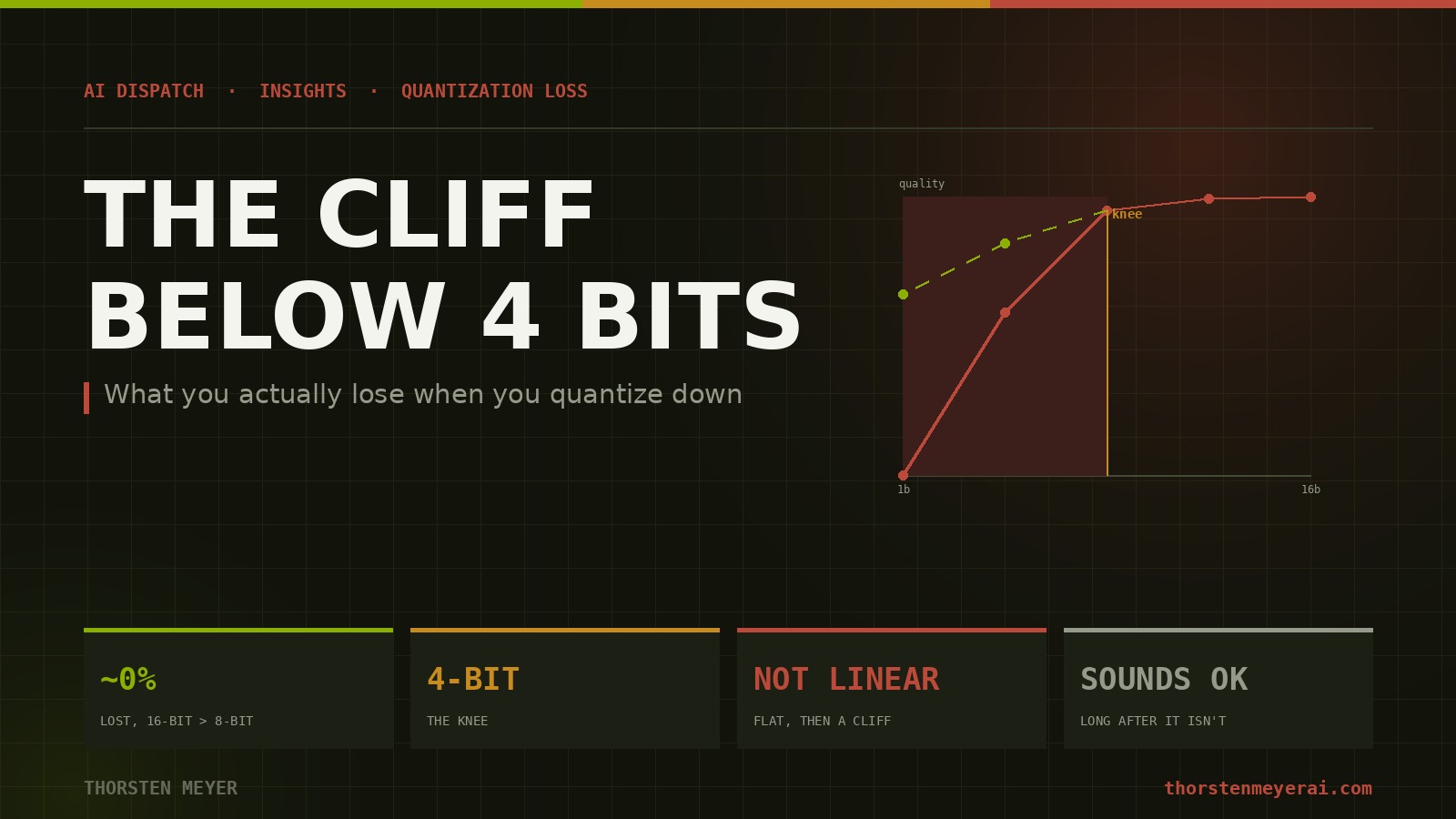
Quantization loss isn’t linear. From 16 bits down to 4, you give up almost nothing measurable. Below 4, uniform quantization falls off a cliff — and where you land depends entirely on whether the build was calibrated or converted blind.
Retained quality against bit-depth. The line is flat across the top, then knees hard at 4-bit. Dynamic mixed-precision bends the cliff into a slope; uniform quantization does not.
It isn’t the model forgetting facts. Each weight gets mapped to the nearest available level, and the gap between the true value and the stored one is error that accumulates through every layer.
The same quantization hits different capabilities at different rates. A build that still chats fluently at 3-bit may have quietly lost its ability to reason or emit valid structured output.
The damage isn’t spread across all weights. A small set carries most of it — which is precisely why calibrated, mixed-precision builds recover so much by protecting just those.
Below the safe band, loss stops being a percentage and starts being behaviour you can watch happen.
The trap isn’t the loss on the benchmark. It’s the loss the benchmark doesn’t capture.
so the model still sounds fine long after it stops being fine.
The curve is flat, then it isn't
Start with the shape, because it governs every decision downstream.
Plot retained quality against bit-depth and the line sits almost pinned to the top across the high-precision range. Eight-bit is effectively indistinguishable from the 16-bit original on any measure that matters. Six-bit — where a 235-billion-parameter model comfortably runs on a 512GB machine — gives up so little it is not worth worrying about. Four-bit, the universal Q4_K_M default, introduces a small, real, but usually acceptable loss. This is the near-lossless band, and it is wide. Most of the useful compression happens here, for free.
Then you hit the knee at 4-bit, and below it the character of the curve changes completely. Uniform quantization — the same bit-depth applied to every weight — drops off a cliff. Two-bit and one-bit uniform builds are not "somewhat worse"; they are frequently broken. The reason this surprises people is that the size keeps falling smoothly and linearly all the way down, so the intuition that quality tracks size feels safe right up until it catastrophically doesn't.
The one thing that bends the cliff back into a survivable slope is dynamic, mixed-precision quantization, and the numbers make the case starkly. Unsloth's calibrated dynamic builds of Kimi K3 hold roughly 90% top-1 accuracy at 2-bit and about 78.9% at 1-bit — where a naive uniform build at the same bit-depth would be somewhere near unusable. Same bit budget, wildly different outcome. The difference is entirely in which weights got the coarse treatment, which is the whole story of this article.
As an affiliate, we earn on qualifying purchases.
What "loss" actually is
Before we can talk about where the loss concentrates, it helps to be precise about the mechanism, because "the model gets worse" is not a mechanism.
Quantization does not remove weights or erase facts. It stores each weight at coarser precision. A 16-bit weight can take one of 65,536 values; a 4-bit weight, one of 16. Every weight is therefore rounded to the nearest available rung, and the small gap between its true value and the stored value is quantization error. On its own, one rounded weight is nothing. But a transformer runs its signal through dozens of layers, and the error accumulates — each layer's slightly-off output becomes the next layer's input. Loss is the compounding of millions of tiny rounding errors through a deep stack.
Quantization is the lever that turns a model needing a datacenter into one needing a workstation. In 2026 it stopped being a simple after-the-fact shrink — and Kimi K3 is the clearest example of why.
Quantization stores the same weights at coarser precision. Fewer bits per weight means less memory and bandwidth, and slightly less accuracy. The size scales almost linearly with bit-depth.
bytes ≈ parameters × bits ÷ 8. K3 figures are Unsloth-reported for the 2.8T model."Quantized" isn't one thing. The format decides which hardware, which loader, and which trade-offs you get.
For years, labs shipped at FP16 and the community shrank the model afterward. Kimi K3 inverts that — and it changes the advice.
- Precision reduced after the model is trained
- Exploits the slack between FP16 and 4-bit
- "Just download a smaller quant" — the old default
- K3 ships natively at MXFP4, MXFP8 activations
- The compression was spent before release
- Can't be squeezed further uniformly — the slack is gone
If K3 can't be squeezed uniformly, how does a 594GB 1-bit build exist? Mixed precision — most weights at 1–2 bits, the load-bearing layers upcast to 8-bit, the whole thing measured against a lossless reference.
Both distort the simple bytes-equals-params-times-bits math, and both bite hardest on the frontier models people most want to run.
The abstractions resolve into a hard boundary. Drawn on a 512GB M3 Ultra:
Choosing a quant is choosing a point on a curve — steep at the ends, flat in the middle.
Now the frontier labs are spending the compression before you download it.
That compounding shows up in three measurable ways, and the order in which they move matters:
Perplexity is the earliest and most sensitive signal — the model's statistical uncertainty about the next token. It starts rising before anything is visibly wrong, which is why it is the measure quantization authors watch most closely.
Top-1 accuracy — how often the model's first-choice token matches a reference — is the headline number printed on quant cards. It is also, importantly, one of the last things to move. A build can lose real capability while its top-1 barely budges, because top-1 rewards getting the single most likely token right and says nothing about the collapse of everything behind it.
The practical warning falls straight out of this: the number most people quote to reassure themselves a quant is safe is the number least sensitive to the damage. A reassuring top-1 is not a clean bill of health.
16-bit to 8-bit AI model converter
As an affiliate, we earn on qualifying purchases.
As an affiliate, we earn on qualifying purchases.
The loss is not spread evenly — and this is the important part
Here is the fact that separates people who have actually run low-bit models from people who have only read the size charts: the same quantization degrades different capabilities at wildly different rates.
A build that still chats fluently, writes a passable email, and answers trivia at 3-bit may have quietly lost its ability to do arithmetic, hold a chain of reasoning together, or emit valid JSON. The fluency is intact; the load-bearing cognition is gone. If your evaluation is "does it still talk like the model," you will conclude the quant is fine and ship something that fails the moment it has to actually think.
The rough order of fragility is consistent across models, even though the exact bit-depth where each one breaks is not:
Math and reasoning break first. Multi-step logic depends on precise intermediate values; coarse rounding perturbs them just enough to derail a chain that needs every link. This is the first capability to go and the one whose loss is easiest to miss if you are not testing for it directly.
Code and structured output are close behind. Generating valid syntax, matching brackets, closing a JSON object, producing a well-formed tool call — these are unforgiving tasks where one wrong token invalidates the whole output. Quantization that a human reader would barely notice can push a model below the threshold of reliable structured generation.
Long-context recall degrades in the middle. The ability to accurately use information from far back in a long input leans on attention precision, and attention error compounds across the sequence, so the longer the context the more the loss shows.
Instruction-following slips next. Subtle adherence — honoring constraints, staying in format, respecting a negative instruction — erodes before gross fluency does.
Casual chat and fluency are the most robust. Producing plausible, grammatical, on-topic prose is what survives furthest down, which is exactly why it is such a treacherous proxy for quality. The model sounds fine long after it stopped being fine.
As an affiliate, we earn on qualifying purchases.
Where the error concentrates — and why calibration rescues it
If loss were spread uniformly across all billions of weights, there would be nothing to do about it below 4-bit. The reason dynamic quantization works at all is that the damage is concentrated in a small minority of the network, and if you protect that minority, you recover most of the quality at a fraction of the memory cost.
Four places carry most of the weight, in both senses:
Outlier weights. A small number of large-magnitude weights matter far more than their count suggests. Coarse quantization clips or distorts them worst, and the model feels their loss most. Identifying and preserving these is the single highest-leverage move in low-bit quantization.
Attention layers. The machinery that decides what the model attends to. Errors here don't stay local — they propagate across the whole sequence and compound at long context.
The first and last layers. Input embeddings and the output projection sit at the entry and exit of the signal path. Corrupt the embedding and you've degraded everything the model reads; corrupt the output projection and you've degraded every token it picks.
The MoE router. In a mixture-of-experts model — which nearly every 2026 frontier open model is — the router chooses which experts fire for each token. Quantize it too aggressively and it starts choosing wrong, so the model routes tokens to the wrong specialists. This is the classic failure of blind community quantizations of large MoE models: they were converted with nothing capable of running the model to check the result, the router broke, and quality fell off a cliff that a naive top-1 measurement could easily miss.
This is the entire case for dynamic, mixed-precision quantization, stated as an engineering principle: drop the bulk of the weights to 1 or 2 bits, but upcast these load-bearing parts back to 8-bit, and calibrate the whole thing against a lossless reference so the damage is measured rather than assumed. Protect the few weights that carry the loss and the cliff becomes a slope. That is why a calibrated 1-bit K3 is usable and a blind one is scrap.
AI model quantization calibration software
As an affiliate, we earn on qualifying purchases.
As an affiliate, we earn on qualifying purchases.
What "off a cliff" actually looks like
Below the safe band, loss stops being a percentage on a chart and starts being behaviour you can watch happen in real time. If you push a model too far down, these are the symptoms, roughly in order of how obvious they are:
Repetition loops — the model gets stuck emitting the same phrase or token, a hallmark of over-quantized, degenerate sampling. Format collapse — malformed JSON, unbalanced brackets, broken tool calls, dropped closing tags; structured output is the first practical casualty because it is so unforgiving. Confident errors — hallucination rises and, worse, the model asserts wrong answers in exactly the same fluent register it uses for right ones, so nothing in the tone flags the failure. And in mixture-of-experts models, routing breakage — the wrong experts fire, and output degrades unpredictably in ways a single aggregate score can entirely fail to capture.
The common thread is that the failures are qualitative and often invisible to aggregate metrics. This is why "the benchmark number barely moved" is cold comfort at low bit-depth.
The loss you measure versus the loss you ship
Which brings us to the trap that catches careful people, not just careless ones.
The loss that shows up on a quant card — a perplexity delta, a top-1 percentage — is the loss you can see. At 4-to-6-bit it barely moves, so the build looks safe on paper, and for many workloads it genuinely is. But the loss you actually ship is a different and larger set: lost nuance, weaker recall of rare knowledge, degraded coherence over long contexts, more frequent edge-case failures, subtler misunderstandings of intent. None of that is captured by a single aggregate number, and some of it is invisible until it shows up as a production incident on exactly the task you cared about.
The correct discipline follows directly. Test at your own task, not on someone else's benchmark. The right quantization is not the one with the highest score on a public leaderboard; it is the lowest bit-depth that still passes your work — your reasoning chains, your JSON schemas, your long-document retrieval, your tone. For most models on most hardware, that lands at 4-bit, sometimes 5 or 6 for quality-sensitive work, and only below 4 with a calibrated dynamic build and eyes open. The bit-depth is a hypothesis. Your own evaluation is the test.
The one-line version
From 16 bits down to 4, you lose almost nothing. Below 4, you lose reasoning before you lose fluency — so the model keeps sounding fine long after it has stopped being fine. The number on the quant card is the loss you can see; the loss that matters is the one it doesn't measure. Pick the lowest bit-depth that still passes your own work, and never trust a reassuring top-1 to tell you the rest of the model survived.
Sources: Unsloth Kimi K3 documentation and dynamic-GGUF release (29 July 2026) for the labelled sub-4-bit top-1 figures; Moonshot AI technical descriptions for K3's MoE and native-precision architecture; general quantization literature for the curve shape, error-concentration behaviour, and per-capability fragility ordering. The accuracy-versus-bit-depth curve is directional and well-established in shape; exact sub-4-bit values for uniform quantization and the precise breakpoint for each capability vary by model and are described directionally. Point-in-time as of 3 August 2026. Not hardware-purchasing advice.
Fall Picks
fall essentials
As an affiliate, we earn on qualifying purchases.