Thorsten Meyer AI Foundations · 04 / 08

Get business pricing on tech for your team
- Business-only prices and quantity discounts
- Tax-exempt purchasing
- Multiple users, one account, clear invoices
Why prompting is spec-writing — and the four levers that actually matter
Here are two prompts for the same task.
Prompt A: “You are a world-class expert copywriter with 20 years of experience. Take a deep breath and think step by step. I’ll tip you $200 if you do this well. Write me a newsletter intro about our new product launch.”
Prompt B: “Write a three-sentence newsletter intro announcing our new product, the X widget. Tone: confident but not breathless. Audience: our existing customers, who already know us. End with a clear call to click the launch blog post.
Example of the tone we want: [paste two-sentence excerpt from a previous intro].”
Which one wins? Prompt B, almost every time. Not because Prompt A is wrong exactly — you’ll still get output. But because Prompt A is vague where it needs to be specific, decorative where it should be structural, and borrowing its confidence from folklore instead of specification.
The useful mental model for prompting is not incantation. It’s specification. You are writing a brief. The model is the contractor. Every unclear sentence in your brief becomes a guess in the output. Every unstated constraint becomes an assumption the model has to make. The patterns that actually move quality are the same patterns that would help a new hire do the task well.
There are four of them.
As an affiliate, we earn on qualifying purchases.
The four levers
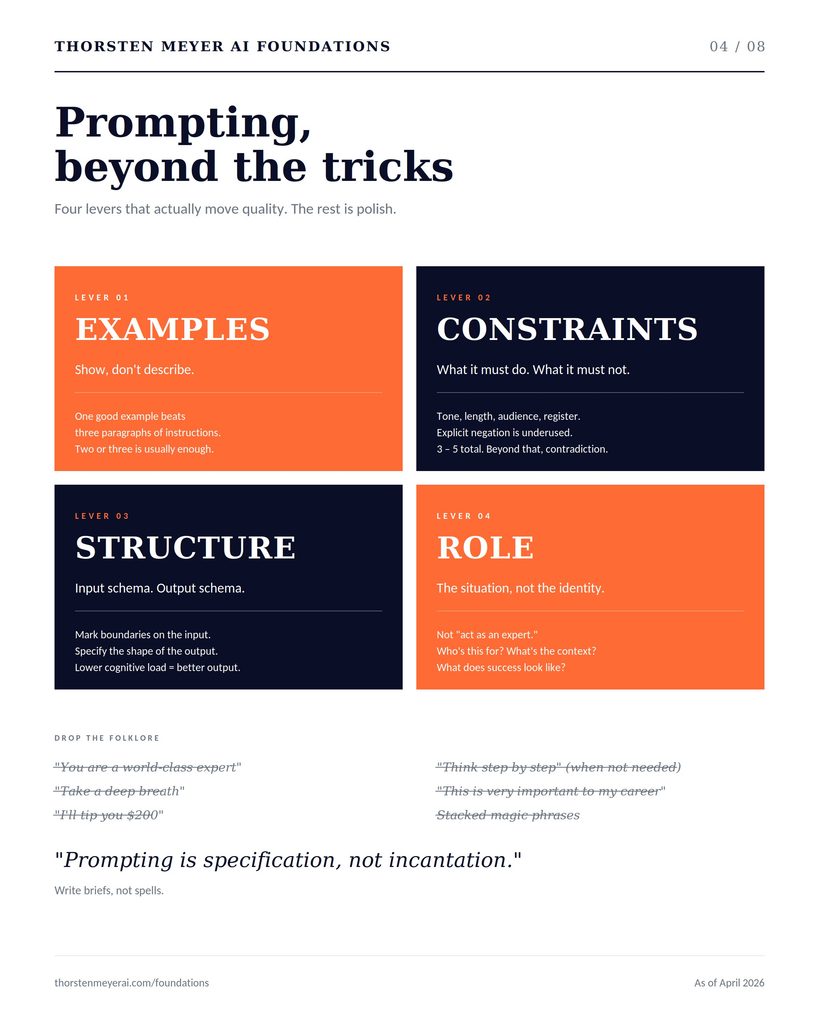
Examples. Show, don’t describe. One well-chosen input-output pair will out-perform three paragraphs of instructions about the same thing. This is the single most under-used tool in prompting.
Constraints. What it must do. What it must not. The size. The shape. The style. Constraints convert ambiguity into specification.
Structure. The input schema (what you’re giving the model) and the output schema (what you want back). Structure removes the ambiguity about format that otherwise produces “close but not quite” output.
Role. The frame the model operates in — not “act as a world-class expert” but genuine situational framing. Who is this for? What’s the context? What does success look like?
These four explain the gap between most prompts that work and most prompts that don’t. Master them and the rest is polish.
As an affiliate, we earn on qualifying purchases.
Lever 1: Examples
The surest way to get something specific is to show an example of it.
“Write me a professional email” is hopeless — professional covers everything from a legal threat to a birthday note. “Write me an email in this style: [paste an email you’ve written]” is a specification the model can execute against.
Two or three examples is usually the sweet spot. One example runs the risk of being over-fit (the model latches on to incidental features of your one example instead of the pattern). Four or more adds tokens without usually adding accuracy. The examples don’t have to be perfect — they have to be representative of what you want.
Where this matters most: any task where the “right” output has a specific shape that’s hard to describe in words. Tone. Format. Code conventions. Data schemas. Labels from a controlled vocabulary. In all of these, one good example beats a paragraph of instructions, and two beat three paragraphs.
The phrase to remember: show, don’t describe.
As an affiliate, we earn on qualifying purchases.
Lever 2: Constraints
Constraints turn an open-ended request into a specified one.
Soft constraints shape the output: tone, length, audience, register. “Three sentences.” “Formal but warm.” “For readers who know the topic.” Each constraint trims the space of acceptable answers and pushes the model toward the region you actually want.
Hard constraints rule things out: what not to include, what format to avoid, what claims the model isn’t allowed to make. “Do not use the word ‘synergy.'” “Do not invent facts — if the information isn’t in the source, say so.” “No bullet points.” These are where prompts go from suggestive to contractual.
The pattern most people underuse: explicit negation. Telling a model what not to do is often more effective than telling it what to do, especially for behaviors you want to suppress. “Don’t hedge — give me a direct answer” produces a different output than “Be confident.” The second asks for a trait; the first rules out the specific failure mode.
A good prompt usually has three to five constraints, no more. Beyond that, you start to contradict yourself without noticing, and the model picks arbitrarily among the contradictions.
structured prompt templates for AI
As an affiliate, we earn on qualifying purchases.
As an affiliate, we earn on qualifying purchases.
Lever 3: Structure
Structure is the schema for what goes in and what comes out.
On the input side: if you’re passing in a document, a dataset, or multiple examples, mark the boundaries. Put the source material between <source> tags or under a heading. Separate the instructions from the content. Models are trained to respect these boundaries, and ambiguity about where the instruction ends and the data begins is a reliable source of confusion.
On the output side: specify the format. Not “give me a summary” but “give me a summary in this format: one-sentence headline, then three bullets of key points, then a one-line recommendation.” Not “analyze this” but “analyze this and return a JSON object with fields rating (1-5), reasons (array of strings), and confidence (low/medium/high).”
Structured output serves two purposes at once. It makes the output reliable — you know what shape it’ll arrive in — and it makes the model’s job easier. A model asked to produce free-form “analysis” has to decide how to organize the analysis on top of producing it. A model asked to fill in three named fields just fills in three fields. The cognitive load is lower, and the output quality is usually higher.
A useful habit: for any prompt you plan to reuse, specify the output format explicitly. For one-off exploratory prompts, don’t bother. The cost-benefit depends on how often you’ll run it.
Lever 4: Role
Role is the most abused of the four levers. The “you are a world-class expert” opening is folklore — it was useful briefly on early models that needed the nudge, and it became a ritual that outlived its usefulness.
What actually matters is situational framing: the context the model should operate in. Not “you are an expert.” Rather: “You are reviewing this code for a junior developer. They need the feedback to learn, not just to ship. Identify the two most important issues and explain why they matter. Tone: direct but encouraging.”
That framing tells the model: who the audience is, what the purpose is, what success looks like, and what register to use. None of it is about declaring the model’s identity. All of it is about specifying the situation.
The difference is practical. A prompt that says “you are a senior doctor” and then asks a medical question gets you output that reads like a senior doctor is performing. A prompt that says “You are helping a patient decide whether to seek emergency care. They’re already anxious. Be clear and specific about what warrants emergency attention, and what can wait for a scheduled visit” gets you output that actually helps.
Use role-as-identity sparingly. Use role-as-situation constantly.
Chain-of-thought, demystified
“Think step by step” has been promoted to magic phrase. It isn’t magic. It’s permission.
Modern models can reason quite a lot out loud, and their outputs are often better when they do — working through intermediate steps helps them avoid jumping to plausible-but-wrong conclusions. But newer frontier models increasingly do this on their own for tasks that require it, and the “think step by step” prompt is often redundant on them.
Where it still helps: complex tasks where the model might shortcut. Ambiguous judgments that benefit from explicit weighing of criteria. Multi-part questions where you want to see the reasoning, not just the conclusion. In these cases, “walk through your reasoning before giving me a final answer” is worth adding.
Where it’s superstition: on simple tasks, on frontier reasoning models that already chain-of-think internally, and on tasks where you actually want the concise answer, not the working. Added reflexively, it just lengthens outputs without improving them.
The prompt-writing workflow
Here’s the practical move, compressed.
Start with the output you want. A concrete example of the ideal response — written by hand, or borrowed from an existing example.
Work backwards. What constraints would produce that output? What structure does it have? What examples would teach the shape? What situational framing would make sense of it?
Write the prompt. Keep it tight. Constraints explicit, structure specified, one or two examples if the task has a specific shape, situational framing only where it adds information.
Iterate on the output, not on the prompt. When the output is wrong, ask which of the four levers would fix it. Was the example unclear? Was a constraint missing? Was the output format underspecified? Was the situation ambiguous? Change the specific lever. Don’t just retry with more magic words.
Stop iterating when the output is good enough for the task. Prompt engineering has a long tail of marginal improvements; most of them aren’t worth your time.
What this changes
Two things change once you think about prompting as specification.
Prompts stop being secret sauce. A good prompt is a good brief. It’s readable, editable, maintainable, and transferable. You can share it with a teammate and have them modify it. Magic-phrase prompts collapse the moment anyone tries to reason about why they work.
Prompt engineering stops decaying. Tricks decay as models improve — the “$200 tip” prompt is already folklore, and “take a deep breath” is close behind. Specification doesn’t decay. A well-specified brief works on this year’s frontier model and next year’s. The skill is durable precisely because it was never about the model in the first place. It was about being clear.
Next in Thorsten Meyer AI Foundations: the best prompt in the world still produces text — text that might be wrong. Hallucination, verification, and trust.
Fall Picks
fall essentials
As an affiliate, we earn on qualifying purchases.