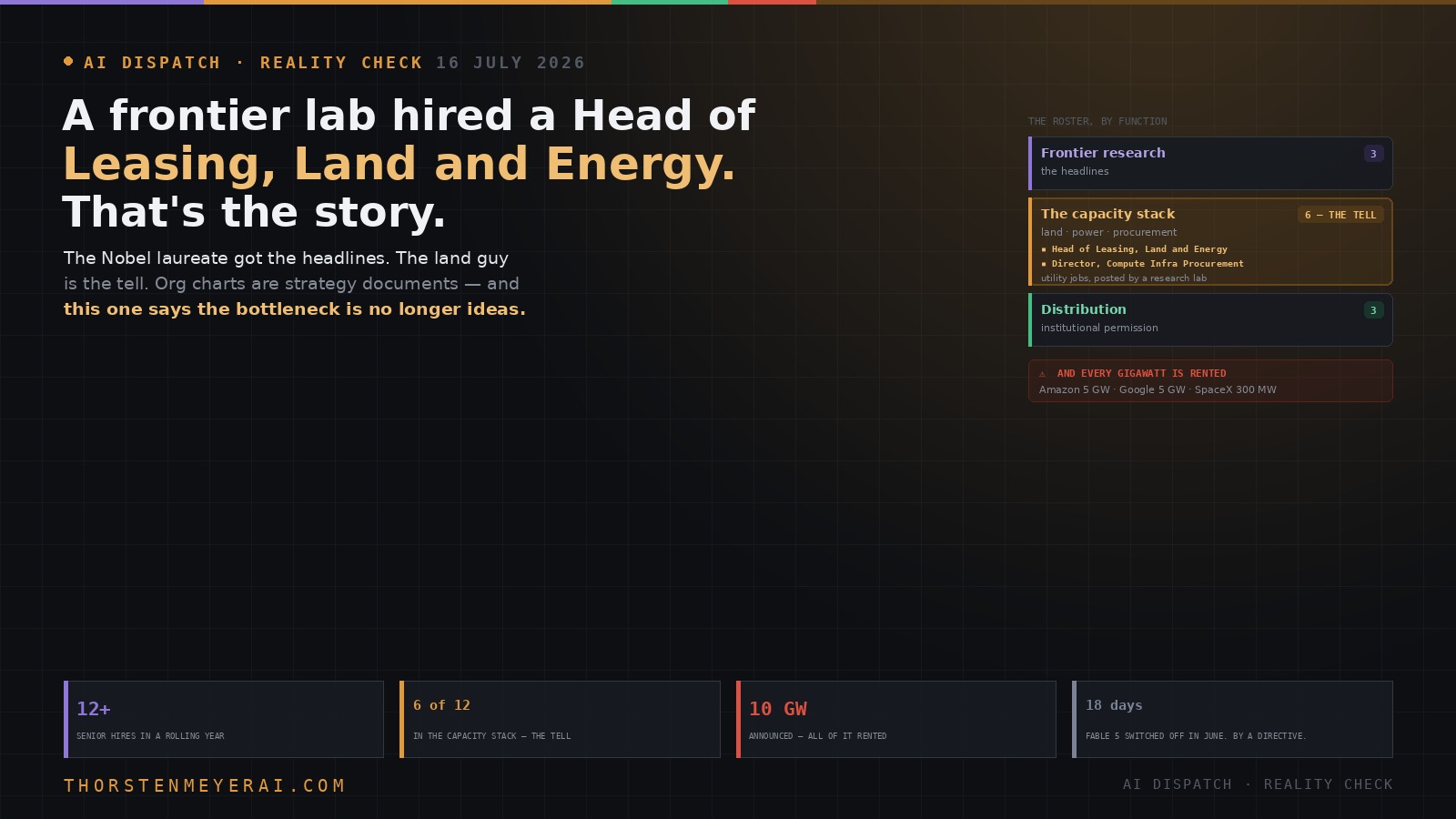

The Nobel laureate got the headlines. The land guy is the tell.

Get business pricing on tech for your team
- Business-only prices and quantity discounts
- Tax-exempt purchasing
- Multiple users, one account, clear invoices
Over the twelve months to July 2026, Anthropic announced or completed at least a dozen senior and strategically placed hires. The famous ones travelled fastest — an OpenAI founding member, a Nobel Prize winner, a chair of Berkeley’s computer science division. But org charts are strategy documents, and when you lay the whole year side by side, the densest cluster isn’t research at all.
It’s capacity: chips, cloud architecture, power, land, procurement, reliability. Including a Head of Leasing, Land and Energy and a Director of Compute Infrastructure Procurement — job titles that belong at a utility, not a research lab.
That’s the confession in the roster: the binding constraint at the frontier is no longer ideas. It’s turning contracted megawatts into productive research cycles.
And here’s the part nobody’s writing. The input Anthropic is staffing hardest against is the input it owns least — and six weeks before its most-discussed hire, a government switched the whole thing off for eighteen days.
A frontier lab hired a Head of Leasing, Land and Energy. That’s the story.
The Nobel laureate got the headlines. The land guy is the tell. Twelve-plus senior hires in a rolling year, and the densest cluster isn’t research — it’s capacity. Org charts are strategy documents. This one says the bottleneck is no longer ideas.
Rented from three parties who are, in different configurations, rivals. Alphabet profits from a lab that just recruited its Nobel laureate while competing with Claude. Anthropic rents at a Musk-affiliated facility while employing an xAI founding member. Not hypocrisy — it’s the trade every lab makes, and the Trainium/TPU/Nvidia diversity is explicitly a resilience strategy, which tells you they know. But state it plainly: Anthropic is staffing hardest against the one input it doesn’t own.
Six weeks before Blomfield’s announcement, the flywheel stopped. On 12 June a Commerce Department directive restricted Fable 5 and Mythos 5 to US nationals; both were pulled worldwide for 18 days, restored 1 July. Not a capacity failure — a directive. You can secure 10 GW across three silicon architectures and still be switched off in an afternoon. Capacity isn’t only physical. It’s political — and there’s no Head of Leasing, Land and Energy for that. Which is why Anthropic appointed its first Global Head of Public Sector weeks later: institutional permission is now a production input.
The lesson isn’t “Anthropic hired well” — every lab is hiring hard; that’s a talent market, not a strategy. It’s what the org chart confesses: at the frontier, ideas are no longer the bottleneck — capacity activation is. And “distribution pays for the compute” is too neat: customer demand monetizes capacity; the $65B raise and the hyperscalers finance it — the same suppliers renting it to you. Now invert it. If the best-resourced labs on earth can’t own their capacity — rented, concentrated in three rivals, gateable in an afternoon — then the better they get at this flywheel, the more dependent everyone downstream becomes on someone else’s flywheel. The case for owning your own stack doesn’t weaken as the frontier improves. It strengthens. The org chart is an argument for portability — written by the people it’s an argument against.
First, the corrections
A version of this story is circulating that’s wrong in four specific ways, and they matter because each one inflates the claim.
“Pulled out of OpenAI, Google DeepMind, Microsoft, xAI, AWS.” Partly. There are direct moves from Google DeepMind, Microsoft, xAI and Berkeley. But Andrej Karpathy came from Eureka Labs, the education startup he paused — he’s an OpenAI founding member and alumnus, not an OpenAI poach. Teresa Carlson came from the General Catalyst Institute, not AWS, where she is an alumna. Tom Blomfield came from Y Combinator. Prominent alumni, not raids.
“They all landed on one team called Compute.” They didn’t. The cluster spans Compute, Infrastructure, infrastructure-for-AI, leasing/land/energy, and procurement. Anthropic’s own CTO announcement treats compute and infrastructure as separate areas. It’s a capacity stack, not an org-chart box — which is a more interesting fact, not a lesser one.
“The three inputs to recursive self-improvement.” That framing is Blomfield’s own characterization, not a demonstrated technical milestone. He publicly described the industry entering the early stages of recursive self-improvement and drew the conclusion that compute availability becomes the problem to solve. That’s a very smart operator’s read on why he took the job. It is not an announcement that anything self-improved.
“This is not prestige signaling ahead of an IPO.” Anthropic confidentially filed a draft S-1 on 1 June, and reporting suggests it could list as soon as this autumn. The functional fit across these hires is too specific to be explained by prestige alone — but IPO optics can’t be ruled out as a secondary benefit, and prediction markets have been pricing meaningful odds of a 2026 listing. “Not a sufficient explanation” is defensible. “Not a factor” isn’t.
With that cleaned up, the pattern gets clearer rather than weaker.
industrial land leasing for data centers
As an affiliate, we earn on qualifying purchases.
As an affiliate, we earn on qualifying purchases.
The roster, by function
Frontier research and science — three. Andrej Karpathy joined the pretraining team on 19 May under pretraining lead Nick Joseph. Anthropic told TechCrunch he will start a team focused on using Claude to accelerate pretraining research. Jelani Nelson, chair of UC Berkeley’s Computer Science Division and a theoretical computer scientist (streaming algorithms, dimensionality reduction, randomized methods), took leave and joined pretraining as a Member of Technical Staff on 1 July. John Jumper announced on 19 June that he was leaving Google DeepMind after nearly nine years — he shared the 2024 Nobel Prize in Chemistry for AlphaFold. His title, team and project have not been disclosed.
The capacity stack — six. Tom Blomfield (co-founder of Monzo and GoCardless, YC general partner) announced on 13 July he was taking leave from YC to join the Compute team as a Member of Technical Staff, working with co-founder Tom Brown — Anthropic’s Chief Compute Officer. Ross Nordeen, an xAI founding member who previously worked on large-scale computing at Tesla, joined in May to focus on compute. Marcus Fontoura moved from CTO of Microsoft’s Azure Core to an individual-contributor MTS role; his own résumé says he works on infrastructure for AI. Eric Boyd left Microsoft Azure in April to become Head of Infrastructure. Tim Hughes became Head of Leasing, Land and Energy. Sophia Marquez became Director of Compute Infrastructure Procurement.
Distribution — three. Teresa Carlson became Anthropic’s first Global Head of Public Sector in July — an AWS and Microsoft public-sector veteran, most recently at the General Catalyst Institute. Chris Ciauri became Managing Director of International. Irina Ghose, formerly Microsoft India’s managing director, became Managing Director of India.
And the capstone: Rahul Patil, appointed CTO in October 2025, whose remit spans product, compute, infrastructure, inference, data science and security — which is precisely why compute and infrastructure shouldn’t be collapsed into one another.
renewable energy land procurement tools
As an affiliate, we earn on qualifying purchases.
As an affiliate, we earn on qualifying purchases.
Read the titles, not the names
Six of twelve sit in capacity. That’s the density. But the titles are more revealing than the count.
Leasing, Land and Energy. Compute Infrastructure Procurement. A frontier AI lab has a land-and-energy executive and a procurement director for infrastructure. Those are the jobs a regional utility posts. And Blomfield — who has, by his own framing, zero infrastructure background — chose compute over everything else a two-time unicorn founder could have done.
The reason is the gap nobody photographs. An announced gigawatt is not a productive gigawatt. Between a signed contract and a researcher running an experiment sits: power interconnects, land, networking, deployment, scheduling, serving systems, reliability engineering, and the commercial dealmaking to secure any of it. That gap is measured in quarters. It is exactly where this roster is aimed.
One outside read captured it well: compute at this scale stopped being a purely technical problem some time ago — it’s a commercial and operational one, which is why you hire someone who built a regulated bank from nothing, where reliability was a condition of existing rather than a feature to add later.
Anthropic’s own framing supports the reading without confirming the interpretation. Fontoura’s remit — infrastructure for AI, spanning utilization, distributed systems, workload placement, reliability — suggests the company treats intelligence per unit of infrastructure, not installed accelerator count, as the competitive variable. That’s inference, and I’m labelling it as such.
enterprise energy management systems
As an affiliate, we earn on qualifying purchases.
As an affiliate, we earn on qualifying purchases.
What’s actually substantiated about the research loop
The Karpathy mandate is the most directly evidenced claim on the roster, because Anthropic said it on the record: a team focused on using Claude to accelerate pretraining research.
What that supports: a model-assisted research loop. Claude helping human researchers write experimental code, analyze runs, investigate failures, compare approaches — compressing the iteration cycle.
What it does not support: Claude autonomously retraining itself. Anthropic has not disclosed the tasks, the degree of autonomy, or whether the model touches training decisions at all. The honest sentence is: part of the R&D cycle is becoming AI-mediated. Anything stronger is extrapolation wearing a lab coat.
Nelson fits the same thesis from the other side: he adds theoretical and algorithmic depth to a pretraining organization otherwise associated with very large empirical runs — the proposition that frontier progress can come from better algorithms and representations, not only more compute. Plausible. Also undisclosed as to project, and it would be speculative to claim his streaming-algorithms work is being pointed at Claude’s training directly.
Jumper requires the most discipline. A sitting Nobel laureate left DeepMind after nine years — that’s real evidence Anthropic sees scientific discovery as a frontier application. Anthropic separately launched Claude Science on 30 June, a scientific workbench combining research tools, auditable artifacts, specialist agents and compute access. The defensible statement is therefore: Jumper arrives as Anthropic productizes scientific workflows. Not that he leads it, joined that team, or was recruited to commercialize AlphaFold-like systems. Everyone writing those sentences is guessing.
compute infrastructure procurement software
As an affiliate, we earn on qualifying purchases.
As an affiliate, we earn on qualifying purchases.
The dependency the org chart can’t solve
Now the part that makes this more than a talent-war story.
Read the capacity roster again. Then read where the capacity actually comes from:
- Amazon — up to 5 GW, with a commitment reported at over $100 billion over ten years.
- Google and Broadcom — 5 GW, with commitments reported at up to a million TPUs.
- SpaceX’s Colossus 1 — a facility associated with xAI, in Memphis — delivering 300+ MW and 220,000+ Nvidia GPUs, which Anthropic said immediately let it raise Claude usage limits.
Every gigawatt on that list is rented. And it’s rented from three parties who are, in different configurations, rivals: Amazon and Google both run competing model efforts, and Google is reported to own roughly 14% of Anthropic — profiting from a lab that just recruited its Nobel laureate while competing with Claude in coding agents and enterprise AI. Anthropic is renting compute at a Musk-affiliated facility while employing an xAI founding member who announced the same day the deal did.
None of that is hypocrisy. It’s the trade every frontier lab makes, and Anthropic is unusually explicit that hardware diversity across Trainium, TPUs and Nvidia is a resilience strategy — which tells you the company knows exactly what the exposure is.
But state it plainly: Anthropic is staffing hardest against the one input it doesn’t own. Twelve hires cannot fix that. They can only make the borrowed capacity productive faster.
And then there’s the part no hire fixes
Six weeks before Blomfield’s announcement, the flywheel stopped.
On 12 June, the Commerce Department issued a directive restricting Claude Fable 5 and Mythos 5 to US nationals. Both models were pulled worldwide for eighteen days, restored on 1 July. Not a capacity failure. Not an engineering failure. A directive.
You can hire the best land-and-energy executive alive, secure ten gigawatts, and diversify across three silicon architectures — and still be switched off by a policy decision made in an afternoon. Capacity isn’t only physical. It’s political. And there is no Head of Leasing, Land and Energy for that.
Which puts the Carlson hire in its sharpest light. Anthropic appointed its first Global Head of Public Sector weeks after the US government gated its flagship model. Read that as what it plainly is: institutional permission has become a production input, alongside power and silicon. Government distribution isn’t enterprise sales — it runs on security controls, contracting vehicles, data residency, acceptable-use boundaries and political legitimacy. Anthropic has separately noted that regulated customers increasingly require in-region infrastructure. That’s a compute requirement arriving disguised as a compliance requirement.
The bet, stated without the sugar
The roster is consistent with one integrated thesis: the frontier goes to whoever most rapidly converts ideas into experiments, experiments into capability, contracted infrastructure into productive capacity, and capability into durable institutional demand — then recycles the capital and experience into the next cycle.
The metric isn’t benchmark position or GPU count. It’s cycle time through the whole system.
Two honest amendments. First, this is a hypothesis the roster is consistent with, not a mechanism anyone has demonstrated. Second, “distribution pays for the compute” is too neat. Anthropic reported more than 300,000 business customers in September 2025 and said more than 100,000 were running Claude through Amazon Bedrock by April 2026 — that demand monetizes and justifies capacity. It doesn’t finance it. The $65 billion raised in May did, alongside hyperscaler investment; Amazon’s expanded agreement bundled capacity commitments with investment. The customers aren’t paying for the gigawatts. The suppliers are — the same suppliers renting them to you.
And the talent market context matters: every frontier lab is hiring aggressively right now. “Anthropic hired well” isn’t a strategy finding. Where they hired is.
What to watch
Five signals, all measurable, none requiring you to trust a press release:
- How fast do announced megawatts become available to researchers and customers?
- Do rate limits and reliability improve as capacity lands? (The Colossus deal reportedly moved this within a month — that’s the benchmark now.)
- How effectively do workloads move among Trainium, TPUs and Nvidia? That’s the resilience claim, testable.
- What portion of pretraining research actually becomes Claude-assisted? Karpathy’s mandate is the thesis; disclosure is the proof.
- Do science and public-sector deployments produce durable workloads — or demonstrations?
The take
The lesson isn’t that Anthropic hired well. It’s what the org chart confesses: at the frontier, ideas are no longer the bottleneck. Capacity activation is — and the tell isn’t the Nobel laureate, it’s the land-and-energy executive and the procurement director sitting quietly under a Chief Compute Officer.
Now invert it, because that’s the part that matters if you’re building on top rather than at the frontier.
Anthropic’s own compute is rented, concentrated in three suppliers who are also competitors, and politically gateable — as June proved, for eighteen days, worldwide. If the best-resourced labs in the world can’t own their capacity, then the better they get at this flywheel, the more dependent everyone downstream becomes on someone else’s flywheel.
That’s the uncomfortable symmetry. The case for owning your own stack — open weights you hold, hardware you control, a router that survives a gate — doesn’t weaken as the frontier improves. It strengthens, because the frontier’s dependencies are becoming yours.
The org chart is an argument for portability. It just happens to have been written by the people it’s an argument against.
Sources: Karpathy’s move (19 May 2026, pretraining under Nick Joseph, Anthropic’s on-record statement about a team using Claude to accelerate pretraining research) via TechCrunch and Karpathy’s own announcement; Blomfield (13 July, leave from Y Combinator, Member of Technical Staff on Compute under co-founder and Chief Compute Officer Tom Brown, and his own recursive-self-improvement framing) via Business Insider, PYMNTS and The Next Web; Jumper’s 19 June departure from Google DeepMind and undisclosed remit via Reuters-derived coverage; Nelson (1 July, Berkeley CS Division chair, MTS, pretraining), Boyd (April, Head of Infrastructure), Nordeen (May, xAI founding member), Fontoura (ex-Azure Core CTO), Hughes (Head of Leasing, Land and Energy), Marquez (Director of Compute Infrastructure Procurement), Carlson (July, first Global Head of Public Sector), Ciauri, Ghose and CTO Rahul Patil (October 2025) via aggregated hire-tracking coverage and company announcements; Claude Science launch (30 June); capacity figures (Amazon up to 5 GW and $100B+/10yr; Google–Broadcom 5 GW; SpaceX Colossus 1 300+ MW and 220,000+ GPUs), the $65B May raise, 300,000+ business customers (Sept 2025) and 100,000+ Bedrock customers (April 2026) as reported; Google’s ~14% stake and the confidential S-1 (1 June) as reported. The Commerce Department directive of 12 June restricting Fable 5 and Mythos 5, and their restoration on 1 July, per contemporaneous reporting. Several remits — notably Jumper’s — remain undisclosed, and where this piece infers strategy from org structure it says so. Analysis and framing are the author’s; not investment advice.
Fall Picks
fall essentials
As an affiliate, we earn on qualifying purchases.