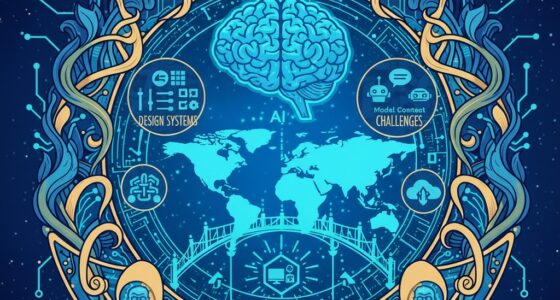

Emerging economies are starting to adopt AI mainly for technical tasks like coding and automation, focusing on improving efficiency in sectors like healthcare, manufacturing, and IT. However, challenges such as limited infrastructure, talent shortages, and low investment slow their progress. While initial efforts are narrowly focused, more advanced applications are beginning to emerge. Understanding how these regions navigate obstacles and capitalize on opportunities can reveal the future of AI’s global impact. Keep exploring to see how they’re shaping their digital transformation.
Key Takeaways
- Emerging economies are in early AI adoption stages, mainly focusing on automation and technical tasks due to infrastructure and talent limitations.
- Key sectors like healthcare, manufacturing, and IT are integrating AI to improve efficiency, diagnostics, and service delivery.
- Challenges such as data scarcity, limited infrastructure, and regulatory gaps hinder broader AI deployment in developing regions.
- The digital divide risks widening economic disparities, with developing countries lagging in AI adoption and innovation.
- International collaboration and targeted investments are essential to promote inclusive AI growth and bridge resource and talent gaps.

AI Starter Kit: A Beginner's 9 Step Guide To Using Artificial Intelligence Confidently At Work And In Life
As an affiliate, we earn on qualifying purchases.
As an affiliate, we earn on qualifying purchases.
Current State of AI Adoption in Emerging Economies

Emerging economies are still in the early stages of AI adoption, often focusing on technical tasks like coding and automation. You’ll notice that their primary use cases involve streamlining basic operations and improving efficiency rather than exploring advanced AI applications. Limited infrastructure, talent shortages, and lower investments hinder broader deployment. Many developing countries prioritize foundational AI activities, such as automating routine processes or supporting basic data analysis, to build capabilities gradually. You’ll find that AI adoption remains concentrated in specific sectors like technology, with slower growth in healthcare, education, and scientific research. Although some nations are making progress, overall, AI integration is still emerging, with significant gaps compared to high-income countries. These early efforts lay the groundwork for future expansion, but many challenges remain. Reliable resources on AI’s role in development can help inform more effective strategies for these economies.

sdidzad Car Mechanic Stethoscope, Professional Automotive Engine Diagnostic Tool, Sensitive Hearing Precision Stethoscope, Universal for Car Truck SUV Motorcycle RV (Black)
Professional Automotive Mechanic Stethoscope: This professional car stethoscope is specially designed for engine diagnostic work. It is an…
As an affiliate, we earn on qualifying purchases.
As an affiliate, we earn on qualifying purchases.
Key Sectors Driving AI Growth in Developing Countries

Healthcare, manufacturing, and information technology are the key sectors fueling AI growth in developing countries. These industries are adopting AI to improve efficiency, reduce costs, and expand services. In healthcare, AI enables diagnostics, telemedicine, and predictive analytics, saving lives and optimizing resource allocation. Manufacturing benefits from AI-driven automation, quality control, and supply chain management, increasing productivity. The IT sector leverages AI for network security, customer support, and data analysis, driving innovation. Additionally, the increasing availability of affordable home theatre projectors is making advanced entertainment options more accessible in these developing regions.

Agentic Artificial Intelligence: Harnessing AI Agents to Reinvent Business, Work and Life
As an affiliate, we earn on qualifying purchases.
As an affiliate, we earn on qualifying purchases.
Challenges Faced by Emerging Markets in Implementing AI

Implementing AI in developing markets presents significant hurdles that can slow progress and widen existing gaps. Limited access to advanced infrastructure, such as reliable internet and data centers, hampers AI deployment. You may also face shortages of local talent skilled in AI development and implementation, making it difficult to build and sustain AI projects. Capital constraints further restrict investment, forcing organizations to prioritize immediate needs over innovative AI solutions. Regulatory frameworks are often unclear or underdeveloped, creating uncertainty and risk. Additionally, data scarcity and quality issues challenge AI models’ effectiveness. These obstacles make it harder for emerging markets to compete with advanced economies, risking a growing divide where benefits of AI remain concentrated in wealthier nations.

TP-Link AC1200 WiFi Router (Archer A54) – Dual Band Wireless Internet Router, 4 x 10/100 Mbps Fast Ethernet Ports, EasyMesh Compatible, Support Guest WiFi, Access Point Mode, IPv6 & Parental Controls
Dual-band Wi-Fi with 5 GHz speeds up to 867 Mbps and 2.4 GHz speeds up to 300 Mbps,…
As an affiliate, we earn on qualifying purchases.
As an affiliate, we earn on qualifying purchases.
Initial Focus Areas: Coding and Technical Tasks

You’ll see that many developing countries start their AI journey by focusing on coding and technical tasks, which require specialized skills. Rapid skill development becomes essential to build local expertise and support AI projects. As these countries grow their technical capabilities, they lay the foundation for broader AI adoption across other sectors. Moreover, investing in diverse design options for AI tools can enhance user engagement and accessibility in various communities.
Focus on Coding Tasks
In the early stages of AI adoption in developing countries, coding and technical tasks serve as primary entry points because they require less complex infrastructure and pose fewer regulatory hurdles. You’ll find many organizations leveraging AI for programming, data analysis, and automation. This focus helps build foundational skills and demonstrates value quickly. Additionally, incorporating Inspirational Quotes About Fatherhood can foster motivation and resilience among developers working through challenges.
Rapid Skill Development
As developing countries accelerate their AI efforts, many focus on quickly building technical skills through coding and related tasks. You might find training programs emphasizing programming languages like Python and data analysis tools, aiming to equip local talent fast. Online platforms, local coding bootcamps, and government initiatives help bridge skill gaps, often tailored to immediate industry needs. The goal is to create a foundation for AI development, enabling local teams to contribute to projects and adapt AI solutions to regional problems. This rapid skill development also fosters innovation, allowing emerging economies to move beyond basic adoption toward creating homegrown AI applications. By prioritizing coding skills, you help build a workforce capable of supporting sustained AI growth and technological independence. Additionally, fostering a growth mindset among learners encourages continuous improvement and adaptation to evolving AI technologies.
Diversification of Use Cases as Adoption Matures

When AI adoption matures, the scope of its use expands beyond initial technical tasks into more diverse areas like education, scientific research, and business operations. You’ll see emerging economies move from basic coding roles to broader applications that directly impact society. These include:
- Enhancing educational tools to personalize learning experiences
- Accelerating scientific discoveries through data analysis
- Optimizing supply chains and logistics for local businesses
- Improving healthcare diagnostics and patient management
- Supporting government services with automated administrative tasks
- Incorporating preppy dog names as part of community engagement and cultural identity initiatives to foster a sense of connection and tradition.
As adoption deepens, AI becomes more integrated into daily life and strategic sectors. Governments and organizations adopt a more holistic approach, leveraging AI to solve complex challenges and foster sustainable development—beyond just initial technical experimentation.
Talent, Infrastructure, and Investment Gaps

Despite the expanding applications of AI in developing countries, widespread adoption remains limited by significant gaps in talent, infrastructure, and investment. You’ll find that many regions lack the skilled workforce needed to develop and implement AI solutions effectively. Infrastructure issues, such as unreliable internet and inadequate data centers, hinder deployment and scaling. Additionally, limited access to capital restricts startups and organizations from investing in AI research and infrastructure. These gaps create a cycle where low investment hampers talent development, and without skilled professionals, infrastructure upgrades stall. As a result, AI remains confined to a few advanced sectors, preventing broader economic benefits. Bridging these gaps requires targeted investments, capacity building, and international cooperation, or else these regions risk falling further behind in the global AI race. Enhancing remote work capabilities can also support distributed talent development and knowledge sharing, helping to close these gaps over time.
Implications for Economic Development and Global Inequality

You need to recognize that disparities in AI access and talent can widen economic gaps between countries. Limited infrastructure and investment in developing regions hinder their ability to benefit from AI-driven growth. Without targeted efforts, these gaps could reinforce global inequalities and slow progress toward shared development.
Digital Divide Risks
The digital divide poses a significant threat to global economic development and increases inequality between nations. If you don’t address these gaps, developing countries risk falling further behind, widening the economic and technological chasm. Limited access to AI infrastructure, talent, and capital hampers growth and innovation in emerging economies. This can lead to:
- Slower adoption of AI-driven industries
- Reduced competitiveness in global markets
- Limited job creation and economic diversification
- Increased regional disparities within countries
- Heightened inequality between high- and low-income nations
Without targeted efforts, the benefits of AI remain concentrated in advanced economies, deepening global inequality. Bridging this divide requires investments in infrastructure, education, and policies that promote inclusive AI development. Otherwise, the digital divide will continue to threaten shared global progress. Ensuring equitable access to vetted AI resources and expertise is essential for fostering sustainable development worldwide.
Talent and Infrastructure Gaps
Limited access to AI talent and infrastructure hampers economic growth in developing countries and worsens global inequality. Without skilled workers, these nations struggle to develop, implement, and scale AI solutions effectively. Infrastructure gaps—such as limited high-speed internet, data centers, and computing power—further restrict AI adoption. Many emerging economies lack the investment and technical resources that high-income countries possess, making it harder to compete in AI-driven industries. This uneven distribution of talent and infrastructure deepens existing economic divides, as advanced economies accelerate AI innovation while developing regions fall behind. To bridge these gaps, you need targeted investments, capacity-building programs, and international collaboration. Otherwise, AI’s benefits risk remaining concentrated, reinforcing global inequality rather than reducing it.
Economic Growth Potential
How profoundly AI can boost economic growth depends largely on how widely and effectively it’s adopted across regions and industries. When emerging economies ramp up AI use, you can *unleash* significant benefits, like increased productivity, innovation, and new market opportunities. For example, AI can:
- Accelerate industrial development and manufacturing efficiency
- Improve agricultural yields and resource management
- Enhance healthcare delivery and scientific research
- Create new jobs in tech and data-driven sectors
- Expand access to education and financial services
- Adoption rates significantly influence the extent of AI’s positive impact on developing economies.
However, limited adoption can deepen inequality, as wealth and technological advantages concentrate in already advanced regions. The countries that succeed in integrating AI into their economies will likely experience faster growth, while those lagging behind risk falling further behind, widening the global economic divide.
Frequently Asked Questions
How Are Emerging Economies Funding AI Initiatives With Limited Resources?
You can look at how emerging economies fund AI initiatives despite limited resources by exploring international aid, government grants, and partnerships with tech companies. Many leverage foreign investment and prioritize cost-effective solutions like coding tasks before expanding to broader applications. You may also see them tapping into global development programs, using open-source AI tools, or encouraging private sector innovation to bridge funding gaps and accelerate adoption.
What Role Do Local Governments Play in AI Policy Development?
Your local governments shape AI policy by creating frameworks for responsible development, setting regulations, and promoting innovation. They often establish national strategies, invest in infrastructure, and foster public-private partnerships to boost adoption. By implementing guidelines on transparency and ethics, they aim to guarantee AI benefits society while minimizing risks. Governments also support workforce training and research initiatives, helping emerging economies stay competitive in the global AI landscape.
How Is AI Adoption Impacting Employment in Developing Countries?
You’ll find AI adoption in developing countries is reshaping employment by automating routine tasks and creating new roles. While some jobs are displaced, many workers gain opportunities in tech and scientific fields. However, limited access to AI talent and infrastructure means progress varies. If you work in these regions, stay adaptable, learn new skills, and embrace AI tools to remain competitive as the job market evolves.
Are There Regional Collaborations to Accelerate AI Development?
You’ll find that regional collaborations are actively shaping AI development, especially in groups like the EU, ASEAN, and Africa Union. These organizations promote shared standards, research partnerships, and policy coordination to facilitate innovation and responsible deployment. By working together, they aim to bridge gaps, improve access, and ensure AI benefits are more evenly distributed, helping emerging economies grow their AI capabilities and compete globally.
How Do Cultural Factors Influence AI Acceptance in Emerging Markets?
You’ll find that cultural factors greatly influence AI acceptance in emerging markets. If your society values trust and community, you may be cautious about AI’s role, fearing privacy breaches or job loss. Conversely, cultures emphasizing innovation and progress often embrace AI faster, seeing it as a tool for growth. Understanding local norms, beliefs, and attitudes helps shape AI deployment strategies, ensuring technology aligns with cultural expectations and gains wider acceptance.
Conclusion
As emerging economies embrace AI, they open new opportunities, yet face hurdles like talent gaps and infrastructure needs. While some see AI as a tool for growth, others worry it could deepen inequalities. You stand at a crossroads—will AI bridge the development divide or widen it? The choice lies in how these nations leverage technology, balancing optimism with caution, to build a future where AI uplifts everyone, not just a few.