
By Thorsten Meyer AI – December 2025
A milestone for open, agentic AI
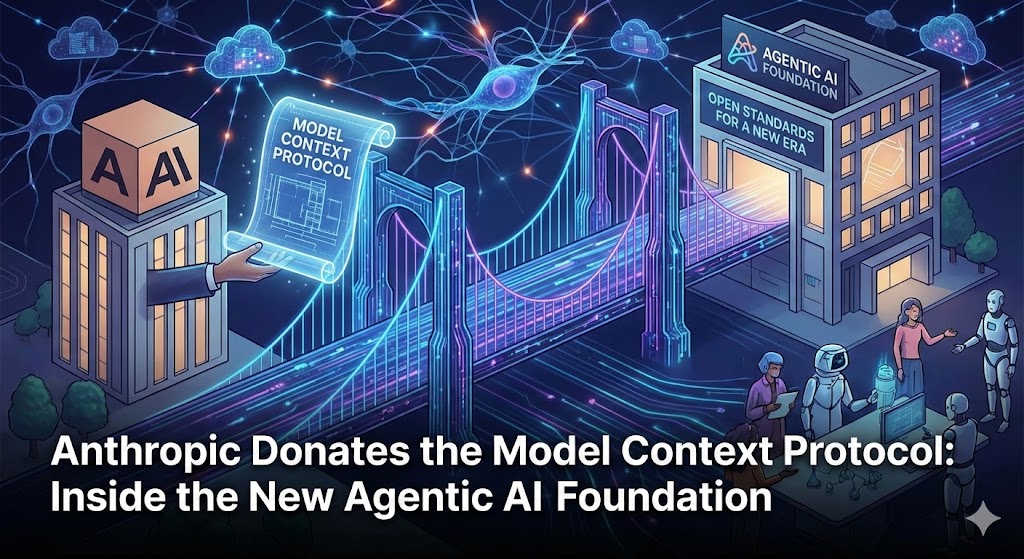
On 9 December 2025 Anthropic announced it was donating its Model Context Protocol (MCP) to the Agentic AI Foundation (AAIF). The foundation operates as a directed fund under the Linux Foundation, co‑founded by Anthropic, Block and OpenAI with backing from major cloud and software companies. The move signals a growing industry commitment to open standards for AI agents and helps ensure that tools developed today remain interoperable tomorrow. This article explores what the MCP is, why it matters, and what the new AAIF means for developers and enterprises.
Top picks for "anthropic donat model"
Open Amazon search results for this keyword.
As an affiliate, we earn on qualifying purchases.
What is the Model Context Protocol?
The Model Context Protocol was open‑sourced in November 2024 as a universal standard for connecting AI assistants to external systemsanthropic.com. Anthropic designed the protocol to solve a persistent problem: even advanced language models struggle when isolated from the data and tools they need. Integrating each new data source often requires custom code; MCP replaces this fragmentation with a single, open protocolanthropic.com. Developers can either expose their data through MCP servers or build MCP clients that connect to those serversanthropic.com.
Key features highlighted when MCP was launched include:
- Two‑way communication: MCP allows AI applications to securely retrieve data and send instructions back to external systems, enabling agents to not just read but act.
- Simplicity and neutrality: It unifies disparate connectors into one standard, reducing complexity for developersanthropic.com.
- Open governance: The specification and SDKs are open‑sourced, and Anthropic encouraged community feedback from the beginninganthropic.com.
The protocol quickly gained traction. Within its first year there were over 10 000 active public MCP servers and the project recorded 97 million monthly SDK downloadsblog.modelcontextprotocol.io. Adoption spans major AI platforms including ChatGPT, Cursor, Google’s Gemini, Microsoft Copilot and Visual Studio Codeanthropic.com. Enterprise‑grade infrastructure from AWS, Cloudflare, Google Cloud and Microsoft Azure now deploys MCP servers, and the Claude directory lists more than 75 connectorsanthropic.com. The protocol also underpins Claude’s Tool Search and Programmatic Tool Calling features, enabling efficient multi‑tool workflowsanthropic.com.
Why donate MCP to the Linux Foundation?
Anthropic has always framed MCP as vendor‑neutral and community‑driven. Donating the project to a neutral foundation ensures that claim holds as MCP becomes critical infrastructure for agentic AI. The Linux Foundation has a decades‑long track record stewarding open‑source projects such as the Linux kernel, Kubernetes and PyTorchanthropic.com. In the words of Anthropic’s chief product officer Mike Krieger:
“MCP started as an internal project to solve a problem our own teams were facing… Donating MCP to the Linux Foundation as part of the AAIF ensures it stays open, neutral, and community‑driven as it becomes critical infrastructure for AI”thenewstack.io.
The decision also aligns with broader industry trends. As Gartner analysts note, 40 % of enterprise applications could include task‑specific AI agents by 2026ciodive.com. A neutral governance model fosters interoperability across companies and discourages vendor lock‑in. The donation addresses concerns that without common standards, the rapid proliferation of agents will splinter into incompatible silosopenai.com.
Inside the Agentic AI Foundation
The Agentic AI Foundation is a directed fund under the Linux Foundation. It was co‑founded by Anthropic, Block and OpenAI with support from Google, Microsoft, Amazon Web Services (AWS), Cloudflare and Bloomberganthropic.com. Its mission is to ensure agentic AI evolves transparently, collaboratively and in the public interestanthropic.com. The foundation will manage funds, recruit members and approve new projects, while leaving each project’s technical direction to its maintainersblog.modelcontextprotocol.io.
Founding projects
At launch the AAIF hosts three flagship initiatives:
| Project | Origin | Purpose |
|---|---|---|
| Model Context Protocol (MCP) | Anthropic | Provides a universal, open protocol for connecting AI models to tools, data and applicationsanthropic.com. |
| goose | Block | An open‑source, local‑first AI agent framework combining language models with extensible tools and standardized MCP‑based integrationlinuxfoundation.org. Goose is designed to offer a structured and trustworthy environment for building and executing agentic workflows. |
| AGENTS.md | OpenAI | A lightweight Markdown specification giving AI coding agents a consistent place to read project‑specific guidance such as coding conventions, build steps and test instructions. Since its release in August 2025, more than 60 000 open‑source projects and agent frameworks have adopted itopenai.com. |
Placing these projects under one foundation ensures they can grow with the transparency and stability that only open governance providesciodive.com. According to Linux Foundation executive director Jim Zemlin, “Within just one year, MCP, AGENTS.md and goose have become essential tools for developers building this new class of agentic technologies”ciodive.com. By bringing them together, the AAIF can coordinate standards and avoid divergent implementations.
Membership tiers and supporters
The foundation’s Platinum members include AWS, Anthropic, Block, Bloomberg, Cloudflare, Google, Microsoft and OpenAIthenewstack.io. Gold members range from Adyen, Cisco, Datadog and Docker to JetBrains, Oracle, Snowflake, Temporal and Twilio, while Silver members include Chronosphere, Cosmonic, Elasticsearch, Hugging Face, Kubermatic, Pydantic, Spectro Cloud, SUSE, Uber and othersthenewstack.io. Obot.ai, another member, donated its MCP Dev Summit events to the AAIF, making a New York summit in April 2026 the foundation’s first official eventthenewstack.io.
Reactions from the industry
Stakeholders across the technology ecosystem have welcomed the move. Swami Sivasubramanian, VP of Agentic AI at AWS, said that placing MCP in a vendor‑neutral foundation allows developers to invest confidently in a universal standard and promised AWS would continue to contribute to the protocollinuxfoundation.org. Shawn Edwards, CTO of Bloomberg, described MCP as a “foundational building block” for APIs in financial services; he noted that making it open will drive broader adoption and innovation across the regulated financial sectorlinuxfoundation.org. Dane Knecht, CTO of Cloudflare, highlighted the explosion of remote MCP servers deployed on Cloudflare’s infrastructure and said joining AAIF enables the company to keep pushing standards forwardlinuxfoundation.org. Google’s Richard Seroter emphasized that shared standards help ensure whatever developers build remains interoperable and gives the community real choiceslinuxfoundation.org, while Microsoft’s Chris DiBona underscored that an open, interoperable foundation is essential for a thriving agentic ecosystemlinuxfoundation.org.
Analysts also see strategic benefits. Gartner’s Jim Scheibmeir told CIO Dive that the more often companies implement MCP, the faster enterprises will achieve productivity gains; he predicts this will accelerate agent adoptionciodive.com. CIO Dive notes that interoperability is key as enterprises in retail, finance and other sectors begin experimenting with AI agentsciodive.com. While early adopters must manage security and update challenges, the donation is expected to be a net positive for MCP’s futureciodive.com.
What this means for developers and enterprises
Donating MCP and establishing the Agentic AI Foundation mark a significant step toward open, interoperable AI agents. For developers, the immediate impact is greater confidence that the tools they build today won’t be subject to proprietary whims tomorrow. An open protocol backed by a neutral foundation means:
- Vendor neutrality and longevity: No single company can change the standard unilaterally; the Linux Foundation provides a stable governance modelanthropic.com.
- Ease of integration: Instead of maintaining bespoke connectors for each data source, developers can use MCP to build once and interoperate across platformsanthropic.com.
- Shared ecosystem: Common protocols like MCP and AGENTS.md reduce fragmentation and allow communities to build complementary toolsopenai.com.
For enterprises, an industry‑endorsed standard lowers the barrier to deploying AI agents at scale. Early adopters like Walmart already use “super agents” to assist customers, suppliers and employeesciodive.com. As more vendors support MCP natively—Salesforce’s Agentforce began supporting MCP in mid‑2025ciodive.com—enterprises can integrate AI agents into existing systems without bespoke engineering.
Looking ahead
The Agentic AI Foundation is only just beginning. Its structure allows new projects to join, and The New Stack notes that additional open‑source agent frameworks are likely to be added in the near futurethenewstack.io. The MCP’s maintainers plan to continue investing in the protocol, and Anthropic’s Claude API recently launched features like programmatic tool calling to optimize large, multi‑tool workflowsanthropic.com. In addition, the protocol’s governance will remain unchanged under the AAIF, with maintainers still driving technical decisions guided by community inputblog.modelcontextprotocol.io.
OpenAI’s article on co‑founding the AAIF emphasizes that open standards prevent the agent ecosystem from splintering as it maturesopenai.com. In this view, the foundation is not just about MCP but about creating shared infrastructure for agentic AI that benefits developers, enterprises and the public. As agents begin handling more complex tasks—from software development to workflow automation and customer support—the need for trust and interoperability will only grow.
Conclusion
The donation of the Model Context Protocol and creation of the Agentic AI Foundation represent a watershed moment for the AI industry. By placing a widely used protocol and complementary projects like goose and AGENTS.md under neutral governance, the leading AI companies signal their commitment to collaboration over competition. For developers, this ensures they can build on a stable, open foundation; for enterprises, it paves the way for widespread adoption of AI agents without fear of vendor lock‑in. As the AAIF grows, it will serve as a hub for standards and tools that underpin the next generation of intelligent, autonomous systems.