
By Thorsten Meyer | ThorstenMeyerAI.com | February 2026
Executive Summary
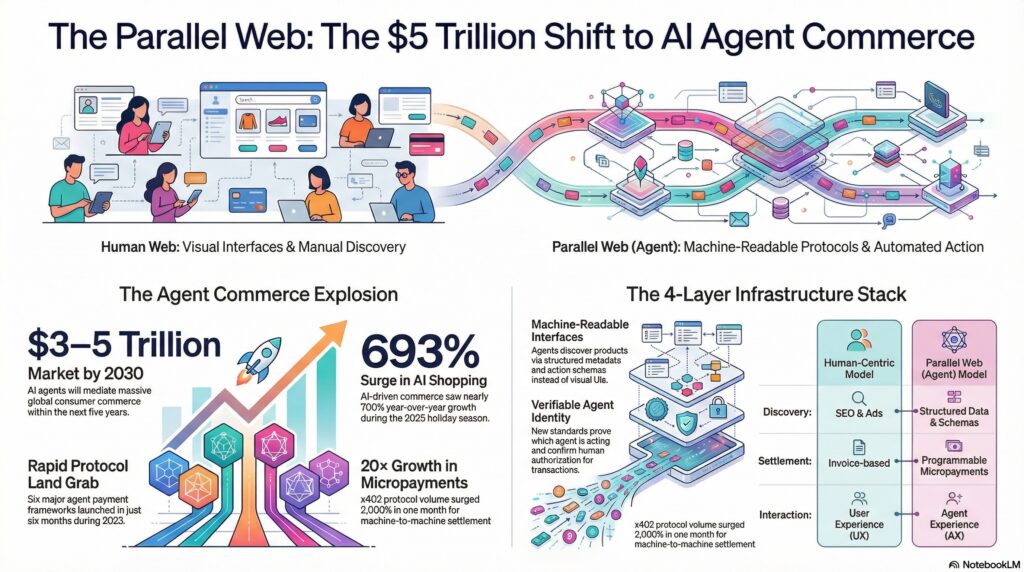
AI agents could mediate $3 trillion to $5 trillion of global consumer commerce by 2030. AI-driven shopping already surged 693% in the 2025 holiday season, accounting for nearly 20% of all holiday commerce — roughly $262 billion in spend. Six major agent payment protocols launched between April and October 2025. The parallel web isn’t a concept paper. It’s under construction.
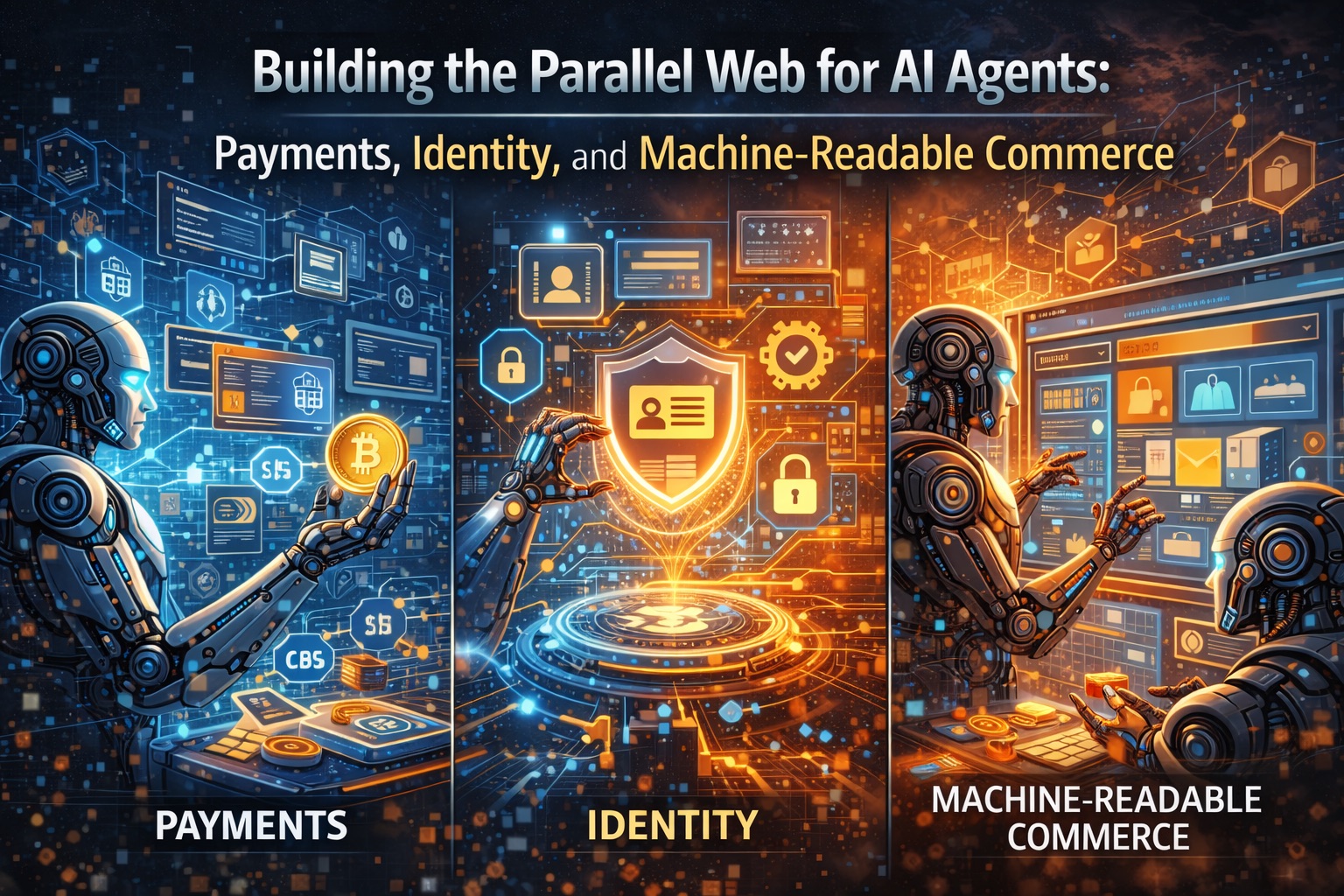
The “parallel web” is becoming a practical design agenda: machine-readable content contracts, agent-to-agent negotiation protocols, programmable payment rails, and trust infrastructure that allows non-human actors to transact safely. Three conditions are converging: agents can perform multi-step tasks with tool use, enterprises demand measurable workflow outcomes rather than chatbot engagement, and payment and identity ecosystems are maturing enough to support machine-mediated transactions.
The API economy alone is worth $16.29 billion in 2026 (34% CAGR), with over $3 trillion in global GDP enabled by API-based transactions. 82% of organizations have adopted an API-first approach. But the readiness gap is real: OECD data shows only 8% of adults are enrolled in formal learning programs, with participation declining between survey cycles. If the parallel web requires new technical, legal, and operational skills — and it does — capability bottlenecks will slow adoption and widen performance gaps.
The strategic implication: firms that redesign their digital surfaces for agents gain distribution and execution advantage. Firms that remain human-UI-only lose discoverability and transaction velocity. The next phase of the internet won’t replace the human web. It will sit beside it as an execution substrate — and the firms that aren’t machine-addressable will become invisible to the fastest-growing transaction channel in commerce.
| Metric | Value |
|---|---|
| Agent-mediated commerce by 2030 (McKinsey) | $3-5 trillion |
| AI-driven holiday commerce (2025) | ~$262 billion (~20% share) |
| AI-driven shopping surge (2025 YoY) | +693% |
| Agent payment protocols launched (Apr-Oct 2025) | 6 major frameworks |
| API economy market (2026) | $16.29 billion |
| API economy CAGR | 34% |
| Global GDP enabled by APIs | $3+ trillion |
| Organizations: API-first approach | 82% |
| Revenue from APIs (74% of orgs) | 10%+ |
| API demand increase from AI/LLMs (2026) | 30%+ |
| Enterprises relying on independent agents (2026) | 30% (Gartner) |
| Enterprise workflows with autonomous agents | 40%+ |
| x402 weekly volume growth (Sep-Oct 2025) | 46,000 → 930,000 |
| Adults in formal learning (OECD) | 8% (declining) |
| Adults in non-formal job learning (OECD) | 37% (declining) |
| Products published in commerce ecosystem (2025) | 5 billion (+46%) |

Building Integrations with MuleSoft: Integrating Systems and Unifying Data in the Enterprise
As an affiliate, we earn on qualifying purchases.
As an affiliate, we earn on qualifying purchases.
1. Why This Trend Is Accelerating Now
Three conditions are converging to turn the parallel web from theoretical to operational:
Condition 1: Agents Can Execute
Agents are no longer limited to generating text. They browse, fill forms, call APIs, execute transactions, and negotiate with other agents. 57% of companies already have agents in production. Gartner projects 40% of enterprise applications will feature task-specific agents by end of 2026. The execution capability is here.
Condition 2: Enterprises Demand Outcomes
The shift from “chatbot engagement” to “workflow completion” changes the commercial surface area. When an enterprise buyer sends an agent to negotiate procurement terms, the vendor’s digital presence needs to be machine-readable — not just human-browsable. 82% of organizations have adopted an API-first approach, but most APIs were designed for human-triggered integrations, not autonomous agent interactions.
Condition 3: Payment and Identity Infrastructure Is Emerging
Between April and October 2025, six major payment protocols launched for agent commerce:
| Protocol | Backers | Function |
|---|---|---|
| ACP (Agentic Commerce Protocol) | OpenAI + Stripe | Programmatic purchase intent; AI executes without leaving native interface |
| AP2 (Agent Payments Protocol) | Google Cloud + Coinbase | Agent wallets, programmable settlement, auditable proofs |
| UCP (Universal Commerce Protocol) | Shopify + Etsy, Target, Walmart, Wayfair | Agent discovery, negotiation, transaction completion |
| x402 Protocol | Coinbase (stablecoin rail) | Revives HTTP 402 status code for machine-to-machine micropayments |
| MCP (Model Context Protocol) | Anthropic + ecosystem | Agent-to-tool connectivity, structured data access |
| A2A (Agent-to-Agent) | Google + ecosystem | Inter-agent negotiation and task delegation |
The Linux Foundation established the Agentic AI Foundation — backed by Anthropic, Block, Google, Microsoft, OpenAI, and others — focused on interoperability, identity, and payment building blocks for autonomous commerce at scale.
AP2 launch partners include Lowe’s Innovation Labs, ServiceNow, Salesforce, PwC, 1Password, Shopee, and Worldpay. x402 weekly transaction volume grew from 46,000 to 930,000 in a single month (September-October 2025) — a 20x increase.
“Six payment protocols in six months. The parallel web’s settlement layer isn’t a standards committee’s agenda. It’s a competitive land grab — and the firms that pick the wrong rail will pay the switching cost in lost transaction velocity.”
![Express Schedule Free Employee Scheduling Software [PC/Mac Download]](https://m.media-amazon.com/images/I/41yvuCFIVfS._SL500_.jpg)
Express Schedule Free Employee Scheduling Software [PC/Mac Download]
Simple shift planning via an easy drag & drop interface
As an affiliate, we earn on qualifying purchases.
As an affiliate, we earn on qualifying purchases.
2. The Stack of the Parallel Web
The parallel web isn’t one technology. It’s a four-layer stack, each with distinct maturity levels and governance requirements.
Layer 1: Machine-Readable Interface
| Component | What It Does | Current Status |
|---|---|---|
| Structured product/service metadata | Agents discover and compare offerings | Growing; 5B products published (+46% YoY) |
| Action schemas and policy metadata | Agents know what they can do and under what terms | Early; protocol-dependent |
| API-first documentation | Agents integrate without human interpretation | Maturing; 82% API-first adoption |
| Usage rights and pricing endpoints | Agents negotiate and transact programmatically | Nascent; protocol fragmentation |
If product data isn’t machine-readable, brands become invisible to AI buyers. This isn’t a technical nice-to-have — it’s a discoverability requirement. 5 billion products were published across the global commerce ecosystem in 2025 (46% growth), and 768 million workflow tasks were automated (50% YoY increase). The infrastructure for machine-readable commerce is scaling — but unevenly.
Layer 2: Trust and Identity
| Component | What It Does | Current Status |
|---|---|---|
| Verifiable agent identity | Proves which agent is acting | Emerging; DIDs + Verifiable Credentials |
| Delegated authority | Proves the agent has human authorization | Standards-phase; Agent Name Service (ANS) proposed at IETF |
| Reputation attestations | Agents verify counterparty trustworthiness | Conceptual; no dominant standard |
| Compliance certificates | Agents verify regulatory standing | Early; linked to EU AI Act requirements |
The identity layer is the least mature and most consequential. Without verifiable agent identity, every transaction requires either human approval (defeating the purpose) or blind trust (creating the attack surface). The proposed Agent Name Service (ANS) — a PKI-backed directory that maps agent identities to verified capabilities, cryptographic keys, and endpoints — represents the most promising architectural direction. But it remains a proposed IETF standard, not a deployed one.
Gartner projects 30% of enterprises will rely on AI agents acting independently by 2026 — triggering transactions and completing tasks on behalf of humans. Without a deployed identity layer, that 30% is operating on implicit trust.
Layer 3: Payment and Settlement
| Component | What It Does | Current Status |
|---|---|---|
| Micropayments | Per-call, per-query, per-transaction pricing | Active; x402 volume 20x in one month |
| Conditional payments | Settlement tied to completion proofs | Protocol-stage; AP2 architecture |
| Dispute/reversal mechanisms | Autonomous transaction error correction | Nascent; no standard mechanism |
| Cross-currency settlement | Agents transact across monetary boundaries | Stablecoin-based; Coinbase/x402 |
The x402 Protocol’s revival of the HTTP 402 “Payment Required” status code is architecturally elegant: it embeds payment logic directly into internet protocols, making every API endpoint potentially monetizable at the machine level. But the dispute and reversal mechanisms — essential for enterprise adoption — remain underdeveloped. When an agent makes a payment error at machine speed, the reversal infrastructure needs to operate at the same speed.
Layer 4: Governance and Legal
| Component | What It Does | Current Status |
|---|---|---|
| Liability assignment | Who’s responsible when an agent errs? | Unresolved; jurisdiction-dependent |
| Contractual boundaries | What can an agent commit to autonomously? | Early corporate experimentation |
| Audit obligations | Provable record of agent decisions | Linked to OWASP Agentic Top 10 |
| Jurisdictional compliance | Cross-border regulatory adherence | Fragmentary; EU AI Act partial framework |
“The parallel web has four layers: interface, identity, payment, governance. Three are under active construction. The fourth — governance — is where the lawsuits will come from.”

Apple Digital ID User Guide for Beginners and Seniors: A Comprehensive Overview of Features, Security, and Seamless Identity Verification
As an affiliate, we earn on qualifying purchases.
As an affiliate, we earn on qualifying purchases.
3. Strategic Winners and Losers
The parallel web creates asymmetric advantage. The firms that move first to make their digital surfaces agent-addressable will capture disproportionate transaction volume. The firms that don’t will find their offerings invisible to the fastest-growing commerce channel.
Likely Winners
| Category | Why They Win | Examples |
|---|---|---|
| Machine-readable inventory platforms | Agents can discover, compare, and transact | Shopify (UCP), Amazon, structured-data-first retailers |
| Identity + payments + compliance providers | Solve the hardest integration problem | Coinbase (x402/AP2), Stripe (ACP), Okta (agent identity) |
| API-first incumbents | Already machine-addressable; need protocol adoption | Salesforce, ServiceNow, cloud-native enterprises |
| Structured data infrastructure | Enable the machine-readable layer | Salsify (5B products), commerce data platforms |
Likely Laggards
| Category | Why They Lag | Risk |
|---|---|---|
| Fragmented API governance | No coherent machine-readable surface | Invisible to agent discovery |
| Perimeter-blocking strategies | Assume agents can be excluded without cost | Lose transaction velocity to competitors |
| Human-UI-only digital presence | No structured data, no action schemas | Excluded from agent-mediated commerce |
| Under-invested workforce | Can’t build or govern agent-compatible systems | Widening performance gap |
The SME Access Question
The parallel web could democratize or concentrate market access. If agent-compatible commerce lowers distribution friction, SMEs gain reach they couldn’t afford through traditional digital marketing. If agent commerce requires infrastructure investment that only large firms can afford, the parallel web becomes another scale advantage for incumbents.
The early evidence is mixed: Shopify’s UCP gives millions of merchants agent-addressable commerce infrastructure. But the governance, identity, and compliance layers add cost that disproportionately burdens smaller firms.
“Who is machine-addressable will increasingly determine who participates in digital growth. That’s not a technology trend. It’s a market access question — and the answer will shape competition policy for the next decade.”

Secure Transaction Protocol Analysis: Models and Applications (Lecture Notes in Computer Science, 5111)
As an affiliate, we earn on qualifying purchases.
As an affiliate, we earn on qualifying purchases.
4. The Readiness Gap: Skills, Workforce, and Institutional Lag
The parallel web requires skills that most organizations — and most workers — don’t have. The OECD data on adult learning participation is the structural constraint that technology roadmaps routinely ignore.
The Learning Deficit
| Indicator | Value |
|---|---|
| Adults in formal learning (OECD average) | 8% |
| Decline between survey cycles | >2 percentage points |
| Adults in non-formal job learning | 37% |
| Non-formal learning decline | ~3 percentage points |
| Countries where participation falling → literacy falling | Correlated |
Only 8% of adults are enrolled in formal learning programs — and that number is declining. Where participation falls, literacy proficiency also falls, creating what the OECD describes as a “mutually reinforcing cycle of skill deterioration.” The parallel web demands new competencies across technical (API design, agent architecture), legal (machine-action liability, autonomous procurement), and operational (agent governance, programmable settlement) domains. The current learning infrastructure isn’t producing them at scale.
Enterprise Operating Model Changes Required
The parallel web doesn’t just add a technology layer. It requires structural changes across every function:
| Function | Current Model | Parallel Web Model |
|---|---|---|
| Product | Human UX design | Agent experience (AX) alongside UX |
| Legal | Human-signed contracts | Machine-action boundaries; autonomous procurement limits |
| Finance | Invoice-based settlement | Programmable settlement; micropayment controls |
| Security | User-centric IAM | Actor-centric IAM (humans + agents) |
| Marketing | Human discovery (SEO, ads) | Agent discovery (structured data, schemas) |
| Procurement | Human-negotiated contracts | Agent-negotiated terms within policy constraints |
The shift from “user experience” to “agent experience” is as fundamental as the shift from desktop to mobile — but it’s happening faster, with fewer established design patterns, and with higher stakes (agents execute transactions, not just browse).
5. Public-Sector and Social-Impact Implications
The parallel web will shape market access, consumer protection, and competitive dynamics in ways that require public-sector attention.
Market Access
If agent-compatible commerce lowers distribution friction, SMEs could gain reach. If it requires expensive infrastructure, it concentrates market power. The public-sector role: ensure agent-commerce standards are open, interoperable, and accessible — not captured by a small number of protocol sponsors.
Consumer Transparency
When agents make purchasing decisions on behalf of consumers, the recommendation logic becomes a competition policy issue. If agent recommendations are opaque — driven by commercial relationships rather than consumer interest — the parallel web replicates the paid-placement problems of the human web at machine speed and scale.
Digital Market Fairness
| Policy Question | Why It Matters | Current Status |
|---|---|---|
| Agent recommendation transparency | Are agent choices in consumer interest? | No regulatory framework |
| Protocol access and interoperability | Can SMEs participate on equal terms? | Linux Foundation effort; early stage |
| Cross-border agent commerce | Which jurisdiction’s rules apply? | Unresolved |
| Liability for agent transactions | Who pays when agents err? | No clear legal doctrine |
| Data rights in agent interactions | Who owns the transaction data? | Fragmentary |
“The parallel web is where competition policy meets protocol design. Get it right, and agent commerce democratizes market access. Get it wrong, and it’s the app store gatekeeping problem — except the gatekeeper is an algorithm negotiating with an algorithm, and nobody can see the terms.”
6. Practical Implications and Actions
For Enterprise Leaders
1. Launch an agent-readiness audit of top revenue journeys. Can your highest-value products and services be discovered, compared, and transacted by an agent? If not, you’re invisible to the fastest-growing commerce channel. Start with structured product metadata and machine-readable pricing.
2. Publish machine-readable policy and pricing endpoints. Not just APIs — action schemas, usage rights, negotiation parameters. The firms on Shopify’s UCP (Etsy, Target, Walmart, Wayfair) are already agent-addressable. If your competitors are and you aren’t, the agent sends the transaction elsewhere.
3. Pilot constrained agent-payment workflows. Start with strict transaction caps, bounded scopes, and full audit trails. AP2’s architecture — wallet + programmable settlement + auditable proofs — provides the template. Don’t wait for protocol consolidation; build governance-first.
4. Implement verifiable agent identity and delegated authorization. The Agent Name Service (ANS) direction: PKI-backed identity mapped to capabilities and permissions. Every agent acting on your behalf needs a verifiable, constrained identity — not a shared API key.
5. Create cross-functional governance councils for agent commerce. Product, legal, security, and finance — together. Agent commerce crosses every organizational boundary. Siloed governance produces the gaps that incidents exploit.
For Public-Sector Leaders
6. Ensure agent-commerce standards are open and accessible. The Linux Foundation’s Agentic AI Foundation is a start. But “open standard” and “accessible to SMEs” aren’t the same thing. Active public-sector participation in protocol governance is essential.
7. Develop regulatory frameworks for agent recommendation transparency. When agents mediate $3-5 trillion in commerce, the recommendation logic becomes a market fairness issue. Consumer protection for agent-mediated transactions needs to be designed before the market structures calcify.
8. Invest in workforce capability for the parallel web. Only 8% of adults are in formal learning. The parallel web requires API literacy, agent governance skills, and programmable commerce understanding. The skills gap is structural, not cyclical.
What to Watch Next
- Whether ACP (OpenAI/Stripe), AP2 (Google/Coinbase), or UCP (Shopify) emerges as the dominant settlement rail — or whether interoperability makes dominance unnecessary
- Growth of agent-native marketplaces where agents are the primary buyers
- Regulatory scrutiny of opaque agent recommendation and procurement behavior
- Whether the Agent Name Service (ANS) or similar identity standards reach deployment
- Whether SMEs gain or lose market access as agent commerce scales
The Bottom Line
The parallel web is the most consequential infrastructure shift since mobile commerce — and it’s moving faster. $3-5 trillion in agent-mediated commerce by 2030. Six major payment protocols in six months. 693% growth in AI-driven shopping. 20x growth in x402 micropayment volume in a single month. The settlement layer, the identity layer, and the interface layer are all under active construction.
The firms that make their digital surfaces machine-addressable — structured data, action schemas, verifiable identity, programmable payments — will capture the next generation of commerce velocity. The firms that assume human-UI-only is sufficient will find themselves invisible to the agents that are increasingly doing the buying.
The parallel web won’t replace the human internet. It will sit beside it — and the firms that aren’t addressable on both won’t be addressable at all.
The next great commerce platform won’t have a homepage. It will have an action schema, a payment endpoint, and a machine-readable policy file — and the agent that finds it first will complete the transaction before the human finishes typing the search query.
Thorsten Meyer is an AI strategy advisor who suspects the most important URL of the next decade won’t be one humans ever visit — it’ll be the machine-readable endpoint where an agent completes a $50,000 procurement in 400 milliseconds. More at ThorstenMeyerAI.com.
Sources:
- McKinsey — The Automation Curve in Agentic Commerce: $3-5 Trillion by 2030
- POPcodes — 2025 Holiday Shopping: AI-Driven Commerce +693%, ~$262B
- MarketsandMarkets / Orbilontech — API Economy 2026: $16.29 Billion, 34% CAGR
- OpenAI + Stripe — Agentic Commerce Protocol (ACP) Specification
- Google Cloud + Coinbase — Agent Payments Protocol (AP2), September 2025
- Shopify Engineering — Universal Commerce Protocol (UCP), 2026
- Coinbase — x402 Protocol: HTTP 402 for Machine-to-Machine Micropayments
- Linux Foundation — Agentic AI Foundation (Anthropic, Block, Google, Microsoft, OpenAI)
- TokenMinds / Chainstack — x402 Protocol Architecture and Payment Flow
- Orium — Agentic Payments Explained: ACP, AP2, and x402
- Fintech Brain Food — The Agentic Payments Map
- commercetools — 7 AI Trends Shaping Agentic Commerce in 2026
- Indicio — Why Verifiable Credentials Will Power AI in 2026
- arXiv — AI Agents with Decentralized Identifiers and Verifiable Credentials
- arXiv — Authenticated Delegation and Authorized AI Agents
- Strata — IAM for AI Agents in 2026; New Identity Playbook
- HID Global — Trust Standards: AI Agents, the Next Chapter for PKI
- Dock.io — AI Agent Identity Verification and Management
- OECD — Education at a Glance 2025: Adult Learning Participation (8%, Declining)
- OECD — Trends in Adult Learning: Participation and Skills
- Salsify — AI-Driven Commerce: 5 Billion Products, 768M Automated Tasks
- Gartner — 30% Enterprises Relying on Independent Agents by 2026
- Gartner — 40% Enterprise Apps with Agents by End 2026
- Opascope — AI Shopping Assistant Guide 2026: Agentic Commerce Protocols
- GC TechAllies — Overview of Agentic Payment: Protocols, PSPs, and Checkout