
Most publishing businesses scale the same way: hire more writers, commission more freelancers, add more editors, and watch costs rise roughly in step with output. Growth is real, but the margin stays flat because every new article carries the same human price tag it always did.
This one took a different route. Instead of scaling the workforce, it scaled an engine.
DojoClaw is the system behind a fleet of more than 450 magazine-style sites — a single content operation that turns topics and keywords into researched, written, formatted, and monetized pages across hundreds of brands. It is the revenue foundation of the portfolio. It is also the architectural template that every other product I build inherits.
This piece kicks off Built in Public, a series that walks through the portfolio one product per day. It makes sense to start at the bottom of the stack, because everything else stands on what DojoClaw established: a way of building that is local-first, provider-agnostic, run by a non-developer, and edited by subtraction. Those four ideas show up again in every product that follows. Today they get named for the first time.
As an Amazon Associate I earn from qualifying purchases. Some links across the fleet are affiliate links; if you buy through them I may earn a commission at no extra cost to you.
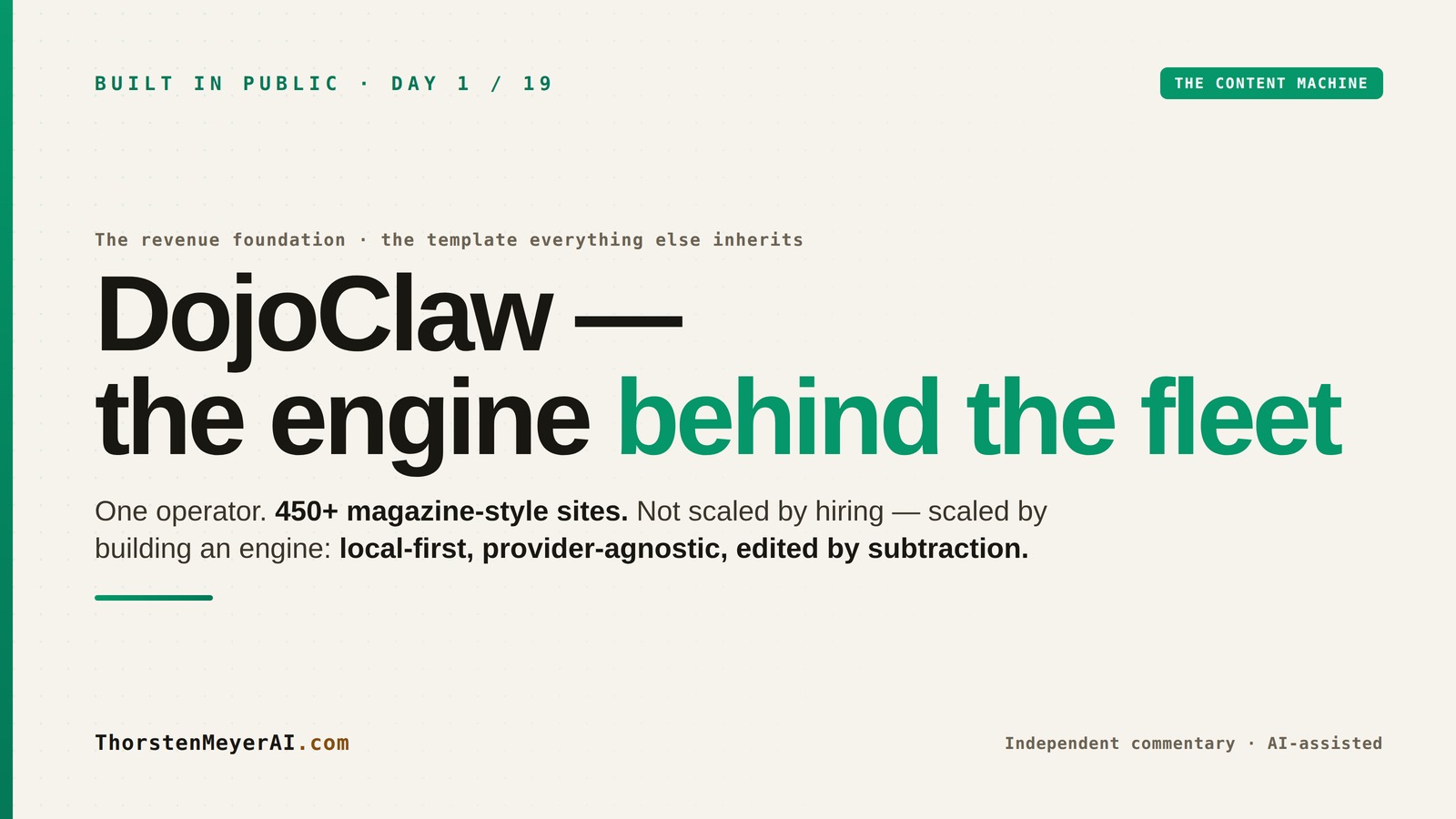
DojoClaw — the engine behind the fleet
One operator. 450+ magazine-style sites. Not scaled by hiring — scaled by building an engine, and a template every other product inherits.
Local inference meter — where the work runs
Target: 70–90% of inference local. Rented cloud is a cost line that climbs with every page you publish. Owned compute is paid once, then ridden — so the marginal cost of the next page falls toward the price of electricity. Cloud frontier models are routed in only for the work that genuinely needs them.
Independent commentary, produced with AI assistance under human editorial oversight. The views are the author’s own and may change. Portions of the products described generate content via automated AI pipelines and may contain errors — verify independently before relying on any of it for a decision. As an Amazon Associate the author earns from qualifying purchases; pages across the fleet may contain affiliate links. Product and company names are trademarks of their respective owners; mention does not imply endorsement.
What DojoClaw actually does
Strip away the jargon and DojoClaw is a factory. Raw material goes in at one end — a topic, a product category, a cluster of search queries. Finished goods come out the other — a published page, on-brand, internally linked, and set up to earn.
The unglamorous part is what makes it a business rather than a demo. A factory is only worth building if it runs reliably, repeatedly, and cheaply enough that each unit of output costs far less than it returns. A clever one-off article generator is a toy. An engine that can produce defensible pages across hundreds of sites, day after day, without a proportional increase in headcount, is operating leverage — and operating leverage is the whole point.
That leverage is why one operator can stand behind a fleet this size. The work that used to require a newsroom — research, drafting, formatting, publishing, internal linking, monetization — is orchestrated by agentic AI under editorial oversight. The human role shifts from producing every page to designing the system that produces them and deciding what is good enough to ship.

The Amazon Management System: The Ultimate Digital Business Engine That Creates Extraordinary Value for Both Customers and Shareholders
As an affiliate, we earn on qualifying purchases.
As an affiliate, we earn on qualifying purchases.
The economics: owned compute over rented cloud
Here is where the business model gets interesting, and where most "AI content" operations quietly bleed margin.
Every page the engine produces costs something to generate. If that cost is paid to a cloud API on a per-token basis, then your variable cost scales linearly with your output — exactly the trap the workforce model fell into, just with GPUs instead of freelancers. Grow the fleet, grow the bill. At meaningful volume, cloud inference alone can run into four figures a month.
The lever I pulled was to move most of that inference off rented cloud and onto owned compute — a local fleet of Apple Silicon machines running open-weight models. The economics change shape entirely. Owned hardware is a fixed, one-time capital cost that amortizes over years; once it is paid for, the marginal cost of an additional page drops toward the price of electricity. The target is to keep 70–90% of inference local, reserving paid cloud calls for the work that genuinely needs a frontier model.
The point is not that local is always cheaper in the first month — it isn't. The point is what the cost curve does over time. Rented cloud is a line that climbs forever with your output. Owned compute is a step you pay once, then ride. For a business whose entire premise is high-volume production, which curve you sit on is the difference between a margin that compounds and one that erodes.

Introduction To ChatGPT: Supercharge Your Productivity With AI - Create Apps, Websites, Google Chrome Extensions & Much More (Artificial Intelligence Uses & Applications)
As an affiliate, we earn on qualifying purchases.
As an affiliate, we earn on qualifying purchases.
Provider-agnostic by design — the part everything else inherits
The single most important architectural decision in DojoClaw is also the most boring to describe: the engine is provider-agnostic. It does not care which model wrote a given page. Models are swappable. A local open-weight model handles the bulk of the work; a cloud frontier model can be routed in for the hard cases; and if the price, quality, or availability of any of them changes tomorrow, the engine keeps running because it was never wired to a single vendor.
In business terms, that is insurance against lock-in — and lock-in is the quiet tax that platform-dependent businesses pay without noticing. If your entire operation is welded to one provider's pricing, terms, and roadmap, then that provider effectively owns a slice of your margin and can revise it at will. A provider-agnostic core hands the negotiating leverage back to the operator. You route to whatever is best on cost and quality this quarter, and you are free to change your mind next quarter.
This is the template the rest of the portfolio copies. Every product downstream — the decision tools, the platforms, the open-source projects — is built on the same swappable-model spine, for the same reason. It is the closest thing the portfolio has to a shared piece of DNA, and DojoClaw is where it was first proven at scale. (For the long version of how the publishing network itself is structured, see the earlier piece on the publishing network.)
![MixPad Free Multitrack Recording Studio and Music Mixing Software [Download]](https://m.media-amazon.com/images/I/71ltIxIuz1L._SL500_.jpg)
MixPad Free Multitrack Recording Studio and Music Mixing Software [Download]
- Multitrack Recording and Mixing: Create mixes with audio, music, and voice tracks
- Track Customization: Apply effects and editing tools to tracks
- Music Creation Tools: Includes Beat Maker and MIDI Creator
As an affiliate, we earn on qualifying purchases.
As an affiliate, we earn on qualifying purchases.
What the engine is — and what it isn't
It is worth being precise here, because "AI runs 450 sites" is the kind of sentence that invites the wrong picture. DojoClaw is not a push-button spam machine that publishes whatever a model coughs up. If it were, it would be worthless — and short-lived — for exactly the reason the bear case below lays out.
The defensible part of the operation is not the generation. Generation is the commodity; everyone has it now. The defensible part is everything wrapped around the generation: which topics are worth pursuing, how a brand's voice stays consistent across hundreds of pages, how sites are structured and internally linked, and — most of all — the editorial gate that decides what is good enough to publish and what gets cut. That gate is where "edited by subtraction" stops being a slogan and becomes the actual job.
In business terms, this is the answer to the make-or-buy question every operator now faces. You no longer buy writing; the marginal cost of competent text has collapsed. So the value migrates to the layer the model can't do for you: judgment, taste, structure, and the discipline to ship less but better. An engine that produces volume is replaceable. An engine plus an operator who knows what to throw away is a different, harder-to-copy thing. DojoClaw is the first; the second is what the rest of this series is really about.

WordPress Revealed: How to Build a Website, Get Visitors and Make Money (Even For Beginners)
As an affiliate, we earn on qualifying purchases.
As an affiliate, we earn on qualifying purchases.
The thesis the series will keep returning to
DojoClaw makes four bets concrete, and the rest of Built in Public is really just those bets applied to different problems:
Local-first. Own the compute and hold the data where you can. Rent the frontier only when it earns its keep.
Provider-agnostic. Treat models as interchangeable parts, not as the foundation. Keep the freedom to switch.
Built by a non-developer. I do not consider myself a developer. Thirty years in ICT, yes — but the actual building here was re-enabled by agentic AI, which is a claim worth examining honestly rather than celebrating.
Edited by subtraction. The hard editorial work at fleet scale is not generating more; it is cutting — deciding what is good enough, killing what isn't, and refusing to ship hype.
Across the series, each product lights up one node of an operator constellation — a map of how the eighteen pieces connect. DojoClaw is the first node lit, and the foundation bar the others sit on. By the final essay, the whole map is illuminated.
The honest bear case
A series called Built in Public that only ever made the bull case wouldn't be worth reading, so here is the other side.
A fleet this size lives or dies on traffic it does not control. Search and discovery platforms change their algorithms and their stance on AI-assisted content on their own schedule, not mine. A single ranking shift can reprice a large chunk of the portfolio overnight. That is real concentration risk, and owning the compute does nothing to fix it.
There is also the commoditization problem. As the cost of producing competent text falls toward zero for everyone, "competent text" stops being a moat. Defensibility has to come from somewhere else — brand, data, structure, genuine usefulness — and any operation leaning on volume alone is standing on sand. The engine's value is increasingly in editorial judgment and curation, not raw output, and that is a harder thing to automate and a fairer thing to be skeptical about.
And maintenance is not free. Hundreds of sites, owned infrastructure, and a local model fleet are an ongoing operational load, not a set-and-forget asset. The leverage is real, but so is the surface area.
The bull case, stated plainly
With the risks on the table: the structural advantages are also real. Margin that improves with scale rather than degrading. Cost control and strategic freedom from a provider-agnostic core. Compounding — every site, every brand, every internal link adds to a base that keeps working. And optionality — an engine and a template that the entire rest of the portfolio could be built on, which is exactly what happened.
Whether that adds up to a durable business or a clever arrangement that the next platform shift will test is a fair question, and one this series will keep returning to honestly. But it is the foundation everything else stands on — so it is where we start.
This article was produced with AI assistance and reviewed under human editorial oversight. It is independent commentary and analysis; the views are the author's own and may change. Product, company, and service names are trademarks of their respective owners; their mention does not imply affiliation, sponsorship, or endorsement. As an Amazon Associate the author earns from qualifying purchases; pages may contain affiliate links. © 2026 Thorsten Meyer · Powered by Thorsten Meyer AI. See Imprint/Impressum and Privacy Policy.