

October 16, 2025 — Brussels
Europe has entered a new phase in its strategic push toward technological sovereignty. The European High Performance Computing Joint Undertaking (EuroHPC JU) has announced the selection of six new AI Factory sites and 13 AI Factory Antennas, expanding the continent’s distributed network of sovereign-ready artificial intelligence infrastructure.
A Continental Grid for AI Power
On October 10, 2025, EuroHPC JU designated six host sites for new AI Factories in Czechia, Lithuania, the Netherlands, Poland, Romania, and Spain. These facilities will deliver AI-optimized supercomputing power, data support, and technical training — forming a backbone for research and enterprise development in each member state.
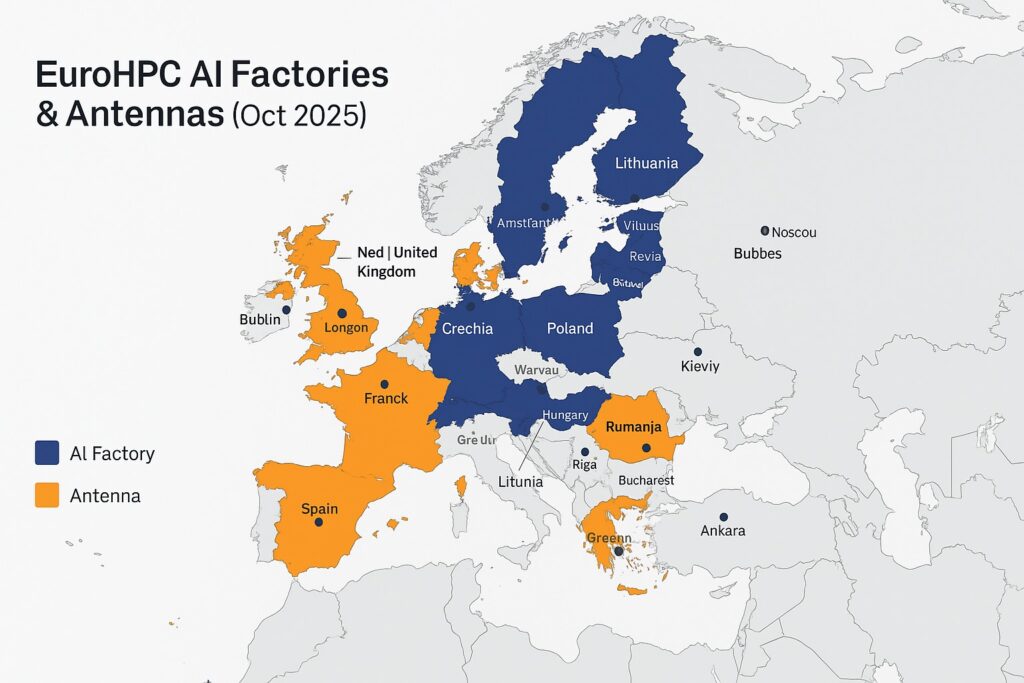
Just three days later, on October 13, EuroHPC and the European Commission jointly unveiled 13 AI Factory Antennas — lighter, interoperable nodes connecting local innovation ecosystems in Belgium, Cyprus, Hungary, Ireland, Latvia, Malta, Slovakia, and partner nations such as Iceland and the United Kingdom.
Together, these nodes extend the reach of EuroHPC’s sovereign AI ecosystem to nearly every corner of Europe.
“AI Factories and their Antennas are Europe’s bridge between compute sovereignty and digital inclusion,” said EuroHPC Executive Director Anders Dam Jensen. “They will ensure every region, not just the traditional tech centers, has access to world-class AI infrastructure.”
Top picks for "europe expand network"
Open Amazon search results for this keyword.
As an affiliate, we earn on qualifying purchases.
What Are AI Factories?
AI Factories are advanced computing hubs designed to support AI model training, data management, and experimental deployments. Each facility integrates EuroHPC’s high-performance computing systems with national cloud and data frameworks, creating secure environments optimized for AI workloads.
They serve as one-stop centers for sovereign AI development, enabling governments, startups, and research institutions to train and deploy AI models on European infrastructure — independent of U.S. or Chinese cloud providers.
| Layer | Description | Example Host Countries | Role |
|---|---|---|---|
| AI Factories | Full-scale compute centers with sovereign control | Czechia, Spain, Romania | Core training and deployment hubs |
| AI Factory Antennas | Regional extensions offering local access | Ireland, Latvia, Malta, Slovakia | Connect local innovation ecosystems |
| EuroHPC Network | Federated European AI supercomputing grid | EU-wide | Ensures interoperability and security |
Strategic Goals: Sovereignty, Security, and Scale
The expansion aligns with the European Commission’s 2024 AI Sovereignty Roadmap, which called for a “federated AI infrastructure layer” to underpin innovation under EU regulatory frameworks like the AI Act and Data Governance Act.
Key objectives include:
- Compute Sovereignty — ensuring AI systems are trained and hosted on EU-governed infrastructure.
- Energy Efficiency — leveraging EuroHPC supercomputers’ optimized architectures to reduce carbon footprints.
- Data Privacy Compliance — aligning operations with GDPR and the AI Act to safeguard personal and industrial data.
- SME Inclusion — lowering barriers for smaller firms to access compute and training resources.
By early 2026, the EuroHPC JU expects to have 19 operational AI Factories interconnected through a secure network architecture — effectively creating a European equivalent to national AI clouds.
National Impact: From Innovation Hubs to Industrial Leverage
Each newly announced Factory is expected to catalyze sectoral innovation:
- Lithuania — strengthening Baltic AI research clusters.
- Netherlands — integrating quantum and AI development under one ecosystem.
- Poland — linking national universities and energy companies to sovereign compute infrastructure.
- Spain — leveraging the MareNostrum supercomputer to power regional AI applications.
Meanwhile, AI Factory Antennas are designed for agility: providing local AI access points that can host datasets, run fine-tuning tasks, and facilitate regional AI literacy programs. This modular approach allows smaller nations or regions to participate in the AI economy without building full-scale data centers.
A Federated Future for European AI
The new AI Factory network is more than a technical initiative — it is a strategic pillar of European autonomy in the digital age. By combining regional specialization with shared European infrastructure, the EU aims to create a resilient and innovation-driven AI ecosystem.
“Europe is weaving its own digital fabric,” said EU Commissioner for the Internal Market Thierry Breton. “Our AI Factories and Antennas are the threads — connecting data, compute, and trust across borders.”
This federated approach could become a model for how democratic nations build shared infrastructure while preserving national control and accountability — a counterpoint to the centralized AI ecosystems dominated by the U.S. and China.
Outlook: Building the Next-Generation AI Economy
By 2026, Europe’s AI Factory network will anchor:
- Over €500 million in total public–private investment.
- Hundreds of AI startups gaining access to sovereign compute.
- A unified AI infrastructure standard across EU and EEA member states.
In essence, EuroHPC’s initiative transforms Europe’s patchwork of AI capacity into a connected, scalable grid — one capable of supporting the continent’s ambition to lead in trustworthy, sustainable, and sovereign AI.
Sources:
- European High Performance Computing Joint Undertaking (EuroHPC JU), October 2025 Releases
- European Commission AI Strategy 2024–2026
- EU AI Act and Digital Europe Programme