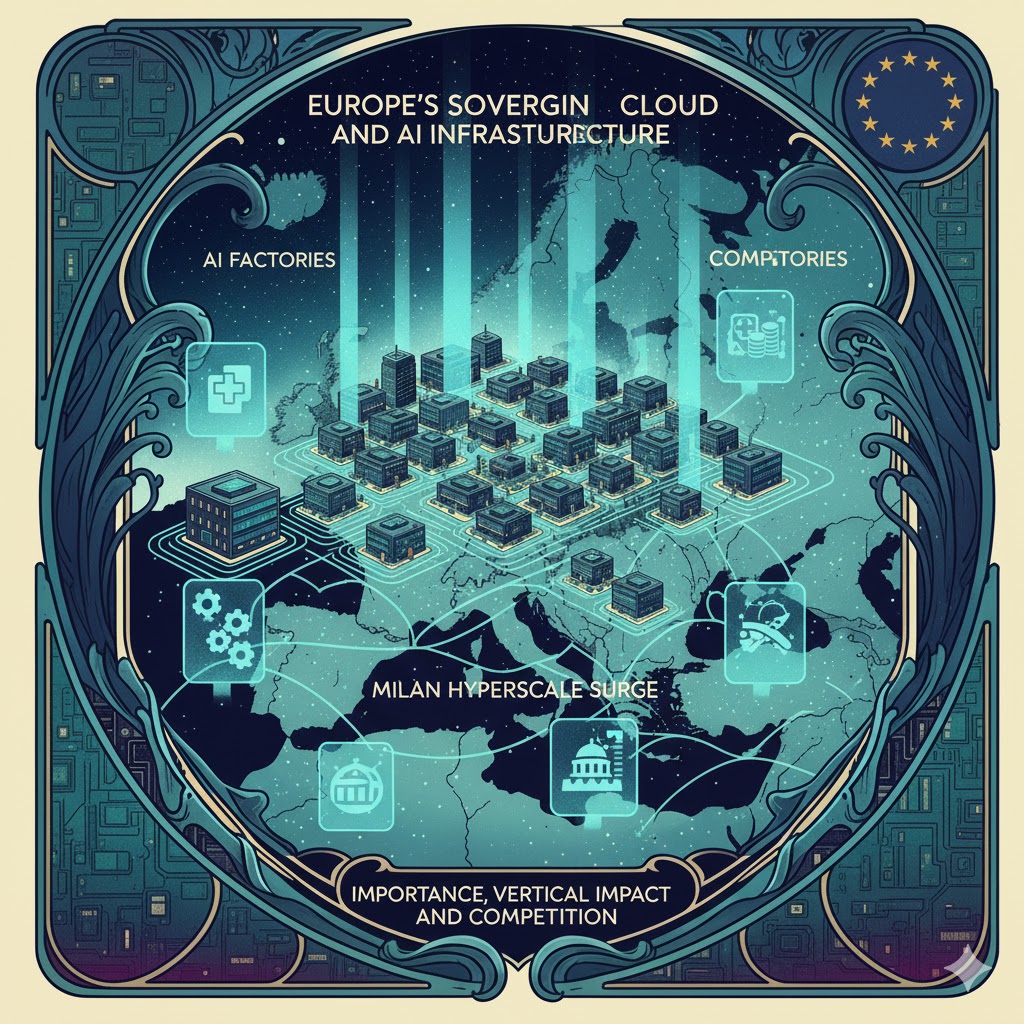

Overview – Europe’s digital autonomy push
Europe’s digital sovereignty agenda has moved from rhetoric to action. Between 2024‑25 the European Commission (EC) launched a €180 million tender under its Cloud III Dynamic Purchasing System to procure sovereign cloud services for EU institutions over six yearsdatacenterdynamics.com. The tender uses a Cloud Sovereignty Framework that evaluates providers against eight objectives – strategic, legal, data & AI sovereignty, operational control, supply‑chain transparency, technological openness, security/compliance and environmental sustainabilitycommission.europa.eu – and it will certify providers at different “Sovereignty Effectiveness Assurance Levels” by late 2025/early 2026datacenterdynamics.com. This sets a benchmark for how cloud vendors must insulate customers from extraterritorial legal claims, minimise lock‑in, deliver transparent supply chains and meet EU security and environmental standards.
The regulatory backdrop is strict: the Data Act gives EU users rights to access, share and port the data they generate while dictating how providers may use ithostingadvice.com; the Digital Operational Resilience Act (DORA) imposes resilience and local‑control requirements on financial institutions from January 2025teradata.com; and the AI Act creates risk‑based rules for AI, with high‑risk systems subject to approval and “unacceptable risk” practices prohibiteddigital-strategy.ec.europa.eu. Together with upcoming Cloud and AI Development Act provisions to triple EU data‑centre capacity and deploy 10,000 edge nodesdigital-strategy.ec.europa.eudigital-strategy.ec.europa.eu, these rules have spurred a wave of sovereign‑cloud investments, partnerships and hardware deployments.

Beyond the Public Cloud: Architecting Private, Secure, and Sovereign AI for the European Enterprise
As an affiliate, we earn on qualifying purchases.
As an affiliate, we earn on qualifying purchases.
Policy instruments and AI infrastructure build‑out
Cloud Sovereignty Framework and procurement
The EC’s Cloud Sovereignty Framework defines eight objectives (SOV‑1 to SOV‑8) that go beyond data residency. Providers must anchor services in the EU’s legal and industrial ecosystem (strategic sovereignty), shield customers from foreign jurisdictions (legal sovereignty), guarantee EU processing of data/AI assets (data & AI), enable independent operations (operational), control critical supply‑chain components (supply‑chain), avoid lock‑in and favour open technology (technology), keep security/compliance operations under EU control (security & compliance) and meet environmental sustainability goalscommission.europa.eu. Services will be certified at four “Sovereignty Effectiveness Assurance Levels” based on how completely they meet these objectives.
Building sovereign AI infrastructure
Europe is also investing in compute capacity. EuroHPC’s AI Factories programme selected six new sites (Czechia, Lithuania, Netherlands, Poland, Romania and Spain) in October 2025. Each site combines an AI‑optimised supercomputer with training, support and one‑stop services for start‑ups, SMEs and researcherseurohpc-ju.europa.eu. This network gives European innovators access to local compute and expertise while ensuring AI models are trained and deployed in EU‑controlled environments.
Private investment is ramping up. AI‑infrastructure firm Nscale signed a US $14 billion contract with Microsoft to deliver around 200,000 NVIDIA GB300 GPUs across Europe and the US. The deal includes 104,000 GPUs for a Texas campus and 12,600 GPUs for Portugal’s Start Campus (Europe’s first GB300 deployment), with deliveries beginning in Q3 2026nscale.com. The project follows Nscale’s 2024‑25 deals to build the UK’s largest AI supercomputer and a 1.2‑GW site in Norwaydatacenterdynamics.com. These facilities are marketed as sovereign AI clouds that keep European data and models within the EU.
AI training supercomputers Europe
As an affiliate, we earn on qualifying purchases.
As an affiliate, we earn on qualifying purchases.
Impact across verticals
Healthcare – compliance and patient trust
Health data are among the most sensitive data categories. According to a July 2025 study by Corti and ICThealth, 37 % of European organisations had already adopted sovereign cloud solutions and another 44 % planned to do so by 2025icthealth.org. Sovereign healthcare clouds enable hospitals and telecare providers to process medical records, telemedicine feeds and AI‑diagnosis models locally, ensuring compliance with GDPR, the AI Act and national health‑data lawsicthealth.org. By disconnecting from US hyperscaler infrastructure, providers avoid extraterritorial data access (e.g., US CLOUD Act). The Corti initiative also addresses Europe’s healthcare worker shortage: AI tools can triage calls and monitor chronic conditions, reducing staff workloads while preserving privacyicthealth.org. With the global healthcare‑AI market projected to reach €187.69 billion by 2030, Europe’s sovereign infrastructures aim to capture value without compromising ethicsicthealth.org.
Financial services – risk resilience and regulatory alignment
Banks and insurers face some of Europe’s strictest digital‑resilience rules. The Digital Operational Resilience Act (DORA), in force from January 2025, requires financial institutions to maintain operational independence from critical third‑party ICT providers; the AI Act will apply between 2026‑27teradata.com. Teradata notes that many European banks are localising data and workloads to comply with GDPR, DORA and potential AI‑Act obligations, but warns that sovereignty alone is not enough – institutions must also implement strong governance, auditability and production‑scale AIteradata.com. The sovereign cloud market for financial services is expected to grow rapidly; analysts predict the global sovereign‑cloud market will reach €160 billion by 2028 (CAGR ≈36 %)teradata.com. Sovereign solutions provide banks with control over encryption keys and operational autonomy, reducing exposure to foreign legal orders while enabling innovation in algorithmic trading, risk modelling and personalised finance.
Public sector – autonomy for critical systems and citizen data
Public administrations and justice–home affairs agencies handle highly sensitive data. EU agency eu‑LISA emphasises that sovereign clouds must offer full control and compliance for high‑security public institutions, supporting mission‑critical systems (e.g., border management databases and law‑enforcement tools) while ensuring data cannot be accessed from outside the EUeulisa.europa.eu. This drives a hybrid multi‑cloud strategy where some workloads run on sovereign public clouds and others remain on‑premises or in national “partner clouds” to balance flexibility with controleulisa.europa.eu. Deloitte advises governments to prioritise data security, encryption‑key control and resilience; rather than trying to beat hyperscalers on scale, Europe should develop partnerships and open standards that guarantee survivability and competitivenessdeloitte.com.
Manufacturing and industrial AI – leveraging Europe’s strengths
Europe’s manufacturing sector benefits from AI when compute and data remain under EU control. An RCR Wireless analyst writes that Europe is pursuing vertical integration of AI and hardware – exemplified by the ASML–Mistral AI partnership, which uses AI to design extreme‑ultraviolet (EUV) lithography machines and optimise semiconductor manufacturingrcrwireless.com. AI‑driven predictive maintenance improves yield and reduces downtime, while simulation models can optimise energy usagercrwireless.com. However, Europe’s compute capacity lags behind global peers; Nscale’s UK AI campus (50 MW with ~45,000 GPUs) and its 1.2‑GW Norwegian site help bridge the gap but still fall short of US hyperscaler build‑outsrcrwireless.comrcrwireless.com. By deploying sovereign AI infrastructure, manufacturers can incorporate sensitive design data and proprietary process knowledge without risking extraterritorial access, and they can align with the EU’s climate goals by choosing facilities powered by renewable energy.
Telecommunications and connectivity – network sovereignty
Europe’s connectivity ecosystem is valued at about €1 trillion, representing 4.7 % of EU GDPconnecteurope.org. However, the State of Digital Communications 2025 report highlights a “now‑or‑never” moment for Europe to control its connectivity value chainconnecteurope.org. The region lags global peers on 5G Standalone coverage (40 % in Europe vs 91 % in North America)connecteurope.org and on edge‑cloud deployment, with only 320 live operator edge nodes compared with the EU’s target of 10,000connecteurope.org. While Europe leads in open‑RAN trials, network fragmentation and low capital spending hamper innovationconnecteurope.org. Sovereign cloud and AI infrastructure can help telecom operators by enabling edge clouds for latency‑sensitive services and by providing AI‑driven RAN optimisation, which 52 % of European operators are already triallingconnecteurope.org. Locally deployed network clouds protect operational data from foreign jurisdiction and allow critical network functions (e.g., core routers, signal routing, lawful interception) to remain under EU control.
SMEs and start‑ups – democratising AI access
Small and medium enterprises (SMEs) often lack the resources to negotiate complex data‑residency agreements. The EuroHPC AI Factories network acts as a one‑stop shop offering compute, training and expertise for start‑ups and SMEseurohpc-ju.europa.eu. Each site is integrated into regional ecosystems (e.g., Lithuania’s LitAI Factory emphasises cybersecurity, green energy and digital health)eurohpc-ju.europa.eu. By providing high‑performance compute within EU borders, these centres democratise access to AI while ensuring compliance with EU laws. SMEs can build models on sensitive data (e.g., medical records, industrial telemetry) without resorting to foreign hyperscalers.

LOCALIZED AI AND DATA SOVEREIGNTY: Building Private Large Language Model Clusters with On-Premises Control and Global Data Governance Standards (The Sovereign Cloud Architect Series)
As an affiliate, we earn on qualifying purchases.
As an affiliate, we earn on qualifying purchases.
Industry competition and provider landscape
European providers and partnerships
Europe’s indigenous cloud providers are leaning into sovereignty as a differentiator. OVHcloud, Scaleway and Deutsche Telekom (Open Telekom Cloud/IONOS) emphasise full EU control of data, hardware and softwarehostingadvice.com. OVHcloud’s partnership with Almaviva aims to deliver sovereign cloud solutions tailored to finance, healthcare and telecom sectors under the new Data Acthostingadvice.com. The Data Act grants users rights to access, share and transfer data they generate and governs how companies may use ithostingadvice.com, making partnerships with companies experienced in public‑sector IT essentialhostingadvice.com. The region’s cloud market is splitting into two camps: EU providers doubling down on sovereignty and US hyperscalers localising their infrastructurehostingadvice.com.
European start‑ups are also emerging as neocloud providers. Nscale, CoreWeave and OpenAI’s Stargate project specialise in GPU‑as‑a‑service for AI workloads. Synergy Research Group estimates that neocloud revenue surpassed US $5 billion in Q2 2025 (205 % year‑over‑year) and predicts it will exceed US $23 billion in 2025computerweekly.com. Although financing, power supply and hardware shortages pose challenges, neocloud revenue could reach US $180 billion by 2030computerweekly.com. These providers allow European customers to rent large GPU clusters without relying on hyperscalers, and deals such as Nscale’s 200,000‑GPU contract with Microsoft underscore their growing influencenscale.com.
Hyperscalers and hybrid models
US hyperscalers are responding by localising operations and offering sovereignty features:
- Microsoft launched a Sovereign Public Cloud that keeps data and operations within Europe, staffed by European personnel, and provides tools such as Data Guardian (European‑only remote access control), External Key Management (customer‑controlled encryption keys) and Regulated Environment Management for monitoring and auditingblogs.microsoft.comblogs.microsoft.com. A Sovereign Private Cloud lets customers run workloads on‑premises or in partner‑operated data centres (e.g., Bleu in France, Delos Cloud in Germany) with full controlblogs.microsoft.com. Microsoft 365 Local ensures productivity data remain in‑countryblogs.microsoft.com. Microsoft’s partnership with Nscale to deploy tens of thousands of GB300 GPUs and its involvement in UK, Portugal and Norway projects signal a strategy to co‑design sovereign AI infrastructure.
- Amazon Web Services (AWS) plans to launch an independently operated European Sovereign Cloud in Brandenburg by end 2025, backed by a €7.8 billion investmentfuturumgroup.com. The environment will be separate from existing AWS regions, offering enhanced security and compliance features for regulated industriesfuturumgroup.com. AWS’s partnership with SAP will allow SAP’s sovereign‑cloud capabilities (e.g., Business Technology Platform and Cloud ERP) to run on AWS’s sovereign infrastructurenews.sap.com.
- Oracle has entered the EU sovereign‑cloud market with an EU Sovereign Cloud Service hosted in Spain and Germany, providing access to more than 100 cloud services at the same prices as other regionsfuturumgroup.com. Oracle has agreed to integrate its cloud infrastructure into the EU administration’s offerings, though its limited regional availability and customer references present challengesfuturumgroup.com.
- Google Cloud offers a Sovereign Solutions portfolio, taking a do‑it‑yourself (DIY) approach whereby customers tailor sovereignty requirements using Google tools and partner solutionsfuturumgroup.com. While flexible, this model lacks the comprehensive assurance features provided by some competitorsfuturumgroup.com.
On‑premises and hybrid hardware – Cisco’s example
Sovereignty concerns extend beyond compute to network hardware. In September 2025 Cisco introduced a Sovereign Critical Infrastructure portfolio. Instead of new products, Cisco created licences for existing routers, switches, access points and collaboration devices that allow them to operate fully air‑gapped – completely isolated from Cisco’s cloud and managed on‑premisestechzine.eu. The products provide identical functionality to the mainstream versions at deployment but do not report status back to Cisco, ensuring organisations (particularly governments, banks and healthcare providers) retain full controltechzine.eu. Cisco emphasised Europe’s importance and is working to comply with the EU Cybersecurity Certification Schemetechzine.eu. This move shows that sovereign infrastructure extends down the stack to networking gear.
European AI cloud solutions
As an affiliate, we earn on qualifying purchases.
As an affiliate, we earn on qualifying purchases.
Implications and future outlook
Europe’s sovereign cloud push reflects a strategic realignment: data and AI capabilities are recognised as critical assets comparable to energy or defence. By setting clear criteria for sovereignty (through the Cloud Sovereignty Framework), investing in AI compute capacity (via AI Factories and neocloud deals) and mandating resilience through regulations like DORA and the AI Act, Europe aims to control its digital destiny.
Vertical impact: Healthcare providers gain compliant AI tools and patient trust; banks achieve regulatory alignment and autonomy; public authorities ensure control over sensitive systems; manufacturers leverage AI while protecting trade secrets; telecom operators pursue network sovereignty and edge innovation; and SMEs access local AI resources. Each vertical benefits not just from data residency but from operational control, supply‑chain transparency and open‑technology requirements.
Competition: The market is diverging. European providers leverage deep local alignment, transparency and open‑source compatibility to compete on trust; hyperscalers localise their infrastructure and offer technical controls to retain clients; neocloud startups capture the booming AI workload segment; and hardware vendors like Cisco deliver air‑gapped solutions for regulated sectors. According to Synergy Research, neocloud revenue is projected to exceed US $23 billion in 2025 and could reach $180 billion by 2030computerweekly.com, highlighting new competitive dynamics. Meanwhile the EC’s tender will certify up to four providers by early 2026datacenterdynamics.com, setting a high bar for sovereignty and likely influencing procurement across all verticals.
In the next few years, the success of Europe’s sovereign cloud initiative will hinge on whether these investments deliver scalable, sustainable and competitive alternatives. The region must balance autonomy with collaboration, avoid fragmented standards and invest in energy‑efficient infrastructure. If executed effectively, Europe could become a leader in ethical, trustworthy AI and digital services – setting a model for how nations can secure digital sovereignty without stifling innovation.