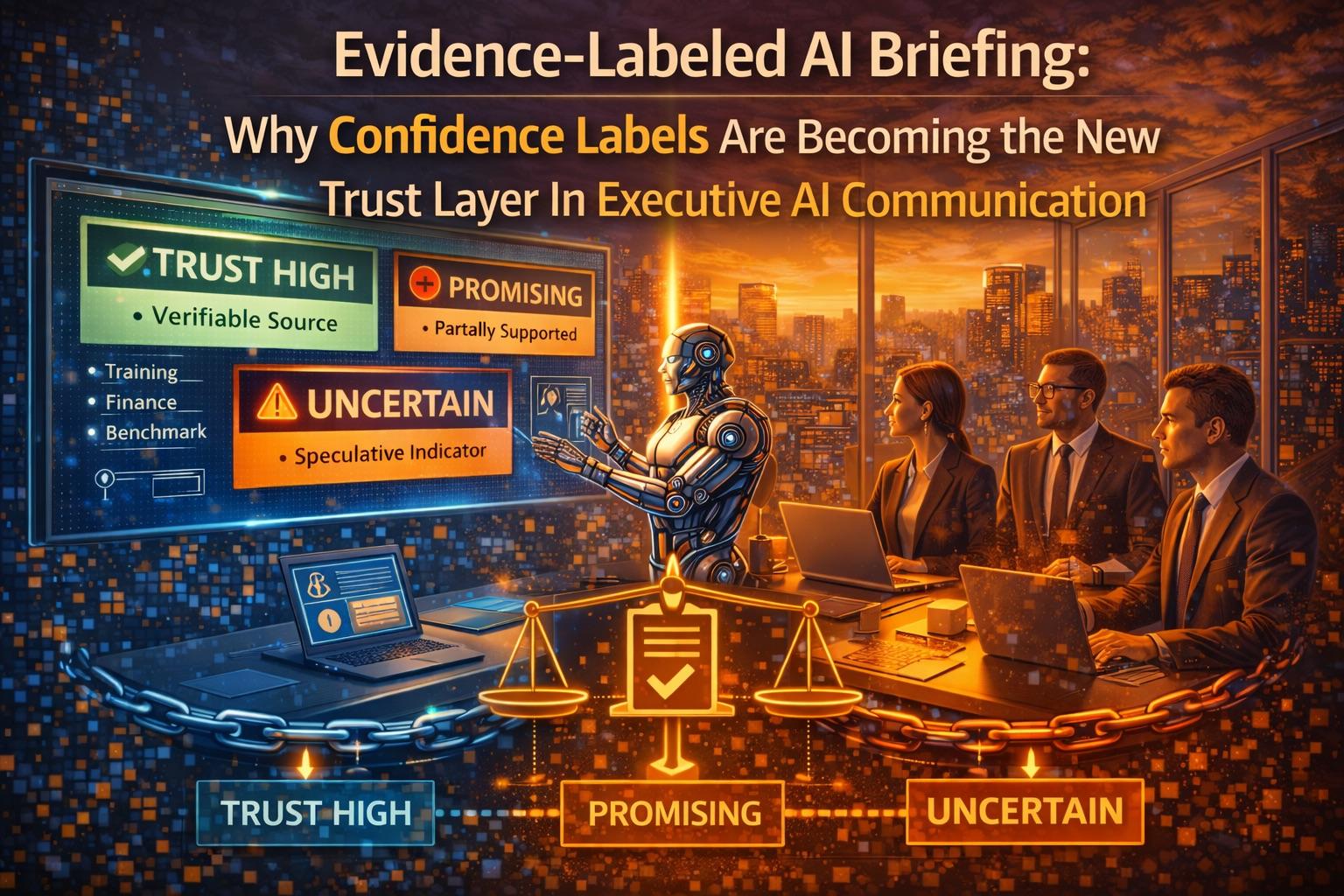
Thorsten Meyer | ThorstenMeyerAI.com | February 2026
Executive Summary
AI briefings are getting faster, denser, and more frequent — but not necessarily more reliable. 90% of online content is projected to be AI-generated by 2026 (Gartner). 47% of marketers encounter AI inaccuracies weekly. Only 15% of B2B decision-makers rate thought leadership quality as “very good” or “excellent” (Edelman-LinkedIn). 71% say less than half the thought leadership they consume provides valuable insights. The volume is up. The signal quality is down.
For enterprise decision-makers, the cost of acting on weakly evidenced claims is rising: strategic misallocation, procurement errors, compliance exposure, and credibility loss with stakeholders. 95% of GenAI pilots fail meaningful impact (MIT). 40%+ of agentic AI projects will be canceled by 2027 (Gartner). These are not technology failures. They are decision failures — driven by overconfident narratives built on weak evidence.
The next evolution in AI communication is straightforward: evidence-labeled briefings. Every major claim carries a confidence tag, source-quality marker, and uncertainty note. This is not academic rigor theater. It is an operational control mechanism for faster, safer decision-making. Organizations that adopt this discipline will make better bets, waste less capital, and build the credibility that — in a world where 73% of B2B buyers trust thought leadership over marketing materials — converts directly to commercial advantage.
| Metric | Value |
|---|---|
| Online content AI-generated by 2026 | 90% (Gartner) |
| Marketers: AI inaccuracies weekly | 47% |
| Thought leadership rated “very good/excellent” | 15% (Edelman-LinkedIn) |
| TL providing valuable insights | <50% (71% say) |
| TL more trustworthy than marketing | 73% (Edelman-LinkedIn) |
| Willing to pay premium for TL | 60% (Edelman-LinkedIn) |
| Decision-makers: 1+ hr TL weekly | 52% (54% C-level) |
| Invited unconsidered vendors via TL | 86% (if consistent quality) |
| GenAI pilots failing meaningful impact | 95% (MIT) |
| Agentic AI projects canceled by 2027 | 40%+ (Gartner) |
| Companies abandoning AI initiatives | 42% |
| CFOs satisfied with AI value delivered | 20% |
| CIOs: data requires cleanup for AI | 94% |
| Zero-trust data governance by 2028 | 50% of orgs (Gartner) |
| Orgs rejecting “black box” AI by 2026 | Growing consensus |
Top picks for "label evidence brief"
Open Amazon search results for this keyword.
As an affiliate, we earn on qualifying purchases.
1. The Problem: Speed Has Outpaced Epistemic Discipline
Most executive AI updates currently mix hard data, directional indicators, and speculative interpretation — without clearly signaling which is which.
The Three Failure Modes
| Failure Mode | What Happens | Cost |
|---|---|---|
| Confidence inflation | Weak claims presented with strong language | Decision-makers treat speculation as fact |
| Decision contamination | One unsupported claim distorts downstream priorities | Resource misallocation, strategy drift |
| Trust erosion | Audiences become skeptical of all insights, including strong ones | Credibility collapse, engagement decline |
In a high-velocity environment where AI briefings arrive daily, these failure modes compound. When everything sounds certain, nothing feels reliable.
The Evidence Quality Gap
| What Executives Receive | What Executives Need |
|---|---|
| “AI will transform procurement” | Which procurement tasks, by when, with what evidence? |
| “Gartner predicts…” (without context) | What was the methodology, sample, and confidence level? |
| “The market will reach $X trillion” | What are the assumptions, and what would change the estimate? |
| “Enterprises are adopting at scale” | What percentage, which industries, at what maturity level? |
| “This changes everything” | What specifically changes, for whom, and under what conditions? |
The gap is not between good writing and bad writing. It is between calibrated communication and uncalibrated communication. The first enables decision-making. The second produces the 95% pilot failure rate.
Why the Volume Problem Makes This Worse
| Content Environment | Value |
|---|---|
| Online content AI-generated (2026) | 90% (Gartner) |
| AI inaccuracies encountered weekly | 47% of marketers |
| TL quality rated “very good” or better | 15% |
| TL providing valuable insights | <50% (per 71% of consumers) |
| Content oversaturation reported | 38% (Edelman-LinkedIn) |
| AI-generated data: unverified proliferation | 50% of orgs adopting zero-trust by 2028 (Gartner) |
The more content that exists, the harder it is to distinguish signal from noise. 90% AI-generated content by 2026 means decision-makers are swimming in confident-sounding prose — most of which has no evidence chain. The confidence label is not a luxury. It is the filter that makes the volume manageable.
2. Why This Now Matters at Board and C-Suite Level
Enterprise leadership teams are no longer evaluating AI as a peripheral innovation stream. They are making operating-model decisions with budget, workforce, and risk implications.
The Decision Stakes Have Changed
| Decision Type | Evidence Requirement | Cost of Error |
|---|---|---|
| AI budget allocation ($85K+ monthly avg) | Strong: ROI data, pilot results | Millions in misallocated capital |
| Workforce transformation (32% retrained) | Strong: task analysis, redeployment data | Organizational capability erosion |
| Vendor/platform selection | Strong: benchmark data, compliance evidence | Lock-in, integration costs |
| Regulatory compliance posture | Strong: regulatory text, legal analysis | Fines, procurement exclusion |
| Competitive positioning | Moderate: market signals, directional data | Strategic drift |
| Horizon technology bets | Weak (acceptable): early signals | Over-investment in unproven paths |
The quality standard for AI briefings should resemble the standard for finance or legal memos: explicit assumptions, traceable evidence, and clear confidence boundaries. CFOs do not present board-level financial projections without assumptions and sensitivity analysis. AI strategy briefings should not present strategic claims without evidence labels and confidence boundaries.
The Commercial Value of Credibility
| Credibility Signal | Business Impact | Source |
|---|---|---|
| TL more trustworthy than marketing | 73% of B2B buyers | Edelman-LinkedIn |
| Willing to pay premium for quality TL | 60% of decision-makers | Edelman-LinkedIn |
| Invited new vendor based on TL | 86% (if consistent quality) | Edelman-LinkedIn |
| TL-driven research → became customer | 23% conversion | Edelman-LinkedIn |
| C-suite: 1+ hr TL weekly | 54% | Edelman-LinkedIn |
| TL prompted research into new product | 75%+ | Edelman-LinkedIn |
73% of B2B buyers trust thought leadership over marketing materials. 60% will pay a premium for companies with quality thought leadership. 86% would invite an unconsidered vendor based on consistent quality content. The commercial incentive for evidence-labeled communication is direct: credibility converts to consideration, which converts to revenue.
Without evidence labels, “thought leadership” becomes strategic liability — confident prose that cannot withstand the scrutiny of a procurement committee, a board question, or a regulatory review.
3. What an Evidence-Labeled AI Briefing Looks Like
A strong format includes four mandatory components per key claim.
The Four Components
| Component | Purpose | Format |
|---|---|---|
| Claim statement | Concise, decision-relevant assertion | One sentence, specific and actionable |
| Evidence quality tag | Source reliability classification | Strong / Moderate / Weak |
| Confidence score | Likelihood the claim holds under scrutiny | High / Medium / Low |
| Uncertainty note | What could invalidate or change the claim | One line, specific |
Evidence Quality Classification
| Tag | Definition | Examples |
|---|---|---|
| Strong | Primary data, audited report, direct filing, peer-reviewed | Gartner survey (n=X), SEC filing, published study |
| Moderate | Reputable secondary source, partial corroboration | Industry report with methodology, expert analysis with data |
| Weak | Directional signal, early commentary, anecdotal | Conference statement, single vendor claim, blog post |
Example: Labeled vs Unlabeled
| Unlabeled (Common) | Evidence-Labeled |
|---|---|
| “AI will automate 60% of jobs” | Claim: 60% of jobs face significant task-level changes (not elimination). Evidence: Strong (National University, Anthropic). Confidence: High. Uncertainty: “Task change” ≠ “job loss”; actual elimination rate is 11.7%. |
| “The agentic AI market is exploding” | Claim: Agentic AI market growing at 44.8% CAGR (2025–2030). Evidence: Moderate (market research estimate). Confidence: Medium. Uncertainty: Market sizing depends on agentic definition; actual enterprise adoption at <5% currently. |
| “Enterprises are abandoning AI” | Claim: 42% of companies with significant AI investments have abandoned initiatives. Evidence: Strong (S&P Global). Confidence: High. Uncertainty: “Abandoned” may include scope reduction, not total exit; selection effects in survey sample. |
The labeled version is not slower. It is more useful — the reader can immediately assess whether to act, wait, or investigate further.
4. The Operational Payoff
Evidence-labeled briefings produce measurable benefits across four dimensions.
Benefit 1: Faster Executive Alignment
| Without Labels | With Labels |
|---|---|
| 30-minute debate: “Is this real?” | 5-minute scan: evidence tag answers the question |
| Loudest voice wins | Strongest evidence wins |
| Decision deferred for “more research” | Decision made at appropriate confidence level |
| Revisit same claims repeatedly | Claim correction loop updates stale assumptions |
Less debate about “what is true,” more focus on “what to do.”
Benefit 2: Better Resource Allocation
| Allocation Error | Label That Prevents It |
|---|---|
| $2M bet on “Gartner says…” | Evidence tag: Moderate. Confidence: Medium. Uncertainty: market sizing methodology unclear. |
| Reorg based on “AI will eliminate X role” | Evidence tag: Weak. Confidence: Low. Uncertainty: task-level change, not role elimination. |
| Vendor selection based on benchmark claims | Evidence tag: Weak. Confidence: Low. Uncertainty: vendor self-reported, no independent verification. |
Fewer strategic moves driven by trend noise. The 95% GenAI pilot failure rate and 42% abandonment rate are evidence of resource allocation contaminated by uncalibrated confidence.
Benefit 3: Lower Reputational Risk
| Risk Scenario | How Labels Protect |
|---|---|
| Board member challenges a claim | “That was labeled Moderate/Medium — here’s what we said could change it” |
| Regulator questions AI strategy basis | Evidence chain is documented and traceable |
| Competitor exploits your overconfident claim | “We explicitly noted the uncertainty” |
| Media quotes your briefing out of context | Label provides defensible qualification |
Transparent uncertainty builds audience trust. In a world where 73% of buyers trust thought leadership over marketing, the credibility premium is commercial.
Benefit 4: Better Cross-Functional Execution
| Function | What Labels Enable |
|---|---|
| Legal | Can assess regulatory claims without re-researching |
| Policy | Can distinguish mandatory compliance from directional guidance |
| Strategy | Can calibrate investment to evidence strength |
| Operations | Can prioritize implementation by confidence level |
| Communications | Can accurately represent organizational position |
Legal, policy, strategy, and operations teams act from the same confidence map. No function over-invests because another function’s briefing sounded more certain than the evidence justified.
5. Implementation Model
The Two-Lane Briefing System
| Lane | Purpose | Content Rules |
|---|---|---|
| Lane A: Decision-Grade Signal | Claims ready for action | 3–5 claims max. Strong/Moderate evidence only. Clear action recommendation. Confidence High or Medium. |
| Lane B: Horizon Scanning | Early signals to monitor | Weak evidence acceptable. Explicit “monitor, don’t act yet” framing. Trigger conditions for escalation to Lane A. |
This avoids a common error: treating frontier curiosity as immediate strategic imperative. Lane B signals become Lane A when evidence strengthens — not when the narrative gets louder.
The Claim Correction Loop
| Cycle | What Happens |
|---|---|
| Weekly | Review Lane A claims: any evidence changed? Upgrade or downgrade confidence. |
| Monthly | Review Lane B: any signals strengthened? Promote to Lane A or archive. |
| Quarterly | Full audit: which claims held? Which failed? Calibrate team’s confidence accuracy. |
The correction loop is the mechanism that prevents stale assumptions from accumulating. Without it, confidence labels degrade into decoration.
Common Objections — and Why They Fail
| Objection | Response |
|---|---|
| “Confidence tags slow us down” | Standardized template increases speed after week one. A 4-field label takes 30 seconds per claim. |
| “Executives don’t need methodology” | They don’t need full methodology — they need calibrated certainty for high-impact decisions. |
| “It makes us sound less authoritative” | The opposite. Explicit uncertainty signals credibility, maturity, and intellectual control. 73% trust TL over marketing precisely because of perceived rigor. |
| “Our competitors don’t do this” | That’s the advantage. 15% rate TL quality as excellent. Evidence labels put you in the 15%. |
6. Practical Actions
Action 1: Standardize a One-Page Evidence-Labeled Briefing Format
| Section | Content | Length |
|---|---|---|
| Header | Topic, date, author, classification (Lane A/B) | 1 line |
| Claims (3–5) | Claim + Evidence tag + Confidence + Uncertainty note | 3–5 blocks |
| Action recommendation | What to do based on current evidence | 2–3 sentences |
| Watch triggers | Conditions that would change the recommendation | 2–3 bullets |
Adopt this format across all AI strategy outputs — internal briefings, board presentations, advisory documents, and client-facing materials.
Action 2: Require Confidence Tags for All Externally Facing AI Claims
Every public-facing AI claim — in reports, presentations, procurement responses, and marketing — should carry an evidence quality tag. The discipline protects against:
- Overconfident claims that get challenged publicly
- Procurement evaluators who verify claims against evidence
- Regulatory reviewers who assess basis for AI-related decisions
Action 3: Limit “High-Confidence” Labels to Strong, Current Evidence
| Confidence Level | Evidence Requirement | Recency Requirement |
|---|---|---|
| High | Strong (primary data, audited, peer-reviewed) | Within 6 months |
| Medium | Moderate (reputable secondary, partial corroboration) | Within 12 months |
| Low | Weak (directional, anecdotal, early signal) | Any |
The temptation is to label everything “High” to sound authoritative. The discipline is the opposite: High confidence is earned, not asserted. Over-labeling destroys the system’s credibility.
Action 4: Build a Weekly Claim Correction Loop
Every week, review active claims:
- Has new evidence emerged that strengthens or weakens the claim?
- Has the source been updated, corrected, or contradicted?
- Has the confidence level shifted based on market developments?
- Should any Lane B signals be promoted to Lane A?
The correction loop is what makes evidence-labeled briefings a living system rather than a static document.
Action 5: Train Teams to Separate “Actionable Now” from “Watchlist Only”
| Signal Type | Team Posture | Example |
|---|---|---|
| Lane A: High/Medium confidence | Act: allocate resources, make decisions | “90% B2B buying agent-intermediated by 2028 (Gartner)” |
| Lane B: Low confidence, strong directional | Watch: monitor weekly, define escalation triggers | “Agent-to-agent payment protocols emerging” |
| Lane B: Low confidence, weak directional | Note: quarterly review only | “Quantum computing may affect AI model training” |
The separation prevents two errors: acting too early on weak signals (wasting resources) and ignoring strong signals because they arrived in a noisy channel (missing opportunities).
What to Watch
Procurement and board teams asking for confidence-labeled strategy documents by default. As AI investment decisions grow in magnitude — $85K+ monthly average spend, workforce transformation affecting 32% of employees — procurement committees and boards will demand the same evidence rigor they require for financial projections. The organization that arrives with labeled briefings wins the credibility test.
Editorial and advisory brands differentiating on evidence quality, not content volume. In a world where 90% of content is AI-generated and only 15% is rated excellent, the brands that differentiate on evidence discipline — not volume — will capture the premium audience. 60% of decision-makers pay premiums for quality thought leadership. The evidence label is the visible marker of that quality.
Growing penalties for overconfident, under-evidenced AI narratives. Commercial penalties (lost procurement, damaged credibility) and regulatory penalties (compliance scrutiny, disclosure requirements) are converging on organizations that make AI claims without evidence chains. The Gartner prediction that 50% of organizations will adopt zero-trust data governance by 2028 reflects the institutional response to uncalibrated confidence.
The Bottom Line
90% of content is AI-generated. 15% is rated excellent. 73% of B2B buyers trust thought leadership over marketing. 60% pay premiums for quality. 95% of GenAI pilots fail. 42% abandon AI initiatives. The gap between AI narrative confidence and AI evidence quality is where strategic capital gets wasted.
Evidence-labeled briefings close that gap. Four components per claim: statement, evidence tag, confidence score, uncertainty note. Two lanes: decision-grade signal and horizon scanning. A weekly correction loop. The operational payoff: faster alignment, better allocation, lower reputational risk, and cross-functional execution from the same confidence map.
The firms that adopt evidence discipline in their AI communication will make better bets, waste less capital, and build the credibility that — in 2026 — is the scarcest strategic resource.
In a world where everything sounds confident, the organization that can show its evidence chain doesn’t just earn trust — it earns the right to be heard.
Thorsten Meyer is an AI strategy advisor who has noticed that the fastest way to lose credibility in 2026 is to present a Weak/Low claim as if it were Strong/High — and the second-fastest way is to not know the difference. More at ThorstenMeyerAI.com.
Sources
- Gartner — 90% Online Content AI-Generated by 2026
- Gartner — 50% of Organizations: Zero-Trust Data Governance by 2028
- Gartner — 40%+ Agentic AI Projects Canceled by 2027
- MIT — 95% GenAI Pilots Fail Meaningful Impact
- S&P Global — 42% Companies Abandoning AI Initiatives
- Edelman-LinkedIn — 73% B2B Buyers: TL More Trustworthy Than Marketing (2024)
- Edelman-LinkedIn — 60% Willing to Pay Premium for Quality TL
- Edelman-LinkedIn — 86% Would Invite Unconsidered Vendor Based on Consistent Quality TL
- Edelman-LinkedIn — 15% Rate TL Quality “Very Good” or “Excellent”
- Edelman-LinkedIn — 71% Say <50% of TL Provides Valuable Insights
- Edelman-LinkedIn — 52% Decision-Makers Consume 1+ Hr TL Weekly (54% C-Level)
- Edelman-LinkedIn — 75%+ TL Prompted Research Into New Products
- Edelman-LinkedIn — 23% TL-Driven Research Converted to Customer
- Edelman-LinkedIn — 38% Report Content Oversaturation
- ISACA — AI Answers Becoming Business Decisions Without Governance (2026)
- IDC Directions 2026 — Analyst Validation Top-3 Factor for C-Suite Buyers
- Gartner Strategic Predictions 2026 — Overconfident Narratives as Enterprise Risk
- Dallas Fed — AI-Exposed Industry Productivity Growth 7% to 27%
- CEPR — AI Misinformation Increases Value Attached to Credible Sources
- Belkin Marketing — 47% Marketers Encounter AI Inaccuracies Weekly
© 2026 Thorsten Meyer. All rights reserved. ThorstenMeyerAI.com