
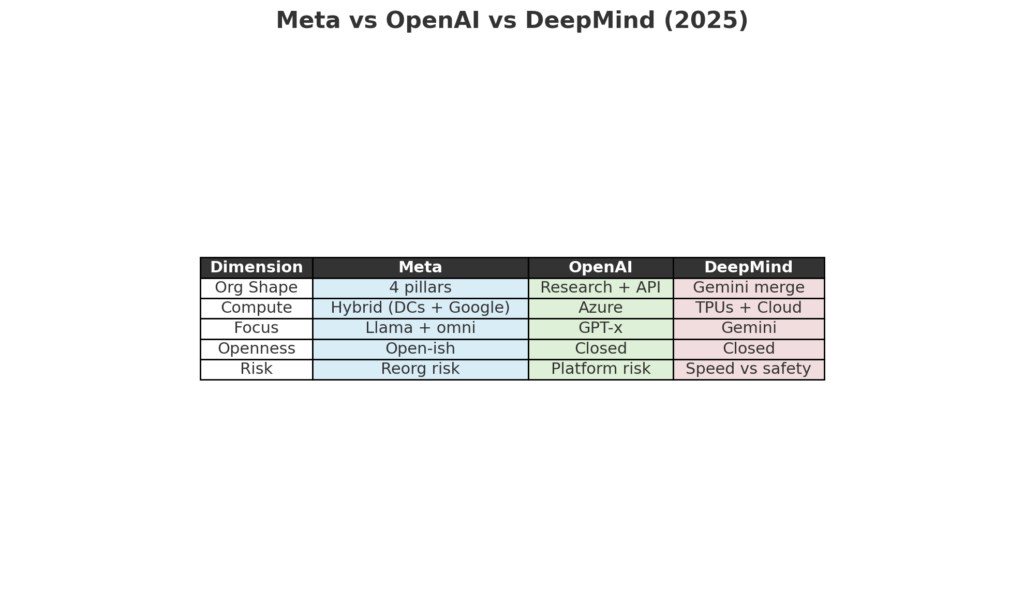
Meta recently enacted its most significant internal shake-up to date of its AI operations. Headed by Chief AI Officer Alexandr Wang, Meta Superintelligence Labs (MSL) has been reorganized into four primary divisions:

Get business pricing on tech for your team
- Business-only prices and quantity discounts
- Tax-exempt purchasing
- Multiple users, one account, clear invoices
- TBD Lab – A focused unit dedicated to training large foundational models with exploratory ambitions, such as developing an “omni” model.
- FAIR (Fundamental AI Research) – Meta’s traditional research engine, now more integrated into MSL’s operations.
- Products & Applied Research – Led by Nat Friedman, this division bridges AI innovation with mainstream product experiences.
- MSL Infrastructure – Overseen by Aparna Ramani, consolidates AI infrastructure for scalability and performance.
Business Insider+15Business Insider+15Business Insider+15
“Most team leaders will report directly to Wang,” according to his internal memo, titled “‘Superintelligence is coming:’ Read the full memo…” Business Insider+6Business Insider+6Business Insider+6
Several prior AI units—including AGI Foundations—have been disbanded, with employees redistributed across the new teams. TechCrunch+12Business Insider+12The Economic Times+12
Why the Change? What’s Driving This Reorg?
- Internal Tension: The influx of high-profile AI recruits—including Wang himself, and developer prodigy Matt Deitke with a $250 million compensation package—sparked friction among veteran staff. PC Gamer+1
- Clarifying Structure: Meta sees the new design as essential for accelerating its pursuit of “personal superintelligence.” Wang emphasized the need for clarity and speed in navigating areas like research, product, and infrastructure. New York Post+9Business Insider+9TechCrunch+9
- Recurring Restructuring: This marks Meta’s fourth AI reorg in six months, reflecting both urgency and perhaps instability in its evolving AI strategy. ReutersPC GamerThe Times of India
large foundational AI models training kit
As an affiliate, we earn on qualifying purchases.
As an affiliate, we earn on qualifying purchases.
Strategic Moves Amid the Turmoil
- Hiring Freeze: As part of the reorganization, Meta paused hiring across its AI division—pausing transfers and new external recruitment—ostensibly for “organizational planning.” Business Insider+9Business Insider+9MarketWatch+9
- Cloud Partnership: Meta inked a major $10 billion, six‑year cloud services deal with Google Cloud, to support its AI infrastructure amid the reorg. Investors.com
- Capital Outlay: The company is forecasting up to $72 billion in annual capital expenditures, with a considerable chunk allocated to AI and infrastructure buildup. The Economic Times+15PC Gamer+15MarketWatch+15
enterprise AI infrastructure hardware
As an affiliate, we earn on qualifying purchases.
As an affiliate, we earn on qualifying purchases.
Market and Analyst Reactions
- Stock Volatility: Meta’s share price dropped sharply, hitting a four-day loss streak and marking its worst weekly performance since April—down around 6%. Still, year‑to‑date gains hover near 25–28%. Investors.com
- Skepticism and Hope:
- Supporters: Some analysts, like BofA, view the restructure as evidence of disciplined execution and maintain a bullish outlook. Investors.com
- Cautionary voices: Concerns are growing about mounting labor costs, lavish stock-based incentives, and whether the AI investment yields meaningful returns. Investors.comBarron’sMarketWatch
- Broader AI Retreat? Some analysts even question if this signals the onset of a new “AI winter,” though many see it more as recalibration. Financial Times
cloud computing services for AI development
As an affiliate, we earn on qualifying purchases.
As an affiliate, we earn on qualifying purchases.
Looking Ahead: What to Watch
| Trend/Item | What to Monitor |
|---|---|
| Implementation of the Reorg | How quickly and effectively the four new MSL units integrate operations and deliver results. |
| Retention and Culture | Whether veteran staff stay engaged amid tension with incoming high-profile AI hires. |
| ROI from Spending | Whether new hires, infrastructure, and cloud deals yield tangible breakthroughs. |
| External Models | Signals indicate Meta is open to using third-party AI models—a departure from its traditionally in-house approach. theinformation.com+10Business Insider+10Business Insider+10The Times of India+4TechCrunch+4Business Insider+4Business Insider+4Business Insider+4New York Post+4WikipediaPC Gamer+1 |
As an affiliate, we earn on qualifying purchases.
Final Thoughts
Meta’s AI restructuring represents a bold gambit to accelerate toward superintelligence. The company is trying to pivot from disjointed growth toward a more centralized, strategic framework under a single AI leadership. But with hefty budgets, cultural friction, and investor skepticism in play, the real test will be whether Meta’s renewed structure can deliver on its ambitious vision—or whether it highlights the challenges of orchestrating deep innovation at scale.
Fall Picks
fall essentials
As an affiliate, we earn on qualifying purchases.