
Yesterday’s piece was about a single AI forecaster — Polybot, one estimate disagreeing with one market price. Today is about what happens when you stop trusting a single opinion and build a whole firm instead.

Get business pricing on tech for your team
- Business-only prices and quantity discounts
- Tax-exempt purchasing
- Multiple users, one account, clear invoices
TradingAgents is a multi-agent research framework that mirrors how an actual trading desk is organized: specialized analyst agents gather different kinds of signal, a bull researcher and a bear researcher argue the two sides, a trader proposes an action, and a risk manager vets it — and can veto it. It’s the council idea from IdeaClyst pointed at the hardest possible subject: structured disagreement, used to fight a single model’s overconfidence about money.
As with yesterday, the most important part comes first:
This is not financial advice, and nothing here recommends trading, investing, or using this software. Automated trading carries a substantial risk of loss, up to and including all of your capital. Market and trading-software access is regulated or restricted in many jurisdictions — it’s your responsibility to know what’s lawful where you are. TradingAgents is an experimental research framework with no guarantee of accuracy, profitability, or fitness for any purpose. Treat anything in this space as risk capital you can afford to lose entirely, and consult a qualified professional — I’m not one.
With that established: it’s Apache-2.0 and open source, at forezai.com/tradingagents.html and on GitHub. It completes the portfolio’s Markets family.
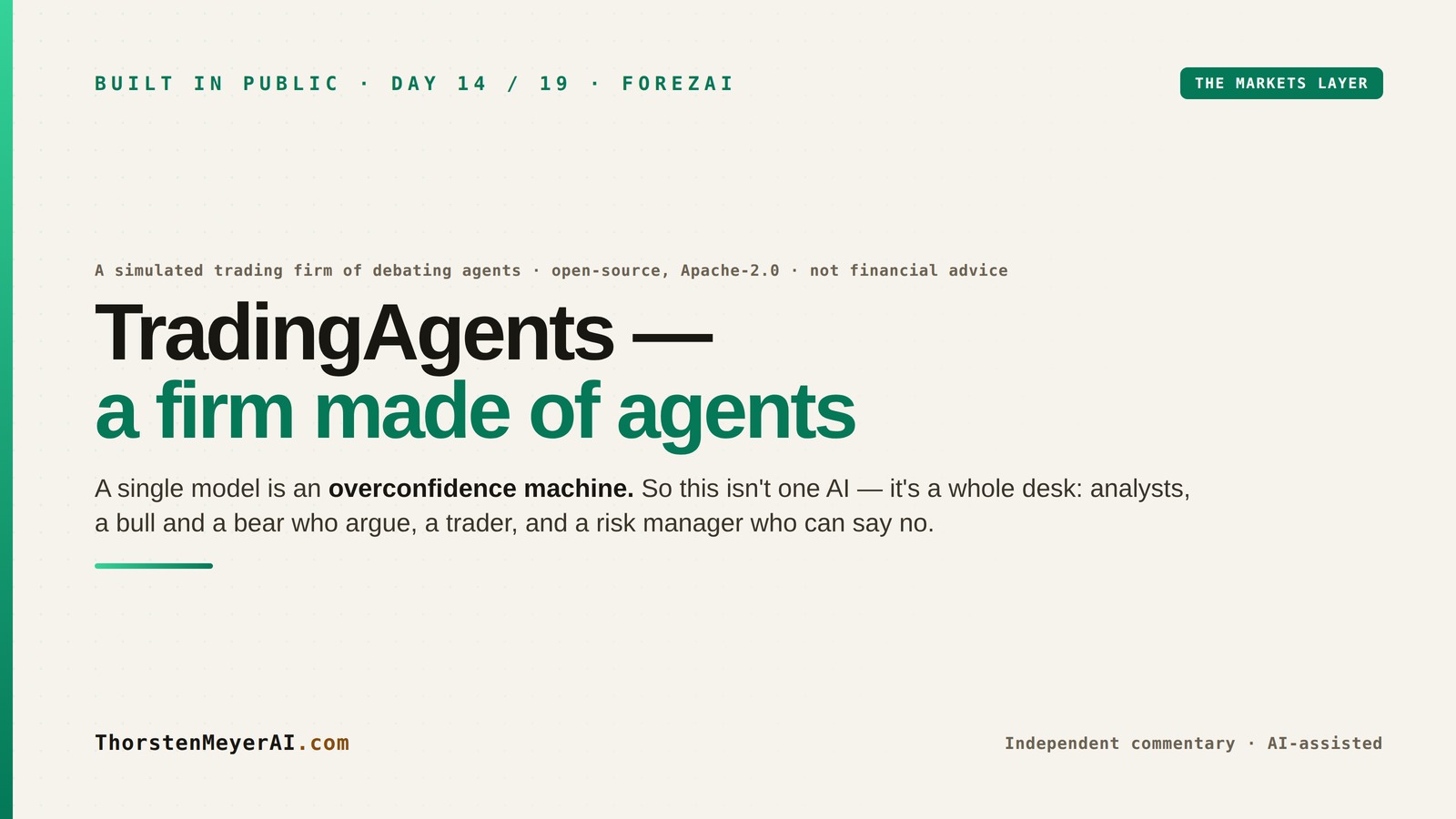
TradingAgents — a firm made of agents
A single model is an overconfidence machine. So this isn’t one AI — it’s a whole desk: analysts, a bull and a bear who argue, a trader, and a risk manager who can say no.
Not financial, investment, legal or tax advice; not a recommendation or solicitation to trade, invest or use any software. Forezai · TradingAgents is an experimental open-source research framework (Apache-2.0), provided “as is” without warranty of accuracy or profitability. Trading and automated trading carry a substantial risk of loss including total loss of capital; past or backtested performance does not indicate future results. Market and trading-software access is regulated or restricted in some jurisdictions — you are solely responsible for compliance with applicable law. Consult a licensed professional before any financial decision. Produced with AI assistance under human editorial oversight; independent commentary, the author’s own views. Product and company names are trademarks of their respective owners; mention does not imply endorsement.
One model is overconfident; a firm argues
The danger with using a single AI to make a market decision is the same danger that runs through this whole portfolio: a language model produces fluent, confident output, and fluent-and-confident is indistinguishable from right until the money clears. Ask one model “should I take this position?” and you’ll get a crisp, well-argued answer — whether or not the answer is any good. A lone model is an overconfidence machine wearing the costume of analysis.
Real trading firms solve this organizationally, not with a single genius. They separate roles so that the person finding reasons to buy isn’t the same person stress-testing those reasons, and they put a risk function above the traders whose entire job is to say “no, smaller, or not yet.” The structure exists precisely because individual conviction is unreliable and needs to be checked by an adversary and a gatekeeper.
TradingAgents copies that structure deliberately. The bet isn’t that any one agent is brilliant. It’s that a well-organized argument among specialized agents, with risk oversight on top, produces better-reasoned and more accountable decisions than any single model talking to itself. And there’s a quieter benefit to the split: each agent holds one job instead of juggling everything at once, which keeps any single reasoning step narrow enough to actually follow — and narrow enough for a human to check afterward.
As an affiliate, we earn on qualifying purchases.
The architecture
The flow mirrors a desk. Analyst agents specialize — fundamentals, news and sentiment, technical signals — each surfacing a different slice of the picture rather than one model trying to hold all of it at once. Their findings feed a research debate that is the heart of the system: a bull researcher builds the strongest case to act, a bear researcher builds the strongest case against, and they argue it out rather than averaging into mush.
That debate hands to a trader agent, which turns the argument into a concrete proposed action. And crucially, that proposal isn’t the final word — it goes to a risk manager, whose job is to vet it against exposure limits, size it down, or veto it outright. The default posture of that risk layer is conservative, which means a very common and correct output of the whole apparatus is no trade at all.
Every step of that — each analyst’s read, each side of the debate, the trader’s reasoning, the risk verdict — is recorded. You can read why the firm decided what it decided, which is the only honest way to operate anything that touches markets.
As an affiliate, we earn on qualifying purchases.
The structure is the point, not any one agent
It’s worth being precise about where the value lives, because it’s easy to misread. TradingAgents is not interesting because its analyst agents are smart. It’s interesting because of the same insight that powers the decision layer of this portfolio: structured disagreement and explicit oversight beat solo judgment. The bull/bear debate is a red-team built into the process; the risk manager is a gatekeeper that conviction has to get past. Neither is a feature you bolt on — they’re the architecture.
That’s “edit by subtraction” operating at the level of trades. The debate exists to kill weak ideas before they become positions, and the risk manager exists to shrink or block the ones that survive. A firm of agents whose structure makes it harder to act on a flimsy thesis is doing exactly what it should. The subtraction — the trades that don’t happen because the bear won the argument or the risk manager said no — is the product working.
As an affiliate, we earn on qualifying purchases.
The thesis fit
TradingAgents carries the portfolio’s spine, and in a way that’s almost on-the-nose. It’s local-first — runnable on owned compute. It’s provider-agnostic in the strongest possible sense: because it’s literally a firm of agents, different roles can run on different, swappable models, making it a genuine multi-model organization rather than one vendor wearing many hats. And it’s auditable by construction, recording the reasoning at every desk.
On the constellation, it’s the second and final Markets node, and it completes a deliberate pair. Polybot is the lone forecaster comparing an estimate to a price; TradingAgents is the organized firm debating an action. Together they’re two honest, open, disciplined ways to point AI at markets — one minimal, one structured — both built on the same refusal to trust a single confident voice.
The pairing isn’t just thematic; it maps to a real choice. The minimal approach is cheaper, faster, and easier to reason about — fewer moving parts means fewer places to be subtly wrong, which is a genuine virtue when the subject punishes complexity. The structured firm is heavier and slower, but it forces the disagreement and the oversight to be explicit rather than implicit. Neither is obviously better; they’re different bets about where rigor should live — in simplicity you can fully inspect, or in structure that institutionalizes doubt. Offering both, openly, and letting the honest tradeoff stand is more useful than pretending one architecture wins.
As an affiliate, we earn on qualifying purchases.
The honest bear case
This section stays long, for the same reasons as yesterday. You can lose everything — organizing your losses into a tidy multi-agent pipeline doesn’t make them smaller. Legality is not optional, and varies by jurisdiction; know your local law before going near live trading. And the subtle, important one: a firm of LLMs is still LLMs. Agents that share training data and architecture can be correlated in their errors — a “debate” between two models that fail the same way isn’t truly independent, and a confident consensus among them can be confidently, collectively wrong. Adversarial structure reduces overconfidence; it does not manufacture genuine independence.
There’s also an over-engineering trap that’s specific to this design. A system that looks like a real trading firm — analysts, researchers, a risk desk — can lend its decisions an unearned air of institutional rigor. “The firm approved it” is a dangerous sentence if it ever stops meaning “and here’s the recorded argument you can inspect and disagree with.” The structure is a reasoning aid, not an authority.
And the market basics still bite: backtests flatter, costs are merciless, and markets adapt. A clever organization of agents is still subject to the same brutal arithmetic that humbles every system that meets a live market.
The bull case, plainly — measured
With all of that standing: as a research framework, TradingAgents is genuinely worthwhile. It’s an open, inspectable implementation of the right idea — that accountable decisions come from structured disagreement and explicit oversight, not from a single confident model — applied to the most unforgiving domain there is. It records its reasoning, it defaults to caution through its risk layer, and it’s a clean expression of a true multi-model, local-first, auditable architecture.
Its value is as a way to study multi-agent reasoning about markets, and as a template for accountable AI decision-making under uncertainty — not as a device that prints returns. Held to that standard, it’s a strong and instructive piece of open source. Held to the other one, it’s a very sophisticated way to discover that the market doesn’t care how many agents you have.
It closes the Markets family the way it should be closed: not with a victory lap, but with the honest observation that pointing AI at money is the place where every one of this portfolio’s principles gets tested by something that keeps an exact, unforgiving score.
Not financial, investment, legal, or tax advice; not a recommendation or solicitation to trade, invest, or use any software. Forezai · TradingAgents is an experimental, open-source research framework under the Apache-2.0 license, provided “as is” without warranty of any kind, including no warranty of accuracy or profitability. Trading and automated trading involve a substantial risk of loss, including total loss of capital; past or backtested performance does not indicate future results. Market and trading-software access is regulated or restricted in some jurisdictions — you are solely responsible for compliance with all applicable laws. Consult a qualified, licensed professional before making any financial decision. This article was produced with AI assistance under human editorial oversight; it is independent commentary and the author’s own views, which may change. Product and company names are trademarks of their respective owners; mention does not imply affiliation, sponsorship, or endorsement. © 2026 Thorsten Meyer · Powered by Thorsten Meyer AI. See Imprint/Impressum and Privacy Policy.
Fall Picks
fall essentials
As an affiliate, we earn on qualifying purchases.