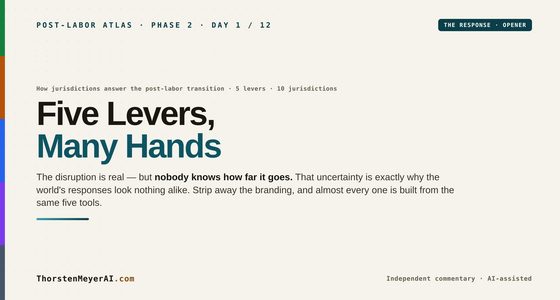

For eleven entries, this Atlas added one row at a time — mapping how ten jurisdictions are responding to the same pressure: automation, AI, and the long question of what happens to income when machines do more of the work. The grid is now full.

Get business pricing on tech for your team
- Business-only prices and quantity discounts
- Tax-exempt purchasing
- Multiple users, one account, clear invoices
This final entry doesn’t add a row. It does the thing the grid was built for: it reads across. Down each column — income, capital, work, skills, institutions — a pattern emerges that no single country piece could show. And stepping back from the whole map, a few uncomfortable findings come into view.
The most important thing to say up front is what this is not. It is not a ranking. There is no winner here, because each model is less a “solution” than the honest expression of a political tradition’s deepest instinct about who should bear the risk of the transition.
It’s a menu. And like any good menu, its real value is showing you not only what you’d order by default — but what you’d never think to.
The Menu
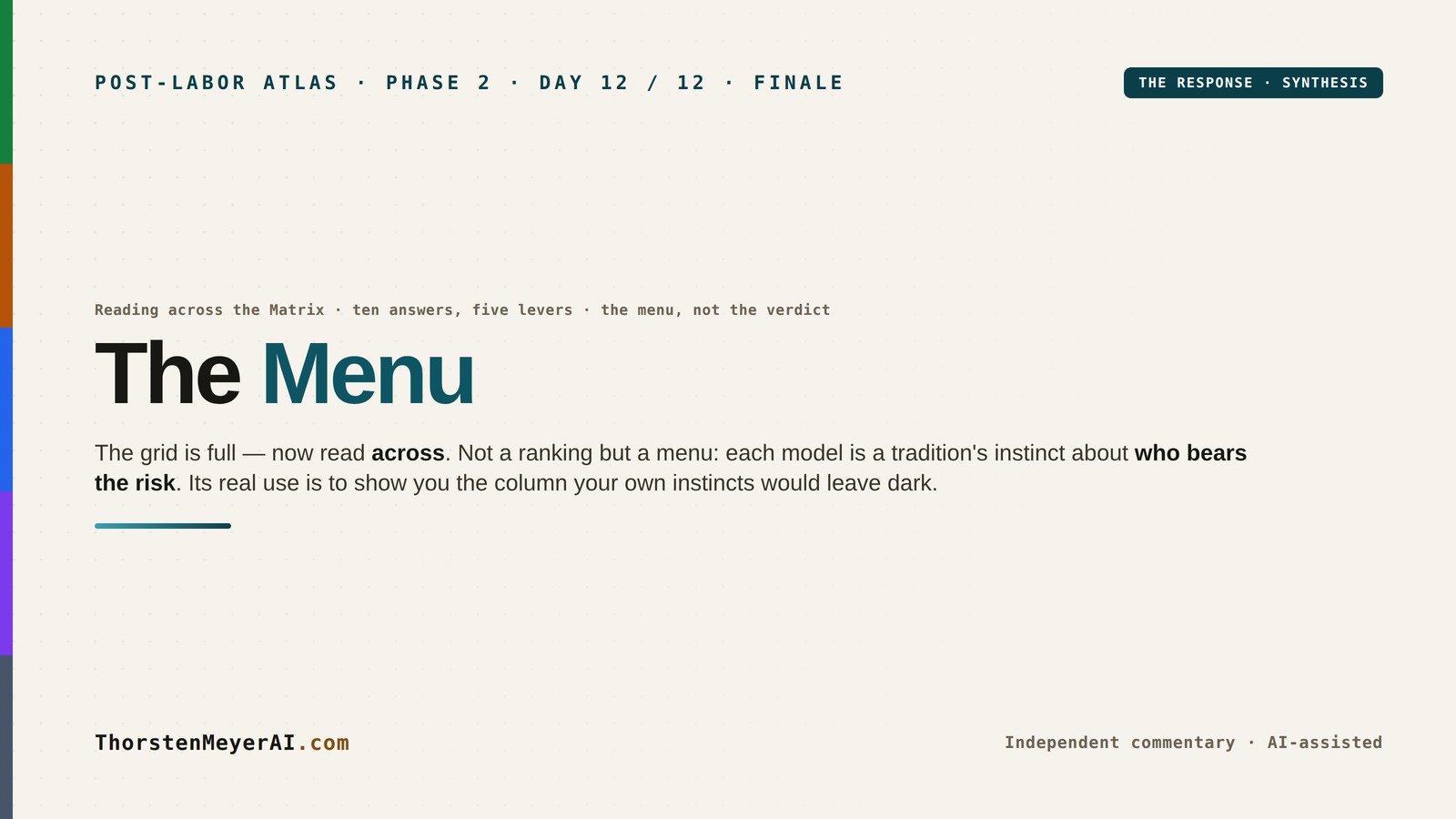
The grid is full — now read across. Not a ranking but a menu: each model is a political tradition’s instinct about who should bear the risk. Its real use is to show you the column your own instincts would leave dark.
Each instinct is a strength and, flipped over, a blindness. The EU cushions but won’t touch capital; the US lets the market run but won’t catch the fall; China owns the capital but grants no claim. The map’s use isn’t to crown a winner — it’s to see the column your own instincts would leave dark, because that dark column is where the transition will find you. The levers are known. The grid is full. The choosing — and the blind spots — are ours.
Independent commentary, produced with AI assistance under human editorial oversight. The views are the author’s own and may change. This is analysis, not policy, economic, investment, or legal advice. This synthesis summarizes the ten jurisdictional entries of Phase 2; underlying figures reflect publicly reported information as of mid-2026 and may change. The “Response Matrix” is an interpretive device, not a quantitative index — its strong/partial/minimal ratings are the author’s analytical judgments offered to aid comparison, not to score or rank, and reasonable people will disagree with specific placements. This phase maps differing approaches and endorses none; characterizations of contested arrangements present competing views, not a verdict. Country and program names are referenced for analysis and imply no affiliation.
Reading down the columns
Income: near-universal, but its shape is the fight
Almost every jurisdiction has at least a partial floor; only the United States runs it minimal. But agreement ends there. The floors split three ways: universal and generous (the Nordics), conditional or targeted (most of the map — the UK, Canada, Singapore, India, Brazil, China), and citizens-only (the Gulf). The deepest divide is whether the floor holds when work disappears or only when you work — and most floors are built for a world with enough work, the exact assumption the transition challenges. The world broadly agrees you need a floor. It disagrees completely on whether the floor should survive the very thing it’s meant to protect against.
Capital: the great void
This is the most important column, and it is nearly empty. The post-labor worry, reduced to a sentence, is that the returns to capital will swamp the returns to labor — that ownership, not work, will decide who prospers. And yet capital is the lever almost everyone leaves untouched. Only two jurisdictions pull it hard: the Gulf, which pays citizens a dividend from its sovereign funds, and China, where the state owns the capital and keeps the return. Both are non-democracies. Every democracy on the map — the EU, the UK, Canada, the US, India, Brazil — runs capital minimal or merely partial, trusting private markets to distribute the gains. If the diagnosis is right, the democracies are answering every column except the decisive one.
Work: adjusted, not reinvented
Almost everyone touches work — short-time schemes, job guarantees, wage ladders, labor codes — but only the EU pulls it strong, and only the US runs it minimal. What’s striking is the absence of radicalism. No jurisdiction has fundamentally reimagined work for a post-labor world: no mandated four-day week at scale, no universal job guarantee, no serious redistribution of working time. The work lever is being adjusted at the margins, not rethought. Everyone is tuning the existing machine; no one is building a different one.
Skills: the one consensus
This is the only column with no minimal cell anywhere. Every jurisdiction pulls skills at least partly; three pull it hard. It is the universal answer — “reskill people” is the one thing the whole map agrees on. That consensus should make us slightly suspicious, because skills is also the cheapest answer politically: it requires no redistribution, no change in who owns what, no new entitlement — only training. It may be genuinely necessary. But it rests on an assumption no one can verify: that humans can reskill roughly as fast as machines acquire new capabilities. If that race is unwinnable — Singapore’s own quiet worry — then the lever the entire world leaned on hardest is the one that fails most quietly.
Institutions: the same word, opposite aims
Strong institutions show up in four very different places — the EU, the Nordics, Singapore, and China — and the column hides a trap, because “strong institutions” means nearly opposite things in each. The EU’s are rights-based, built to protect workers; China’s are control-oriented, built to maintain stability. Singapore’s are technocratic competence; the Nordics’ are bargained trust. Meanwhile the column runs minimal in three places for three different reasons: conviction (the US, actively deregulating), a small directive state (the Gulf), and something closer to neglect (Canada). Don’t read this column as a single axis. The real question isn’t how strong the guardrails are — it’s who they’re built to serve.
As an affiliate, we earn on qualifying purchases.
What the whole map reveals
A few findings only appear once you step back from the grid entirely.
The first is that the cleanest answers are the least copyable. The models that look most decisive each rest on something that can’t be exported: the Gulf’s dividend needs oil; Singapore’s calibration needs its singular state; the Nordics’ flexicurity needs a century of union trust; China’s direction needs one-party control. The single most portable thing on the entire map is India’s digital plumbing — but that’s a way to deliver an answer, not the answer itself. The menu is real, but most diners can’t order most dishes.
The second is that state capacity is the hidden variable behind almost everything. Every model that pulls multiple levers hard has either exceptional state capacity or exceptional resource wealth; the thin rows reflect either ideology or the absence of that capacity. And the most-admired execution on the map, Singapore’s, is precisely the thing that can’t be handed to anyone else. It may be that how well you run it matters as much as which lever you pull — a deflating thought for any country shopping the menu for a quick fix.
The third is the democratic dilemma, and it’s the one worth sitting with. The lever most central to the post-labor problem — capital and ownership — is pulled hard by exactly two jurisdictions, and both are authoritarian. The democracies’ deep aversion to the state owning capital leaves them most exposed on the precise axis the diagnosis names. The uncomfortable implication is that democracies may eventually need to do the one thing only non-democracies have so far done — build broad public or shared ownership of capital — without the authoritarianism that has so far come attached to it. Nothing on this map shows how.
And the fourth ties the others together: no one has solved it. Read across, and every jurisdiction is hedging against a future it hasn’t fully met, with tools mostly built for a present — or a past — that still had enough work to go around. The strong floors assume work; the skills bet assumes a winnable race; the empty capital column assumes markets will share; the work lever adjusts rather than reinvents. There is no model here that has cracked the post-labor transition. There are ten partial bets, each strong where its political tradition is strong, and blind exactly where that tradition is blind.
As an affiliate, we earn on qualifying purchases.
The menu, not the verdict
So what is the map for, if not to crown a winner?
Its use is to show you your own blind spot. Each model is the reflex of a tradition — a default answer to the question who bears the risk? The US says the individual. China says the state, which keeps the return. The Gulf says the citizen, paid from the fund. The Nordics say the collective. Singapore says the technocrat will manage it. India says: at least the rails will reach you. Brazil says: the family, in exchange for its children’s future. The EU says: we’ll regulate the risk and cushion the landing.
Each instinct is a strength and, flipped over, a blindness. The EU will cushion and regulate but won’t touch capital. The US will let the market run but won’t catch the fall. China will direct and own but won’t grant you a claim. Singapore will reskill you relentlessly but has no answer if the race can’t be won. The point of seeing all ten at once is not to pick one. It’s to notice the column your own instincts would have left dark — because that dark column is exactly where the transition will find you.
And the transition hasn’t fully arrived. This Atlas opened on a genuinely contested question: whether what’s coming is reallocation — old work giving way to new, as it always has, in which case these responses are insurance you may never need — or displacement, the case where the pattern finally breaks, in which case most of these responses are too thin for what’s coming. Nothing here resolves that question; it can’t be resolved in advance.
What the map does instead is more modest, and more useful. It lays out the full set of levers, shows which ones each tradition reaches for and which it ignores, and makes sure that whichever way the future breaks, you can see the whole menu — including the dishes your own instincts would never have put on the table. The levers are known. The grid is full. The choosing, and the blind spots, are ours.
That is the end of the Post-Labor Transition Atlas.
Independent commentary, produced with AI assistance under human editorial oversight; the views are the author’s own and may change. This is analysis, not policy, economic, investment, or legal advice. This synthesis summarizes the ten jurisdictional entries of Phase 2; all underlying figures and program descriptions reflect publicly reported information as of mid-2026 and may change. The “Response Matrix” is an interpretive device, not a quantitative index: its strong/partial/minimal ratings are the author’s analytical judgments, reasonable people will disagree with specific placements, and they are offered to aid comparison, not to score or rank jurisdictions. This phase maps differing approaches and endorses none; characterizations of contested arrangements present competing views rather than a verdict. Country and program names are referenced for analysis and imply no affiliation. © 2026 Thorsten Meyer · Powered by Thorsten Meyer AI. See Imprint/Impressum and Privacy Policy.
income inequality mitigation tools
As an affiliate, we earn on qualifying purchases.
As an affiliate, we earn on qualifying purchases.
As an affiliate, we earn on qualifying purchases.
Fall Picks
fall essentials
As an affiliate, we earn on qualifying purchases.