
How “open” autonomy models, NVIDIA hardware dependency, and new simulation/data pipelines could reshape automotive, logistics, and the future of driving jobs.
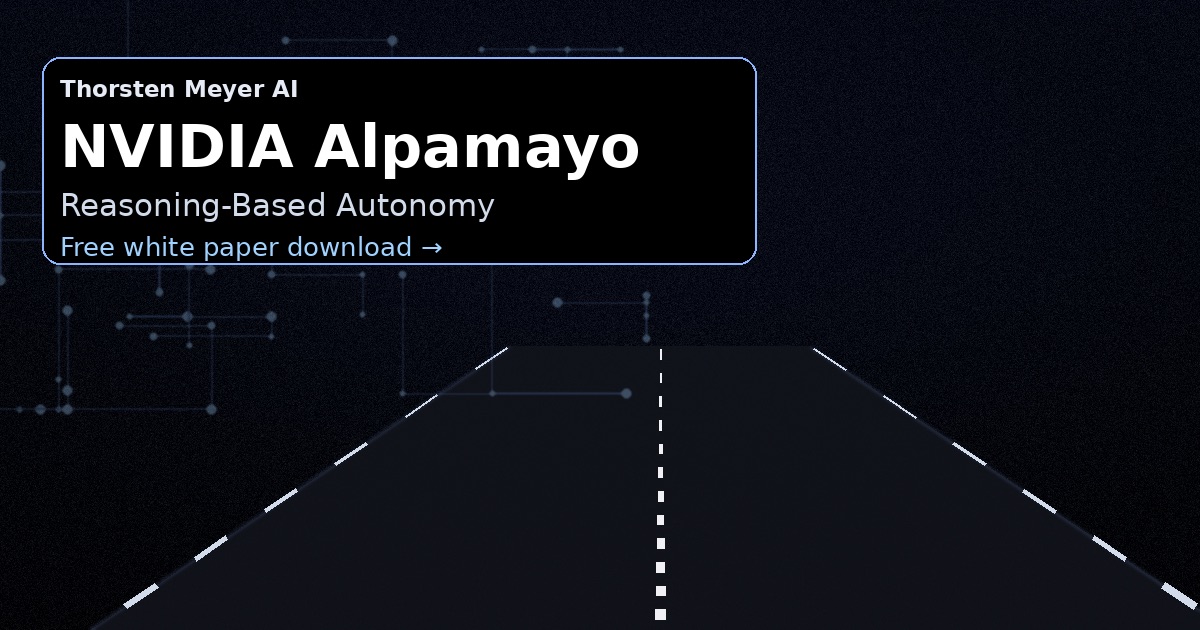
Download the white paper (PDF) — free
Why this matters right now
Autonomous driving is entering a new phase. For years, the conversation centered on sensor stacks, mapping strategies, and incremental ADAS improvements. Now, a new theme is taking center stage: reasoning-capable models that can explain why a vehicle chooses a path—especially in the rare, messy “long-tail” scenarios that break traditional systems.
At CES 2026, NVIDIA introduced Alpamayo, positioning it as an open developer platform for autonomy that combines:
- A reasoning-first vision-language-action model (Alpamayo 1)
- An open simulation stack (AlpaSim)
- A large-scale multi-sensor driving dataset
If this approach scales, it won’t just influence how autonomy is built—it will influence who can build it, what ecosystems dominate it, and how quickly it moves from R&D into real fleets.
That’s why we wrote this white paper.
What you’ll learn in the white paper
This report is designed for decision-makers and technical leaders who need clarity—not hype—on what NVIDIA Alpamayo changes, and what it doesn’t.
Inside, you’ll find:
- What NVIDIA Alpamayo is and why “reasoning” matters for autonomy safety and long-tail performance
- Who’s adopting it (or signaling adoption)—including how legacy OEMs can use a platform approach
- How Alpamayo differs from Tesla and Google/Waymo approaches (platform ecosystem vs vertically integrated autonomy)
- The real meaning of “open source” and “open weights” in this context—what is open, what is restricted, and what that means for commercialization
- Dependency on NVIDIA hardware and stack: how openness can still drive platform lock-in through compute, tooling, and licensing
- Industry impact across:
- Automotive (ADAS → autonomy pipelines)
- Logistics and trucking (hub-to-hub automation, fleet economics)
- Other verticals (ports, mining, yard operations, warehousing, campus mobility)
- Job market implications:
- Taxi and ride-hail disruption patterns
- Delivery and trucking job reshaping
- New roles that grow alongside autonomy (remote ops, safety validation, fleet maintenance, simulation/scenario engineering)
Who this is for
If you work in or around mobility, autonomy, or fleet operations, this paper is written for you:
- Automotive OEM and Tier-1 strategy teams
- ADAS/autonomy engineering leaders
- Logistics and fleet executives (trucking, last-mile, yards, ports)
- Investors and corporate innovation teams tracking autonomy platform shifts
- Policymakers and workforce transition stakeholders
- AI teams evaluating model openness, licensing, and hardware dependency risk
The key questions we answer
To make this actionable, we structured the paper around the questions we hear most often:
- Is Alpamayo truly open—or “open, but…”?
- What new dependency does it create on NVIDIA hardware?
- Does this accelerate time-to-market for OEM autonomy?
- Where do Tesla and Waymo remain structurally advantaged?
- Which industries will benefit next (beyond passenger cars)?
- Which jobs are most exposed—and which new jobs appear?
Get the white paper (free PDF)
Download: “NVIDIA Alpamayo: Open-weight reasoning models for autonomous driving”
✅ Free PDF download
✅ Practical, business + technical lens
✅ Built for leaders who need decisions, not headlines
About Thorsten Meyer AI
Thorsten Meyer AI helps leaders understand and apply emerging AI technologies—especially where real-world constraints (safety, regulation, operations, workforce impact) matter as much as model performance.
If you’d like to discuss what Alpamayo-style stacks mean for your roadmap—OEM integration, fleet strategy, simulation/validation, or workforce transition—reach out.
The Disruptive Impact of Lethal Autonomous Weapons Systems Diffusion: Modern Melians and the Dawn of Robotic Warriors (Emerging Technologies, Ethics and International Affairs)
As an affiliate, we earn on qualifying purchases.
As an affiliate, we earn on qualifying purchases.

NVIDIA GeForce RTX 5080 Founders Edition
- Blackwell Architecture for Gaming and Creators: Optimized platform for gamers and creators
- Tensor Cores for AI Performance: Enhanced AI with FP4 and DLSS 4
- NVIDIA Reflex 2 with Frame Warp: Reduced latency and improved responsiveness
As an affiliate, we earn on qualifying purchases.
As an affiliate, we earn on qualifying purchases.
open-source autonomous driving dataset
As an affiliate, we earn on qualifying purchases.
As an affiliate, we earn on qualifying purchases.

Drone Autonomy with Practical Code: Build safer missions in simulation before testing them in real flight.
As an affiliate, we earn on qualifying purchases.
As an affiliate, we earn on qualifying purchases.