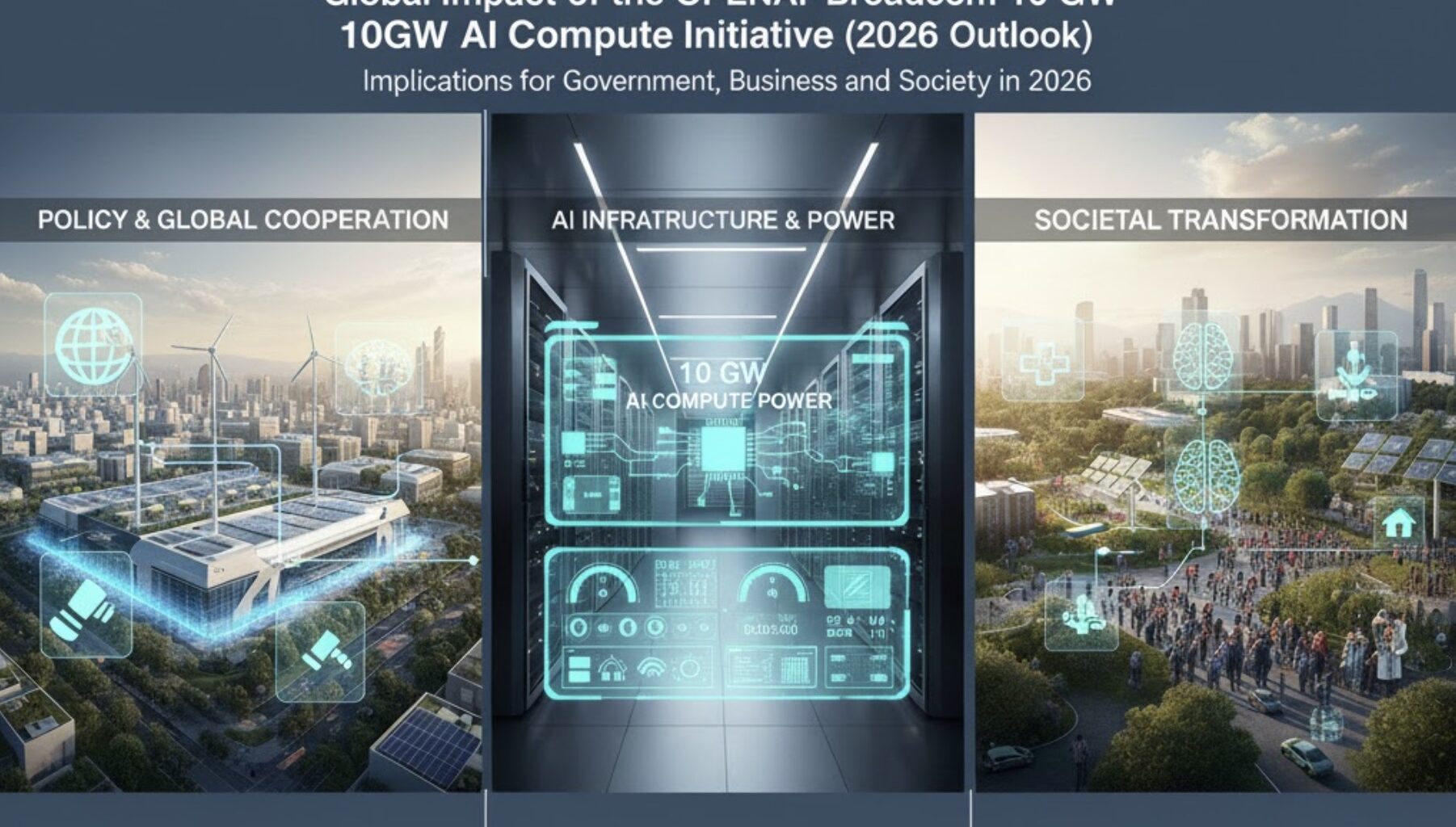

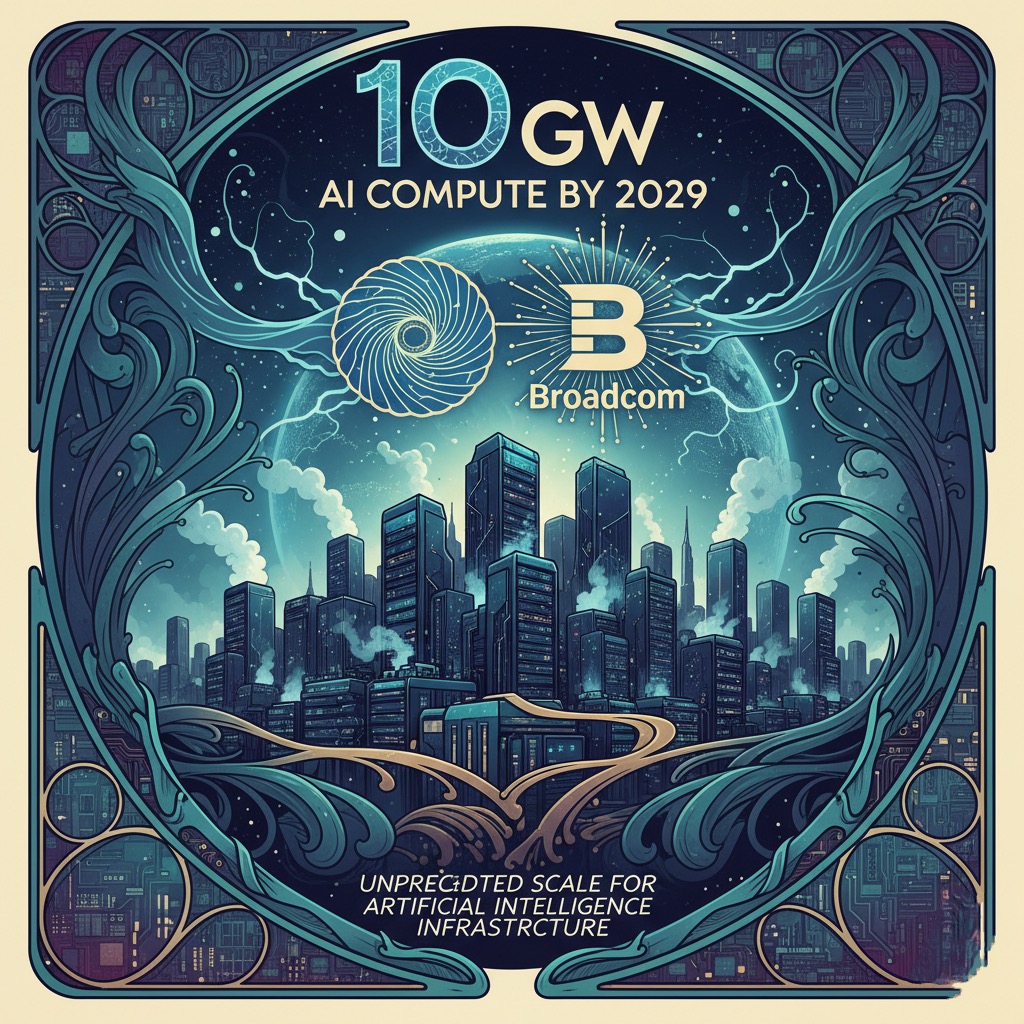
In late 2025, OpenAI and Broadcom announced a strategic collaboration to co-develop custom AI accelerators with a staggering target: 10 gigawatts (GW) of AI compute capacity to be deployed by 2029datacenterdynamics.comdatacenterdynamics.com. To put 10 GW in perspective, 1 gigawatt can power ~700,000 U.S. homes, so 10 GW represents roughly the electricity supply for 7 million householdsdatacentremagazine.com. In other words, OpenAI plans to build AI computing “power plants” comparable to a small nation’s energy consumption. This report provides a comprehensive analysis of the expected global impact in 2026 of this OpenAI–Broadcom initiative and broader trends in AI infrastructure scaling, focusing on implications for governments, businesses, and society.
We begin with a brief overview of the OpenAI–Broadcom project and explain what “10 GW of AI compute” means in practice. We then explore anticipated impacts around the world – with specific attention to the USA, Europe, and the Asia-Pacific (APAC) region. Finally, we examine how these developments may shape government policies (from regulation to defense and energy), business strategies (from productivity gains to competitive dynamics), and social outcomes (from workforce changes to education and inequality). We also highlight key risks, challenges, and open questions – such as managing enormous energy demands, ensuring chip supply chain security, and balancing innovation with environmental and ethical considerations.
Throughout the report, factual insights are grounded in recent data and industry reports, but presented in an accessible way for a general audience. Let’s dive into what the OpenAI–Broadcom 10 GW AI accelerator collaboration entails and why it matters.
The OpenAI–Broadcom 10 GW AI Accelerator Initiative
OpenAI’s Shift to Custom AI Chips: OpenAI – the company behind ChatGPT and GPT-4 – has historically relied on third-party hardware (notably NVIDIA GPUs) to train and run its advanced AI models. However, exploding demand for AI and supply bottlenecks have prompted a strategic pivot. In October 2025, OpenAI “announced a major partnership with Broadcom to design and roll out 10 GW of custom AI accelerators”datacentremagazine.comdatacentremagazine.com. Under this multi-year deal, OpenAI will lead the chip design (embedding its AI modeling know-how into silicon), while Broadcom manufactures and integrates the new chips and networking systemsdatacentremagazine.comdatacentremagazine.com. The first custom accelerators are expected in H2 2026, with a full rollout across OpenAI’s data centers (and partners’ facilities) by end of 2029datacenterdynamics.comdatacenterdynamics.com.
What does “10 GW of AI compute” mean? In this context, 10 GW refers to the total power capacity of the planned AI accelerator deployments. It signals an enormous amount of computing power: 10 GW of sustained draw is comparable to the output of 10 large power plants. OpenAI’s cluster would consume electricity on the order of billions of watts, underscoring how AI at scale is becoming a significant infrastructure categoryenkiai.comenkiai.com. For scale, 1 GW of continuous power over a year equates to about 8.76 billion kWh. Running 10 GW of AI hardware continuously could use ~87.6 billion kWh annually – a huge number (global data centers in 2022 consumed an estimated ~460 billion kWh in total)datacentremagazine.com. While 10 GW is a capacity target (the hardware could draw that much at peak), even a fraction of that utilization represents a dramatic leap in AI compute availability by late this decade.
Why custom AI chips? Developing in-house accelerators allows OpenAI to “embed what it’s learned from developing frontier models directly into the hardware, unlocking new levels of capability and efficiency”datacenterdynamics.comdatacentremagazine.com. In practical terms, custom-designed chips can be optimized for the specific mathematical operations and workloads of large language models and other AI systems. Sam Altman (OpenAI’s CEO) called the Broadcom partnership a “critical step in building the infrastructure needed to unlock AI’s potential… Developing our own accelerators adds to the broader ecosystem of partners building the capacity required to push the frontier of AI”datacenterdynamics.comdatacentremagazine.com. By tailoring chips to its models (e.g. GPT-4 and beyond), OpenAI expects improvements in performance per watt and cost-efficiency, reducing reliance on any single vendor. This move parallels other tech giants (Google’s TPUs, Amazon’s Inferentia/Trainium, etc.) and reflects an industry-wide trend to achieve greater scale at lower cost. Broadcom, for its part, brings deep semiconductor expertise and an end-to-end networking portfolio (Ethernet switches, PCIe interfaces, optical links) to connect these accelerators in massive clustersdatacentremagazine.comdatacentremagazine.com. Notably, the new OpenAI systems will use Ethernet-based networking (as championed by Broadcom) for scalability, instead of proprietary alternatives like NVIDIA’s InfiniBanddatacentremagazine.comdatacentremagazine.com.
Timeline and Complementary Deals: OpenAI and Broadcom have already begun co-development, with formal agreements in place to start deploying the custom chips in data centers by late 2026datacentremagazine.comdatacentremagazine.com. The 10 GW figure will be reached in stages through 2027–2029. This is one of several massive hardware deals OpenAI struck recently: earlier in 2025, OpenAI signed an agreement with AMD to supply hundreds of thousands of GPUs (AMD’s MI250/MI300 series), totaling an additional 6 GW of power capacitydatacenterdynamics.com. OpenAI even obtained warrants to purchase a stake in AMD – indicating a long-term partnership. Around the same time, OpenAI inked a letter of intent with NVIDIA to deploy at least 10 GW of NVIDIA GPU-based hardware, in a deal that could involve up to $100 billion investment by NVIDIA as those systems come onlinedatacenterdynamics.com. All these arrangements (Broadcom, AMD, NVIDIA) are expected to kick off in the second half of 2026datacenterdynamics.com. In essence, OpenAI is securing multiple supply channels to scale out an unprecedented level of compute. By the late 2020s, OpenAI could command on the order of 20–26 GW of AI-focused capacity when combining these partnerships – a concentration of computing might never seen before in the AI field.
Key Takeaway: 10 GW of AI compute is a bold and almost hard-to-fathom target that exemplifies the rapid scaling of AI infrastructure. If AI models of the future (such as GPT-5 or beyond) demand 10x or 100x more compute, OpenAI aims to be ready with a tailored hardware backbone. This initiative is not happening in isolation – it is part of a broader race to build larger, more efficient AI supercomputers. Next, we examine how this trend is expected to impact different regions and sectors by 2026.

Artificial Intelligence and Hardware Accelerators
As an affiliate, we earn on qualifying purchases.
As an affiliate, we earn on qualifying purchases.
Global Impact on Governments and Policy
The OpenAI–Broadcom collaboration, and the wider surge in AI compute scaling, carry significant implications for governments worldwide. By 2026, even as the first chips are just rolling out, policymakers are grappling with how to support technological advancement while managing security, economic, and environmental considerations. We discuss impacts on the United States, Europe, and the Asia-Pacific (APAC) region in turn, noting common themes and regional nuances.
United States: Maintaining Leadership and Powering the AI Era
For the United States, OpenAI’s massive compute ramp-up reinforces U.S. leadership in AI – but also highlights new challenges in infrastructure and energy policy. The U.S. government has signaled strong support for accelerating AI development, viewing it as critical to economic and national security. In fact, in July 2025 the White House issued an “AI Action Plan” that explicitly prioritizes the rapid build-out of AI data centers. An executive order directed agencies to streamline federal permits and even use federal lands for new AI mega-centers, “easing regulatory burdens” to speed up constructionwhitehouse.govwhitehouse.gov. Projects adding >100 MW of AI computing capacity are designated as strategic “Qualifying Projects,” eligible for loans, grants, tax incentives, and other supportwhitehouse.govwhitehouse.gov. This reflects a U.S. policy shift: treating AI compute akin to critical infrastructure (the way highways or power grids are), and removing red tape to ensure facilities like OpenAI’s can be built in time.
Energy and Grid Considerations: The U.S. is keenly aware that AI data centers could strain power grids. Recent studies warn that AI data centers might need an extra 10 GW of power in 2025 (more than the entire state of Utah’s capacity) and up to 68 GW globally by 2027, nearly doubling data center energy demand from 2022 levelsrand.org. If U.S. companies cannot secure enough power domestically, they might locate compute farms abroad, which officials fear could “compromise U.S. AI leadership” and pose security risksrand.orgrand.org. To preempt this, the U.S. government is encouraging investment in power generation and grid upgrades for AI. For example, the Defense Production Act has been floated as a tool to fast-track energy infrastructure specifically for AI projectsrand.org. By 2026, we can expect federal and state authorities to coordinate with tech firms on siting new data centers near reliable power (possibly near renewable sources or even considering small modular nuclear reactors for clean, steady supplyrand.org). The overarching goal is to ensure the U.S. retains its edge in AI capacity – keeping the likes of OpenAI onshore and well-powered – while avoiding blackouts or slowing climate goals.
National Security and AI Sovereignty: From a defense perspective, American officials view cutting-edge AI capabilities as a strategic asset. The U.S. Department of Defense and intelligence community are likely to leverage these advancements, either via partnerships with companies (e.g. using OpenAI’s services through Microsoft’s Azure Government cloud) or by developing classified models on high-security clusters. The White House’s AI Action Plan includes building secure AI data centers for military usewhitecase.com, reflecting that future defense systems (from intelligence analysis to autonomous vehicles) may depend on immense compute power. Moreover, the U.S. continues to enforce export controls on advanced AI chips to rival nations (particularly China) to maintain a strategic advantage. In late 2024 and early 2025, the U.S. tightened rules to prevent even indirect export of top-tier GPUs to Chinarand.org. By restricting access to the most powerful hardware, the U.S. hopes to “slow China’s access to cutting-edge AI”, albeit with the risk that overly aggressive bans might spur China to double down on self-sufficiencybrookings.edu. In summary, by 2026 U.S. policy balances turbocharging domestic AI infrastructure (through deregulation and investment) and denying adversaries the same capabilities (through export controls and alliances). This delicate balance is driven by the belief that AI prowess will translate to both economic and military strength in the coming decade.
Europe: Balancing Competitiveness, Regulation, and Energy Constraints
Keeping Up in Compute: Europe enters 2026 keenly aware of a potential compute gap versus the U.S. and China. European policymakers and businesses see enormous AI clusters like OpenAI’s as both an inspiration and a concern – will Europe have access to similar capabilities, or risk falling behind in the AI race? In late 2025, Europe made a significant leap with JUPITER, its first exascale supercomputer, going live in Germany. JUPITER is Europe’s most powerful system (achieving over an exaflop for HPC and up to 90 exaflops for AI applications)blogs.nvidia.com. It is intended for both scientific research and training large AI models (including multilingual European-language models)blogs.nvidia.comblogs.nvidia.com. European officials hailed it as a “historic pioneering project” and a step toward AI sovereignty – ensuring Europe can develop and run advanced AI on European soilblogs.nvidia.com. By 2026, JUPITER and other EU-funded “AI factories” will be accessible to startups and researchers across Europe to foster innovationsiliconrepublic.comeurohpc-ju.europa.eu. However, even JUPITER’s power (on the order of tens of MW) is far below the multi-GW scale OpenAI is planning. Europe may need many such supercomputers to match the total capacity U.S. firms are amassing. The EU’s Chips Act and HPC Joint Undertaking are policy efforts aimed at boosting semiconductor production in Europe and building more high-performance computing centers. We can expect announcements of new European AI data centers (“AI at scale” facilities) and incentives for cloud providers to deploy cutting-edge hardware in EU countries, to ensure businesses in Europe can access top-tier compute without relying solely on U.S. providers.
Figure: Inside an advanced AI supercomputing facility. Europe’s new JUPITER exascale supercomputer (shown above) exemplifies the infrastructure investments aimed at closing the AI compute gapblogs.nvidia.comblogs.nvidia.com. Yet, its power remains a fraction of OpenAI’s 10 GW vision, highlighting the challenge for Europe to keep pace.
Regulation and Ethical AI: Unlike the U.S., which is taking a light-touch regulatory approach to enable rapid expansion, Europe is simultaneously rolling out comprehensive AI governance. The EU AI Act (expected to take effect around 2025–2026) will regulate AI systems based on risk, imposing requirements on transparency, safety, and oversight – especially for powerful “foundation models” like GPT. This could mean that by 2026, any AI model trained on very large compute (like OpenAI’s frontier models) may need to register and comply with EU rules to be used in Europe. Big compute initiatives may face mandatory impact assessments or obligations to share certain information with regulators. European policymakers have also discussed whether extremely large AI training runs should be monitored or even require notification, as part of managing “frontier AI”. While these regulations aim to ensure AI is safe and trustworthy, they also raise concerns: will bureaucracy slow down Europe’s AI advancements or dissuade companies from deploying their latest models in Europe? Policymakers are thus trying to strike a balance – encouraging innovation (Europe wants its own OpenAI-like successes) but insisting on ethics and privacy (e.g. requiring European data to be handled in compliance with GDPR, and preventing AI from exacerbating social harms).
Energy and Climate Priorities: Europe’s energy context also shapes its view of AI expansion. Electricity costs in many EU countries are higher than in the U.S., and there is strong political pressure to meet climate targets. Running giant AI data centers poses a challenge: can Europe power them sustainably? The JUPITER supercomputer, for instance, uses advanced warm-water cooling and is part of an effort to maximize energy efficiencyblogs.nvidia.comblogs.nvidia.com. European data centers are often sited in cooler climates or near renewable energy sources (like Scandinavia’s hydroelectric power) to reduce carbon footprint. By 2026, it’s likely that any large AI compute project in Europe will come under scrutiny for its environmental impact. Policymakers may incentivize AI clouds to run on green energy and recover waste heat (for example, using server heat to warm buildings). There is also discussion of energy usage transparency – requiring data center operators to report AI workloads’ power consumption and efficiency. Europe wants to avoid a scenario where AI growth undermines its decarbonization progress. The International Energy Agency projects global data center electricity demand could more than double by 2030 (to ~945 TWh), driven significantly by AI, which puts pressure on all regions to find cleaner energy solutionsiea.org. Europe in 2026 is likely to lead in setting standards for energy-efficient AI (e.g., promoting research into low-power AI chips, encouraging cloud providers to achieve 24/7 renewable power matching). In sum, Europe’s approach marries investment in competitive infrastructure with a strong dose of regulation and sustainability oversight.
Asia-Pacific: The Race for AI Self-Reliance and Capacity
The Asia-Pacific region is diverse, but two major players – China and Japan – plus others like South Korea and India, are all responding to the global AI compute race in distinct ways by 2026.
China’s Push for Domestic AI Compute: China has identified AI and semiconductors as strategic industries and is pouring resources into both. U.S. export controls have cut off Chinese companies from the latest NVIDIA and AMD AI chips, so China is aggressively pursuing self-sufficiency. By 2026, we expect Chinese tech giants (Baidu, Alibaba, Tencent, Huawei, etc.) to be deploying homegrown AI accelerators in large numbers. Indeed, Huawei reportedly developed 7nm AI chips (like the Ascend series) and, despite sanctions, achieved some parity in specific tasks. The Chinese government has mandated increasing use of domestic chips – targeting 55% of the Chinese AI chip market to be supplied by local firms by 2027markets.financialcontent.com. Massive state-backed funds are supporting this goal. We can anticipate new Chinese supercomputers (which may not be fully public due to secrecy) aiming to rival the OpenAI/NVIDIA scale. For instance, China’s National Supercomputing Centers have prototype exascale systems, and rumor suggests they are adapting them for AI workloads. The geopolitical dimension is strong: China sees control over compute as essential to lead in AI for both economic and military reasons. By 2026, compute sovereignty will be a buzzword in Beijing – meaning China wants its own supply chain (fabs, chips, data centers) free from U.S. leverage. This may result in China forking its AI ecosystem, using alternate hardware and perhaps focusing on optimizing algorithms to get more out of slightly less powerful chips. On the military side, China’s PLA is likely investing in AI for intelligence and autonomous systems, which means secure, high-power computing must be available domestically. The scale of OpenAI’s 10 GW plan could spur China to announce similar big projects (e.g. a multi-GW “AI cloud” for national use), though they may not tout the power numbers publicly.
Japan, South Korea, and Others: In Japan, there is a renewed interest in AI hardware through partnerships (SoftBank, which owns Arm, reportedly invested in OpenAI and is exploring custom AI silicon developmenttomshardware.comevertiq.com). Japan’s government is also funding AI research compute – for example, the RIKEN institute has the Fugaku supercomputer (world’s top in 2021) and is turning some focus to AI. By 2026, Japan may unveil plans for its own large-scale AI compute center, possibly in collaboration with industry (the way it did for Fugaku with Fujitsu). South Korea is investing in AI chips and has major memory semiconductor companies (Samsung, SK Hynix) which are now also researching processing-in-memory to accelerate AI. The Korean government has discussed building AI data centers and nurturing local startups in AI hardware. India, while not a hardware leader, is strongly promoting AI usage and could partner with Western firms to host regional AI compute hubs (leveraging its large IT sector and talent pool), albeit power and infrastructure constraints exist. Other APAC countries like Singapore and Australia might position themselves as regional cloud hubs for AI, given stable business environments – Singapore in particular has many data centers and could import AI hardware (though it has land and energy limits). Taiwan remains central globally as the manufacturing base (TSMC) for many of these advanced chips, so geopolitical stability in the Taiwan Strait is a critical factor underlying all AI compute trends. By 2026, APAC governments are likely to emphasize collaborative initiatives (e.g., Japan and India’s announced plans to jointly work on open AI models and talent exchange) and talent development to ensure they can utilize the new AI capabilities.
Policy Coordination and Divergence: It’s worth noting that unlike the EU, APAC’s major players do not have a unified regulatory stance. Japan and Korea tend to follow global norms (with interest in safe AI but not heavy-handed regulation yet), whereas China has its own AI governance (focusing on censoring undesirable content and ensuring AI aligns with state ideology). This means the societal and governmental impact of big compute may differ: in China, giant models might be deployed nationwide under government guidance (e.g., large models powering e-government and surveillance with less regard to personal privacy), while in democratic APAC countries there will be debates about ethics, similar to the West. By 2026, we may see government investments across APAC to ensure they “have a seat at the table” in the AI era: whether that’s sovereign AI compute funds (Canada already committed $700 million to build domestic AI compute capacityenkiai.com, and others may follow) or international partnerships (like the U.S.-Japan cooperation on advanced chips). A “computing power race” is emerging alongside the AI algorithm race, and APAC is fully engaged.

Data Center Manager Stainless Steel Insulated Water Bottle
Buy Cool Shirts cares about what YOU wear!
As an affiliate, we earn on qualifying purchases.
As an affiliate, we earn on qualifying purchases.
Implications for Businesses and Industry Strategy
Beyond governments, the OpenAI–Broadcom 10 GW initiative and broader scaling of AI compute will significantly shape the business landscape by 2026. Companies across sectors are both users of AI and competitors in the AI economy, so the availability of massive compute – and who controls it – has strategic ramifications. We explore impacts on productivity and costs, the competitive landscape (big tech vs startups, chipmakers, cloud providers), and how businesses may adjust strategies in response to AI’s rapid evolution.
Productivity Boon and Cost Dynamics
Many analysts predict that more powerful AI systems could substantially boost productivity in the economy. Advanced generative AI and “AI assistants” can automate routine tasks, augment human decision-making, and unlock new capabilities like complex data analysis or design at a fraction of current costs. According to Goldman Sachs Research, the diffusion of generative AI could raise global GDP by 7% (nearly $7 trillion) over a decade and lift annual productivity growth by ~1.5 percentage pointsgoldmansachs.com. By 2030, PwC estimates AI could add $15.7 trillion to global output, much of it through productivity gainspwc.com. Already by 2025, enterprise adoption of AI is high – one global survey found nearly 80% of companies have begun using generative AI in some formmckinsey.com.
However, realizing these productivity benefits hinges on access to AI compute. If only a few organizations (like the OpenAIs of the world) have cutting-edge models, others must rely on them via cloud APIs or else use smaller-scale models. By 2026, businesses are likely to enjoy improved AI services at lower unit cost, thanks in part to the compute scale-up. OpenAI’s investment in custom hardware is aimed at making AI more efficient and affordable per query or per model training. Sam Altman noted that integrating model knowledge into hardware can unlock new levels of performancedatacenterdynamics.com – which should translate to lower cost per inference or per token generated, if passed on to customers. We can expect the price of AI cloud services (like API calls to language models) to either stabilize or drop, even as those models get more capable. Indeed, greater competition among hardware providers (NVIDIA vs AMD vs Broadcom’s custom chips) could reduce the compute cost premium. In 2023, AI compute was extremely expensive – e.g., training GPT-4 reportedly cost tens of millions of dollars and running it incurs significant GPU time. By late 2026, with diversified hardware, those costs may come down, enabling startups and enterprises to do more with their budgets.
For example, token processing costs (the cost to generate or analyze each word/token with AI) might drop as efficiency rises. A recent analysis found a typical ChatGPT (GPT-4) query of ~500 tokens likely consumes about 0.3 watt-hours of energyepoch.ai – roughly 10× better than early 2023 estimates, due to better hardware utilization and model optimization. This suggests energy cost per AI query is improving. If OpenAI’s new accelerators further improve energy efficiency, businesses could see cheaper usage. Another estimate put training the GPT-3 model at ~1.3 million kWh of electricitycacm.acm.org (equivalent to a 7-hour 747 airplane flight in energy terms), but such training might become less costly as specialized hardware is deployed. In economic terms, as compute supply increases, the “price” of compute-intensive AI services should drop – making AI-driven automation more accessible to businesses of all sizes.
That said, in the short term, overall spending on AI by businesses is surging. Global spending on AI infrastructure is projected to exceed $200 billion by 2028 as companies invest in GPUs, data center space, and cloud contractsenkiai.com. By 2026, many enterprises will have line items in their IT budgets for AI compute (either building in-house capabilities or buying from cloud providers). The cost of not leveraging AI could be falling behind competitively, so most firms feel pressure to invest. We might also see innovative pricing models – for instance, cloud providers offering “AI bursts” or specialized instances to give smaller firms short-term access to large compute for a project, without needing to own it outright.
Competitive Landscape: Tech Titans, Chipmakers, and AI Startups
The race to build massive AI compute has profound effects on the tech industry’s structure:
- Big Tech and AI Labs: The “hyperscalers” (Amazon, Microsoft, Google) and leading AI labs (OpenAI, Meta AI, etc.) are in an arms race. OpenAI’s collaboration with Broadcom – along with its deals with NVIDIA and AMD – signals that it aims to remain at the forefront of AI capabilities. This puts pressure on competitors: e.g., Google has its TPU v5 (tensor processing units) and the upcoming Gemini AI model, and will likely expand its TPU pod clusters to multi-exaflop scales to keep up. Microsoft as OpenAI’s partner is effectively co-investing in this compute (Azure will host much of OpenAI’s hardware), giving it an edge in AI services on its cloud. Amazon has introduced its own AI chips (Inferentia for inference, Trainium for training) and, by 2026, will likely unveil next-gen versions to close any gap. Meta (Facebook), which open-sourced Llama models, is also reportedly developing a custom AI chip and building out huge data centers for AI – they want to support billions of users with AI features, which needs immense compute. In summary, the tech giants are in an AI infrastructure escalation, each planning billion-dollar outlays. The OpenAI 10 GW announcement may spur others to announce their “GW-scale” plans: we might soon hear about Google’s next supercomputer or Amazon scaling its AWS AI cluster by an order of magnitude.
- Semiconductor Industry: The Broadcom partnership is a big win for Broadcom, putting it on the map alongside NVIDIA and AMD in AI accelerators. By 2026, we’ll have at least three major classes of AI chips in deployment: GPUs (NVIDIA/AMD), TPUs/ASICs (like Google’s TPUs, OpenAI/Broadcom’s custom ASICs, possibly similar chips from startups), and FPGAs or other specialized chips for certain tasks. This diversification could diminish NVIDIA’s dominance over time, or at least limit its pricing power. (Notably, NVIDIA responded by not just selling chips but partnering deeply – its 10 GW deal with OpenAI and a broader AI Infrastructure Alliance with firms like Microsoft and BlackRock show NVIDIA moving “up the stack” to co-build data centersenkiai.comenkiai.com). By 2026, chipmakers will emphasize energy efficiency (performance per watt) as a key competitive metricenkiai.com. If Broadcom’s design proves more power-efficient than NVIDIA’s, it could tilt the market. We’ll also likely see new entrants: for example, startups working on analog AI chips or photonics may come to market, promising even more efficient compute. However, achieving the robustness and software ecosystem of NVIDIA is tough – hence most new efforts are partnerships (like OpenAI-Broadcom or Tesla’s in-house D1 chip for Autopilot). The global chip supply chain remains a concern; these advanced chips rely on TSMC or similar fabs. Any disruption there (geopolitical or otherwise) could bottleneck everyone’s plans.
- Cloud Providers and Enterprise Services: For cloud platforms, having the most AI compute becomes a selling point. By 2026, AI cloud services will be a battleground – Azure touting its exclusive OpenAI hardware, Google Cloud offering its TPU clusters and perhaps Broadcom-based instances (Google has a partnership with Broadcom for networking too), AWS pushing its custom chips and also renting NVIDIA clusters. This competition could benefit business customers through better offerings or lower prices. It might also lead to consolidation: smaller cloud providers may struggle to afford the huge investments needed for state-of-the-art AI infrastructure, potentially driving more clients to the big three or four providers.
- Startups and Democratization: One concern is whether the concentration of compute in a few hands will make it impossible for startups or academia to innovate at the cutting edge. If training the best model requires millions of dollars in compute, only a few players can do it. However, there are counter-trends: open-source AI models (like Llama 2, etc.) have shown that slightly smaller models can be finely tuned to achieve strong performance at lower cost. By 2026 we might see new algorithms improving efficiency (e.g., techniques that get more bang from less compute, or that enable distributed training across many smaller nodes). Also, initiatives like government or nonprofit research compute centers are in discussion – for instance, the UK government in 2023 budgeted for a national “AI Research Resource” to provide compute for researchers. So while OpenAI’s 10 GW is a moonshot, there is awareness to avoid an AI divide where only the richest companies can experiment. For startups, one strategy is focusing on niche models or efficient models that don’t require such scale, or using the cloud APIs as a layer (though that means relying on the big providers). We also see new business opportunities: AI consulting and integration firms are popping up to help traditional companies implement AI – by 2026, nearly every industry from finance to healthcare will have specialist firms or internal teams leveraging big models (like GPT-4/5 via API) to improve operations. Those that move early could gain a competitive edge in efficiency or customer experience.
Competitive Risks: It’s worth noting that with so much money flowing, risks of over-investment exist. If, say, AI capabilities plateau or the ROI on these huge clusters isn’t immediate, companies might face investor skepticism. (Analysts are watching whether advanced “reasoning models” indeed unlock new revenue streams proportional to their costenkiai.com.) For example, if by 2026 companies have built massive compute but regulatory or market hurdles prevent full utilization, there could be a glut or underused capacity. On the flip side, if only a few firms capture the clear lead, they could gain outsized market power. We might see antitrust attention on AI – already, regulators eye dominance in cloud and AI foundation models. By 2026, it’s plausible there will be discussions about whether access to large compute should be considered an essential facility or whether dominant AI firms need fair licensing practices for others to build on their models.
Overall, the business strategy theme for 2026 is: adapt or fall behind. Every company needs an AI plan – whether to use the new tools or compete in providing them. The OpenAI–Broadcom collaboration exemplifies how central AI hardware and compute has become to business outcomes, not just in the tech sector but across the economy.

INFINIBAND FOR HIGH-PERFORMANCE COMPUTING AND AI CLUSTERS: Configure RDMA networking, optimize GPU interconnects, and build low-latency infrastructure for distributed training and HPC workload
As an affiliate, we earn on qualifying purchases.
As an affiliate, we earn on qualifying purchases.
Societal Outcomes: Workforce, Education, Inequality, and Access
The ripples from scaling AI compute to such heights will extend into society at large. By enabling more powerful AI systems, initiatives like the 10 GW project will indirectly influence how people work, learn, and access services. Here we analyze potential impacts on the workforce and jobs, education and skills, and issues of inequality and access to AI, as we head into 2026. We will consider both the opportunities and the challenges – as these technologies can uplift productivity and convenience, but also raise concerns about job displacement and digital divides.
Workforce and Employment: Automation vs Augmentation
A pressing question is how advanced AI will affect jobs. With models approaching human-level proficiency in more tasks (from drafting documents to writing code or analyzing data), many roles will be transformed. Some jobs will be streamlined or partially automated: routine tasks in accounting, customer support, or administrative functions, for instance, can be handled by AI assistants, allowing one employee to do much more. However, this efficiency can also mean fewer people are needed for the same output. Goldman Sachs economists estimated that generative AI could expose 300 million full-time jobs globally to automation in coming yearsgoldmansachs.com – roughly a quarter of all work tasks could potentially be done by AI in some fashion. That doesn’t mean 300 million people unemployed, but rather that portions of many jobs might be taken over by AI. Indeed, they found two-thirds of occupations could see some degree of AI automation in their task mixgoldmansachs.com. Jobs heavy in routine data processing, basic content creation, or predictable decision rules are most at risk.
By 2026, workers may already start feeling these effects. For example, a customer service center might use an AI chatbot as Tier-1 support, reducing the number of entry-level agents needed. Or a marketing firm might automate copywriting for simple ads, affecting junior copywriter positions. On the other hand, AI can also create new jobs and augment existing ones. Historically, technology replaces some occupations but creates others – an often-cited stat is that ~85% of employment growth over the last 80 years was in occupations that didn’t exist in 1940, arising from technological innovationsgoldmansachs.com. We might see new roles by 2026 like “AI workflow coordinator” or “prompt engineer” or more demand for data curators and AI ethicists. Many jobs will be complemented rather than replaced – e.g., a lawyer uses AI to draft a contract template quickly (saving hours) but then refines it and provides counsel; the AI makes the lawyer more productive rather than obsolete.
The net impact on employment by 2026 is expected to be a mix: certain sectors may shrink in workforce, while others grow. For instance, sectors like tech, consulting, and cloud services are hiring due to the AI boom. Meanwhile, some roles in clerical work or basic media writing might contract. It’s also possible we’ll see short-term displacements – companies may not immediately retrain workers whose tasks are automated. Policymakers and society will need to manage this transition. Already, there are calls for upskilling programs to prepare workers for an AI-enhanced economy. By 2026, governments might expand training in digital and AI skills, so that workers can move into new roles that leverage AI tools.
Labor productivity could see an uptick – tasks that took hours might take minutes with AI co-pilots. The optimistic scenario is that liberated from drudge work, humans focus on more creative, complex, or interpersonal aspects of jobs. The pessimistic scenario is a polarization: highly skilled workers become even more productive (and valuable), while lower-skilled roles are automated away faster than new opportunities emerge, potentially increasing unemployment or depressing wages in certain strata. The truth will likely vary by country and region, depending on how quickly industries adopt AI and how robust the economy is at creating new avenues for labor. In the U.S. and Europe, there may be enough new demand (and aging demographics that cause labor shortages in some areas) to absorb changes; in developing countries, if AI undercuts outsourcing or manufacturing (e.g., automated coding reduces need for offshore IT services), that could be disruptive.
In summary, by 2026 workplaces will increasingly incorporate AI, and employees will be expected to work alongside AI tools. Adaptability will be key. Forward-looking companies will invest in reskilling their workforce rather than pure layoffs – for example, training customer service reps to handle more complex cases with AI handling the simple ones, or teaching entry-level analysts to use AI data analysis tools to increase their output. There will also likely be more discussion around social safety nets and policies like job transition support, if signs of displacement become evident. Society has navigated automation waves before (from agriculture to industrial to computer revolutions), but the speed and breadth of AI’s impact could be unprecedented, which is why many experts call 2025–2030 a critical period for policy intervention to ensure a just transition.
Education and Skills: An AI-Augmented Learning Environment
By 2026, the presence of AI will be felt in education and skill development. AI tutors and educational assistants might become commonplace, particularly given the scale of deployment OpenAI and others are aiming for (making advanced language models widely accessible). Students could have AI homework helpers, language practice partners, or personalized lesson generators. Educators might use AI to draft curricula, grade essays (with oversight), or identify where a student is struggling through learning analytics. This has potential to improve learning outcomes – AI can provide one-on-one style tutoring at scale, something that was not feasible before. For example, a student learning a foreign language could converse with an AI in that language for extra practice, or a math student could get step-by-step help solving problems. Early studies have shown AI-based tutoring can modestly improve performance when used appropriately.
However, there are also challenges: schools and universities have grappled with how to handle AI-generated work (concerns about cheating and plagiarism arose as students started using ChatGPT to write essays). By 2026, education systems will likely have developed new guidelines and curricula around AI. We may see classes teaching students how to effectively use AI tools – treating prompt crafting and AI verification as a literacy. Conversely, evaluation methods might shift towards more oral exams, project-based assessments, or in-person tasks to ensure students learn material, not just how to get an AI to do their homework.
Access is a concern as well: If advanced AI educational tools become a key to success, ensuring all schools (including underfunded ones) have access will be important to avoid widening educational inequality. Perhaps governments will sponsor licenses or development of open educational models. There are already efforts like a publicly funded large language model for education in some countriesethz.chdigital-strategy.ec.europa.eu. By 2026, one could imagine a “National AI Tutor” project in some forward-looking education ministry.
On the higher education and workforce training side, AI skills will be in high demand. Universities are expanding programs in data science, machine learning engineering, and AI ethics. Online platforms and employer training programs for AI and machine learning usage are booming. Many more people will need at least a basic understanding of AI – similar to how basic computer literacy became essential. This is not just for developing AI, but for using it in fields like marketing, finance, healthcare, etc. So we anticipate a rise in professional development courses focusing on integrating AI into different domains (for example, “AI for medical diagnosis” courses for doctors, or “AI in finance” for analysts). Companies may partner with universities or ed-tech firms to train their existing staff on using new AI tools, so they can augment rather than be replaced.
Research and innovation in academia might also accelerate. With greater compute available (if OpenAI’s models or similar are accessible to researchers via API or partnerships), scholars in fields from medicine to linguistics can leverage AI to make discoveries – e.g., drug discovery efforts using generative models, or social science analysis using AI to summarize vast datasets. The flip side is the concern that academic researchers without access to big compute can’t compete with industry labs on core AI research. There’s a push to establish academic compute resources (some universities are building their own GPU clusters, and consortia like Europe’s JUPITER are meant to be used by academicsblogs.nvidia.comblogs.nvidia.com). By 2026 we might see more grants specifically providing cloud credits or computing time to universities to ensure the next generation of AI experts can train models as part of their research.
In conclusion, in education we’ll likely see AI both as a tool and a subject. Society will benefit if AI can help raise the quality of education globally (imagine remote regions getting AI teachers if human teachers are scarce). But it requires careful integration – training educators, updating methods, and ensuring equitable access. If done right, AI-augmented education could produce a workforce even better prepared for the AI-driven economy of the 2030s.
Inequality and Access: The Global AI Divide
A major societal concern is whether the AI revolution will widen existing inequalities or help close gaps. On one hand, AI could democratize expertise – giving anyone with an internet connection access to information and skills (for instance, a free or low-cost AI assistant that can help with legal advice, medical questions, or learning new skills). On the other hand, the benefits might accrue mainly to advanced economies and well-resourced groups, leaving poorer communities further behind.
The global picture raises alarms: The IMF has warned that AI could exacerbate cross-country inequality, with gains in advanced economies potentially more than double those in low-income countriescsis.org. One key reason is the unequal distribution of compute and data infrastructure. “Compute capacity remains concentrated in advanced economies. Africa accounts for less than 1% of global data center capacity,” an analysis notedcsis.org. If AI power is the new engine of growth, countries without that engine risk lagging. By 2026, we might see a pronounced “AI divide”: nations like the U.S., parts of Europe, and East Asia forging ahead with AI-driven productivity, while some developing nations struggle to access these tools. This could compound economic disparities. For example, companies in countries with cheap or abundant AI compute could outcompete those in places where AI resources are scarce or expensive.
Efforts are underway to mitigate this. International organizations and some governments are talking about inclusive AI initiatives – e.g., supporting AI research centers in the Global South, or making pre-trained models open-source so others can use them without huge compute investments. The Global Digital Compact (2024) recognized the need for equitable AI developmentcsis.org. By 2026, we may have programs where richer nations or companies provide access to AI systems for poorer nations (akin to how life-saving drug formulas were shared or licensed cheaply). Additionally, region-specific models (like an open-source LLM for African languages) could empower local innovation. If OpenAI’s mission of “benefiting all humanity” is taken seriously, one might hope that increased capacity leads them to roll out more services in more languages at low cost around the world. Already, OpenAI’s ChatGPT has a free version accessible if one has internet, but language and cultural relevance might be improved for broad access.
Within countries, inequality could also be affected. AI might amplify income gaps if high-skilled workers become more productive (and thus higher paid) while lower-skilled jobs vanish or see wages suppressed. There’s a fear of technological unemployment in certain sectors, which could increase inequality if social systems don’t adapt. However, if AI boosts overall economic growth, governments could have more resources to redistribute or invest in social programs. Policies like universal basic income or job guarantees have been floated as responses if AI truly displaces many workers – those debates might intensify by 2026 if evidence of displacement mounts. On the positive side, AI might reduce some inequalities in access to services: for instance, telemedicine AI could bring at least basic healthcare advice to remote areas; AI translation can break language barriers and help non-English speakers access information (indeed, the development of LLMs in many languages is in progress, helping billions who aren’t fluent in the dominant languages on the internet).
Digital inclusion is critical. Many benefits of AI (education, healthcare, finance) come via digital platforms. Ensuring people have internet access, devices, and digital literacy remains a foundational challenge. By 2026, about two-thirds of the world might be online, but the last third (often the poorest communities) are still offline or poorly connected. Without connectivity, AI might as well be on Mars for those populations. Governments and NGOs will need to continue expanding internet infrastructure (perhaps leveraging low-orbit satellites, etc.) and ensure AI tools are designed with low bandwidth or offline capabilities for resource-constrained settings.
There’s also a risk of bias and fairness issues with AI that can entrench social inequalities. If the models are trained predominantly on data from wealthy countries, they might not work as well for other cultures or languages (initially, many AI systems performed worse for non-English queries or underrepresented dialects). By 2026, more effort will go into diversifying training data and testing AI systems for fairness across demographics. Social pressure and possibly regulation (like the EU AI Act’s focus on non-discrimination) will push companies to address these issues.
In summary, the social outcome of the AI boom is not predetermined – it depends on policy choices and intentional actions to ensure broad sharing of benefits. We can be cautiously optimistic that awareness of these risks in 2025 will lead to mitigating steps by 2026: such as international cooperation to provide “AI for good” solutions in underserved areas, and national policies to retrain workers and support those affected by automation. The OpenAI–Broadcom 10 GW project itself is a reminder of the vast resources being mobilized – society will rightfully ask, how will those resources be used to solve human problems and not just to generate private profit? That open question leads us to consider the broader risks and challenges ahead.

Tecmojo 4U Wall Mount Rack,4U Rack 14 inch Depth,19" Network Rack for Shallow Server and IT Equipment, Network Switches,Patch Panel Bracket,110lbs(50kg) Weight Capacity,Black
Sturdy:4u server rack is construct from cold rolled steel, with a weight capacity of 110lbs(50kg); Electrostatic powder coat…
As an affiliate, we earn on qualifying purchases.
As an affiliate, we earn on qualifying purchases.
Risks, Challenges, and Open Questions
Finally, we turn to the potential downsides and uncertainties surrounding the rapid scaling of AI infrastructure exemplified by the OpenAI–Broadcom project. These include energy and environmental trade-offs, chip supply chain and sovereignty issues, regulatory and ethical dilemmas, and broader strategic uncertainties. It’s crucial to highlight these, as they will shape whether the global impact of AI in 2026 and beyond is ultimately positive or negative.
- Energy Consumption and Climate Impact: The sheer power requirements of multi-GW AI compute clusters pose an environmental challenge. If the 10 GW OpenAI cluster (plus others) runs on electricity that isn’t carbon-neutral, the carbon emissions could be significant. Some estimates project data center and AI-related emissions reaching 0.4 to 1.6 billion metric tons CO₂ annually by 2030scientificamerican.com, which is comparable to the emissions of some mid-sized countries. One analysis warns data center CO₂ emissions could be 2.5 billion tons by 2030 if uncheckedcleanair.org. This would undermine global climate goals unless mitigated. Challenge: Ensuring that AI’s growth is paired with green power investment. OpenAI and its partners will likely need to purchase renewable energy, improve efficiency, and perhaps invest in novel energy solutions (e.g., on-site small nuclear reactors or advanced cooling to reduce power use). The opportunity is that AI can also help climate action (AI optimizing grids, modeling climate, etc.), potentially offsetting some of its footprintnews.mit.edu. In 2026, a key question will be: Can the AI industry innovate on energy usage as quickly as it does on algorithms? – perhaps through new low-power chip designs or AI that schedules tasks when renewable energy is abundant. Regions with surplus clean energy might become hubs for AI data centers (e.g., Scandinavian hydro, Middle Eastern solar). If not addressed, energy bottlenecks might slow AI deployments (as RAND noted, power delays are already causing multi-year wait times for new data centers in places like Virginiarand.org).
- Chip Supply and Geopolitical Risks: The advanced chips for AI (5nm, 3nm processes etc.) come from a delicate global supply chain. Taiwan’s TSMC is a linchpin – and any instability there (e.g., conflict in the Taiwan Strait) could severely disrupt supply. The U.S. is investing via the CHIPS Act to build fabs domestically and in allied countries (TSMC and Samsung are setting up some U.S. plants, but those will take time). China, as mentioned, is racing to build its own semiconductor capacity but still lags a couple generations behind. Chip sovereignty is a big issue: Europe also launched its Chips Act to get to 20% global chip production share by 2030 (up from ~10%). By 2026, we’ll see partial progress: maybe one or two new fabs nearing completion in the U.S./Europe, but not yet at scale. So in the interim, companies like Broadcom will likely fab their custom AI chips at TSMC’s Taiwan facilities. This interdependence is a risk: one that governments are actively trying to manage by diversifying and “friend-shoring” chip manufacturing. Another aspect is rare materials – advanced chips need rare earth elements, cobalt, etc. Sourcing those ethically and securely is another challenge; shortages or price spikes could occur if demand soars. An open question: Will the race for AI compute lead to any unintended conflicts or trade wars? We already see tech tensions between the U.S. and China rising. Perhaps by 2026, international agreements or standards might emerge for responsible AI development, to reduce the risk of an arms race spiraling – though given current trends, competition seems more likely than cooperation at the highest levels.
- Concentration of Power and Market Dynamics: If only a handful of companies control the majority of advanced AI compute and models, this concentrates a lot of power over information and economics in those entities. This raises antitrust and ethical issues. For instance, if in 2026 most businesses rely on OpenAI (or a small few) for AI services, how do we ensure those services aren’t being used anti-competitively (like bundling them to squash smaller competitors) or that they respect privacy (as these models train on vast data including possibly personal data)? Regulators may consider frameworks for AI accountability – such as audits of large models for bias or harmful content, or even licensing regimes for deploying very powerful AI (some have proposed something akin to how nuclear power is regulated, for the most powerful AI systems). The EU AI Act is one step, but globally there’s no unified approach. Another angle: open-source vs proprietary. There’s a vibrant open-source AI community that believes transparency is key to safety and innovation. If compute becomes very expensive, open projects might wane because only big companies can train the largest models. However, we have seen open models like Llama 2 (released by Meta) making waves by being more accessible. How this dynamic evolves is open – by 2026, we might see a split between ultra-large, proprietary models and a long tail of smaller, open models. Society benefits from competition there, since it can prevent a monopoly on “intelligence”.
- Alignment and Safety of AI: With great power (compute) comes great responsibility – another challenge is ensuring that more powerful AI systems behave as intended and do not pose unintended risks. Already, models like GPT-4 sometimes produce incorrect or biased outputs, and as they get more capable (possibly reaching new levels of reasoning or autonomy), experts worry about AI safety (the field of aligning AI with human values and avoiding catastrophic mistakes). OpenAI’s push to ever larger “frontier models” intensifies these questions. By 2026, there may be attempts to set evaluation benchmarks or certifications that advanced AI must pass (e.g., not exhibiting dangerous behavior, or having robust guardrails). The UK is hosting a Global AI Safety Summit (late 2023) precisely to discuss these frontier risks. It’s possible international scientific collaborations will form to monitor cutting-edge AI development – analogous to how certain biotech or physics research is monitored due to potential risks. If a model trained on a 10 GW cluster has capabilities far beyond current AI, do we have procedures in place to test it safely? This remains an open question and a moral challenge for organizations like OpenAI, which explicitly aim for beneficial AI but are also racing to build more powerful systems. The year 2026 might see either reassuring progress (better alignment techniques, more transparency from AI labs) or worrying incidents (for example, an AI system causing a high-profile mishap) that could spur stricter regulation.
- Economic and Social Transition Questions: Will economies be able to adapt to the productivity surge without severe disruption? Will the gains from AI be widely shared or concentrated? These are societal questions that remain open. Some economists forecast a significant boost in productivity and GDP (as noted, possibly several percent over a decadegoldmansachs.com), but also caution that policy must guide the transition. If, for instance, AI enables a small group of companies to dominate markets with fewer workers, inequality could spike and consumer welfare might suffer despite higher productivity. Conversely, if AI is used to empower many entrepreneurs and workers, we might see a flourishing of innovation and even a renascence of small businesses (since AI tools can allow small firms to achieve things once only big firms could). By 2026, it may start to become clear which way things are trending, but it will likely be a mix.
- Public Perception and Trust: As AI becomes more prevalent, public opinion matters. Any major scandal (like misuse of AI, or a harmful error) could sway public trust. Governments could face pressure either to pause certain AI developments or to accelerate them if citizens feel they’re falling behind. Already, surveys show people have mixed feelings – fascinated by AI’s potential but also worried about privacy, jobs, and even existential risks. How the narrative is managed (with transparency and public engagement) will influence policy. OpenAI has been relatively open about some of its research, but the custom chip project was under wraps until announced. By 2026, civil society groups might demand more say in how these powerful systems are developed and deployed, framing it as not just a business decision but something that affects everyone (much like debates around other transformative tech, e.g. GMOs or social media algorithms).
In concluding this section, it’s clear that maximizing the upsides of AI while mitigating the downsides is a complex task that will be a major focus in 2026. Energy usage, fairness, safety, and equitable access are as important as model size and speed. The OpenAI–Broadcom collaboration shows humanity pushing the boundaries of compute; the hope is that we also push the boundaries of wisdom in using it responsibly. As we proceed into 2026, stakeholders around the world – governments, businesses, educators, and communities – will need to collaborate to address these challenges.
Conclusion
By 2026, the OpenAI–Broadcom 10 GW AI accelerator initiative is set to begin delivering its first fruits, marking the dawn of an era of truly industrial-scale AI. This ambitious effort, alongside parallel moves by others, is reshaping the global landscape across government policy, business strategy, and societal domains. In governments, we see a mix of strategic investment and jockeying for advantage, from the U.S.’s rapid infrastructure build-out and export controls, to Europe’s quest for digital sovereignty balanced with strong AI governance, to APAC’s drive for self-reliance and capacity building. In business, the AI gold rush is accelerating productivity and spawning new competitive dynamics, where having the most and best compute can confer market leadership – yet also forcing every industry to adapt or be left behind.
For society, 2026 will likely be a year where the impacts of AI are no longer abstract musings but concrete realities: some workers collaborating with AI daily, some facing job transitions; students getting AI tutors even as curricula teach AI skills; and questions of inequality coming to the fore – will AI be a great equalizer or a great divider? The world will be watching how initiatives like OpenAI’s are implemented: do they aim to “provide benefits to all humanity” as stateddatacenterdynamics.com, or do benefits concentrate narrowly?
One thing is certain: AI infrastructure scaling is the new space race of our time, with gigawatts as the new gigabytes. The broad trends suggest AI capabilities will continue to grow exponentially, especially with these vast hardware commitments. That promises amazing innovations – from breakthroughs in medicine and science powered by AI analysis, to more efficient economies – but also raises stakes in ensuring these technologies are aligned with human values and sustainable practices.
The narrative for 2026 is cautiously optimistic. Many indicators (investment flows, early productivity gains, rapid adoption rates) point to AI becoming a general-purpose technology that, like electricity or the internet, could uplift many aspects of life. Yet, as highlighted, this will not happen automatically or evenly. It will require forward-thinking policies, corporate responsibility, and global cooperation to navigate risks. The coming year will likely see intensifying dialogue among policymakers, industry leaders, ethicists, and the public on questions that have no easy answers – from “How do we keep AI’s power in check?” to “How do we share its gains broadly?”.
In conclusion, the OpenAI–Broadcom 10 GW collaboration is more than just a tech deal; it is a signal of AI’s coming of age and the challenges of scale that accompany success. The global impacts in 2026 will be profound across government agendas, business plans, and daily life. By preparing for these impacts – investing in people, updating regulations thoughtfully, and addressing ethical and logistical challenges – we can aim to harness the full potential of scaled-up AI for the common good, steering towards a future where AI acts as a tool to empower humanity rather than divide it. The story is still being written, and 2026 will be a pivotal chapter.